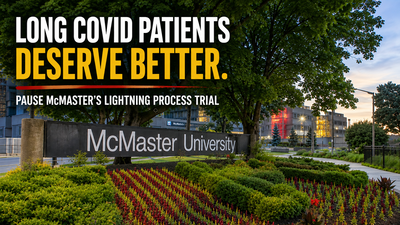
Long COVID Patients Deserve Better: Pause McMaster’s FALCON Lightning Process Trial
The Issue
Petition to McMaster University, the Hamilton Integrated Research Ethics Board, the Faculty of Health Sciences, and the funders of the FALCON study.
McMaster University has registered the planned Fatigue in Long COVID (FALCON) clinical trial (ClinicalTrials.gov ID: NCT07697261), which will compare the commercially branded Lightning Process with activity pacing in people living with Long COVID.
As checked on October 13, 2026, the registry lists the study as “not yet recruiting,” with an estimated start in November 2026. That entry was last updated on July 13, 2026; it is not independent confirmation of the study’s current recruitment or ethics status.
For the campaign timeline, institutional replies and redacted correspondence, visit Long COVID Action Canada’s FALCON campaign page: https://longcovidaction.ca/falcon
We are calling on McMaster University to pause recruitment for the FALCON trial until an independent scientific, ethical, and patient-led review has addressed serious concerns regarding the study's design, transparency, participant protections, conflicts of interest, commercial relationships, and use of objective outcome measures.
This is not a call to stop Long COVID research.
It is a call for better Long COVID research.
Why this matters
More than six years after the pandemic began, millions of people continue to live with Long COVID.
Patients still face enormous barriers to diagnosis, treatment, disability support, and recognition. At the same time, Canada has committed relatively limited resources to Long COVID research compared with the scale of the crisis.
Every Canadian treatment trial matters.
Every research dollar matters.
That is why many patients are deeply concerned that one of Canada’s leading medical institutions has chosen to study a commercially branded program focused on changing how people think about, interpret, and respond to their symptoms, rather than prioritizing research into the underlying biology of this disease.
Our concerns
1. Long COVID is increasingly understood as a complex biomedical illness.
Research from around the world continues to identify abnormalities involving the immune system, viral persistence, the vascular system, autonomic function, metabolism, inflammation, and other biological processes.
Psychological support can be an important part of living with any chronic illness.
However, psychological support is fundamentally different from testing an intervention whose central premise is that changing thoughts, beliefs, language, and behavioural responses may substantially improve the illness itself.
Many patients fear this risks reinforcing the psychologizing of Long COVID—a narrative that has already contributed to stigma, delayed diagnosis, barriers to disability benefits, and dismissal within healthcare.
2. The study appears heavily dependent on subjective outcomes.
The FALCON trial is open-label for participants and treatment providers. The registry states that data analysts and interpreters will remain blinded until the primary analyses and interpretation are completed.
The registered primary outcome is change in self-reported fatigue on the Checklist Individual Strength (CIS) fatigue questionnaire at 12 months. The listed measures of physical function and functional impairment are also questionnaires.
This raises an important scientific concern.
A program specifically designed to change how participants perceive and describe their symptoms is being evaluated largely by asking participants whether those symptoms have changed.
Patients deserve to know:
• Will participants objectively regain physical function?
• Will they be able to walk farther?
• Return to work?
• Care for their families?
• Increase daily activity without worsening?
Objective improvement—not simply changes in symptom reporting—should be central to evaluating any treatment.
The registry also includes a post-exertional malaise questionnaire and recording of adverse events and serious adverse events. These are relevant safeguards, but patients still need a clear explanation of how worsening will be detected between follow-ups, who will review safety concerns independently, and what stopping or withdrawal criteria will apply.
3. Canada’s scarce research capacity should be used wisely.
Canada already conducts relatively few Long COVID treatment trials.
Patients continue to wait for meaningful biomedical therapies while researchers around the world investigate:
• viral persistence
• immune dysfunction
• endothelial injury
• autonomic dysfunction
• metabolic abnormalities
• biomarkers
• antiviral therapies
• immune-modulating treatments
With so little Canadian research capacity available, many patients are asking:
Why is this where our limited resources are being directed?
4. Greater transparency is needed.
The Lightning Process is a commercially branded program delivered by trained practitioners.
In his August 23, 2026 reply, Dr. Jason Busse reported $188,904 in funding through a competitive Hamilton Academic Health Sciences Organization (HAHSO) grant and said therapists would be paid their usual hourly rate. This provides some funding information, but does not resolve all of the campaign’s transparency requests.
Patients deserve a complete public account of:
• all funding sources and the full study budget;
• any licensing or trademark fees;
• payments made to practitioners;
• commercial relationships;
• potential conflicts of interest;
• and whether anyone connected to the Lightning Process participated in designing the study.
Transparency should be expected—not requested.
Dr. Busse also stated that patient partners on the research team had reviewed the protocol. The campaign asks McMaster to explain their role, which changes their input produced, and how a wider range of people living with Long COVID can influence an independent review.
We respectfully call on McMaster University to:
1. Pause recruitment until an independent scientific, ethical, and patient-led review has addressed concerns regarding the study's methodology, transparency, participant protections, commercial relationships, conflicts of interest, and objective outcome measures.
2. Publicly disclose all funding sources and commercial relationships connected to the trial.
3. Publish the full study protocol and statistical analysis plan.
4. Clearly explain what objective measures—not simply self-reported questionnaires—will determine whether participants have truly improved.
5. Demonstrate how the study will detect and respond to post-exertional symptom worsening, deterioration, adverse events, and loss of function, including monitoring between follow-ups, independent safety oversight, and clear stopping or withdrawal criteria.
6. Meaningfully involve people living with Long COVID in an independent review of the study’s design, and explain how existing patient partners’ input influenced the protocol and decisions.
Long COVID patients deserve better.
People living with Long COVID have spent years fighting to have this illness recognized as real.
They deserve rigorous science.
They deserve transparency.
They deserve meaningful biomedical research.
Most importantly, they deserve research that does not risk returning this illness to a framework centred on patients’ thoughts and behaviours before its underlying biology has been adequately understood.
McMaster University has an opportunity to lead.
We urge McMaster University to pause recruitment until these concerns have been independently reviewed and publicly addressed, ensuring that any future Long COVID research meets the highest standards of scientific rigor, transparency, participant safety, and accountability.
Please sign this petition if you believe Long COVID patients deserve research that is transparent, scientifically rigorous, and worthy of the people whose lives depend on it.
Media coverage
The Sick Times — “People with Long COVID demand pause of McMaster University clinical trial” (September 22, 2026).

2,094
The Issue
Petition to McMaster University, the Hamilton Integrated Research Ethics Board, the Faculty of Health Sciences, and the funders of the FALCON study.
McMaster University has registered the planned Fatigue in Long COVID (FALCON) clinical trial (ClinicalTrials.gov ID: NCT07697261), which will compare the commercially branded Lightning Process with activity pacing in people living with Long COVID.
As checked on October 13, 2026, the registry lists the study as “not yet recruiting,” with an estimated start in November 2026. That entry was last updated on July 13, 2026; it is not independent confirmation of the study’s current recruitment or ethics status.
For the campaign timeline, institutional replies and redacted correspondence, visit Long COVID Action Canada’s FALCON campaign page: https://longcovidaction.ca/falcon
We are calling on McMaster University to pause recruitment for the FALCON trial until an independent scientific, ethical, and patient-led review has addressed serious concerns regarding the study's design, transparency, participant protections, conflicts of interest, commercial relationships, and use of objective outcome measures.
This is not a call to stop Long COVID research.
It is a call for better Long COVID research.
Why this matters
More than six years after the pandemic began, millions of people continue to live with Long COVID.
Patients still face enormous barriers to diagnosis, treatment, disability support, and recognition. At the same time, Canada has committed relatively limited resources to Long COVID research compared with the scale of the crisis.
Every Canadian treatment trial matters.
Every research dollar matters.
That is why many patients are deeply concerned that one of Canada’s leading medical institutions has chosen to study a commercially branded program focused on changing how people think about, interpret, and respond to their symptoms, rather than prioritizing research into the underlying biology of this disease.
Our concerns
1. Long COVID is increasingly understood as a complex biomedical illness.
Research from around the world continues to identify abnormalities involving the immune system, viral persistence, the vascular system, autonomic function, metabolism, inflammation, and other biological processes.
Psychological support can be an important part of living with any chronic illness.
However, psychological support is fundamentally different from testing an intervention whose central premise is that changing thoughts, beliefs, language, and behavioural responses may substantially improve the illness itself.
Many patients fear this risks reinforcing the psychologizing of Long COVID—a narrative that has already contributed to stigma, delayed diagnosis, barriers to disability benefits, and dismissal within healthcare.
2. The study appears heavily dependent on subjective outcomes.
The FALCON trial is open-label for participants and treatment providers. The registry states that data analysts and interpreters will remain blinded until the primary analyses and interpretation are completed.
The registered primary outcome is change in self-reported fatigue on the Checklist Individual Strength (CIS) fatigue questionnaire at 12 months. The listed measures of physical function and functional impairment are also questionnaires.
This raises an important scientific concern.
A program specifically designed to change how participants perceive and describe their symptoms is being evaluated largely by asking participants whether those symptoms have changed.
Patients deserve to know:
• Will participants objectively regain physical function?
• Will they be able to walk farther?
• Return to work?
• Care for their families?
• Increase daily activity without worsening?
Objective improvement—not simply changes in symptom reporting—should be central to evaluating any treatment.
The registry also includes a post-exertional malaise questionnaire and recording of adverse events and serious adverse events. These are relevant safeguards, but patients still need a clear explanation of how worsening will be detected between follow-ups, who will review safety concerns independently, and what stopping or withdrawal criteria will apply.
3. Canada’s scarce research capacity should be used wisely.
Canada already conducts relatively few Long COVID treatment trials.
Patients continue to wait for meaningful biomedical therapies while researchers around the world investigate:
• viral persistence
• immune dysfunction
• endothelial injury
• autonomic dysfunction
• metabolic abnormalities
• biomarkers
• antiviral therapies
• immune-modulating treatments
With so little Canadian research capacity available, many patients are asking:
Why is this where our limited resources are being directed?
4. Greater transparency is needed.
The Lightning Process is a commercially branded program delivered by trained practitioners.
In his August 23, 2026 reply, Dr. Jason Busse reported $188,904 in funding through a competitive Hamilton Academic Health Sciences Organization (HAHSO) grant and said therapists would be paid their usual hourly rate. This provides some funding information, but does not resolve all of the campaign’s transparency requests.
Patients deserve a complete public account of:
• all funding sources and the full study budget;
• any licensing or trademark fees;
• payments made to practitioners;
• commercial relationships;
• potential conflicts of interest;
• and whether anyone connected to the Lightning Process participated in designing the study.
Transparency should be expected—not requested.
Dr. Busse also stated that patient partners on the research team had reviewed the protocol. The campaign asks McMaster to explain their role, which changes their input produced, and how a wider range of people living with Long COVID can influence an independent review.
We respectfully call on McMaster University to:
1. Pause recruitment until an independent scientific, ethical, and patient-led review has addressed concerns regarding the study's methodology, transparency, participant protections, commercial relationships, conflicts of interest, and objective outcome measures.
2. Publicly disclose all funding sources and commercial relationships connected to the trial.
3. Publish the full study protocol and statistical analysis plan.
4. Clearly explain what objective measures—not simply self-reported questionnaires—will determine whether participants have truly improved.
5. Demonstrate how the study will detect and respond to post-exertional symptom worsening, deterioration, adverse events, and loss of function, including monitoring between follow-ups, independent safety oversight, and clear stopping or withdrawal criteria.
6. Meaningfully involve people living with Long COVID in an independent review of the study’s design, and explain how existing patient partners’ input influenced the protocol and decisions.
Long COVID patients deserve better.
People living with Long COVID have spent years fighting to have this illness recognized as real.
They deserve rigorous science.
They deserve transparency.
They deserve meaningful biomedical research.
Most importantly, they deserve research that does not risk returning this illness to a framework centred on patients’ thoughts and behaviours before its underlying biology has been adequately understood.
McMaster University has an opportunity to lead.
We urge McMaster University to pause recruitment until these concerns have been independently reviewed and publicly addressed, ensuring that any future Long COVID research meets the highest standards of scientific rigor, transparency, participant safety, and accountability.
Please sign this petition if you believe Long COVID patients deserve research that is transparent, scientifically rigorous, and worthy of the people whose lives depend on it.
Media coverage
The Sick Times — “People with Long COVID demand pause of McMaster University clinical trial” (September 22, 2026).
The Decision Makers

Supporter Voices
Petition Updates
Share this petition
Petition created on August 2, 2026