History Lesson: The Automobile - Looking at history and NSW today

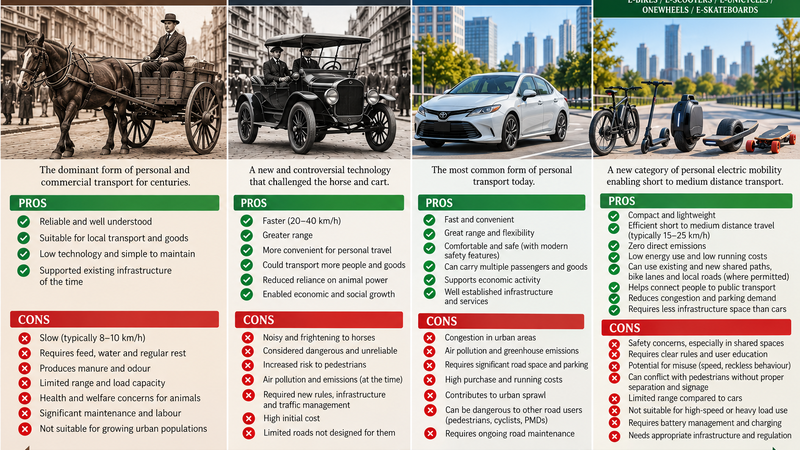
When the motorcar first appeared on public roads, it was not immediately welcomed as the obvious replacement for the horse and cart.
Quite the opposite.
People complained that motorcars were noisy, dangerous and too fast. They frightened horses, threatened pedestrians and disrupted a road system that had been built around horses, carts, bicycles and people on foot.
Those concerns were not imaginary. Early cars really did create new safety problems.
But something else was happening at the same time.
The automobile was a new form of transport entering an environment designed around an older one. The argument therefore became much bigger than "cars versus horses". Society had to decide who the road was for, how fast vehicles should travel, where pedestrians should walk, who had right of way, and what behaviour should be considered normal.
During the early 20th century, those rules gradually changed.
Pedestrians who had traditionally crossed streets wherever necessary were increasingly directed towards designated crossings. Traffic lights and road rules appeared. Streets were redesigned around motor vehicles. Even the language changed: the pedestrian increasingly became someone who was "crossing the road", rather than simply someone using the street.
The concept of "jaywalking" is part of this history. Importantly, the term itself predates the major automobile industry's campaigns, so it is inaccurate to say that car manufacturers simply "invented jaywalking". But automobile interests and motoring organisations did participate in the broader campaign that helped establish a new hierarchy on the road: pedestrians were increasingly expected to accommodate motor vehicles rather than the other way around.
Within a few decades, the machine that had once been regarded as an intrusive and dangerous novelty had become the normal form of personal transportation.
Now look at NSW today.
A new category of transport technology has emerged: personal electric mobility — Personal Mobility Devices (PMDs), Personal Electric Vehicle (PEVs) and other forms of small electric transport.
In 2021, the National Transport Commission incorporated Personal Mobility Devices (PMDs) into the Australian National Road Rules model framework, creating a nationally developed approach based on objective characteristics such as speed, weight, dimensions, braking and motor type.
The ACT had already recognised PMDs in its road laws, and other jurisdictions have since adopted similar frameworks. Rather than banning an entire category, they have defined the technology, established safety standards and regulated how and where it can be used.
The technology changed. The rules adapted.
Western Australia provides a particularly useful example. WA has created a defined eRideable category covering a range of personal electric mobility devices, with objective limits on things such as weight, dimensions, speed and together with rules governing where and how they can operate.
South Australia, Queensland, Tasmania and the ACT have likewise established frameworks for defined forms of personal electric mobility.
In other words, a number of Australian jurisdictions have taken the approach of:
Define the technology.
Set technical standards.
Set operating rules.
Establish safety responsibilities.
Then regulate it.
NSW has taken a considerably more restrictive approach to the broader category.
And this is where the historical parallel becomes worth considering.
The problem with a new technology is often not simply the technology itself. The problem is that the rules were written before the technology existed.
The horse-and-cart era had laws, customs, infrastructure and expectations designed around horses.
Then the motorcar arrived.
Society could have simply said:
"It doesn't fit the existing system, therefore it cannot be accommodated."
Instead, over time, the system changed.
Road rules changed.
Infrastructure changed.
Vehicle standards developed.
Driver licensing developed.
Traffic management developed.
And eventually an entirely new transport ecosystem emerged.
Personal electric mobility presents a similar challenge.
The answer does not have to be "allow everything."
A proper regulatory framework can impose speed limits, dimensions, weight, etc. It can determine where different classes of devices can operate and establish responsibilities for their users.
The choice is not simply "ban it" or "let people do whatever they want."
There is another option:
Define it. Regulate it. Integrate it.
And that is perhaps the most interesting lesson from the history of the automobile.
The horse-and-cart driver of 1900 could look at a motorcar and see an unnecessary, dangerous machine invading his street.
The motorist of 1930 could look at a pedestrian and wonder why they were still getting in the way of traffic.
And today, we can look at PMDs and PEVs and ask whether we are witnessing another stage in the evolution of personal transportation.
History doesn't tell us exactly what NSW's answer should be.
But it does remind us that the transport system we regard as normal today was itself created by adapting laws, infrastructure and public expectations to technologies that were once considered dangerous, disruptive and out of place.
The question for NSW may therefore be whether our regulatory framework is keeping pace with the technology — or whether we are expecting a 21st-century form of personal transport to fit into rules designed for an earlier transport era.