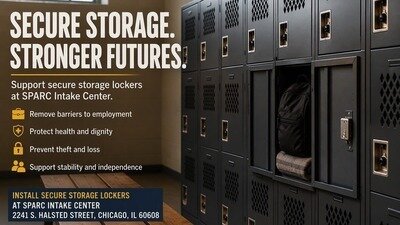

Install Secure Storage Lockers at Chicago’s SPARC Intake Center
The Issue
To the Chicago Department of Family and Support Services and Chicago City Leadership:
We call for the immediate procurement and installation of secure, individualized storage lockers for clients using the Shelter Placement and Resource Center (SPARC), located at 2241 S. Halsted Street, Chicago, Illinois 60608.
SPARC serves as a critical 24-hour shelter-placement and transitional resource hub. However, the absence of individual, lockable storage undermines its central mission of helping unhoused people move toward employment, permanent housing, personal stability, and independence.
Requiring clients to carry their suitcases, duffel bags, bedding, important documents, medication, clothing, and other essential property wherever they go creates an unnecessary obstacle to employment and housing searches. It also increases the risks of theft, loss, contamination, exhaustion, and public exposure of a person’s housing status.
Secure storage is not a luxury. It is a practical and necessary support that can help people participate meaningfully in employment services, attend medical appointments, pursue housing opportunities, and complete other essential tasks without carrying all of their possessions through the city.
1. Removing Barriers to Employment and Reducing Hiring Bias
Physical toll: Carrying heavy suitcases, duffel bags, bedding, and other property throughout the day consumes the physical energy clients need for job training, interviews, medical appointments, benefit applications, and prolonged housing searches.
Hiring barriers: Job applicants who arrive with large amounts of luggage may face unfair assumptions about their housing status, reliability, or appearance. Even when those assumptions are never stated, they can place unhoused applicants at an immediate disadvantage.
Equal opportunity: Secure lockers would allow clients to attend interviews and employment programs clean, prepared, unencumbered, and on more equal footing with other applicants.
Workforce stability: A person who obtains employment must also be able to report to work without carrying bedding and personal property into the workplace or leaving essential possessions unsecured.
2. Mitigating Public Health and Sanitation Risks
Cross-contamination: A communal bin-storage system may allow possessions belonging to different individuals to come into close contact. Without secure separation and appropriate sanitation procedures, pests and contaminants may spread between stored items.
Protection of clean property: Clients seeking employment, housing, or medical care should not risk having clean clothing and other belongings contaminated because individual storage is unavailable.
Sanitation and treatment: Individual lockers made from durable, nonporous, and easily cleaned materials could be isolated, inspected, sanitized, and treated when necessary.
Preventive action: Properly managed individual storage can help SPARC address sanitation concerns before they become larger facility-wide problems requiring more disruptive and expensive responses.
Any locker system should operate alongside reasonable inspection, cleaning, pest-control, and maintenance procedures that respect client dignity and privacy.
3. Preventing Theft and Protecting Essential Property
Limitations of communal storage: Shared or insufficiently secured storage can leave client property vulnerable to theft, loss, misplacement, accidental disposal, and unauthorized handling.
Critical documents: For an unhoused person, losing identification cards, birth certificates, Social Security records, housing paperwork, employment documents, benefit information, medical records, or prescriptions can delay access to housing, treatment, employment, and public benefits.
Limited ability to replace property: Residents may not have the financial resources, transportation, technology, mailing address, or documentation required to replace stolen or lost items quickly.
Accountability: An individualized locker system would establish clearer responsibility for property access and make it easier to investigate reports of theft, damage, contamination, or unauthorized entry.
4. Protecting Personal Dignity, Privacy, and Safety
People should not have to publicly reveal their housing status simply because they have no secure place to leave their belongings.
Constantly carrying personal property through public spaces can expose private medical, financial, legal, and identity-related information. It can also make unhoused people more visible as potential targets for theft, harassment, exploitation, or discrimination.
A secure locker system would provide clients with a reasonable measure of privacy and dignity while they work toward stable housing and employment.
Proposed Operational Safeguards and Access Rules
We recognize that SPARC is a temporary shelter-placement and transitional resource hub, not a permanent residence. To ensure that lockers are used safely, fairly, and for their intended purpose, we propose a written Conditional Access and Property Protection Policy that includes the following:
- Active case engagement: Locker access may be connected to a client’s active participation in SPARC services, case management, employment searches, housing applications, medical treatment, benefit applications, or other documented stability-related activities.
- Fair access: Lockers should be assigned using transparent, consistently applied criteria. Access should not depend on favoritism or arbitrary decisions.
- Reasonable renewal periods: Locker assignments may be renewed weekly or biweekly based on continued participation or need. Clients should receive clear written or posted notice of applicable deadlines.
- Notice before removal: Except in a genuine emergency involving an immediate safety risk, clients should receive reasonable notice and an opportunity to retrieve their belongings before a locker is opened, cleared, reassigned, or its contents are discarded.
- Prohibited-items policy: Written rules should prohibit perishable food, hazardous materials, weapons, illegal substances, and other items that create a legitimate health or safety risk.
- Transparent inspections: Any inspection process should follow a written policy, occur only for legitimate health, safety, maintenance, or legal reasons, and be documented. Whenever reasonably possible, the assigned client should receive notice and be present.
- Property documentation: When staff removes property from a locker, a written inventory should identify what was removed, why it was removed, who authorized the action, and where the property was placed.
- Sanitation standards: Lockers should be constructed from durable, nonporous, pest-resistant, and easily sanitized materials. SPARC should maintain a regular cleaning, inspection, and pest-management schedule.
- Accessibility: A reasonable number of lockers should be accessible to clients with disabilities or mobility limitations.
- Secure access controls: Lockers should use individual keys, combinations, access codes, or another reliable access-control method. Any staff overrides of access should be restricted, documented, and used only for authorized purposes.
- Abandoned-property procedure: The policy should establish reasonable notice, documentation, retention, and retrieval procedures before property is treated as abandoned or discarded.
- Incident reporting: Clients should have a clear way to report theft, damage, contamination, missing property, unauthorized access, or unfair denial of locker access.
Confidentiality and Privacy Protection
The identities of residents, clients, witnesses, petition supporters, and people reporting storage-related concerns should remain confidential to the fullest extent permitted by law.
DFSS and its contractors should establish a confidential reporting method that does not require clients to submit complaints directly to the same on-site personnel whose conduct or decisions may be involved. Reports should be able to be submitted through an appropriate DFSS oversight office or another designated city channel.
Personally identifying information should not be publicly disclosed, posted, unnecessarily shared, or included in publicly accessible reports. Access to complaint records should be limited to personnel with a legitimate need to review them.
Public reports concerning locker implementation, theft, sanitation, or complaints should use aggregated or de-identified information whenever possible.
Non-Retaliation Statement
No resident, client, witness, petitioner, supporter, or person reporting a storage-related concern should face retaliation for supporting this petition, requesting secure storage, submitting a complaint, cooperating with an investigation, or raising concerns about facility conditions.
Prohibited retaliation should include, but not be limited to:
- Threats, intimidation, harassment, or coercion;
- Reduction, delay, or denial of services;
- Unfavorable treatment by staff or contractors;
- Arbitrary denial or removal of locker access;
- Destruction, removal, or interference with personal property;
- Adverse changes in shelter placement or eligibility;
- Unnecessary transfer, discharge, or removal from programming;
- Interference with housing, employment, medical, or benefit-related assistance; and
- Any attempt to identify, isolate, punish, or discourage petition supporters or complainants.
DFSS should require all employees, contractors, security personnel, service providers, and partner organizations assigned to SPARC to comply with a written non-retaliation policy. Alleged violations should be reviewed promptly and impartially through an appropriate oversight process.
Accountability and Implementation
We request that DFSS and Chicago city leadership:
1. Conduct a prompt assessment of the number, size, type, and placement of lockers needed at SPARC;
2. Identify an operational budget and procurement process for installing safe, durable, individualized lockers;
3. Consult clients, disability-access specialists, sanitation professionals, case-management personnel, and facility staff without requiring residents to disclose publicly whether they support this petition;
4. Publish a written implementation plan with reasonable target dates for procurement, installation, and operation;
5. Establish written rules governing access, inspections, sanitation, prohibited items, property removal, abandoned property, complaints, confidentiality, and non-retaliation;
6. Designate an accountable DFSS office or official to oversee implementation and receive confidential complaints;
7. Track theft, loss, contamination, unauthorized access, and property-related complaints using de-identified information; and
8. Provide public progress updates without revealing the identity of any resident, petitioner, witness, supporter, or complainant.
Our Demand
By failing to provide basic, secure storage, the current system is actively prolonging the cycle of homelessness for people who are working to regain stability and independence.
Clients should not have to choose between protecting their belongings and attending a job interview, medical appointment, housing meeting, or other essential service.
We demand that the Chicago Department of Family and Support Services and Chicago city leadership allocate the necessary operational funding and begin the procurement and installation of secure, individualized storage lockers at SPARC, 2241 S. Halsted Street.
This request includes clear sanitation standards, fair access rules, property-protection procedures, confidential reporting, meaningful oversight, and enforceable protections against retaliation.
Secure storage protects health, property, privacy, dignity, employment opportunities, and the ability to move from homelessness toward permanent stability.

71
The Issue
To the Chicago Department of Family and Support Services and Chicago City Leadership:
We call for the immediate procurement and installation of secure, individualized storage lockers for clients using the Shelter Placement and Resource Center (SPARC), located at 2241 S. Halsted Street, Chicago, Illinois 60608.
SPARC serves as a critical 24-hour shelter-placement and transitional resource hub. However, the absence of individual, lockable storage undermines its central mission of helping unhoused people move toward employment, permanent housing, personal stability, and independence.
Requiring clients to carry their suitcases, duffel bags, bedding, important documents, medication, clothing, and other essential property wherever they go creates an unnecessary obstacle to employment and housing searches. It also increases the risks of theft, loss, contamination, exhaustion, and public exposure of a person’s housing status.
Secure storage is not a luxury. It is a practical and necessary support that can help people participate meaningfully in employment services, attend medical appointments, pursue housing opportunities, and complete other essential tasks without carrying all of their possessions through the city.
1. Removing Barriers to Employment and Reducing Hiring Bias
Physical toll: Carrying heavy suitcases, duffel bags, bedding, and other property throughout the day consumes the physical energy clients need for job training, interviews, medical appointments, benefit applications, and prolonged housing searches.
Hiring barriers: Job applicants who arrive with large amounts of luggage may face unfair assumptions about their housing status, reliability, or appearance. Even when those assumptions are never stated, they can place unhoused applicants at an immediate disadvantage.
Equal opportunity: Secure lockers would allow clients to attend interviews and employment programs clean, prepared, unencumbered, and on more equal footing with other applicants.
Workforce stability: A person who obtains employment must also be able to report to work without carrying bedding and personal property into the workplace or leaving essential possessions unsecured.
2. Mitigating Public Health and Sanitation Risks
Cross-contamination: A communal bin-storage system may allow possessions belonging to different individuals to come into close contact. Without secure separation and appropriate sanitation procedures, pests and contaminants may spread between stored items.
Protection of clean property: Clients seeking employment, housing, or medical care should not risk having clean clothing and other belongings contaminated because individual storage is unavailable.
Sanitation and treatment: Individual lockers made from durable, nonporous, and easily cleaned materials could be isolated, inspected, sanitized, and treated when necessary.
Preventive action: Properly managed individual storage can help SPARC address sanitation concerns before they become larger facility-wide problems requiring more disruptive and expensive responses.
Any locker system should operate alongside reasonable inspection, cleaning, pest-control, and maintenance procedures that respect client dignity and privacy.
3. Preventing Theft and Protecting Essential Property
Limitations of communal storage: Shared or insufficiently secured storage can leave client property vulnerable to theft, loss, misplacement, accidental disposal, and unauthorized handling.
Critical documents: For an unhoused person, losing identification cards, birth certificates, Social Security records, housing paperwork, employment documents, benefit information, medical records, or prescriptions can delay access to housing, treatment, employment, and public benefits.
Limited ability to replace property: Residents may not have the financial resources, transportation, technology, mailing address, or documentation required to replace stolen or lost items quickly.
Accountability: An individualized locker system would establish clearer responsibility for property access and make it easier to investigate reports of theft, damage, contamination, or unauthorized entry.
4. Protecting Personal Dignity, Privacy, and Safety
People should not have to publicly reveal their housing status simply because they have no secure place to leave their belongings.
Constantly carrying personal property through public spaces can expose private medical, financial, legal, and identity-related information. It can also make unhoused people more visible as potential targets for theft, harassment, exploitation, or discrimination.
A secure locker system would provide clients with a reasonable measure of privacy and dignity while they work toward stable housing and employment.
Proposed Operational Safeguards and Access Rules
We recognize that SPARC is a temporary shelter-placement and transitional resource hub, not a permanent residence. To ensure that lockers are used safely, fairly, and for their intended purpose, we propose a written Conditional Access and Property Protection Policy that includes the following:
- Active case engagement: Locker access may be connected to a client’s active participation in SPARC services, case management, employment searches, housing applications, medical treatment, benefit applications, or other documented stability-related activities.
- Fair access: Lockers should be assigned using transparent, consistently applied criteria. Access should not depend on favoritism or arbitrary decisions.
- Reasonable renewal periods: Locker assignments may be renewed weekly or biweekly based on continued participation or need. Clients should receive clear written or posted notice of applicable deadlines.
- Notice before removal: Except in a genuine emergency involving an immediate safety risk, clients should receive reasonable notice and an opportunity to retrieve their belongings before a locker is opened, cleared, reassigned, or its contents are discarded.
- Prohibited-items policy: Written rules should prohibit perishable food, hazardous materials, weapons, illegal substances, and other items that create a legitimate health or safety risk.
- Transparent inspections: Any inspection process should follow a written policy, occur only for legitimate health, safety, maintenance, or legal reasons, and be documented. Whenever reasonably possible, the assigned client should receive notice and be present.
- Property documentation: When staff removes property from a locker, a written inventory should identify what was removed, why it was removed, who authorized the action, and where the property was placed.
- Sanitation standards: Lockers should be constructed from durable, nonporous, pest-resistant, and easily sanitized materials. SPARC should maintain a regular cleaning, inspection, and pest-management schedule.
- Accessibility: A reasonable number of lockers should be accessible to clients with disabilities or mobility limitations.
- Secure access controls: Lockers should use individual keys, combinations, access codes, or another reliable access-control method. Any staff overrides of access should be restricted, documented, and used only for authorized purposes.
- Abandoned-property procedure: The policy should establish reasonable notice, documentation, retention, and retrieval procedures before property is treated as abandoned or discarded.
- Incident reporting: Clients should have a clear way to report theft, damage, contamination, missing property, unauthorized access, or unfair denial of locker access.
Confidentiality and Privacy Protection
The identities of residents, clients, witnesses, petition supporters, and people reporting storage-related concerns should remain confidential to the fullest extent permitted by law.
DFSS and its contractors should establish a confidential reporting method that does not require clients to submit complaints directly to the same on-site personnel whose conduct or decisions may be involved. Reports should be able to be submitted through an appropriate DFSS oversight office or another designated city channel.
Personally identifying information should not be publicly disclosed, posted, unnecessarily shared, or included in publicly accessible reports. Access to complaint records should be limited to personnel with a legitimate need to review them.
Public reports concerning locker implementation, theft, sanitation, or complaints should use aggregated or de-identified information whenever possible.
Non-Retaliation Statement
No resident, client, witness, petitioner, supporter, or person reporting a storage-related concern should face retaliation for supporting this petition, requesting secure storage, submitting a complaint, cooperating with an investigation, or raising concerns about facility conditions.
Prohibited retaliation should include, but not be limited to:
- Threats, intimidation, harassment, or coercion;
- Reduction, delay, or denial of services;
- Unfavorable treatment by staff or contractors;
- Arbitrary denial or removal of locker access;
- Destruction, removal, or interference with personal property;
- Adverse changes in shelter placement or eligibility;
- Unnecessary transfer, discharge, or removal from programming;
- Interference with housing, employment, medical, or benefit-related assistance; and
- Any attempt to identify, isolate, punish, or discourage petition supporters or complainants.
DFSS should require all employees, contractors, security personnel, service providers, and partner organizations assigned to SPARC to comply with a written non-retaliation policy. Alleged violations should be reviewed promptly and impartially through an appropriate oversight process.
Accountability and Implementation
We request that DFSS and Chicago city leadership:
1. Conduct a prompt assessment of the number, size, type, and placement of lockers needed at SPARC;
2. Identify an operational budget and procurement process for installing safe, durable, individualized lockers;
3. Consult clients, disability-access specialists, sanitation professionals, case-management personnel, and facility staff without requiring residents to disclose publicly whether they support this petition;
4. Publish a written implementation plan with reasonable target dates for procurement, installation, and operation;
5. Establish written rules governing access, inspections, sanitation, prohibited items, property removal, abandoned property, complaints, confidentiality, and non-retaliation;
6. Designate an accountable DFSS office or official to oversee implementation and receive confidential complaints;
7. Track theft, loss, contamination, unauthorized access, and property-related complaints using de-identified information; and
8. Provide public progress updates without revealing the identity of any resident, petitioner, witness, supporter, or complainant.
Our Demand
By failing to provide basic, secure storage, the current system is actively prolonging the cycle of homelessness for people who are working to regain stability and independence.
Clients should not have to choose between protecting their belongings and attending a job interview, medical appointment, housing meeting, or other essential service.
We demand that the Chicago Department of Family and Support Services and Chicago city leadership allocate the necessary operational funding and begin the procurement and installation of secure, individualized storage lockers at SPARC, 2241 S. Halsted Street.
This request includes clear sanitation standards, fair access rules, property-protection procedures, confidential reporting, meaningful oversight, and enforceable protections against retaliation.
Secure storage protects health, property, privacy, dignity, employment opportunities, and the ability to move from homelessness toward permanent stability.
The Decision Makers


Petition Updates
Share this petition
Petition created on August 19, 2026