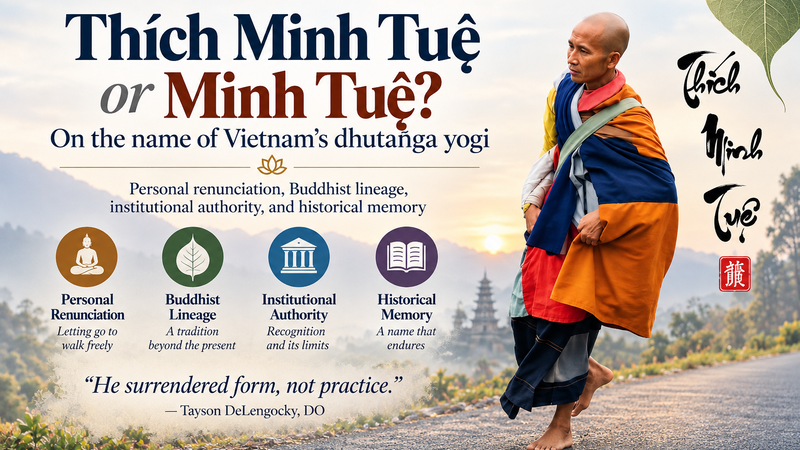
Thích Minh Tuệ or Minh Tuệ? Why I Still Write His Full Name

An open letter to friends and supporters who have asked me to remove “Thích”
October 2026
SSRN, https://papers.ssrn.com/sol3/papers.cfm?abstract_id=7607686
Thích Minh Tuệ (Thich Minh Tue), the barefoot dhutaṅga yogi now in Nepal, calls himself only Minh Tuệ. This letter explains why I still write his full name.
Dear friends,
Since I started my petition for Thầy Minh Tuệ on March 27, 2025, some of you have asked me a question that has stayed with me:
“If you truly respect Thầy, why do you continue calling him Thích Minh Tuệ when he himself has relinquished ‘Thích’?”
One supporter put it plainly: “If you respect Thầy, please remove the word Thích.” Others have expressed more than disagreement. Some are genuinely offended by my continued use of the name.
I have thought about these reactions many times. I know that many of them come from genuine affection and a desire to honor Thầy’s wishes. I share that affection. Before I turn to Buddhist history or institutional authority, I want to explain something much more personal.
I Think in English
I think in English, and I write in English.
I do not form my thoughts in Vietnamese and then write them out in English. When I sit down to study documents and build arguments about Thầy’s journey, my thoughts take shape in English from the beginning. English is the language of most of my analytical thinking, long before a manuscript is finished.
In fact, even as I compose this very letter to my Vietnamese-speaking friends, I am thinking in English. These words, and even the emotions behind them, take shape in English first. Only afterward will I translate this letter into Vietnamese so that more supporters can read it. Some readers will meet my words entirely in Vietnamese and never realize that the arguments and feelings behind them were first expressed in English.
The Vietnamese version translates thoughts that first took form in English.
And that is where some misunderstandings may begin.
My research on Thầy began with a desire to understand an extraordinary Buddhist practitioner whose life has drawn enormous attention and whose religious identity has also been disputed. As I studied his pilgrimage and its reception abroad, I developed my arguments in English. I wanted readers beyond the Vietnamese community to understand who he is and why his journey raises questions about renunciation and religious authority.
My papers are English-language works, conceived and written in English and sometimes translated into Vietnamese afterward. In that English-language scholarly world, the name that comes naturally to me is “Thích Minh Tuệ.” It is the name by which I first came to know him, and it connects the historical record and international reporting with my own research.
When I read about Thích Nhất Hạnh or Thích Quảng Đức in English, I meet their full Buddhist names. English-language writing does not ordinarily repeat a title such as Venerable or Master every time a name appears. I have grown used to this convention. In my English prose, “Thích Minh Tuệ” sounds complete and respectful.
Something changes when I switch languages.
When I speak or write in Vietnamese, I naturally call him “Thầy Minh Tuệ” or “Sư Minh Tuệ.”
I would not ordinarily address him simply as “Minh Tuệ.” To my Vietnamese ear, that sounds too familiar for someone I deeply respect, even though I know it is the name he prefers for himself. Vietnamese expresses respect through forms of address and relationships in ways that do not always carry over into English. When I say “Thầy Minh Tuệ,” the word Thầy carries my affection and my respect for the example I see in his conduct. When I write “Thích Minh Tuệ” in English, the religious surname carries a related reverence for me, and it keeps the name by which he became known around the world.
The language and the form of address change. My reverence does not.
There is another complication. When my English research is translated into Vietnamese with artificial intelligence, the software sometimes adds “Thầy” before “Thích Minh Tuệ,” producing “Thầy Thích Minh Tuệ.” I would not ordinarily write it that way myself. The English original carries the historical name with no added title, and the machine supplies a Vietnamese form of address, joining two conventions that I keep separate. Readers who see only the translation may assume that I insist on “Thầy Thích Minh Tuệ.” That is not my usual practice.
In my English writing I use Thích Minh Tuệ. In my own Vietnamese I use Thầy Minh Tuệ or Sư Minh Tuệ, and I recognize Minh Tuệ as his present self-designation. These are different ways of referring to the same person in different languages, and none of them declares his institutional status.
I also recognize that some of you hear “Thích” differently from the way I hear it. For those who associate the surname with the Vietnam Buddhist Sangha, it may evoke an institution that disputed Thầy’s standing. For me, writing in English, it evokes the Śākya lineage and the continuity of the documentary record. We may be responding to different meanings attached to the same word.
When I write “Thích,” I am thinking of the Buddha’s lineage and of the practitioner whose example has inspired my research. The VBS is far from my mind.
That is why I hope my Vietnamese-speaking friends will not read my English convention as disregard for Thầy’s renunciation. I do not ask Thầy to reclaim the surname or anyone else to use it, and I do not suggest that his chosen name, Minh Tuệ, is incomplete. I am explaining why, when I sit down to think and write in English, “Thích Minh Tuệ” remains the name that comes naturally to my mind and my pen. Even this letter, written to explain that name, began in English.
I think and write in English. The respect I feel for Thầy needs no translation.
I Respect the Name He Has Relinquished
In April 2025, while in Sri Lanka, Thầy Minh Tuệ categorically denied carrying “Thích,” the religious surname associated with Śākyamuni Buddha. He explained that he did not consider himself worthy of that name. I find this deeply moving. Here is a practitioner whose discipline has inspired people across countries and traditions, yet who refuses to claim a name he associates with the Buddha. I take his rejection seriously, as far more than an administrative change.
I have no desire to contradict his humility or speak on his behalf. Yet there is a distinction between what Thầy chooses to call himself and the name under which his journey entered the historical record. He has set aside possessions, conventional robes, institutional affiliation, and claims to religious standing. Setting something aside does not mean it never existed. His earlier name remains part of his journey, just as his civil name, Lê Anh Tú, remains part of his biography.
His renunciation belongs to him. Preserving the historical record is a responsibility that belongs to those of us who document his journey.
Why Does “Thích” Offend Some of Us?
I have been surprised, and sometimes saddened, to find that some of Thầy’s most devoted supporters are more than uncomfortable with my use of “Thích Minh Tuệ.” Some are genuinely offended by it.
I understand one reason. For them, “Thích” has become tied to the Vietnam Buddhist Sangha (VBS), the institution that disputed Thầy’s monastic standing. Because Thầy himself has relinquished the surname, they believe that using it disregards his wishes or places him under an institution whose authority he does not claim. I respect their intentions. I wonder, though, whether we have let the meaning of a much older Buddhist tradition become inseparable from one contemporary organization.
Thích is not synonymous with the VBS. The VBS is not synonymous with the entire Buddhist Sangha.
The religious surname “Thích” derives from the Śākya lineage of the Buddha. Chinese monastics took it up in the fourth century, many centuries before the present VBS was established in 1981.
This confusion reminds me of another distinction familiar to Vietnamese people. The Communist Party, the state, the nation, and the Vietnamese people are not interchangeable. In Vietnamese political discourse, critics of the ruling party have been labeled phản động (reactionary), phản cách mạng (counterrevolutionary), or ba que, a slur drawn from the yellow flag of the former Republic of Vietnam. These labels show how political disagreement becomes entangled with national belonging. A critic of the Party may love the country and its people. In the same way, a critic of the VBS may be a devout Buddhist.
I offer this comparison to question the conflation of an institution with a wider identity. I do not suggest that supporters who disagree with me have been politically conditioned. Many simply wish to honor Thầy’s expressed preference, and that is a legitimate concern.
My continued use of “Thích” grants the VBS no ownership of the Śākya lineage. I refuse to concede that any single contemporary institution can define that historical tradition.
A Name of Origin Can Endure
Nearly 6.5 million people of Vietnamese origin live in more than 130 countries and territories around the world. Many have made permanent homes abroad, and many carry passports issued by countries other than Vietnam. Yet a change of passport does not erase Vietnamese ancestry or cultural memory. Those of us living abroad know this distinction intimately. Every immigrant who becomes a naturalized United States citizen must take the Oath of Allegiance, pledging to renounce allegiance and fidelity to foreign states or sovereigns. That solemn oath changes civic allegiance and leaves untouched where one came from. We may become American citizens and still be Vietnamese by heritage.
Bhikkhu Paññākāra (Sư Tuệ Nhân), who led the Walk for Peace across the United States, was born in Đắk Lắk in 1981 and came to America in 1997. He was fully ordained in 2010. When he traveled to Sri Lanka and Nepal in 2026, reports variously described him as a Vietnamese monk, a Vietnamese-American monk, or a monk from America. The example shows how public descriptions can preserve origins and history without exhausting how a person identifies himself.
Thầy’s decision is different and deserves particular care: he explicitly relinquished the name itself. I do not claim that an inherited identity and a renounced religious surname are interchangeable. I suggest only that recording a historical designation need not amount to imposing it upon the person. His renunciation belongs to him; the responsibility to document the past belongs to those who write about his journey.
Thầy himself kept one document he could not set down. To walk beyond Vietnam he needed a passport, a paper the state owns and issues to its citizens. Every other marker he could relinquish, and that one still ties him to the country he walked out of. Even he carries a record of where he comes from.
Wikipedia and the Historical Record
Wikipedia offers another example of the distinction between a historical name and a present self-designation. As documented in my October 2026 research note, the Vietnamese, English, and Malay Wikipedia biographies were created under “Thích Minh Tuệ” in May and June 2024. The Vietnamese article was briefly moved to his civil name on May 31, 2024, then restored the same day. Those editions still used “Thích Minh Tuệ” in the October 2026 review, even after his categorical rejection of the surname in Sri Lanka in April 2025. Wikipedia holds no authority over his wishes, and article titles can change as sources and editorial consensus evolve. These titles still show the name under which his journey entered the international historical record. I respect “Minh Tuệ” as his own designation while retaining “Thích Minh Tuệ” in my English-language documentary work.
Have We Stopped Calling Him a Buddhist?
There is another question I would gently ask my fellow supporters. Thầy has repeatedly said that he is neither a monk nor a teacher. How many of us have stopped calling him Thầy or Sư? We keep these respectful forms because we recognize qualities in his conduct that inspire reverence, even though he does not claim those roles for himself.
There is an even more striking example. In April 2026, in Nepal, answering accusations about his religious appearance, Thầy said that he did not follow the Buddhist religion and that he kept the five precepts taught by the Buddha.
Have we therefore stopped calling him a Buddhist?
Have we stopped describing his barefoot pilgrimage, his alms rounds, his patched robe, and his dhutaṅga discipline as Buddhist practice? I have not. I continue to recognize the Buddhist foundations of his practice while I report his own words about religious affiliation. Why, then, must the same distinction be impossible with “Thích”?
A surname differs from a form of address or a description of practice, and his decision to set aside a particular name deserves special consideration. The same question still runs through each: must our descriptions of a practitioner always reproduce his self-designations, or may they also reflect documented history and the qualities we observe? I believe both have a legitimate place.
There are things Thầy, out of humility and nonattachment, may never claim for himself. Others need not ignore his religious formation or stay silent about the Buddhist qualities they recognize in his conduct. When I call him “Thích Minh Tuệ” in my English-language research, I do not ask him to reclaim the surname. I acknowledge the historical name and the Śākya lineage behind it.
Thầy may relinquish a name out of humility. I may preserve that name out of historical responsibility and reverence. Neither act needs to invalidate the other.
I hope that those who call him Thầy or Sư despite his own disclaimers can understand why I continue to write “Thích Minh Tuệ.” I write it in recognition of the tradition and history the name carries, and with no defiance of him.
One Word Should Not Divide Those Who Care About Him
Of all the objections I have received, one has saddened me most. Some supporters have told me they would not sign my petition because it uses the name “Thích Minh Tuệ.” I respect their decision. I only wish we could look beyond that single word.
The petition does not ask Thầy to reclaim a religious surname or accept an institutional title. It asks that he be allowed to continue his practice and pilgrimage in peace, with lawful means to remain and travel, free from harassment.
Some of those who have raised objections have more than ten thousand social-media followers. I will not identify them. I respect their devotion and the influence they have earned. My hope is that our voices, whether they reach ten people or ten thousand, can serve the same compassionate purpose. We may differ about what to call Thầy without differing about his right to practice freely.
Would it not be unfortunate if our disagreement over a word became more important than the welfare of the person we all seek to support?
And Yes, I Admit My Attachment
As a Buddhist, I must also examine my own attachment. Perhaps I am attached to the name and to the history I have spent so much time documenting. Perhaps I am attached to the example of a man who seems to want so little from the world. I do not pretend otherwise.
There is even a small joke I carry in my heart. In Vietnamese, Thích is the religious surname associated with the Śākya lineage, and thích is also the everyday verb meaning “to like.” So when I write “Thích Minh Tuệ,” I sometimes smile. As a surname, it reminds me of the Buddha’s lineage. As a verb, it says something wonderfully simple:
Tôi thích Minh Tuệ.
“Like” hardly expresses the depth of my affection and devotion to his example. Perhaps that little coincidence still shows why the name means so much to me. It is a playful personal association and makes no scholarly argument. I hope Thầy, who so often encourages others to follow what brings them happiness within the precepts, might understand the affection behind it. I cannot presume his consent.
A Final Request to My Friends
I do not ask you to change how you address Thầy. Please continue calling him Thầy Minh Tuệ, Sư Minh Tuệ, Hành giả Minh Tuệ, or simply Minh Tuệ, as your understanding and conscience guide you. I ask only that you allow me the same freedom to express my respect through the historical name I use in my English-language research.
The Buddha taught impermanence. Names and institutions change, and so do the meanings we attach to words. My understanding may change as well. If better evidence or changing usage calls for a different scholarly designation, I will reconsider it. What I hope will not change is our compassion for Thầy and our commitment to his freedom to practice.
Thầy may have no need of the name. History still has a responsibility to remember it.
And I will remember it with gratitude and a little smile.
With respect and mettā,
Based on the author’s research paper “Thích Minh Tuệ or Minh Tuệ? On the Name of Vietnam’s Dhutaṅga Yogi: Personal Renunciation, Buddhist Lineage, Institutional Authority, and Historical Memory”, SSRN (October 2026), https://papers.ssrn.com/sol3/papers.cfm?abstract_id=7607686 | Petition: https://www.change.org/TMTWalk4Peace
#ThichMinhTue #MinhTue #ThíchMinhTuệ #MinhTuệ #DhutangaYogi #BarefootMonk #TMTWalk4Peace #WalkInPeace #ReligiousFreedom #FreedomOfBelief #Buddhism #Dhutanga #Vietnam #Nepal #Lumbini #HistoricalMemory