
From BookTok to the Big Screen: Protect Audiences as Dark Romance Goes Mainstream
The Issue
Demand age-appropriate safeguards, responsible visual adaptation, transparent content labeling, and consistent social-media moderation without censoring dark fiction.
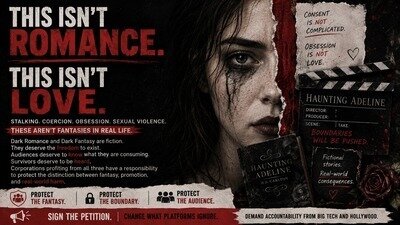
A once-niche corner of the internet and BookTok has made its way into mainstream media, bringing with it renewed conversations about Dark Romance, consent, and the normalization and romanticization of violence. As Dark Romance has grown online, the boundary between fictional storytelling, promotional personas, dark humor, and real-world social commentary has become increasingly blurred. Social-media platforms distribute this material widely, often without clear contextual labels or meaningful restrictions identifying accounts as mature fictional or promotional content. Online creators can build massive followings around content depicting predatory behavior and manipulative rhetoric under the guise of “dark humor,” “dark romance/fantasy,” or “artistic expression,” sometimes blurring the distinction between fictional promotion, satire, social commentary, and rhetoric about real-world relationships. Simultaneously, the film industry is actively developing mainstream movie adaptations of dark romance titles like H.D. Carlton’s Haunting Adeline, whose central relationship incorporates severe stalking, intimidation, coercion, and sexual violence into a romance narrative.
The Multi-Front Concern Facing Women, LGBTQ+ People, Survivors, and Minors
- The Digital Blueprint: Dark-fiction creators such as Jackson Noble (@jax.theripper_) use social media to extend fictional personas beyond the pages of their books. Noble’s modern reimagining of Jack the Ripper is not itself evidence that he endorses serial murder or real-world violence. Our concern begins when that fictional persona extends beyond promotion of the book or film and becomes intertwined with social-media content about real-world women, stalking, sexual violence, coercive relationships, misogyny, transgender people, feminism, and other social or political subjects. At that point, the question is no longer whether dark fiction should be allowed to exist. For example, content asserting that “ALL women” fantasize about a man unexpectedly appearing and pursuing them transforms an individual dark fantasy into a generalized statement about women’s desires. Fictional fantasies involving stalking can exist without presenting those fantasies as universal truths about women. This petition does not attempt to diagnose Noble, determine whether his online persona reflects his private beliefs, or claim that his fictional work demonstrates criminal intent. The question is whether social-media platforms have a responsibility to clearly contextualize and appropriately restrict mature fictional-persona content when it is distributed beyond the adult audiences intentionally seeking dark fiction.
- The Book-to-Movie Pipeline: As Dark Romance enters mainstream entertainment, graphic stories originally consumed within a niche literary community are being considered for large-scale visual adaptation. The planned adaptation of Haunting Adeline brings a relationship involving stalking, coercion, threats, and sexual violence from written fiction into audiovisual entertainment, raising important questions about how those behaviors will be portrayed, marketed, and contextualized. H.D. Carlton openly stated online in the announcement of Haunting Adeline becoming a movie that ”We are not watering this movie down and it will absolutely push boundaries as far as the spice.” The terminology matters. “Spice” is commonly used within romance communities to describe sexually explicit content. Consensual explicit sex and sexual assault, however, are not simply different degrees of the same thing. If the adaptation retains scenes involving sexual violence, audiences deserve transparency about whether those scenes are being discussed and marketed as sexual violence or incorporated into the broader promotional category of “spice.” H.D. Carlton has also responded publicly to criticism surrounding the adaptation. We are concerned that framing the controversy primarily as supporters of dark romance versus outsiders attempting to censor it risks excluding an important third group: existing H.D. Carlton readers, dark-romance readers, and survivors who support the genre but nevertheless found this particular material distressing or have concerns about translating it to film.
- The Normalization and Romanticization of Abuse: Portraying non-consensual obsession, stalking, coercion, or sexual violation through romantic framing raises legitimate questions about how audiences understand consent, abuse, and relationship norms—particularly when these portrayals move from niche written fiction into highly visual mainstream entertainment. Many survivors support this adaptation, and their experiences should not be dismissed. Other survivors oppose it or have expressed concerns about how the material affected them. Supporting survivors requires listening to both groups rather than treating either as representative of every survivor. Dark-romance writer and commentator Rachel D. Oak, who has publicly defended dark romance as a fictional space for exploring scenarios people may never want in reality, reported that 86% of respondents to a poll of her own audience opposed the adaptation. This is not evidence that 86% of the dark-romance community opposes the film. It demonstrates something more limited but important: opposition to the adaptation also exists within the dark-romance community. Neither of these voices should be ignored, and both should have the same level of respect and care.
Our Core Demands for Corporate Accountability
The goal of this petition is not government-mandated censorship or the banning of literature. It’s not to demonize dark romance authors like Jackson Noble and H.D. Carlton, or their fanbase. Instead, we seek meaningful corporate and social-media responsibility regarding the labeling, recommendation, monetization, age-restriction, marketing, and visual adaptation of material that romanticizes stalking, coercion, grooming behavior, and sexual violence.
To the Producers, Directors, and Investors of Haunting Adeline:
- Transparency Before Production: Before filming scenes involving sexual violence, coercion, or intimate-partner abuse, publicly establish the production’s commitment to appropriate intimacy coordination, performer consent, closed-set procedures where appropriate, and trauma-informed safety practices.
- Establish Ethical Boundaries: If the adaptation retains scenes involving stalking, coercion, or sexual assault, filmmakers should carefully consider how those scenes are framed through performance, cinematography, editing, sound, and music. Depicting sexual violence is not inherently unethical; presenting sexual violence to audiences as indistinguishable from consensual erotic material deserves scrutiny.
- Accurate Content Disclosure: Clearly distinguish consensual sexual content from sexual assault, coercion, stalking, and intimate-partner violence in ratings information, content advisories, trailers, and promotional materials. Sexual violence should not be obscured beneath euphemistic labels such as “spice.”
3. To Meta and Social Media Executives:
- Apply Safety Standards Regardless of Genre: Accounts centered on mature dark-fiction personas—including @jax.theripper_ and comparable creators—should not be punished merely for depicting fictional violence. However, labeling an account “dark romance,” “horror,” “satire,” or “book promotion” should not exempt otherwise actionable content from the platform’s ordinary policies concerning threats, targeted harassment, sexual violence, hate, stalking, or exploitation.
- Age-Appropriate Distribution: Provide meaningful age-gating and recommendation restrictions for accounts predominantly featuring graphic sexual violence, gore, stalking, kidnapping, coercion, or similarly mature fictional themes. Users—particularly minors—should not have such content algorithmically introduced without meaningful safeguards simply because it is categorized as entertainment.
Close the “Dark Humor” Loophole: Ensure that labeling content as a “joke,” “skit,” “satire,” fictional persona, or book promotion does not automatically exempt it from review when the same content would otherwise implicate platform policies concerning targeted violence, sexual exploitation, harassment, or hate. - User-Controlled Content Filtering: Give users meaningful controls to opt out of recommendations involving graphic violence, sexual violence, stalking, coercive abuse, gore, or other mature fictional themes. Adults should be free to seek out dark content without algorithms repeatedly exposing users who have indicated that they do not want to see it.
- This petition is not asking to see Dark Romance or Dark Fantasy creators or authors shamed or have their books, films or platforms banned. This is a call to preserve the distinction between fantasy and reality. Adults are entitled to explore disturbing fictional fantasies, including fantasies involving experiences that would constitute abuse or criminal behavior in reality. But those fantasies do not erase real-world consent, platform safety standards, appropriate audience restrictions, or corporate responsibility. When creators extend fictional predatory personas into social media, platforms have a responsibility to distinguish mature fictional promotion from content addressing real people, relationships, and social groups—and to enforce their safety policies consistently when those boundaries overlap. Behaviors recognized in reality as stalking, coercive control, sexual violence, or abuse do not become healthy relationship behaviors simply because those same behaviors can be safely explored through fantasy.
Sign this petition to send a unified message to big tech and Hollywood executives: Dark fiction deserves the freedom to remain dark. Audiences deserve the freedom to know what they are consuming. Survivors deserve to be heard. And corporations profiting from all three have a responsibility to protect the distinction between fantasy, promotion, and real-world harm.
Protect the fantasy. Protect the boundary. Protect the audience.

30
The Issue
Demand age-appropriate safeguards, responsible visual adaptation, transparent content labeling, and consistent social-media moderation without censoring dark fiction.
A once-niche corner of the internet and BookTok has made its way into mainstream media, bringing with it renewed conversations about Dark Romance, consent, and the normalization and romanticization of violence. As Dark Romance has grown online, the boundary between fictional storytelling, promotional personas, dark humor, and real-world social commentary has become increasingly blurred. Social-media platforms distribute this material widely, often without clear contextual labels or meaningful restrictions identifying accounts as mature fictional or promotional content. Online creators can build massive followings around content depicting predatory behavior and manipulative rhetoric under the guise of “dark humor,” “dark romance/fantasy,” or “artistic expression,” sometimes blurring the distinction between fictional promotion, satire, social commentary, and rhetoric about real-world relationships. Simultaneously, the film industry is actively developing mainstream movie adaptations of dark romance titles like H.D. Carlton’s Haunting Adeline, whose central relationship incorporates severe stalking, intimidation, coercion, and sexual violence into a romance narrative.
The Multi-Front Concern Facing Women, LGBTQ+ People, Survivors, and Minors
- The Digital Blueprint: Dark-fiction creators such as Jackson Noble (@jax.theripper_) use social media to extend fictional personas beyond the pages of their books. Noble’s modern reimagining of Jack the Ripper is not itself evidence that he endorses serial murder or real-world violence. Our concern begins when that fictional persona extends beyond promotion of the book or film and becomes intertwined with social-media content about real-world women, stalking, sexual violence, coercive relationships, misogyny, transgender people, feminism, and other social or political subjects. At that point, the question is no longer whether dark fiction should be allowed to exist. For example, content asserting that “ALL women” fantasize about a man unexpectedly appearing and pursuing them transforms an individual dark fantasy into a generalized statement about women’s desires. Fictional fantasies involving stalking can exist without presenting those fantasies as universal truths about women. This petition does not attempt to diagnose Noble, determine whether his online persona reflects his private beliefs, or claim that his fictional work demonstrates criminal intent. The question is whether social-media platforms have a responsibility to clearly contextualize and appropriately restrict mature fictional-persona content when it is distributed beyond the adult audiences intentionally seeking dark fiction.
- The Book-to-Movie Pipeline: As Dark Romance enters mainstream entertainment, graphic stories originally consumed within a niche literary community are being considered for large-scale visual adaptation. The planned adaptation of Haunting Adeline brings a relationship involving stalking, coercion, threats, and sexual violence from written fiction into audiovisual entertainment, raising important questions about how those behaviors will be portrayed, marketed, and contextualized. H.D. Carlton openly stated online in the announcement of Haunting Adeline becoming a movie that ”We are not watering this movie down and it will absolutely push boundaries as far as the spice.” The terminology matters. “Spice” is commonly used within romance communities to describe sexually explicit content. Consensual explicit sex and sexual assault, however, are not simply different degrees of the same thing. If the adaptation retains scenes involving sexual violence, audiences deserve transparency about whether those scenes are being discussed and marketed as sexual violence or incorporated into the broader promotional category of “spice.” H.D. Carlton has also responded publicly to criticism surrounding the adaptation. We are concerned that framing the controversy primarily as supporters of dark romance versus outsiders attempting to censor it risks excluding an important third group: existing H.D. Carlton readers, dark-romance readers, and survivors who support the genre but nevertheless found this particular material distressing or have concerns about translating it to film.
- The Normalization and Romanticization of Abuse: Portraying non-consensual obsession, stalking, coercion, or sexual violation through romantic framing raises legitimate questions about how audiences understand consent, abuse, and relationship norms—particularly when these portrayals move from niche written fiction into highly visual mainstream entertainment. Many survivors support this adaptation, and their experiences should not be dismissed. Other survivors oppose it or have expressed concerns about how the material affected them. Supporting survivors requires listening to both groups rather than treating either as representative of every survivor. Dark-romance writer and commentator Rachel D. Oak, who has publicly defended dark romance as a fictional space for exploring scenarios people may never want in reality, reported that 86% of respondents to a poll of her own audience opposed the adaptation. This is not evidence that 86% of the dark-romance community opposes the film. It demonstrates something more limited but important: opposition to the adaptation also exists within the dark-romance community. Neither of these voices should be ignored, and both should have the same level of respect and care.
Our Core Demands for Corporate Accountability
The goal of this petition is not government-mandated censorship or the banning of literature. It’s not to demonize dark romance authors like Jackson Noble and H.D. Carlton, or their fanbase. Instead, we seek meaningful corporate and social-media responsibility regarding the labeling, recommendation, monetization, age-restriction, marketing, and visual adaptation of material that romanticizes stalking, coercion, grooming behavior, and sexual violence.
To the Producers, Directors, and Investors of Haunting Adeline:
- Transparency Before Production: Before filming scenes involving sexual violence, coercion, or intimate-partner abuse, publicly establish the production’s commitment to appropriate intimacy coordination, performer consent, closed-set procedures where appropriate, and trauma-informed safety practices.
- Establish Ethical Boundaries: If the adaptation retains scenes involving stalking, coercion, or sexual assault, filmmakers should carefully consider how those scenes are framed through performance, cinematography, editing, sound, and music. Depicting sexual violence is not inherently unethical; presenting sexual violence to audiences as indistinguishable from consensual erotic material deserves scrutiny.
- Accurate Content Disclosure: Clearly distinguish consensual sexual content from sexual assault, coercion, stalking, and intimate-partner violence in ratings information, content advisories, trailers, and promotional materials. Sexual violence should not be obscured beneath euphemistic labels such as “spice.”
3. To Meta and Social Media Executives:
- Apply Safety Standards Regardless of Genre: Accounts centered on mature dark-fiction personas—including @jax.theripper_ and comparable creators—should not be punished merely for depicting fictional violence. However, labeling an account “dark romance,” “horror,” “satire,” or “book promotion” should not exempt otherwise actionable content from the platform’s ordinary policies concerning threats, targeted harassment, sexual violence, hate, stalking, or exploitation.
- Age-Appropriate Distribution: Provide meaningful age-gating and recommendation restrictions for accounts predominantly featuring graphic sexual violence, gore, stalking, kidnapping, coercion, or similarly mature fictional themes. Users—particularly minors—should not have such content algorithmically introduced without meaningful safeguards simply because it is categorized as entertainment.
Close the “Dark Humor” Loophole: Ensure that labeling content as a “joke,” “skit,” “satire,” fictional persona, or book promotion does not automatically exempt it from review when the same content would otherwise implicate platform policies concerning targeted violence, sexual exploitation, harassment, or hate. - User-Controlled Content Filtering: Give users meaningful controls to opt out of recommendations involving graphic violence, sexual violence, stalking, coercive abuse, gore, or other mature fictional themes. Adults should be free to seek out dark content without algorithms repeatedly exposing users who have indicated that they do not want to see it.
- This petition is not asking to see Dark Romance or Dark Fantasy creators or authors shamed or have their books, films or platforms banned. This is a call to preserve the distinction between fantasy and reality. Adults are entitled to explore disturbing fictional fantasies, including fantasies involving experiences that would constitute abuse or criminal behavior in reality. But those fantasies do not erase real-world consent, platform safety standards, appropriate audience restrictions, or corporate responsibility. When creators extend fictional predatory personas into social media, platforms have a responsibility to distinguish mature fictional promotion from content addressing real people, relationships, and social groups—and to enforce their safety policies consistently when those boundaries overlap. Behaviors recognized in reality as stalking, coercive control, sexual violence, or abuse do not become healthy relationship behaviors simply because those same behaviors can be safely explored through fantasy.
Sign this petition to send a unified message to big tech and Hollywood executives: Dark fiction deserves the freedom to remain dark. Audiences deserve the freedom to know what they are consuming. Survivors deserve to be heard. And corporations profiting from all three have a responsibility to protect the distinction between fantasy, promotion, and real-world harm.
Protect the fantasy. Protect the boundary. Protect the audience.
Petition Updates
Share this petition
Petition created on August 2, 2026