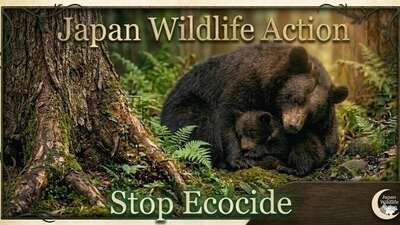

Expose Japan’s Greenwash: Stop the Ecocide of Sacred Forests and Bears
署名活動の主旨
【Short Summary】
Under the guise of "green energy," Japan’s ancient, sacred mountain ecosystems and marine environments are being devastated by hyper-development, driven by corporate interests and political opacity. While international promises like "Nature Positive" are openly broken, critically endangered wildlife is being ruthlessly culled. Under the radar, the state is injecting substantial public funds to actively set up a framework to commercialize these slaughtered lives as "gibier" (wild game) meat, all while subjecting them to archaic, cruel traps long banned in Western nations. With domestic media fueling public fear and concealing the truth, we urgently need the objective gaze and solidarity of the international community. Stand with us to end this state-sponsored ecocide.
【Petition Body】
To all citizens of the world who love nature, cherish life, and believe in the sacred balance of our Earth,
Our nation, Japan, was once a land that existed in deep harmony with the natural world. Our steep, ancient mountains have long been revered as the spiritual birthplace of pure waters, sustaining an invisible vow of coexistence between humans and wildlife for millennia.
Today, that sacred vow is being systematically dismantled. Under the guise of "environmental consciousness" and green energy, pristine forests and fragile ecosystems are facing irreversible destruction, driven by opaque administrative systems and deeply entrenched commercial interests.
We are reaching across borders to you because our internal avenues for change are being suffocated. In Japan, mainstream media coverage remains blind to the root causes of this crisis, keeping domestic public opinion in the dark. To stop this localized extinction, we urgently need an objective eye open to the international community and a deep, powerful empathy that transcends national borders.
1. The Media Illusion and the "Manufactured Terror"
Currently, major Japanese media outlets completely ignore the true survival crisis facing our wildlife. They remain silent on the violent encroachment of energy projects into the deep mountains and the corporate profits tied to them. Instead, they repeatedly broadcast sensationalized footage of displaced, panicked bears wandering into human areas, intentionally fueling public anxiety. This distorted reporting has fostered a cold, unsympathetic societal mindset, allowing the mass slaughter of innocent lives to be justified under the official name of "nuisance pest control."
2. The Tragedy of Hyper-Development: Broken International Promises and Devastated Mountains
Japan’s terrain consists mostly of steep, fragile mountain ranges with very little flat land. These mountains act as the physical backbone of our archipelago, nurturing the life-cycles of the entire land. Stripping these ridges for industrial energy projects is an act of ecological devastation.
Completely ignoring international zoning standards, massive industrial wind turbines—standing 150 to 200 meters tall, equivalent to high-rise skyscrapers—are being built in continuous chains of dozens or even hundreds, directly on narrow, highly vulnerable mountain ridges and critical wildlife habitats. The relentless low-frequency noise and ground vibrations generated by these industrial facilities have shattered the peace of these ancient sanctuaries. Terrified and displaced, wildlife is pushed out into human settlements. According to public data, since the influx of these developments, the number of captured and culled animals has skyrocketed by 5 to 18 times, with localized sightings and encounters surging by nearly 100-fold in certain areas.
While the Japanese government publicly pledges to achieve "Nature Positive" biodiversity targets by 2030, official deliberations in the National Diet (House of Councillors Committee on Environment) revealed a stunning reality: even if Japan completely eliminates its CO2 emissions by 2050, the resulting reduction in global temperature would be a mere 0.006°C or less. To sacrifice ancient, irreplaceable ecosystems and impose immense financial burdens on citizens for such a minuscule theoretical effect proves that these projects are driven not by genuine climate action, but by the lucrative gains of corporate greenwashing.
3. On the Brink of Extinction: Flawed Protection and the Reality of "Man-Made Disasters"
Recent government-backed academic surveys show that the Asiatic black bear population in Japan's Shikoku region has dwindled to a mere 25 individuals. They stand on the absolute precipice of extinction.
Meanwhile, even the Asiatic black bear population in the Kii Peninsula—which is officially listed as a "critically endangered regional population" on the Ministry of the Environment's Red List—is falling victim to arbitrary administration. Based merely on superficial desktop estimates combining three prefectures (Mie, Wakayama, and Nara) that claim the theoretical population has surpassed a protection threshold of "400 individuals," authorities are moving to remove its endangered status entirely, completely abandoning rigorous scientific field assessments.
The mountain ridges of this sacred sanctuary are already crowded with massive wind turbines, pushing displaced bears closer to human settlements. As a direct result, this year alone, at least three precious bears have already been killed in Wakayama and Mie.
The justification given for these killings is deeply flawed: administrative authorities and workers routinely authorize immediate shooting on the spot simply because a bear has accidentally wandered into a trap set for deer or wild boar and is "acting aggressively inside the cage." This penalizes the animal's natural instinct to survive. Furthermore, in Nagano Prefecture, the sheer panic of these cage-side culling operations recently led to a severe human casualty, where a member of a local hunting association accidentally shot and wounded a fellow hunter.
Executed without robust ecological data or established population density targets, these mass eradication strategies are completely backwards "man-made disasters" that threaten human safety, representing a total abandonment of the international "Precautionary Principle."
4. Commercial Exploitation and the Betrayal of Animal Welfare
Among developed nations, Japan’s practice of forcing large-scale renewable energy construction directly through the migratory corridors of large mammals is highly irregular. While the mainstream media hides the commercial infrastructure, the government is rapidly building a distribution network to utilize these slaughtered lives as "gibier" (wild game meat) for commercial markets.
The state is injecting substantial public funds to build processing facilities to funnel these sacred animals into the commercial market. This exploitation is enabled by a deeply flawed legal loophole: although the species is listed under CITES Appendix I, Japan still permits the lucrative domestic trade of "Yutan" (bear gallbladders). At a time when the international community fiercely condemns bear bile farming as inhumane, Japan’s preservation of this cruel domestic trade is a severe betrayal of international animal welfare standards.
Our Demands
We do not seek political conflict or corporate warfare. We simply refuse to remain silent as innocent, voiceless lives are erased under the beautiful banner of "environmental consciousness," with no one held accountable. We demand an immediate review of large-scale developments across Japan’s fragile terrains and marine zones, and a swift transition toward a scientific, humane coexistence modeled on international standards.
To preserve the dignity of these living souls and build a true coexistence, we humbly ask for your strength. Your signature and your global solidarity will serve as a vital shield to break this systemic injustice and protect these precious lives.
With deepest gratitude and humility, infused with love for all living souls,
Japan Wildlife Action: Peace Bear
Representative: hauno

896
署名活動の主旨
【Short Summary】
Under the guise of "green energy," Japan’s ancient, sacred mountain ecosystems and marine environments are being devastated by hyper-development, driven by corporate interests and political opacity. While international promises like "Nature Positive" are openly broken, critically endangered wildlife is being ruthlessly culled. Under the radar, the state is injecting substantial public funds to actively set up a framework to commercialize these slaughtered lives as "gibier" (wild game) meat, all while subjecting them to archaic, cruel traps long banned in Western nations. With domestic media fueling public fear and concealing the truth, we urgently need the objective gaze and solidarity of the international community. Stand with us to end this state-sponsored ecocide.
【Petition Body】
To all citizens of the world who love nature, cherish life, and believe in the sacred balance of our Earth,
Our nation, Japan, was once a land that existed in deep harmony with the natural world. Our steep, ancient mountains have long been revered as the spiritual birthplace of pure waters, sustaining an invisible vow of coexistence between humans and wildlife for millennia.
Today, that sacred vow is being systematically dismantled. Under the guise of "environmental consciousness" and green energy, pristine forests and fragile ecosystems are facing irreversible destruction, driven by opaque administrative systems and deeply entrenched commercial interests.
We are reaching across borders to you because our internal avenues for change are being suffocated. In Japan, mainstream media coverage remains blind to the root causes of this crisis, keeping domestic public opinion in the dark. To stop this localized extinction, we urgently need an objective eye open to the international community and a deep, powerful empathy that transcends national borders.
1. The Media Illusion and the "Manufactured Terror"
Currently, major Japanese media outlets completely ignore the true survival crisis facing our wildlife. They remain silent on the violent encroachment of energy projects into the deep mountains and the corporate profits tied to them. Instead, they repeatedly broadcast sensationalized footage of displaced, panicked bears wandering into human areas, intentionally fueling public anxiety. This distorted reporting has fostered a cold, unsympathetic societal mindset, allowing the mass slaughter of innocent lives to be justified under the official name of "nuisance pest control."
2. The Tragedy of Hyper-Development: Broken International Promises and Devastated Mountains
Japan’s terrain consists mostly of steep, fragile mountain ranges with very little flat land. These mountains act as the physical backbone of our archipelago, nurturing the life-cycles of the entire land. Stripping these ridges for industrial energy projects is an act of ecological devastation.
Completely ignoring international zoning standards, massive industrial wind turbines—standing 150 to 200 meters tall, equivalent to high-rise skyscrapers—are being built in continuous chains of dozens or even hundreds, directly on narrow, highly vulnerable mountain ridges and critical wildlife habitats. The relentless low-frequency noise and ground vibrations generated by these industrial facilities have shattered the peace of these ancient sanctuaries. Terrified and displaced, wildlife is pushed out into human settlements. According to public data, since the influx of these developments, the number of captured and culled animals has skyrocketed by 5 to 18 times, with localized sightings and encounters surging by nearly 100-fold in certain areas.
While the Japanese government publicly pledges to achieve "Nature Positive" biodiversity targets by 2030, official deliberations in the National Diet (House of Councillors Committee on Environment) revealed a stunning reality: even if Japan completely eliminates its CO2 emissions by 2050, the resulting reduction in global temperature would be a mere 0.006°C or less. To sacrifice ancient, irreplaceable ecosystems and impose immense financial burdens on citizens for such a minuscule theoretical effect proves that these projects are driven not by genuine climate action, but by the lucrative gains of corporate greenwashing.
3. On the Brink of Extinction: Flawed Protection and the Reality of "Man-Made Disasters"
Recent government-backed academic surveys show that the Asiatic black bear population in Japan's Shikoku region has dwindled to a mere 25 individuals. They stand on the absolute precipice of extinction.
Meanwhile, even the Asiatic black bear population in the Kii Peninsula—which is officially listed as a "critically endangered regional population" on the Ministry of the Environment's Red List—is falling victim to arbitrary administration. Based merely on superficial desktop estimates combining three prefectures (Mie, Wakayama, and Nara) that claim the theoretical population has surpassed a protection threshold of "400 individuals," authorities are moving to remove its endangered status entirely, completely abandoning rigorous scientific field assessments.
The mountain ridges of this sacred sanctuary are already crowded with massive wind turbines, pushing displaced bears closer to human settlements. As a direct result, this year alone, at least three precious bears have already been killed in Wakayama and Mie.
The justification given for these killings is deeply flawed: administrative authorities and workers routinely authorize immediate shooting on the spot simply because a bear has accidentally wandered into a trap set for deer or wild boar and is "acting aggressively inside the cage." This penalizes the animal's natural instinct to survive. Furthermore, in Nagano Prefecture, the sheer panic of these cage-side culling operations recently led to a severe human casualty, where a member of a local hunting association accidentally shot and wounded a fellow hunter.
Executed without robust ecological data or established population density targets, these mass eradication strategies are completely backwards "man-made disasters" that threaten human safety, representing a total abandonment of the international "Precautionary Principle."
4. Commercial Exploitation and the Betrayal of Animal Welfare
Among developed nations, Japan’s practice of forcing large-scale renewable energy construction directly through the migratory corridors of large mammals is highly irregular. While the mainstream media hides the commercial infrastructure, the government is rapidly building a distribution network to utilize these slaughtered lives as "gibier" (wild game meat) for commercial markets.
The state is injecting substantial public funds to build processing facilities to funnel these sacred animals into the commercial market. This exploitation is enabled by a deeply flawed legal loophole: although the species is listed under CITES Appendix I, Japan still permits the lucrative domestic trade of "Yutan" (bear gallbladders). At a time when the international community fiercely condemns bear bile farming as inhumane, Japan’s preservation of this cruel domestic trade is a severe betrayal of international animal welfare standards.
Our Demands
We do not seek political conflict or corporate warfare. We simply refuse to remain silent as innocent, voiceless lives are erased under the beautiful banner of "environmental consciousness," with no one held accountable. We demand an immediate review of large-scale developments across Japan’s fragile terrains and marine zones, and a swift transition toward a scientific, humane coexistence modeled on international standards.
To preserve the dignity of these living souls and build a true coexistence, we humbly ask for your strength. Your signature and your global solidarity will serve as a vital shield to break this systemic injustice and protect these precious lives.
With deepest gratitude and humility, infused with love for all living souls,
Japan Wildlife Action: Peace Bear
Representative: hauno
賛同者からのコメント
オンライン署名の最新情報
このオンライン署名をシェアする
2026年6月21日に作成されたオンライン署名