Over 1,200 sign appeal to expel Cuba from the UN Human Rights Council.

Thanks to your support and taking action, this petition to expel Cuba from the UN Human Rights Council has amassed over 1,200 signatures. Please share it with others.
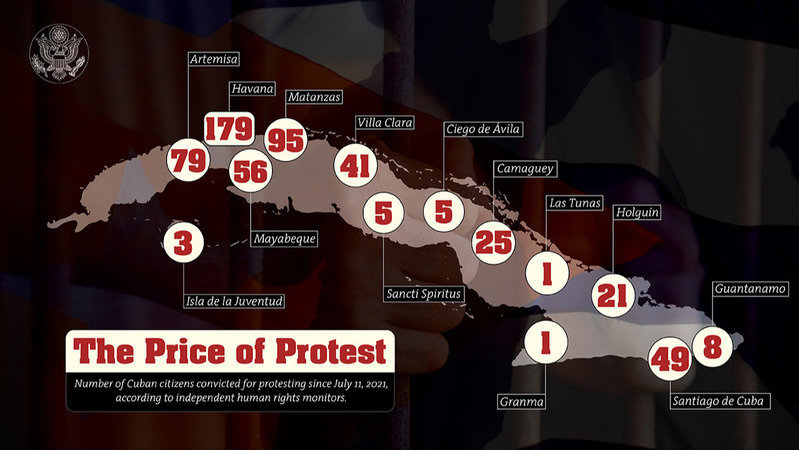
The non-governmental human rights group Justicia 11J in their most recent report, according to Marti News, found that of 564 people put on trial in Cuba for protesting against the Cuban government 519 have been condemned, 40 are awaiting sentencing, and only five were found not guilty.
They also found that the number that they had documented as detained rose from 1,444 to 1,470 Cubans detained for taking part in the July protests. According to Justicia 11J, " of the total number of demonstrators prosecuted judicially, or awaiting trial, between 70 and 80% have awaited (or are awaiting) trial under provisional detention."
On June 28, 2022 Secretary of State Antony Blinken tweeted: "The Cuban regime has condemned over 550 protestors to more than 4,000 combined years of prison or other punitive measures since the historic July 11, 2021 protests. As we near the #11J anniversary, those protestors who remain detained should be returned home to their families."
The artists associated with the Patria y Vida music video who remain in Cuba are now in prison ( Luis Manuel Otero Alcántara and Maykel “Osorbo” Castillo Pérez).
Others have been forced out of the island, or denied the right to return.
El Funky is in exile, and both Omara Isabel Ruiz Urquiola and Anamely Ramos González have been barred from entering Cuba, by the dictatorship and complicit airlines carrying out Havana's instructions.
The Washington Post has condemned this crackdown in a June 27, 2022 editorial.
The Washington Post, June 27, 2022
The Post's View
Opinion
With the world distracted, Cuba cracks down on dissident artists
By the Editorial Board
It has been nearly a year since Cuba’s streets erupted in mass protests. July 11, 2021, sent a thrill through supporters of freedom around the world — and a fearful chill down the spines of Cuba’s rulers. The dictatorship brutally suppressed the revolt and has spent the months since systematically bolstering its apparatus of political control. As part of that, the regime has been rounding up and punishing those who took part in the demonstrations, and in the dissident ferment that preceded them. Some 725 people are in detention, according to the U.S.-based human rights group Cubalex. And on June 24, the regime delivered stiff prison sentences to two of the movement’s best-known leaders, Maykel “Osorbo” Castillo and Luis Manuel Otero Alcántara.
No doubt the Cuban regime has issued these punishments on the assumption that they will receive little notice, or condemnation, from a world distracted by war in Ukraine, inflation and other serious problems. All the more reason to spend a few moments understanding the nature of these brave men’s protests — and why the dictatorship finds them particularly threatening.
Like many of the most oppressed and alienated people in Cuba, both Mr. Castillo and Mr. Otero are Black. Both come from humble economic circumstances. Both have made innovative careers in Cuban popular culture: The former is a rapper; the latter, a performance artist and sculptor. And both have defiantly expressed resistance to the regime through art. Mr. Otero is one of the founders of the San Isidro Movement, begun in 2018 by journalists, academics and artists to protest heightened censorship. In tandem with Black Cuban artists in exile, Mr. Castillo and Mr. Otero took part in a music video for the hip-hop freedom anthem “Patria y Vida” — “Fatherland and Life” — which went viral in February 2021. A clever, catchy reversal of the regime’s slogan “Patria o Muerte” — “Fatherland or Death” — the piece eventually won song of the year at the Latin Grammys. On July 11, its words were on the lips of many who joined the protests.
The Opinions Essay: ‘Liberation is born from the soul’: Oswaldo Payá’s struggle for a free Cuba
The regime is now getting payback for this devastating blow to its international image. Having been savagely beaten by state security agents two months after the video’s release, Mr. Castillo, 39, was arrested in May 2021 and has been in prison ever since. The nine-year sentence he just received was for murky offenses such as “contempt” and “defamation of institutions and organizations, heroes and martyrs,” as well as “assault,” an apparent reference to his attempts to fend off the police. (Three others were penalized for helping Mr. Castillo resist arrest, including one man sentenced to five years.) Mr. Otero got five years for similar trumped-up offenses, as well as “insulting national symbols,” an apparent reference to his use of the Cuban flag in his performances.
This latest gross human rights violation vindicates President Biden’s refusal to permit Cuba’s attendance at the recent Summit of the Americas; it should embarrass Latin American governments, led by Mexico, that protested that exclusion. Any regime that jails peaceful artists deserves all the denunciation the world can muster.
https://www.washingtonpost.com/opinions/2022/06/27/cuba-july-11-protests-castillo-otero/