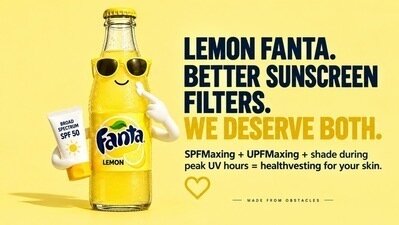

Europe gets modern sunscreen filters AND Fanta Lemon. Why are we still waiting for both?
The Issue
I’m a board-certified dermatologist, and every day I tell patients to protect their skin from the sun.
Wear sunscreen.
Use enough.
Reapply it.
Protect your children.
Protect yourself.
I think of those small choices as healthvesting: making simple investments in your health today that may pay off years—or decades—from now.
When it comes to sun protection, that means SPFMaxing and UPFMaxing: maximizing sunscreen, sun-protective clothing, shade and other everyday habits that reduce unnecessary UV exposure.
But there is an obstacle.
And if there is one idea behind Made From Obstacles, it is that obstacles are not simply there to be accepted.
They are there to be understood, challenged and, when possible, changed.
One of those obstacles is surprisingly simple:
Americans still do not have access to the same sunscreen toolbox available in many other parts of the world.
And, for reasons that will make sense in a minute, let’s start with Fanta.
In Spain, for example, Fanta Lemon contains lemon juice and uses beta-carotene for color.
In the United States, Fanta Lemon is not part of the standard Fanta lineup.
What we do get is Fanta Orange, which contains Yellow 6 and Red 40.
Those correspond to Sunset Yellow and Allura Red, colors for which certain foods in the European Union must carry a warning that they “may have an adverse effect on activity and attention in children.”
So let me understand this:
Europe gets Fanta Lemon.
Europe gets a much bigger toolbox of modern sunscreen filters.
And we get neither?
This petition is officially about the sunscreen.
But to be clear:
We would also like the Fanta Lemon.
Come on.
We’re the country of lemonade.
Now, back to the serious part.
Why does sunscreen overseas often feel so much better?
In Europe, Australia, Brazil, South Korea, Japan and many other countries, sunscreen formulators can work with combinations of modern UV filters that can help provide:
Excellent UVA and UVB protection
Greater photostability
Broader UV coverage
Lighter, more transparent textures
Less white cast
Better cosmetic elegance
American sunscreen formulators have historically had far fewer options.
And sunscreen is about much more than the SPF number printed on the bottle.
We talk about UVB.
We sometimes forget about UVA.
UVB is strongly associated with sunburn.
UVA penetrates more deeply into the skin and contributes to collagen breakdown, premature skin aging, pigmentation and cumulative ultraviolet damage.
Both UVA and UVB contribute to the biological damage associated with skin cancer.
And SPF primarily reflects protection against UVB-induced redness.
So if we are going to SPFMax, we should not think only about chasing a bigger number on the front of a bottle.
We should be thinking about:
Strong UVA protection.
Strong UVB protection.
Photostability.
Tolerability.
And a sunscreen people actually want to wear.
As a dermatologist, this matters to me because patients don’t just come into my office with sunburns.
I see what ultraviolet exposure can leave behind years later:
Premature aging.
Pigmentation.
Precancers.
And skin cancers.
That is why access to multiple modern UV filters matters.
Great sunscreen requires a toolbox—not one magic ingredient.
Many sophisticated international sunscreens use several UV filters working together.
Different filters protect different portions of the ultraviolet spectrum.
Some are particularly effective against UVB.
Others strengthen UVA protection.
And modern, photostable combinations give formulators greater flexibility to create sunscreens that are protective, transparent, lightweight and pleasant to wear.
Because there is one part of sunscreen science that is incredibly simple:
People actually have to wear it.
If sunscreen is greasy, heavy, chalky, irritating, leaves a noticeable white cast or burns around the eyes, people may use less of it, skip reapplication or stop wearing it altogether.
The sunscreen people enjoy wearing is the sunscreen they are more likely to use.
Cosmetic elegance is not merely cosmetic.
It affects adherence.
America finally got Tinosorb S.
There has finally been real progress.
In 2026, the FDA added bemotrizinol, commonly known internationally as Tinosorb S, as a permitted U.S. sunscreen active ingredient.
It was the first new sunscreen active ingredient added to the U.S. OTC sunscreen monograph since the late 1990s.
Nearly three decades.
That is a major step forward.
But:
ONE NEW FILTER IS NOT THE FULL TOOLBOX.
Many advanced international sunscreens combine Tinosorb S with several other modern UV filters.
When those additional filters are unavailable to American formulators, manufacturers cannot necessarily bring the same formulation sold overseas directly to the United States.
Changing the UV-filter system can change:
UVA protection.
UVB protection.
Photostability.
Transparency.
Texture.
White cast.
Tolerability.
And ultimately:
Whether someone actually wants to put the sunscreen on every morning.
Tinosorb S was an important beginning.
It should not be the end.
This is where healthvesting matters.
We spend enormous amounts of time talking about what people can do later in life to stay healthier.
But many healthy habits begin much earlier.
Protecting a child’s skin.
Putting on sunscreen.
Wearing a UPF shirt.
Choosing shade.
Wearing a hat.
Avoiding intentional tanning.
Doing those things once is small.
Doing them repeatedly over years can become meaningful.
That is healthvesting.
And when it comes to ultraviolet exposure:
SPFMaxing + UPFMaxing + Smart Sun Avoidance = healthvesting for your skin.
No single sunscreen makes anyone invincible.
No shirt does either.
It is the combination of good habits, repeated over time, that matters.
And if we want people to build those habits, we should give them the best tools we reasonably can.
Because there is another obstacle.
At the same time dermatologists are encouraging better sun protection, social media is promoting trends such as tanmaxxing, “solar calluses” and intentionally chasing dramatic tan lines.
Tanning can be presented online as aesthetic, harmless or even healthy.
But biologically, a tan is a response to ultraviolet injury.
Meanwhile, skin cancer remains the most common cancer in the United States.
In 2026, approximately 112,000 Americans are expected to be diagnosed with melanoma and about 8,510 are expected to die from it.
Millions of basal cell and squamous cell skin cancers are also diagnosed each year.
As dermatologists, we spend our careers telling people:
Wear sunscreen.
Wear enough.
Reapply it.
Protect your children.
Protect yourself.
If we are going to ask millions of Americans to do that every day, shouldn’t we also give sunscreen scientists the broadest evidence-supported toolbox possible to create products people genuinely want to use?
We are not asking for weaker regulation.
We are not asking the FDA to approve an ingredient simply because another country uses it.
Safety matters.
Science matters.
Rigorous evaluation matters.
But high-quality international research, decades of real-world experience and international safety data should also be considered efficiently.
We need a modern, predictable and evidence-based pathway that evaluates these ingredients and makes them available when the science supports them.
And yes.
We are coming back to the Fanta.
This campaign is not claiming that Fanta causes hyperactivity.
It is not saying that food dyes and sunscreen filters are scientifically equivalent.
It is making a much simpler point:
The United States can regulate and sell brightly colored soda containing Yellow 6 and Red 40.
Yet Americans waited nearly three decades for one new sunscreen active ingredient.
When ultraviolet radiation is a known human carcinogen, that contrast deserves some attention.
And while we are modernizing things...
Seriously. Why can’t we get Fanta Lemon?
What we are asking for
We are asking the FDA, Congress and policymakers to:
Accelerate the scientific evaluation of additional modern UV filters already used internationally.
Create a faster, predictable and evidence-based pathway that appropriately considers international safety data and extensive real-world use.
Give American sunscreen formulators access to a broader range of evidence-supported filters so they can develop sophisticated multi-filter sunscreens comparable with products available elsewhere.
And evaluate sunscreen innovation not only by SPF, but also by UVA protection, UVB protection, photostability, transparency, tolerability, skin-tone inclusivity and cosmetic elegance.
We are not asking for weaker regulation.
We are asking for modern regulation.
Americans waited nearly three decades for one new sunscreen filter.
We should not have to wait another three decades for the next one.
And that is what Made From Obstacles means here:
See the obstacle. Understand it. Then work to change it.
Better sun protection is healthvesting.
Better sunscreen options help us SPFMax.
Sun-protective clothing helps us UPFMax.
And better science gives people better tools to protect their skin for life.
BETTER FILTERS.
BETTER UVA PROTECTION.
BETTER SUNSCREEN.
MADE FROM OBSTACLES.
And while you’re at it...
SEND THE FANTA LEMON TOO. 🍋

2
The Issue
I’m a board-certified dermatologist, and every day I tell patients to protect their skin from the sun.
Wear sunscreen.
Use enough.
Reapply it.
Protect your children.
Protect yourself.
I think of those small choices as healthvesting: making simple investments in your health today that may pay off years—or decades—from now.
When it comes to sun protection, that means SPFMaxing and UPFMaxing: maximizing sunscreen, sun-protective clothing, shade and other everyday habits that reduce unnecessary UV exposure.
But there is an obstacle.
And if there is one idea behind Made From Obstacles, it is that obstacles are not simply there to be accepted.
They are there to be understood, challenged and, when possible, changed.
One of those obstacles is surprisingly simple:
Americans still do not have access to the same sunscreen toolbox available in many other parts of the world.
And, for reasons that will make sense in a minute, let’s start with Fanta.
In Spain, for example, Fanta Lemon contains lemon juice and uses beta-carotene for color.
In the United States, Fanta Lemon is not part of the standard Fanta lineup.
What we do get is Fanta Orange, which contains Yellow 6 and Red 40.
Those correspond to Sunset Yellow and Allura Red, colors for which certain foods in the European Union must carry a warning that they “may have an adverse effect on activity and attention in children.”
So let me understand this:
Europe gets Fanta Lemon.
Europe gets a much bigger toolbox of modern sunscreen filters.
And we get neither?
This petition is officially about the sunscreen.
But to be clear:
We would also like the Fanta Lemon.
Come on.
We’re the country of lemonade.
Now, back to the serious part.
Why does sunscreen overseas often feel so much better?
In Europe, Australia, Brazil, South Korea, Japan and many other countries, sunscreen formulators can work with combinations of modern UV filters that can help provide:
Excellent UVA and UVB protection
Greater photostability
Broader UV coverage
Lighter, more transparent textures
Less white cast
Better cosmetic elegance
American sunscreen formulators have historically had far fewer options.
And sunscreen is about much more than the SPF number printed on the bottle.
We talk about UVB.
We sometimes forget about UVA.
UVB is strongly associated with sunburn.
UVA penetrates more deeply into the skin and contributes to collagen breakdown, premature skin aging, pigmentation and cumulative ultraviolet damage.
Both UVA and UVB contribute to the biological damage associated with skin cancer.
And SPF primarily reflects protection against UVB-induced redness.
So if we are going to SPFMax, we should not think only about chasing a bigger number on the front of a bottle.
We should be thinking about:
Strong UVA protection.
Strong UVB protection.
Photostability.
Tolerability.
And a sunscreen people actually want to wear.
As a dermatologist, this matters to me because patients don’t just come into my office with sunburns.
I see what ultraviolet exposure can leave behind years later:
Premature aging.
Pigmentation.
Precancers.
And skin cancers.
That is why access to multiple modern UV filters matters.
Great sunscreen requires a toolbox—not one magic ingredient.
Many sophisticated international sunscreens use several UV filters working together.
Different filters protect different portions of the ultraviolet spectrum.
Some are particularly effective against UVB.
Others strengthen UVA protection.
And modern, photostable combinations give formulators greater flexibility to create sunscreens that are protective, transparent, lightweight and pleasant to wear.
Because there is one part of sunscreen science that is incredibly simple:
People actually have to wear it.
If sunscreen is greasy, heavy, chalky, irritating, leaves a noticeable white cast or burns around the eyes, people may use less of it, skip reapplication or stop wearing it altogether.
The sunscreen people enjoy wearing is the sunscreen they are more likely to use.
Cosmetic elegance is not merely cosmetic.
It affects adherence.
America finally got Tinosorb S.
There has finally been real progress.
In 2026, the FDA added bemotrizinol, commonly known internationally as Tinosorb S, as a permitted U.S. sunscreen active ingredient.
It was the first new sunscreen active ingredient added to the U.S. OTC sunscreen monograph since the late 1990s.
Nearly three decades.
That is a major step forward.
But:
ONE NEW FILTER IS NOT THE FULL TOOLBOX.
Many advanced international sunscreens combine Tinosorb S with several other modern UV filters.
When those additional filters are unavailable to American formulators, manufacturers cannot necessarily bring the same formulation sold overseas directly to the United States.
Changing the UV-filter system can change:
UVA protection.
UVB protection.
Photostability.
Transparency.
Texture.
White cast.
Tolerability.
And ultimately:
Whether someone actually wants to put the sunscreen on every morning.
Tinosorb S was an important beginning.
It should not be the end.
This is where healthvesting matters.
We spend enormous amounts of time talking about what people can do later in life to stay healthier.
But many healthy habits begin much earlier.
Protecting a child’s skin.
Putting on sunscreen.
Wearing a UPF shirt.
Choosing shade.
Wearing a hat.
Avoiding intentional tanning.
Doing those things once is small.
Doing them repeatedly over years can become meaningful.
That is healthvesting.
And when it comes to ultraviolet exposure:
SPFMaxing + UPFMaxing + Smart Sun Avoidance = healthvesting for your skin.
No single sunscreen makes anyone invincible.
No shirt does either.
It is the combination of good habits, repeated over time, that matters.
And if we want people to build those habits, we should give them the best tools we reasonably can.
Because there is another obstacle.
At the same time dermatologists are encouraging better sun protection, social media is promoting trends such as tanmaxxing, “solar calluses” and intentionally chasing dramatic tan lines.
Tanning can be presented online as aesthetic, harmless or even healthy.
But biologically, a tan is a response to ultraviolet injury.
Meanwhile, skin cancer remains the most common cancer in the United States.
In 2026, approximately 112,000 Americans are expected to be diagnosed with melanoma and about 8,510 are expected to die from it.
Millions of basal cell and squamous cell skin cancers are also diagnosed each year.
As dermatologists, we spend our careers telling people:
Wear sunscreen.
Wear enough.
Reapply it.
Protect your children.
Protect yourself.
If we are going to ask millions of Americans to do that every day, shouldn’t we also give sunscreen scientists the broadest evidence-supported toolbox possible to create products people genuinely want to use?
We are not asking for weaker regulation.
We are not asking the FDA to approve an ingredient simply because another country uses it.
Safety matters.
Science matters.
Rigorous evaluation matters.
But high-quality international research, decades of real-world experience and international safety data should also be considered efficiently.
We need a modern, predictable and evidence-based pathway that evaluates these ingredients and makes them available when the science supports them.
And yes.
We are coming back to the Fanta.
This campaign is not claiming that Fanta causes hyperactivity.
It is not saying that food dyes and sunscreen filters are scientifically equivalent.
It is making a much simpler point:
The United States can regulate and sell brightly colored soda containing Yellow 6 and Red 40.
Yet Americans waited nearly three decades for one new sunscreen active ingredient.
When ultraviolet radiation is a known human carcinogen, that contrast deserves some attention.
And while we are modernizing things...
Seriously. Why can’t we get Fanta Lemon?
What we are asking for
We are asking the FDA, Congress and policymakers to:
Accelerate the scientific evaluation of additional modern UV filters already used internationally.
Create a faster, predictable and evidence-based pathway that appropriately considers international safety data and extensive real-world use.
Give American sunscreen formulators access to a broader range of evidence-supported filters so they can develop sophisticated multi-filter sunscreens comparable with products available elsewhere.
And evaluate sunscreen innovation not only by SPF, but also by UVA protection, UVB protection, photostability, transparency, tolerability, skin-tone inclusivity and cosmetic elegance.
We are not asking for weaker regulation.
We are asking for modern regulation.
Americans waited nearly three decades for one new sunscreen filter.
We should not have to wait another three decades for the next one.
And that is what Made From Obstacles means here:
See the obstacle. Understand it. Then work to change it.
Better sun protection is healthvesting.
Better sunscreen options help us SPFMax.
Sun-protective clothing helps us UPFMax.
And better science gives people better tools to protect their skin for life.
BETTER FILTERS.
BETTER UVA PROTECTION.
BETTER SUNSCREEN.
MADE FROM OBSTACLES.
And while you’re at it...
SEND THE FANTA LEMON TOO. 🍋
Petition Updates
Share this petition
Petition created on August 29, 2026