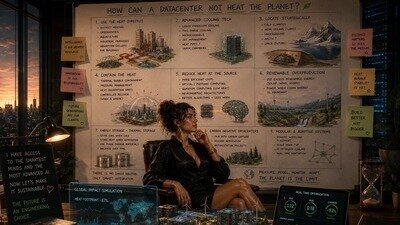

Establish National Standards for Next-Generation Data Centres
The issue
...The question isn't whether we build more data centres. The question is what kind of data centres we choose to build...
The Issue
The decisions we make today will shape the world that future generations inherit. Earth is the only home we share, sustaining every person, every community, and every living thing. As technology advances, we have a responsibility to ensure that innovation strengthens our future rather than unnecessarily straining the environment that supports us.
Australia has an opportunity to become a global leader in next-generation digital infrastructure. Rather than simply building more data centres, we should build smarter ones - designed from the outset to maximise energy efficiency, minimise water consumption, recover and reuse waste heat, integrate renewable energy, and intelligently optimise their own operation.
The Problem
Artificial intelligence, cloud computing, and digital services are expanding rapidly. Every large-scale data centre approved today is likely to operate for decades, meaning today's design decisions will shape Australia's energy demand, water use, and environmental footprint for generations. Setting smarter standards now is far more effective, and more affordable, rather than attempting to retrofit critical infrastructure later.
Data centres are essential infrastructure, powering everything from hospitals and universities to businesses and artificial intelligence. However, they also consume significant amounts of electricity, water, and cooling resources. According to the International Energy Agency, data centres account for approximately 1.5% of global electricity consumption, with demand expected to continue rising. In Australia, data centres are projected to consume between 8% and 15% of the nation's electricity by 2030, according to NABERS.
Building tomorrow's infrastructure using yesterday's design philosophy risks locking Australia into unnecessary energy waste, higher operating costs, and avoidable environmental impacts.
The Solution
We call on the Australian Government to establish a National Smart Data Centre Standard for new large-scale data centres.
But we should not expect government to design this alone.
Engineers, researchers, universities, data-centre operators, energy specialists, environmental scientists, technology companies and the public should have the opportunity to contribute to its development.
For this reason, an open engineering project—the Smart Data Centre Initiative (SDCI)—has been started to develop, challenge and improve a draft framework publicly.
https://github.com/generationalpieru/Smart-Data-Centre-Initiative-SDCI
The project is currently an RFC (Request for Comments). It is not an official standard and does not represent the Australian Government or a standards organisation. It exists so that the proposal can be criticised, researched and improved openly.
The Standard
The Australian Smart Data Centre Standard (ASDCS) should require every new large-scale data centre to demonstrate best-practice design in the following areas:
- Innovation
- Next-generation cooling technologies
- Demonstrate best-practice cooling with minimal environmental impact.
- Advanced chip architectures
- Thermal innovation
- Minimise waste heat released to the surrounding environment and maximise beneficial heat recovery where practical.
- Continuous efficiency improvement
- Research partnerships with Australian universities
- Next-generation cooling technologies
- Energy
- Minimum world-class energy efficiency benchmarks
- Smart power management
- Integration of renewable or verified low-emission energy sources
- Heat
- Waste heat recovery where feasible
- Thermal energy storage
- Beneficial heat reuse for nearby communities or industry where practical
- Water
- Responsible water management
- Low-water or alternative cooling technologies
- Water recycling and conservation
- Intelligent Operation
- AI-assisted operational optimisation of energy and cooling
- Real-time environmental monitoring
- Predictive maintenance
- Adaptive cooling and workload management
- Future-Ready Design
- Modular and upgradeable infrastructure
- Whole-of-life carbon management
- Transparent environmental reporting
- Capacity to adopt emerging sustainable technologies
-
Site Selection . Sustainability should begin before construction. Site assessment should consider:
-
grid capacity;
-
renewable-energy availability;
-
local climate;
-
water availability;
-
fibre connectivity;
-
opportunities for heat reuse;
-
brownfield and existing industrial sites;
-
environmental sensitivity;
-
natural hazards and climate resilience;
-
impacts and potential benefits for surrounding communities.
-
At the very least
Every new large-scale data centre should demonstrate:
- industry-leading energy efficiency,
- responsible water management,
- minimised waste heat emissions,
- practical heat recovery opportunities,
- transparent environmental reporting,
- resilience to future technological improvements.
Closing
Australia has the engineering talent, the renewable energy resources, and the technological expertise to become a global leader in smart digital infrastructure. The challenge is not whether we continue building data centres—it is whether we choose to build them for yesterday or for tomorrow.
If we can build artificial intelligence capable of solving some of humanity's most complex challenges, we can also build the intelligent infrastructure needed to power it responsibly.
Let's build the world's smartest data centres—here in Australia.
Please sign this petition and help make that future a reality.

2
The issue
...The question isn't whether we build more data centres. The question is what kind of data centres we choose to build...
The Issue
The decisions we make today will shape the world that future generations inherit. Earth is the only home we share, sustaining every person, every community, and every living thing. As technology advances, we have a responsibility to ensure that innovation strengthens our future rather than unnecessarily straining the environment that supports us.
Australia has an opportunity to become a global leader in next-generation digital infrastructure. Rather than simply building more data centres, we should build smarter ones - designed from the outset to maximise energy efficiency, minimise water consumption, recover and reuse waste heat, integrate renewable energy, and intelligently optimise their own operation.
The Problem
Artificial intelligence, cloud computing, and digital services are expanding rapidly. Every large-scale data centre approved today is likely to operate for decades, meaning today's design decisions will shape Australia's energy demand, water use, and environmental footprint for generations. Setting smarter standards now is far more effective, and more affordable, rather than attempting to retrofit critical infrastructure later.
Data centres are essential infrastructure, powering everything from hospitals and universities to businesses and artificial intelligence. However, they also consume significant amounts of electricity, water, and cooling resources. According to the International Energy Agency, data centres account for approximately 1.5% of global electricity consumption, with demand expected to continue rising. In Australia, data centres are projected to consume between 8% and 15% of the nation's electricity by 2030, according to NABERS.
Building tomorrow's infrastructure using yesterday's design philosophy risks locking Australia into unnecessary energy waste, higher operating costs, and avoidable environmental impacts.
The Solution
We call on the Australian Government to establish a National Smart Data Centre Standard for new large-scale data centres.
But we should not expect government to design this alone.
Engineers, researchers, universities, data-centre operators, energy specialists, environmental scientists, technology companies and the public should have the opportunity to contribute to its development.
For this reason, an open engineering project—the Smart Data Centre Initiative (SDCI)—has been started to develop, challenge and improve a draft framework publicly.
https://github.com/generationalpieru/Smart-Data-Centre-Initiative-SDCI
The project is currently an RFC (Request for Comments). It is not an official standard and does not represent the Australian Government or a standards organisation. It exists so that the proposal can be criticised, researched and improved openly.
The Standard
The Australian Smart Data Centre Standard (ASDCS) should require every new large-scale data centre to demonstrate best-practice design in the following areas:
- Innovation
- Next-generation cooling technologies
- Demonstrate best-practice cooling with minimal environmental impact.
- Advanced chip architectures
- Thermal innovation
- Minimise waste heat released to the surrounding environment and maximise beneficial heat recovery where practical.
- Continuous efficiency improvement
- Research partnerships with Australian universities
- Next-generation cooling technologies
- Energy
- Minimum world-class energy efficiency benchmarks
- Smart power management
- Integration of renewable or verified low-emission energy sources
- Heat
- Waste heat recovery where feasible
- Thermal energy storage
- Beneficial heat reuse for nearby communities or industry where practical
- Water
- Responsible water management
- Low-water or alternative cooling technologies
- Water recycling and conservation
- Intelligent Operation
- AI-assisted operational optimisation of energy and cooling
- Real-time environmental monitoring
- Predictive maintenance
- Adaptive cooling and workload management
- Future-Ready Design
- Modular and upgradeable infrastructure
- Whole-of-life carbon management
- Transparent environmental reporting
- Capacity to adopt emerging sustainable technologies
-
Site Selection . Sustainability should begin before construction. Site assessment should consider:
-
grid capacity;
-
renewable-energy availability;
-
local climate;
-
water availability;
-
fibre connectivity;
-
opportunities for heat reuse;
-
brownfield and existing industrial sites;
-
environmental sensitivity;
-
natural hazards and climate resilience;
-
impacts and potential benefits for surrounding communities.
-
At the very least
Every new large-scale data centre should demonstrate:
- industry-leading energy efficiency,
- responsible water management,
- minimised waste heat emissions,
- practical heat recovery opportunities,
- transparent environmental reporting,
- resilience to future technological improvements.
Closing
Australia has the engineering talent, the renewable energy resources, and the technological expertise to become a global leader in smart digital infrastructure. The challenge is not whether we continue building data centres—it is whether we choose to build them for yesterday or for tomorrow.
If we can build artificial intelligence capable of solving some of humanity's most complex challenges, we can also build the intelligent infrastructure needed to power it responsibly.
Let's build the world's smartest data centres—here in Australia.
Please sign this petition and help make that future a reality.
The Decision Makers


Petition Updates
Share this petition
Petition created on 17 July 2026