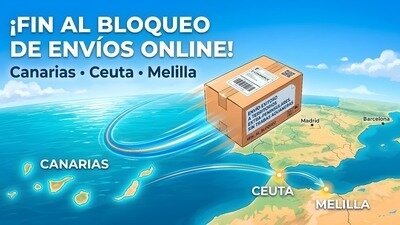

¡Envíos justos y sin bloqueos para Canarias, Ceuta y Melilla!
El problema
¿Sabías que un ciudadano de Las Pamas, Ceuta o Melilla tiene más facilidades para comprar un artículo de un euro a un fabricante en Shenzhen (China) que a una tienda de Madrid o Barcelona?
Parece una broma de mal gusto, pero es la realidad diaria de más de 2,3 millones de españoles. Vivir en Canarias, Ceuta o Melilla hoy en día significa encontrarse sistemáticamente con el cartel de "No realizamos envíos a Canarias, Ceuta y Melilla". Significa ser tratados como ciudadanos de segunda en el entorno digital. Mientras las administraciones públicas se llenan la boca hablando de "cohesión territorial", "digitalización" e "igualdad de condiciones", las trabas aduaneras y fiscales nos aíslan del mercado del que, por derecho, formamos parte.
El absurdo de las aduanas internas
Nuestros regímenes fiscales especiales (el IGIC en Canarias y el IPSI en Ceuta y Melilla) nacieron para proteger nuestras economías y garantizar que no pagáramos los altos impuestos de consumo peninsulares (el IVA). Sin embargo, la falta de adaptación de estos sistemas a la era de internet los ha transformado en un muro burocrático infranqueable.
Para cualquier pequeña empresa de la Península, enviarnos un producto se convierte en una pesadilla de exportación aduanera: facturas sin IVA, obligatoriedad de rellenar el Documento Único Administrativo (DUA) y el riesgo constante de que el cliente en destino rechace el paquete porque la empresa de mensajería le exige tasas de gestión aduanera desproporcionadas en la puerta de su casa (que a veces duplican el valor del propio producto).
Para colmo, la nueva normativa europea de 2026 introduce aranceles fijos (como la tasa de 3€ a plataformas extranjeras) y se endurece la recaudación local eliminando exenciones fiscales de bajo valor, encareciendo aún más el consumo exterior sin ofrecer ninguna alternativa viable para comprar en nuestro propio país. Si comprar a China se vuelve más caro y comprar a la Península sigue siendo imposible, ¿qué opción nos queda?
PROPUESTA:
No queremos evadir impuestos. Queremos pagar los impuestos que nos corresponden (nuestro IGIC o IPSI) de manera justa, sencilla y sin que el envío de un libro, una pieza de repuesto o ropa se convierta en una odisea burocrática y financiera.
Por ello, dirigimos esta petición al Ministerio de Hacienda, a la Agencia Tributaria (AEAT), al Gobierno de Canarias y a las Asambleas de Ceuta y Melilla para que implementen de forma urgente las siguientes medidas:
1. Ventanilla Única de IVA/IGIC/IPSI para envíos nacionales (Sistema de "Suministro Unificado")
Exigimos la creación de un sistema informático unificado y simplificado para las tiendas online de la Península. Al igual que la UE implementó el sistema IOSS para importar desde el extranjero, España debe facilitar que cualquier comercio peninsular pueda calcular, cobrar e ingresar el IGIC o IPSI directamente en el momento del pago, eximiendo el paquete de cualquier trámite aduanero manual a su llegada.
2. Eliminación de las tasas de tramitación aduanera (DUA) para particulares
Las agencias de mensajería privada no deben seguir haciendo negocio a costa de la fragmentación territorial. Exigimos la prohibición de cobrar tasas de "gestión aduanera" o "presentación al despacho" a particulares en envíos de valor inferior a 150€. Si el impuesto ya se liquida de forma digital o mediante autodespacho simplificado, la entrega debe ser limpia y sin "sorpresas" económicas en la puerta.
3. Autodespacho simplificado y 100% móvil
Los sistemas de autodespacho actuales siguen siendo confusos y poco accesibles para el ciudadano medio. Exigimos una plataforma estatal y autonómica unificada, intuitiva y en formato app, que permita liberar cualquier paquete retenido en menos de dos clics y de forma gratuita.
4. Prohibición del Geobloqueo comercial de transporte en territorio nacional
La legislación de consumo debe actualizarse para que las grandes corporaciones y plataformas que operan en España (incluyendo grandes marketplaces y filiales como AliExpress Plaza) no puedan discriminar sistemáticamente a los ciudadanos de Canarias, Ceuta y Melilla en sus opciones de envío si existen operadores postales públicos (como Correos) capaces de dar cobertura al territorio.
Firma esta petición.
Ayúdanos a romper el bloqueo. No somos un tercer país, no somos el extranjero. Vivir en las islas o en las ciudades autónomas no puede seguir siendo un castigo digital.
¡Por un mercado único real y un e-commerce sin fronteras internas!
------------------------------------------------------------------------------------------------------------------------------------------------------------
Did you know that a citizen of Las Palmas, Ceuta, or Melilla has an easier time buying a one-euro item from a manufacturer in Shenzhen (China) than from a store in Madrid or Barcelona?
It sounds like a bad joke, but it is the daily reality for over 2.3 million Spaniards. Living in the Canary Islands, Ceuta, or Melilla today means systematically encountering the sign "We do not ship to the Canary Islands, Ceuta, and Melilla." It means being treated as second-class citizens in the digital environment. While public administrations fill their mouths talking about "territorial cohesion," "digitalization," and "equal conditions," customs and tax barriers isolate us from the market to which we rightfully belong.
The absurdity of internal customs
Our special tax regimes (the IGIC in the Canary Islands and the IPSI in Ceuta and Melilla) were created to protect our economies and ensure that we did not pay the high mainland consumption taxes (the VAT). However, the failure to adapt these systems to the internet age has transformed them into an insurmountable bureaucratic wall.
For any small business on the mainland, sending us a product becomes a customs export nightmare: invoices without VAT, the obligation to fill out the Single Administrative Document (SAD/DUA), and the constant risk that the customer at the destination will reject the package because the courier company demands disproportionate customs management fees at their doorstep (which sometimes double the value of the product itself).
To make matters worse, the new 2026 European regulations introduce fixed tariffs (such as the €3 fee for foreign platforms) and local tax collection is tightened by eliminating low-value tax exemptions, making foreign consumption even more expensive without offering any viable alternative to buy in our own country. If buying from China becomes more expensive and buying from the mainland remains impossible, what option do we have left?
PROPOSAL:
We do not want to evade taxes. We want to pay our corresponding taxes (our IGIC or IPSI) fairly, simply, and without the shipping of a book, a spare part, or clothing turning into a bureaucratic and financial odyssey.
Therefore, we direct this petition to the Ministry of Finance, the Tax Agency (AEAT), the Government of the Canary Islands, and the Assemblies of Ceuta and Melilla so that they urgently implement the following measures:
1. Single Window for VAT/IGIC/IPSI for national shipments ("Unified Supply" System)
We demand the creation of a unified and simplified IT system for online stores on the mainland. Just as the EU implemented the IOSS system for importing from abroad, Spain must make it easy for any mainland business to calculate, collect, and remit the IGIC or IPSI directly at the time of payment, exempting the package from any manual customs processing upon arrival.
2. Elimination of customs processing fees (DUA) for individuals
Private courier agencies must not continue profiting at the expense of territorial fragmentation. We demand the prohibition of charging "customs management" or "customs presentation" fees to individuals on shipments valued under €150. If the tax is already settled digitally or through simplified self-clearance, the delivery should be clean and without economic "surprises" at the door.
3. Simplified and 100% mobile self-clearance
Current self-clearance systems remain confusing and inaccessible for the average citizen. We demand a unified, intuitive state and regional platform in an app format that allows any held package to be released in less than two clicks and for free.
4. Prohibition of commercial transport Geoblocking within national territory
Consumer legislation must be updated so that large corporations and platforms operating in Spain (including large marketplaces and subsidiaries like AliExpress Plaza) cannot systematically discriminate against citizens of the Canary Islands, Ceuta, and Melilla in their shipping options if there are public postal operators (like Correos) capable of providing coverage to the territory.
Sign this petition.
Help us break the blockade. We are not a third country; we are not foreigners. Living on the islands or in the autonomous cities can no longer be a digital punishment.
For a real single market and an e-commerce without internal borders!

3
El problema
¿Sabías que un ciudadano de Las Pamas, Ceuta o Melilla tiene más facilidades para comprar un artículo de un euro a un fabricante en Shenzhen (China) que a una tienda de Madrid o Barcelona?
Parece una broma de mal gusto, pero es la realidad diaria de más de 2,3 millones de españoles. Vivir en Canarias, Ceuta o Melilla hoy en día significa encontrarse sistemáticamente con el cartel de "No realizamos envíos a Canarias, Ceuta y Melilla". Significa ser tratados como ciudadanos de segunda en el entorno digital. Mientras las administraciones públicas se llenan la boca hablando de "cohesión territorial", "digitalización" e "igualdad de condiciones", las trabas aduaneras y fiscales nos aíslan del mercado del que, por derecho, formamos parte.
El absurdo de las aduanas internas
Nuestros regímenes fiscales especiales (el IGIC en Canarias y el IPSI en Ceuta y Melilla) nacieron para proteger nuestras economías y garantizar que no pagáramos los altos impuestos de consumo peninsulares (el IVA). Sin embargo, la falta de adaptación de estos sistemas a la era de internet los ha transformado en un muro burocrático infranqueable.
Para cualquier pequeña empresa de la Península, enviarnos un producto se convierte en una pesadilla de exportación aduanera: facturas sin IVA, obligatoriedad de rellenar el Documento Único Administrativo (DUA) y el riesgo constante de que el cliente en destino rechace el paquete porque la empresa de mensajería le exige tasas de gestión aduanera desproporcionadas en la puerta de su casa (que a veces duplican el valor del propio producto).
Para colmo, la nueva normativa europea de 2026 introduce aranceles fijos (como la tasa de 3€ a plataformas extranjeras) y se endurece la recaudación local eliminando exenciones fiscales de bajo valor, encareciendo aún más el consumo exterior sin ofrecer ninguna alternativa viable para comprar en nuestro propio país. Si comprar a China se vuelve más caro y comprar a la Península sigue siendo imposible, ¿qué opción nos queda?
PROPUESTA:
No queremos evadir impuestos. Queremos pagar los impuestos que nos corresponden (nuestro IGIC o IPSI) de manera justa, sencilla y sin que el envío de un libro, una pieza de repuesto o ropa se convierta en una odisea burocrática y financiera.
Por ello, dirigimos esta petición al Ministerio de Hacienda, a la Agencia Tributaria (AEAT), al Gobierno de Canarias y a las Asambleas de Ceuta y Melilla para que implementen de forma urgente las siguientes medidas:
1. Ventanilla Única de IVA/IGIC/IPSI para envíos nacionales (Sistema de "Suministro Unificado")
Exigimos la creación de un sistema informático unificado y simplificado para las tiendas online de la Península. Al igual que la UE implementó el sistema IOSS para importar desde el extranjero, España debe facilitar que cualquier comercio peninsular pueda calcular, cobrar e ingresar el IGIC o IPSI directamente en el momento del pago, eximiendo el paquete de cualquier trámite aduanero manual a su llegada.
2. Eliminación de las tasas de tramitación aduanera (DUA) para particulares
Las agencias de mensajería privada no deben seguir haciendo negocio a costa de la fragmentación territorial. Exigimos la prohibición de cobrar tasas de "gestión aduanera" o "presentación al despacho" a particulares en envíos de valor inferior a 150€. Si el impuesto ya se liquida de forma digital o mediante autodespacho simplificado, la entrega debe ser limpia y sin "sorpresas" económicas en la puerta.
3. Autodespacho simplificado y 100% móvil
Los sistemas de autodespacho actuales siguen siendo confusos y poco accesibles para el ciudadano medio. Exigimos una plataforma estatal y autonómica unificada, intuitiva y en formato app, que permita liberar cualquier paquete retenido en menos de dos clics y de forma gratuita.
4. Prohibición del Geobloqueo comercial de transporte en territorio nacional
La legislación de consumo debe actualizarse para que las grandes corporaciones y plataformas que operan en España (incluyendo grandes marketplaces y filiales como AliExpress Plaza) no puedan discriminar sistemáticamente a los ciudadanos de Canarias, Ceuta y Melilla en sus opciones de envío si existen operadores postales públicos (como Correos) capaces de dar cobertura al territorio.
Firma esta petición.
Ayúdanos a romper el bloqueo. No somos un tercer país, no somos el extranjero. Vivir en las islas o en las ciudades autónomas no puede seguir siendo un castigo digital.
¡Por un mercado único real y un e-commerce sin fronteras internas!
------------------------------------------------------------------------------------------------------------------------------------------------------------
Did you know that a citizen of Las Palmas, Ceuta, or Melilla has an easier time buying a one-euro item from a manufacturer in Shenzhen (China) than from a store in Madrid or Barcelona?
It sounds like a bad joke, but it is the daily reality for over 2.3 million Spaniards. Living in the Canary Islands, Ceuta, or Melilla today means systematically encountering the sign "We do not ship to the Canary Islands, Ceuta, and Melilla." It means being treated as second-class citizens in the digital environment. While public administrations fill their mouths talking about "territorial cohesion," "digitalization," and "equal conditions," customs and tax barriers isolate us from the market to which we rightfully belong.
The absurdity of internal customs
Our special tax regimes (the IGIC in the Canary Islands and the IPSI in Ceuta and Melilla) were created to protect our economies and ensure that we did not pay the high mainland consumption taxes (the VAT). However, the failure to adapt these systems to the internet age has transformed them into an insurmountable bureaucratic wall.
For any small business on the mainland, sending us a product becomes a customs export nightmare: invoices without VAT, the obligation to fill out the Single Administrative Document (SAD/DUA), and the constant risk that the customer at the destination will reject the package because the courier company demands disproportionate customs management fees at their doorstep (which sometimes double the value of the product itself).
To make matters worse, the new 2026 European regulations introduce fixed tariffs (such as the €3 fee for foreign platforms) and local tax collection is tightened by eliminating low-value tax exemptions, making foreign consumption even more expensive without offering any viable alternative to buy in our own country. If buying from China becomes more expensive and buying from the mainland remains impossible, what option do we have left?
PROPOSAL:
We do not want to evade taxes. We want to pay our corresponding taxes (our IGIC or IPSI) fairly, simply, and without the shipping of a book, a spare part, or clothing turning into a bureaucratic and financial odyssey.
Therefore, we direct this petition to the Ministry of Finance, the Tax Agency (AEAT), the Government of the Canary Islands, and the Assemblies of Ceuta and Melilla so that they urgently implement the following measures:
1. Single Window for VAT/IGIC/IPSI for national shipments ("Unified Supply" System)
We demand the creation of a unified and simplified IT system for online stores on the mainland. Just as the EU implemented the IOSS system for importing from abroad, Spain must make it easy for any mainland business to calculate, collect, and remit the IGIC or IPSI directly at the time of payment, exempting the package from any manual customs processing upon arrival.
2. Elimination of customs processing fees (DUA) for individuals
Private courier agencies must not continue profiting at the expense of territorial fragmentation. We demand the prohibition of charging "customs management" or "customs presentation" fees to individuals on shipments valued under €150. If the tax is already settled digitally or through simplified self-clearance, the delivery should be clean and without economic "surprises" at the door.
3. Simplified and 100% mobile self-clearance
Current self-clearance systems remain confusing and inaccessible for the average citizen. We demand a unified, intuitive state and regional platform in an app format that allows any held package to be released in less than two clicks and for free.
4. Prohibition of commercial transport Geoblocking within national territory
Consumer legislation must be updated so that large corporations and platforms operating in Spain (including large marketplaces and subsidiaries like AliExpress Plaza) cannot systematically discriminate against citizens of the Canary Islands, Ceuta, and Melilla in their shipping options if there are public postal operators (like Correos) capable of providing coverage to the territory.
Sign this petition.
Help us break the blockade. We are not a third country; we are not foreigners. Living on the islands or in the autonomous cities can no longer be a digital punishment.
For a real single market and an e-commerce without internal borders!
Los destinatarios de la petición


Actualizaciones de la petición
Compartir esta petición
Petición creada en 17 de julio de 2026