

Chicago 2100: Demand A World-Class Transit Future
The Issue
Chicago’s public transportation, now led by the Northern Illinois Transit Authority (NITA), has the opportunity to reimagine and shape our future. The 2100 plan is an ambitious network revitalization and expansion that will improve every neighborhood for every Chicagoan. Daniel Burnham's plan shaped this city, and the "Make no little plans" mentality can inspire its future. The city that invented the skyscraper, reversed a whole river, and hosted 2 World Fairs shouldn’t shun away from ambition. Sign this petition to demand the world-class transit system our city deserves.
Chicago 2100 Blog | Full Map PDF | Feasibility Information
WHY:
We need to be bold and truly aspire for something grand to work towards. A commitment to the Chicago 2100 plan would grow transit and the city alike. This is a policy imperative for not only transportation efficiency, but housing affordability, city fiscal sustainability, climate impact reduction, and of public health & safety.
1) Transportation Efficiency: If every trip in Chicago required a car to get around, areas of the city would be at constant gridlock, worsening our 'worlds worst' traffic, even though 25% of households don't own a car. It is a space issue. We need alternatives, and the most efficient way to move people is transit. This is not inherently anti-car, but true freedom in a city is having the choice of what mode you want to travel with, not being forced to use a car for every trip.
2) Housing Affordability: More transit allows more dense housing (like TOD & infill) w/out traffic congestion. A main complaint to new housing, especially denser apartments, is a shortage of parking and traffic. Transit is the answer. Parts of the city are in a deep housing crunch, while others are half vacated. Growth is demand based, and transportation should follow that demand. But it also can spur new development and equitably bring up a divested neighborhood through connectivity and economic activity. Great work is being done by Center for Neighborhood Technology's ETOD research. Housing supply is linked to affordability, so building more housing in areas that are experiencing surging prices is necessary
3) Fiscal Sustainability: The city’s fiscal problems are deep, huge yearly deficits, compounding debt, and unsustainable pension obligations. Without increasing the tax base, the fiscal outlook is grim. Part of the issue is overall government spending, but revenue from taxpayers should increase by growing our population, not raising taxes and continuing the capital flight the state has seen. By supporting a larger population, we can outpace tax revenue growth and reduce the burden. Transit is not a cheap investment, but it is a driver of economic activity and growth that we should leverage to spur housing, business, and recreation.
4) Climate: Public transit is well documented to reduce carbon emissions & driving pollution / capita. It not only reduces the footprint of transportation, but enables denser cities. Building up here means less sprawl, displacement of natural habitat for critical species. Increased walkability of the city via transit and density can reduce the need for a 3 ton vehicle to drive 5 minutes to the store, simultaneously improving health outcomes by building in a baseline level of activity into peoples lives.
5) Health: Death by car is startlingly common and democratic. It is the #1 leading cause of death in the US for those between 1-44 years old. Over 39,000+ funerals a year in the US, because the majority of our cities are designed to accommodate and crowd out any other form of transport. Car crashes cause a significant number of life altering injuries, burdensome medical costs, and lost productivity. To add insult to injury, car congestion directly destroys our air, causing at least 50% of the pollution in cities. Tailpipe emissions are disturbingly carcinogenic, contributing to a higher rate of respiratory illness and death. There are a litany of other underdiscussed negative externalities: elevated noise pollution, storm water excess runoff, microplastic particles, and manufacturing / oil extraction pollutants. It is time to reimagine our transportation network towards a more sustainable, safer network to end these appalling statistics.
WHAT:
Chicago 2100 calls for the city to improve, integrate, and expand the network. Before any expansion, the notorious reputation for cleanliness, safety, and unreliable service must be addressed. Raising the standards of service to be clean, reliable, and safe are not aspirational. It is a clear lack of accountability and transparency that needs to be fixed. With new management and accountability procedures, we can work towards solving miles of slow zones and deferred maintenance to revitalize before expanding. For the sake of transportation that Chicagoans can rely on, the new NITA management needs to build trust that it can execute upgrades to make the system respectable.
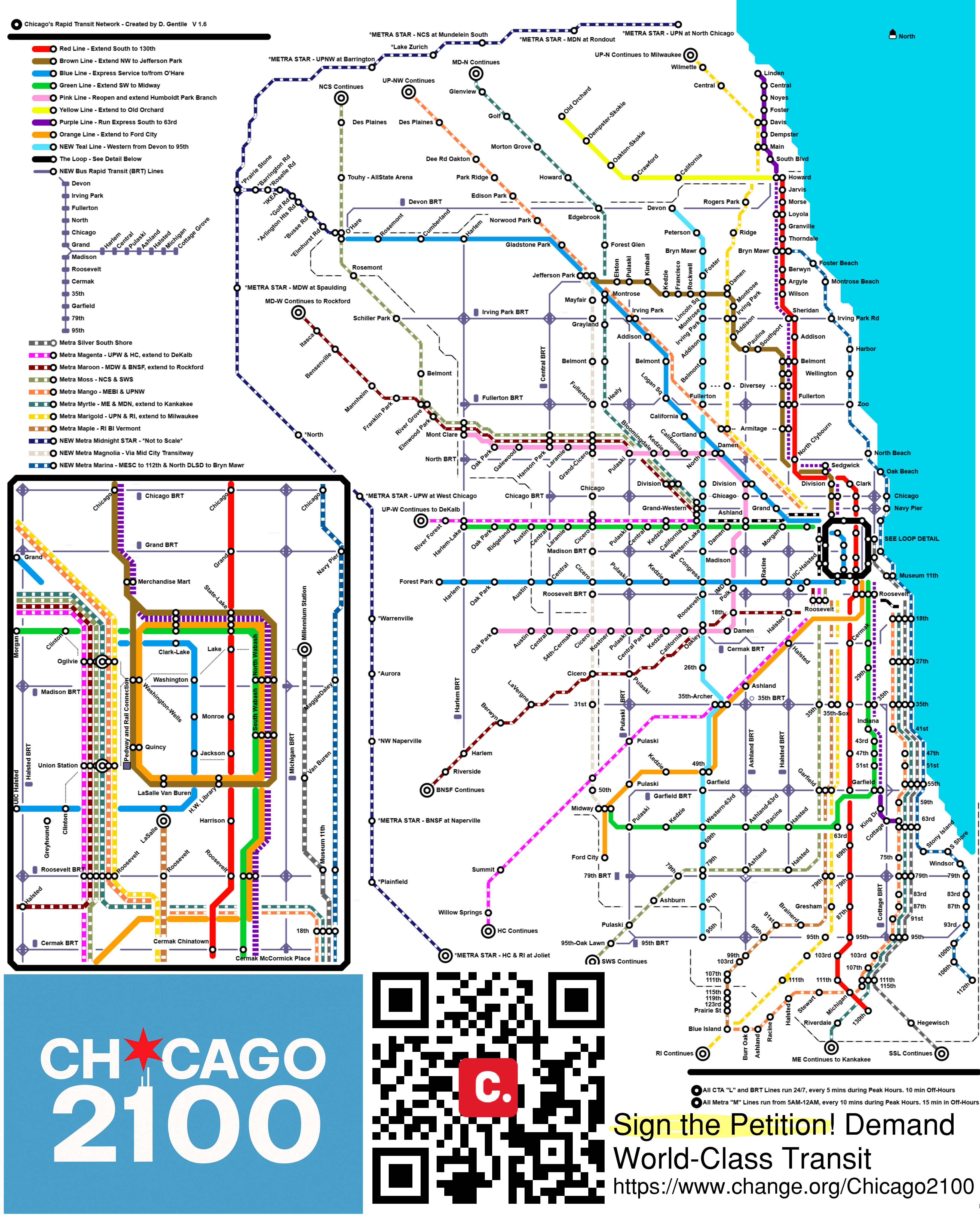
Every addition to the network is an opportunity to increase people’s access to jobs, education, and recreation. The whole city deserves world-class rapid transit. As pictured, CTA should pursue extensions to most “L” lines and promote TOD along them. Similarly, we should leverage our extensive bus network with priority signaling, lanes, and other upgrades, with specific corridors receiving full blown Bus Rapid Transit. Our existing Metra commuter service can be retrofitted to serve city and suburban riders alike, with improved service, infill stations, and through running.
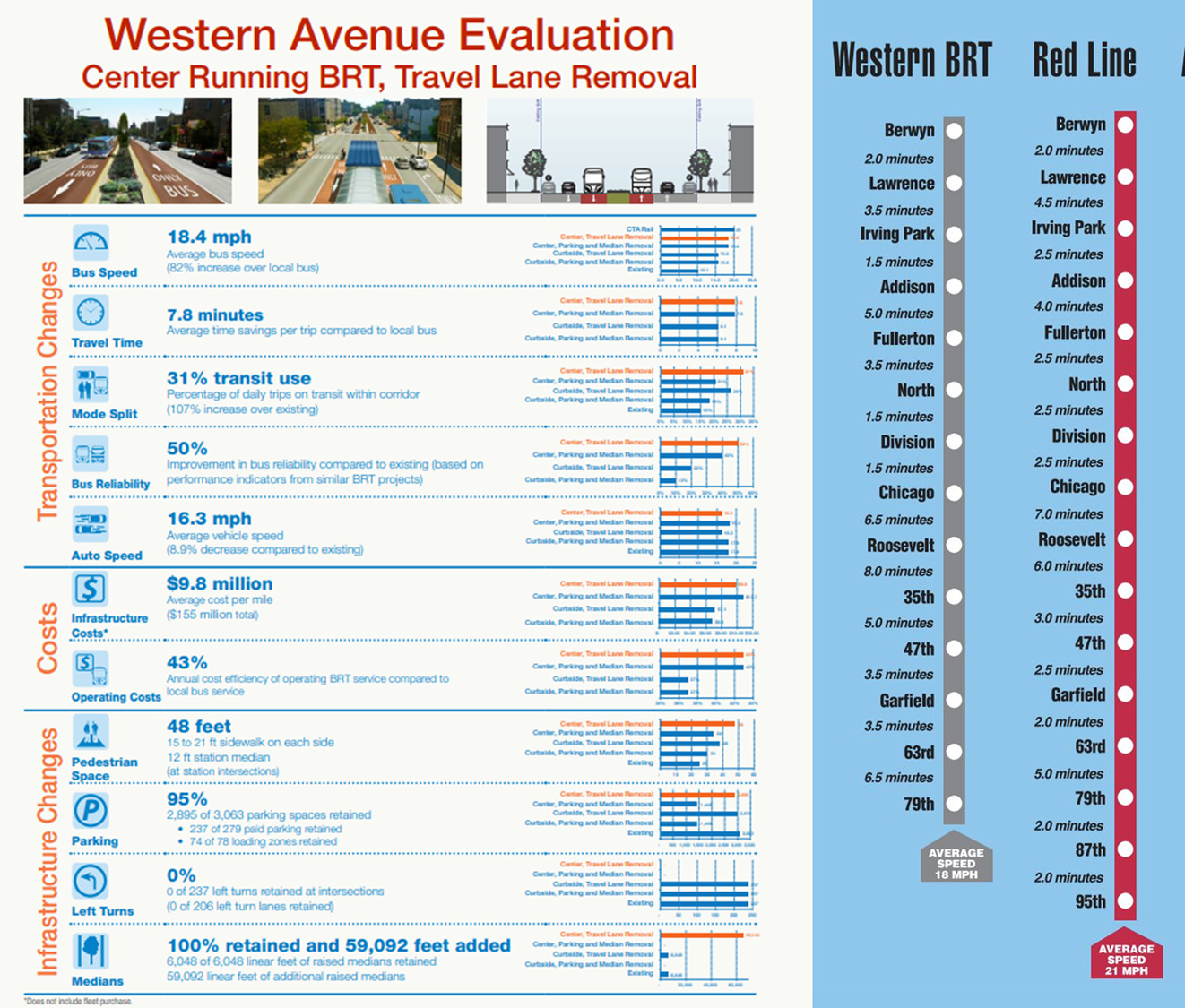
1) Bus Priority: To begin implementation and bridge remaining gaps, bus rapid transit (BRT) with dedicated right-of-way, signal priority, improved station amenities/spacing, is drastically more cost-effective than rail while delivering similar service. A corridor for Ashland avenue already has a conceptual design, and a larger scale proof of concept beyond the existing and well-utilized loop link improvements. This is the least expensive way to add rapid transit quickly, as routes would double bus speeds and reliability. Work is being done to promote the Bus Priority Corridor Study, and particularly Western Avenue as Chicago's first BRT line.
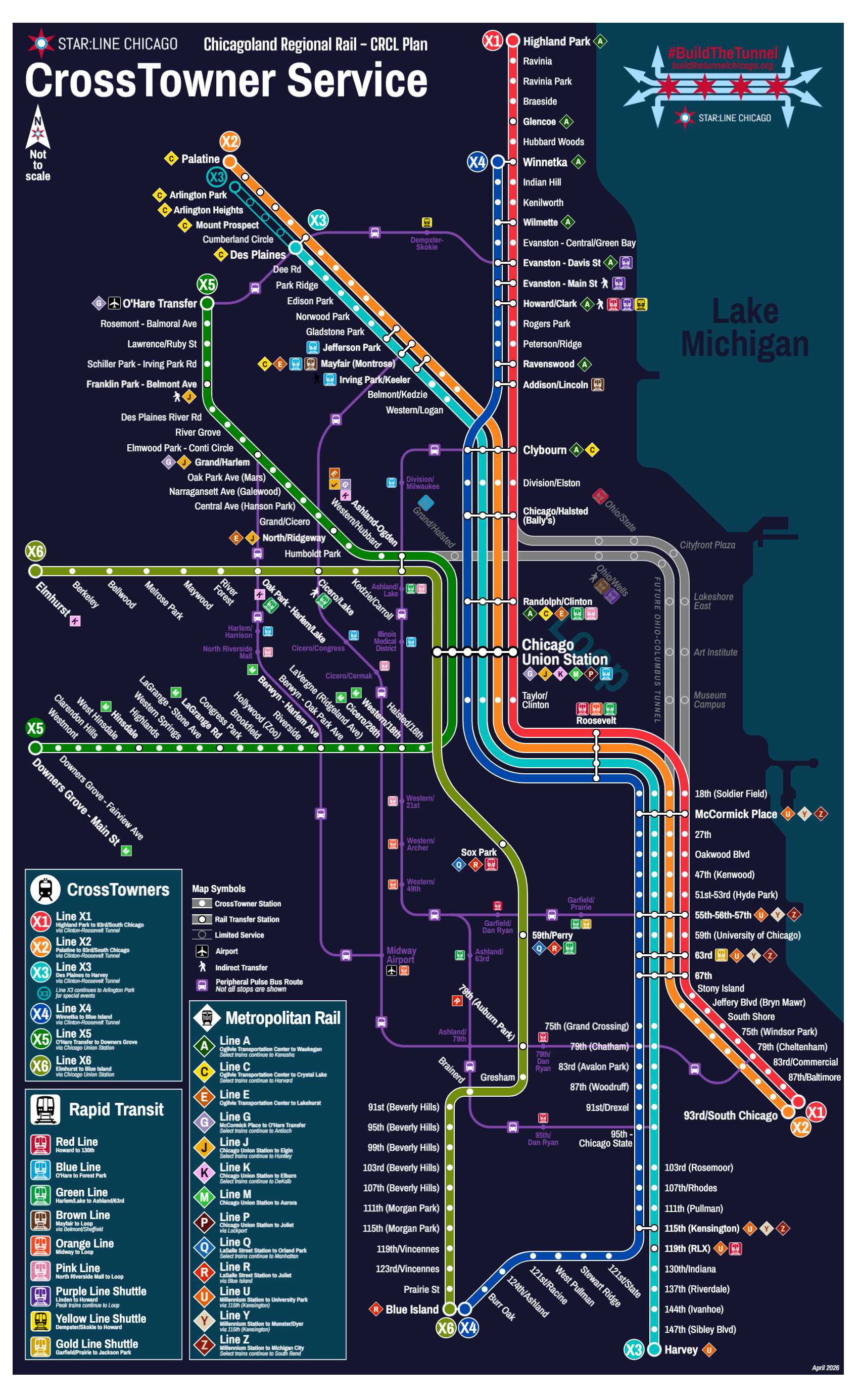
2) Metra Integration: Existing Metra trains are underutilized and under connected for city transport, mainly serving commuters. With new infill stations, comprehensive fare/schedule integration, and improved service, these new crosstown Metra “M” lines would better connect the city with additions to existing infrastructure. Chicago 2100 also includes a once proposed suburban connector STAR (Midnight) and Mid-Transitway (Magnolia), which would run on mostly existing ROW and track. Critical backbone projects to the Metra integration are the A2 flyover, St Charles Air Flyover (SCAL), CHIP (Chicago Hub Improvement), and total electrification. Through-running can be enabled at Union with the mail platforms, but long term a dedicated ROW is needed to facilitate interlined trains every couple minutes. The plan includes building the proposed Clinton-Roosevelt Connector Line (CRCL), featured in StarLine's #BuildTheTunnel connection for regional rail.
3) CTA L Revitalization & Expansion: The current network needs an overhaul. This will be the first task of NITA. Provide reliable service on lines per scheduled, deep clean and facelift at every station (I'm smelling you Clark/Lake subway), and better security at stations (fare gates & random checks, staff monitoring platforms and vehicles, emergency response).
With the creation of a new teal line along western, cross city connections not centered on the loop are convenient. By bringing the pink line to the old Humboldt park alignment, that neighborhood is served and frees up the loop’s capacity. The southside extensions to the green and purple connect currently underserved and underinvested neighborhoods. The brown line connection gives the north side easier O’Hare and NW side connections. The orange and yellow extensions connect malls and further development opportunities. These alignments help connect every neighborhood more succinctly, without every trip going through the loop.
HOW:
There are so many hurdles to a plan like this, and it’s easy to write this off as overly-ambitious. These challenges exist, but peer cities have demonstrated it is doable today. Construction costs of transit nationwide are out of control and must be addressed to make this feasible. Along with institutional capacity for design, the city must reform its contracting and consulting models to avoid costs like the Red Line Extension at almost $1B per mile! This not only makes expansions difficult to pursue with limited resources, but cripples the budget with debt servicing in the long term. Adopting standardization of station designs and agency governance consolidation under NITA are great first steps to mitigate costs. The legislation included great revenue reforms that will ensure service/expansion is funded, but they are inheriting a deteriorating system. There is a huge $20B backlog in deferred maintenance that should be addressed ASAP, and once shown to be capable of routine maintenance, can begin working on expansion efforts.
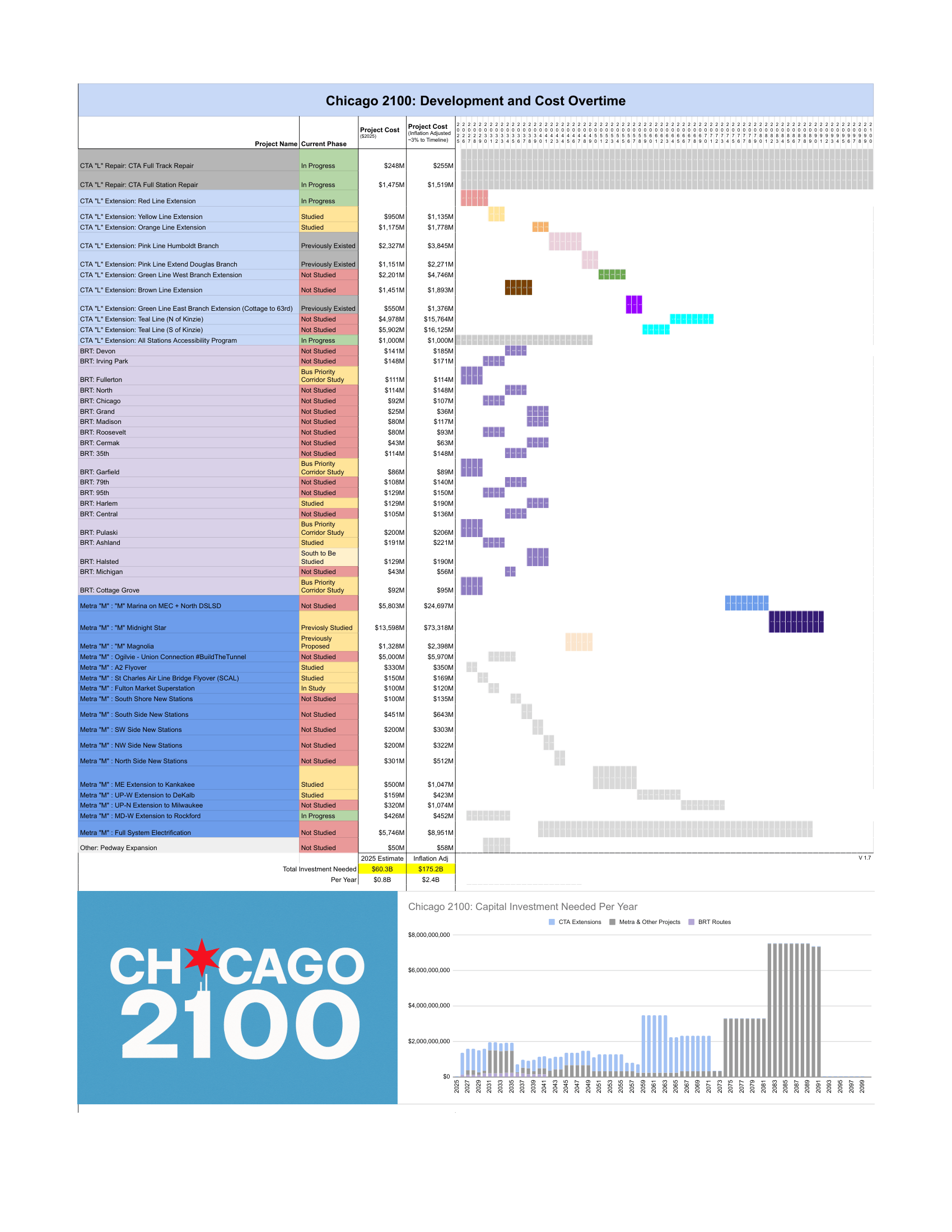
With shown feasibility projections and better cost management, this system could be achieved BEFORE 2100 with capital investment of under $1B/year. This is a fraction of what the state and federal government invest in Illinois road network. Both serve as important transportation infrastructure, but it is time to invest heavily in transit. To put it in perspective, the total estimated cost (2025 $) of $60B is less than our country has wasted bombing and conducting wars that does little to help the average citizen here, while actively killing others abroad. Public transit has been underinvested-in for decades, and now is a shining moment to promote and grow the system. A Chicago-specific study by Argonne National Laboratory determined that every dollar spent on transit produces $13 in economic activity and societal benefit. The best way to fuel the region's economy and prepare for needed future growth is to adopt this transit expansion plan.
Why 2100? We need to dream big, and my goal is to show that in a future after many years of successive investment and development. The projects should be built iteratively, starting with critical connections, Metra enabling projects, and the BRT system, to increase mobility for the best cost. Then work to find large capital sums for larger line extensions, and then new line development.
"A man has made at least a start on discovering the meaning of human life when he plants shade trees under which he knows full well he will never sit." Do what's best for the future of Chicago and the future Chicagoans.
This petition is just the start. If you've read this far, you care about transportation. You probably care about living in a vibrant and livable neighborhood. Maybe you care about bike infrastructure and living in a vibrant community. You don't know it yet, but this is the start to something bigger. The goal of this vision is to inspire action: Volunteer for a candidate you care about, email your current alderman, simply share this link.
The 2027 Chicago city council elections are coming, and that is the next big step for a better future here. I don't need to explain to you why voting is important. What you need to know is there are likeminded candidates for each ward, board seat, and more you get to vote on. Follow this petition and Chicago Growth Project to find out which elected officials will lead this charge and leverage your voice to shape that future.
AND MORE:
The ambition of Chicago 2100’s transit is grand. It shouldn't stop there, we should inspire equally important projects that improve the city’s transit access and livability, such as:
- High Speed Rail Hub: The CHIP and regional development can affirm Chicago’s place as the vibrant center of a Midwest rail system. Shoutout to HSR Alliance for their advocacy.
-Chicago River Enhancement: An extension of the Chicago riverwalk and integration with the wild mile. The whole river should be a clean, beautiful, and natural draw for commerce and recreation. Shoutout to Friends of the Chicago River for their advocacy.
- Rethinking Urban Highways: Redefine the Drive, to create a safer, transit-friendly, and beautiful lakefront. Add caps: Cap the Kennedy and Cap DSLSD in Grant Park
The Human Centered Grid is a concept developed by myself and the Chicago Growth Project. A livable neighborhood requires more than just transit. Being able to access green space, micromobility options, and lively pedestrianized areas should be a staple of every neighborhood.
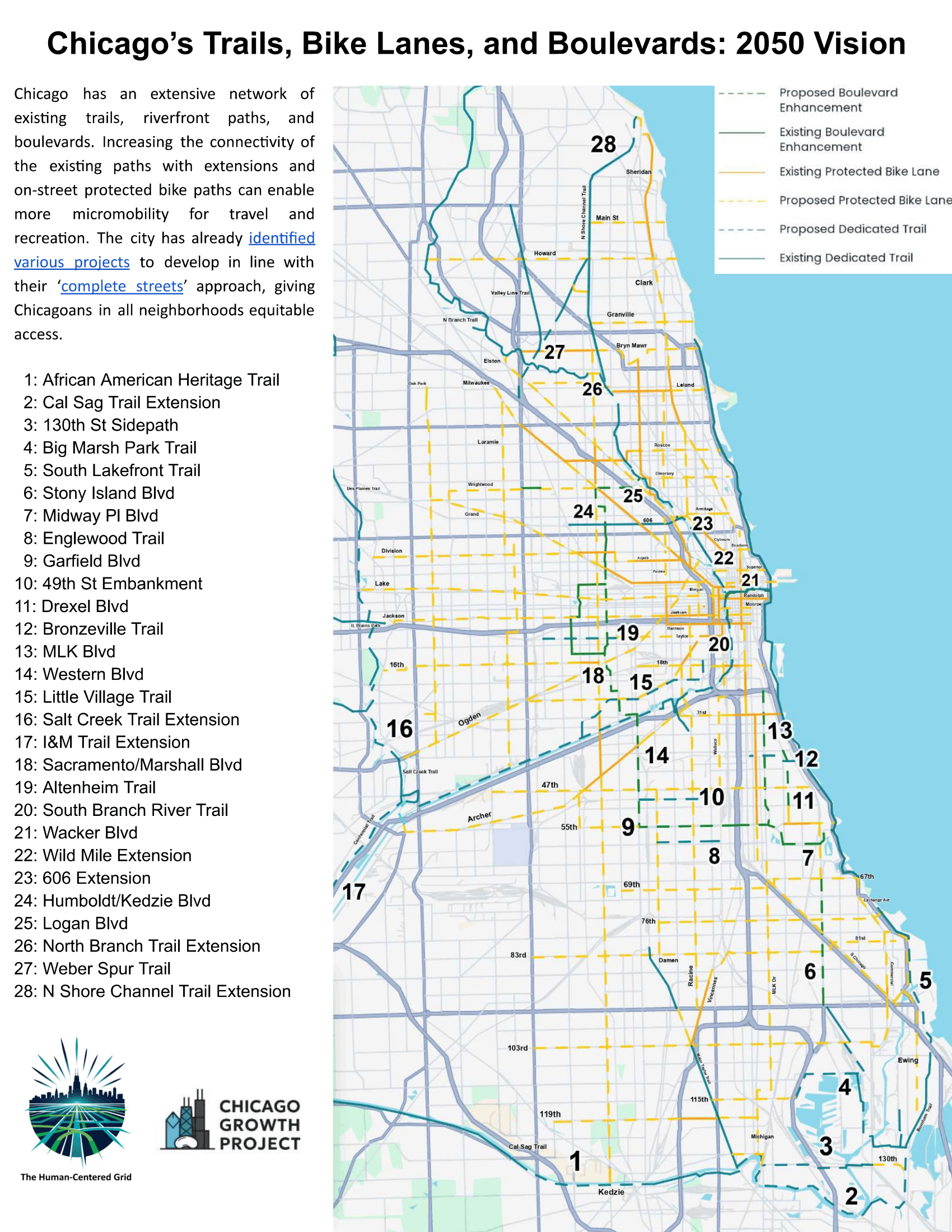
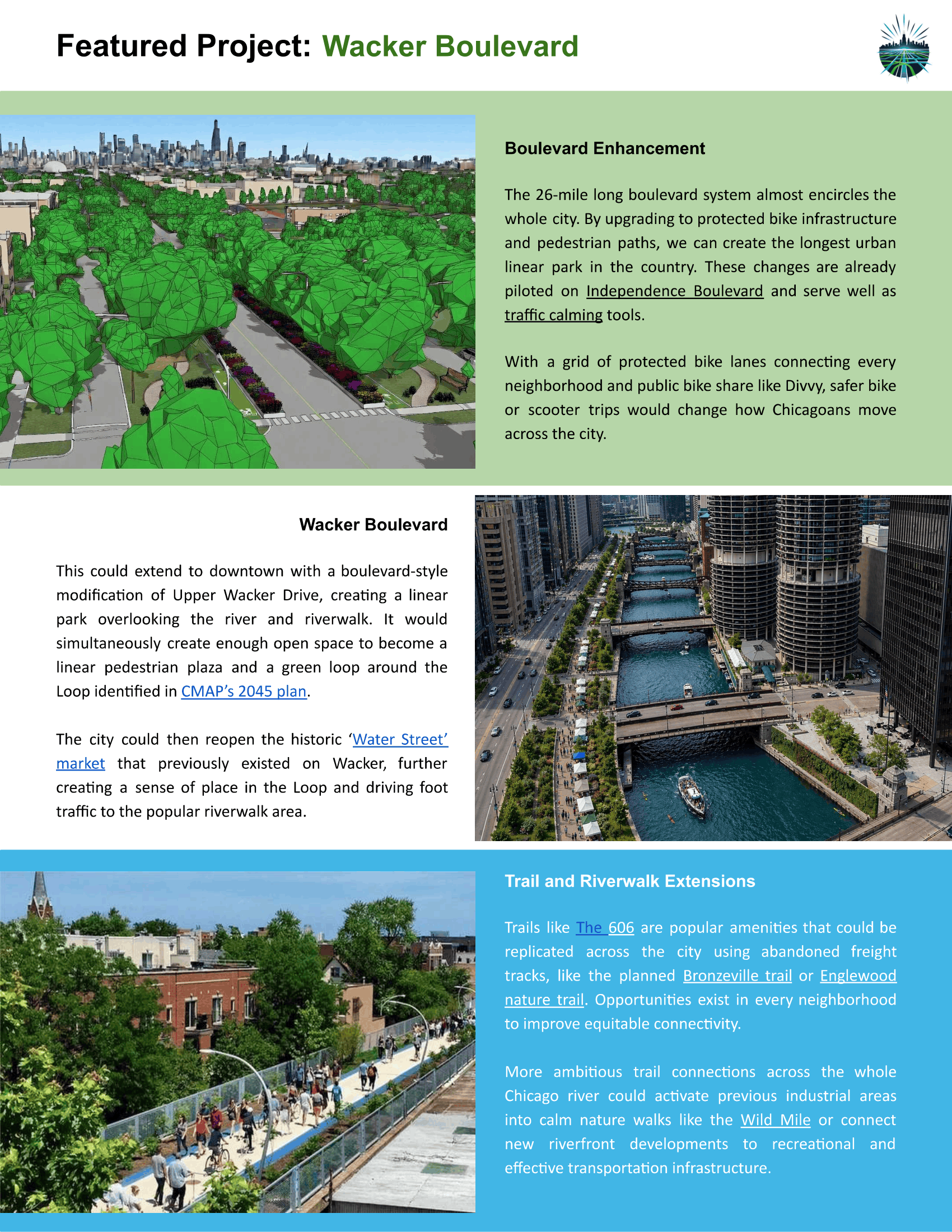
- Trails and Corridors: Wacker Dr Green Belt, 606 extension, Boulevard Enhancement, Englewood Nature Trail, Kenwood rail to trail conversion, and so many more already identified by CDOT. Shoutout to Active Transportation Alliance for their advocacy
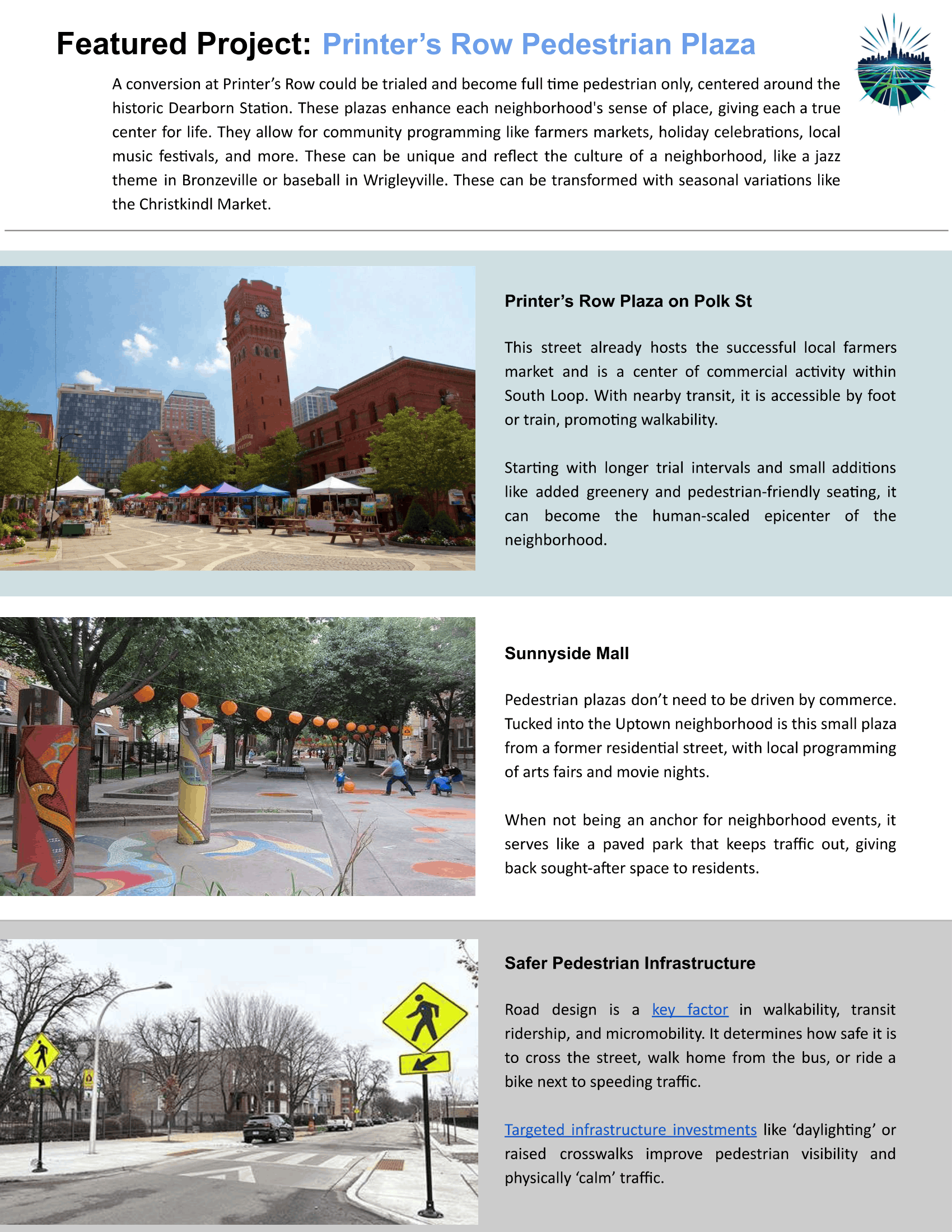
- City-wide Neighborhood Pedestrian/Bike Infrastructure: Curb bump outs, raised crosswalks, lower speed limit, and so much more identified by CDOT. Shoutout to BetterStreetsChicago for their advocacy.
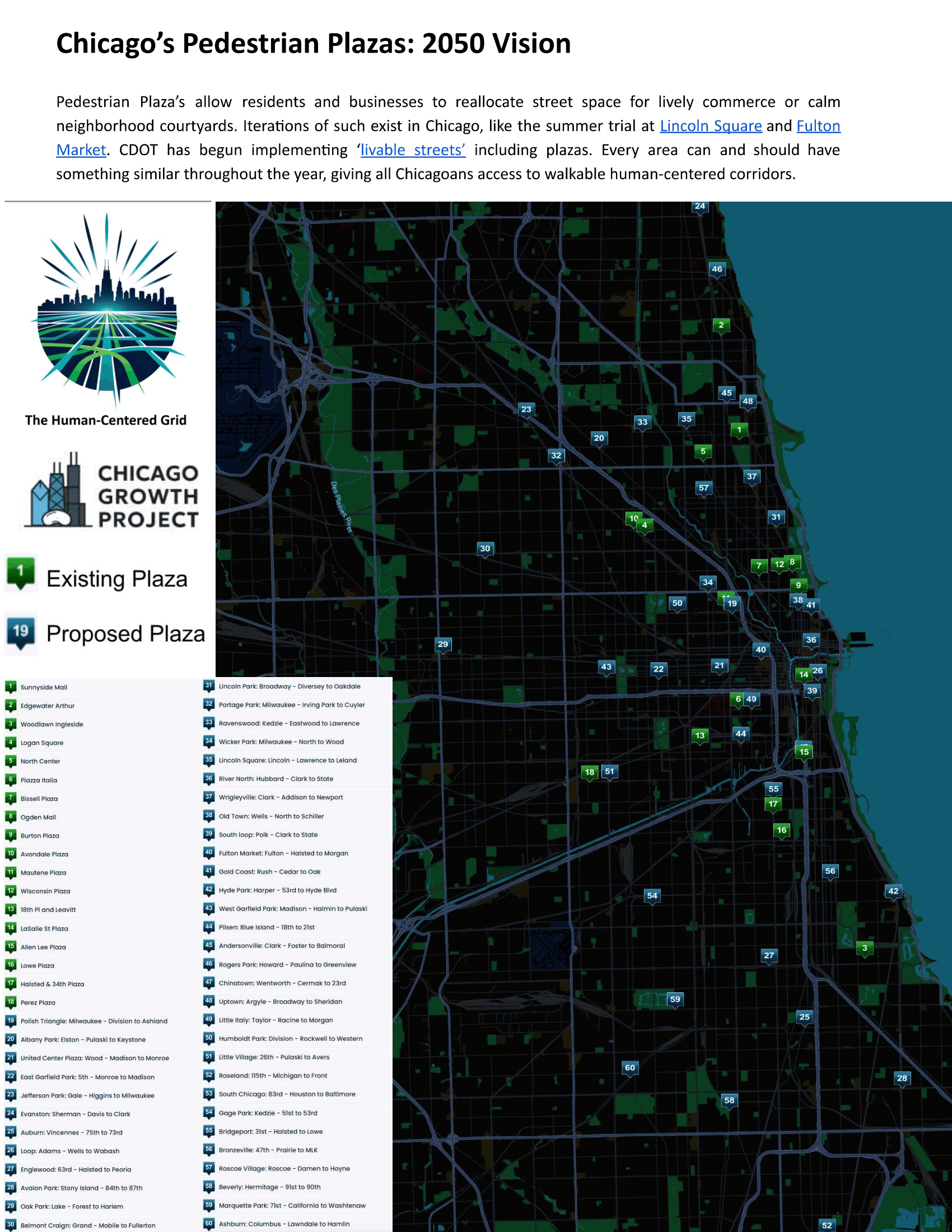
- Neighborhood Pedestrianized Areas: New pedestrian-only streets near rapid transit for business, events, and community would be great gathering places in every area of the city. Examples include the recent Logan Square renovation, and temporary Lincoln Square pedestrianization + other improvements have made those segments the center of community affair.
Please reach out with any constructive suggestions. Shoutout to MetroMapMaker for the web tool, however this inherently limits the design of any suggestions.
Q&A:
1) What is the plan and why support it?
The plan is to save transit from the fiscal cliff in the short term (UPDATE: DONE!). Then promote and grow transit with Chicago 2100 being a map for that. It would add first create new rapid transit corridors in the form of Bus Rapid Transit, fully integrate / infill Metra to create a city-wide network, and feasible extensions to CTA lines. It uses mainly existing infrastructure and historic right-of-ways to connect every neighborhood with fast, reliable, and useful service.
The plan is necessary for the future of Chicago. Public transportation accounts for 1/3 of people's daily commute, so drastic cuts would add traffic and grind the city to a halt. It is the third largest city in the country, and the economic engine of Illinois. The state should invest in the system now and show a bright future, as it is clearly critical public infrastructure. That starts with this petition to engage interest in a world-class transit future. Peer cities have this kind of network now.
Especially as the city approaches other fiscal cliffs with its own debt and pension obligations, it needs to grow its tax-base. To do so, people need to be able to get around the city effectively without a car. How can the city fit more residents - who would rely on a car - if it is already the top 5 traffic-ridden city in the world? With transit-oriented development, more residents can start and frequent more businesses, contribute to our great city, and keep Chicago thriving.
2) What is the fiscal cliff? What will happen to the CTA?
UPDATE: Chicago’s transit just barely overcame a drastic fiscal cliff, now with the passing of Illinois bill SB2111. THANK YOU for helping cross this first crucial step
3) Is this realistic? Where would we ever find the money for this? Do we have the political will?
YES! Peer cities have this level of network now. Of course, construction costs in the US for large projects have ballooned, so that must be addressed. In the richest nation in history, we can find the money to invest in our people, our cities, the lifeblood of our economy. That support needs to come from the state and federal governments, as it is an investment in infrastructure that returns dividends. The system needs to be less restricted by fare revenue input, and should receive levels of funding current road infrastructure does. Chicago and the collar counties give per-capita more in taxes than they receive compared to other IL areas, justifying it as a worthy place to invest.
Tax Increment Financing can be used for project funding. As shown with other projects, increased value of land due to rapid transit access can offset capital costs and can help alleviate any funding issues. The current model within the city keeps added value from property appreciation within the private landholders; which is dependent on its access to the rapid transit built within its vicinity.
Politically, Chicago and Illinois do not have the best reputation. That should not write off investments that are properly managed. With such divisiveness nationally, it would be important for the city to come together and have a clear optimistic vision for the future. Constituents from all parts of Chicagoland should support better public transportation, even if you do not use it. Others would, lessening traffic, increasing economic output, and meet stated sustainability goals.
4) What is on-going to make this reality?
Currently, the Red Purple Modernization completed a phase on the northside to improve service speed and station quality. The next phase is the red line extension to 130th. Other station modernization projects are ongoing.
UPDATE: The CTA has agreed to begin study on several identified corridors for Bus Rapid Transit. A Huge WIN!!!
There is no firm commitment to any other large capital projects that would grow the network. The new NITA needs to adopt a long-term framework, with backing from the city and state.
5) Could this be more flushed out? Are these plans final?
Specific alignments should be more flushed out, but the general layout is what needs to conveyed, the rest is coordinated with detailed engineering work. No plans or lines are final as part of this plan, it is open to change and constructive criticism.
I took inspiration from several previous proposals online, and I think they deserve recognition too. A coalition of likeminded, transit-oriented groups and individuals should come together and put forward a unified plan. I hope Chicago 2100 is it, but want to hear community feedback
6) Ridership has been declining since before Covid and has not recovered to pre-Covid levels, why does a declining system deserve investment?
Yes, ridership has been declining since before Covid for several years, and even in 2025 has not returned to pre-covid levels. This is the reality of our current system, and it must be addressed before expansion. It has been steadily increasing since covid but still below prepandemic levels. Richard Day from A City That Works wrote a great article about this, and so did Ravi Mishra at Illinois Policy. There are several reasons for this decline:
- Commuter-focused system in a region that is more decentralized
- Poor service quality and perception of safety/cleanliness
- Decades of underinvestment
- Growth of rideshare and micro mobility
- CTA Budget Inefficiencies
- Subsidized Car Travel
The current system is commuter-focused, so as the region and greater economy has adapted, less people commute to the loop for work. Work from home has not helped, and suburb-suburb trips are more common for work. With a system that makes it difficult to traverse between neighborhoods, people will find more convenient transportation with their car, or with rideshare and micromobility. Without a well-connected world class network, people only find the current L useful to get to the loop. Therefore, as the demand for loop trips declines, so does ridership. CMAP performed a study on transit trends and concluded this is a critical ridership contributor. The system should look to adopt rapid transit aligned with Chicago 2100 to facilitate more convenient and reliable regional service.
Riders feel like the system has gotten worse, and it has. Track slow zones now account for almost ~25% of mileage, a criminally record-setting high amount that renders the system slow and ineffective. As this increases, ridership decreases. The system has gained notoriety for uncleanliness and safety concerns. Another CMAP study illustrated this decline in quality as well. Other peer cities / regions have better success, from big factors like social safety nets for individuals, to smaller things like available public restrooms.
The network has poorly managed its finances, and with the new bill passing, the governance structure of NITA should focus on budget constraints. When the CTA uses its budget to pay for more overtime than keeping service reliable, we end up with a fiscal cliff of obligations and undermaintained infrastructure.
The system, just like cars, is subsidized by the tax payer. This is a worthy investment in the economic engine of the region. When people can get around faster and easier, they will patronize more businesses and have more time for work and quality of life. Our road network deserves investment too, but currently owning a car is more subsidized with cheap gasoline, free roads and residential street parking, and unmitigated emissions / pollution. This is especially relevant for those who do not own a car and rely heavily on public transportation. The imperative is not to raise costs of owning a car, rather to increase and match that level of investment into transit. Compound overtime the investment in cars and underinvestment in transit and you're left with our system today, where roads are wide and extensive, and transit is decaying.
The city does need to grow, not just out, but up, in tandem with this plan via transit-oriented development. Would grow its tax base to support a world-class system and alleviate the already existing financial woes
7) What is Bus Rapid Transit (BRT)?
BRT is a huge part of this plan because it fits well with Chicago's establish grid and main arterials. It can be many things, but there are existing plans to convert Ashland to BRT. Here, it would be center running bus-only lanes, include a paid entrance for boarding speed, traffic signal priority, ~1/2 mile stop spacing. All bus routes can use lane if passing through. Overall it improves the whole system and connectivity. Side benefit, emergency vehicles can use the lanes and would have better response times.
https://www.transitchicago.com/ashlandbrt/
8) I don't want this ruining my neighborhood
The goal of increasing transit and aligning the city with the future of mass transit is to make every neighborhood better: more vibrant, more accessible, more sustainable. In addition, the plan would prioritize minimization of housing demolition. Proposed line extensions can run elevated above streets or alleys to avoid property demo.
A neighborhood would become more accessible to all Chicagoans with more rapid transit and connectivity. People should not be priced out of their homes, yet it would be hard to imagine Chicago today without many of the lines currently built, which faced the same opposition. Neighborhoods and areas change, often for the better. Stagnation is death in this economy
9) Is this the first long-term expansion idea for Chicago?
No, my petition was heavily inspired by other plans, such as the StarLine Metra proposal, ATA's Transit Future Campaign, and other plans that have circulated online.

1,944
The Issue
Chicago’s public transportation, now led by the Northern Illinois Transit Authority (NITA), has the opportunity to reimagine and shape our future. The 2100 plan is an ambitious network revitalization and expansion that will improve every neighborhood for every Chicagoan. Daniel Burnham's plan shaped this city, and the "Make no little plans" mentality can inspire its future. The city that invented the skyscraper, reversed a whole river, and hosted 2 World Fairs shouldn’t shun away from ambition. Sign this petition to demand the world-class transit system our city deserves.
Chicago 2100 Blog | Full Map PDF | Feasibility Information
WHY:
We need to be bold and truly aspire for something grand to work towards. A commitment to the Chicago 2100 plan would grow transit and the city alike. This is a policy imperative for not only transportation efficiency, but housing affordability, city fiscal sustainability, climate impact reduction, and of public health & safety.
1) Transportation Efficiency: If every trip in Chicago required a car to get around, areas of the city would be at constant gridlock, worsening our 'worlds worst' traffic, even though 25% of households don't own a car. It is a space issue. We need alternatives, and the most efficient way to move people is transit. This is not inherently anti-car, but true freedom in a city is having the choice of what mode you want to travel with, not being forced to use a car for every trip.
2) Housing Affordability: More transit allows more dense housing (like TOD & infill) w/out traffic congestion. A main complaint to new housing, especially denser apartments, is a shortage of parking and traffic. Transit is the answer. Parts of the city are in a deep housing crunch, while others are half vacated. Growth is demand based, and transportation should follow that demand. But it also can spur new development and equitably bring up a divested neighborhood through connectivity and economic activity. Great work is being done by Center for Neighborhood Technology's ETOD research. Housing supply is linked to affordability, so building more housing in areas that are experiencing surging prices is necessary
3) Fiscal Sustainability: The city’s fiscal problems are deep, huge yearly deficits, compounding debt, and unsustainable pension obligations. Without increasing the tax base, the fiscal outlook is grim. Part of the issue is overall government spending, but revenue from taxpayers should increase by growing our population, not raising taxes and continuing the capital flight the state has seen. By supporting a larger population, we can outpace tax revenue growth and reduce the burden. Transit is not a cheap investment, but it is a driver of economic activity and growth that we should leverage to spur housing, business, and recreation.
4) Climate: Public transit is well documented to reduce carbon emissions & driving pollution / capita. It not only reduces the footprint of transportation, but enables denser cities. Building up here means less sprawl, displacement of natural habitat for critical species. Increased walkability of the city via transit and density can reduce the need for a 3 ton vehicle to drive 5 minutes to the store, simultaneously improving health outcomes by building in a baseline level of activity into peoples lives.
5) Health: Death by car is startlingly common and democratic. It is the #1 leading cause of death in the US for those between 1-44 years old. Over 39,000+ funerals a year in the US, because the majority of our cities are designed to accommodate and crowd out any other form of transport. Car crashes cause a significant number of life altering injuries, burdensome medical costs, and lost productivity. To add insult to injury, car congestion directly destroys our air, causing at least 50% of the pollution in cities. Tailpipe emissions are disturbingly carcinogenic, contributing to a higher rate of respiratory illness and death. There are a litany of other underdiscussed negative externalities: elevated noise pollution, storm water excess runoff, microplastic particles, and manufacturing / oil extraction pollutants. It is time to reimagine our transportation network towards a more sustainable, safer network to end these appalling statistics.
WHAT:
Chicago 2100 calls for the city to improve, integrate, and expand the network. Before any expansion, the notorious reputation for cleanliness, safety, and unreliable service must be addressed. Raising the standards of service to be clean, reliable, and safe are not aspirational. It is a clear lack of accountability and transparency that needs to be fixed. With new management and accountability procedures, we can work towards solving miles of slow zones and deferred maintenance to revitalize before expanding. For the sake of transportation that Chicagoans can rely on, the new NITA management needs to build trust that it can execute upgrades to make the system respectable.
Every addition to the network is an opportunity to increase people’s access to jobs, education, and recreation. The whole city deserves world-class rapid transit. As pictured, CTA should pursue extensions to most “L” lines and promote TOD along them. Similarly, we should leverage our extensive bus network with priority signaling, lanes, and other upgrades, with specific corridors receiving full blown Bus Rapid Transit. Our existing Metra commuter service can be retrofitted to serve city and suburban riders alike, with improved service, infill stations, and through running.
1) Bus Priority: To begin implementation and bridge remaining gaps, bus rapid transit (BRT) with dedicated right-of-way, signal priority, improved station amenities/spacing, is drastically more cost-effective than rail while delivering similar service. A corridor for Ashland avenue already has a conceptual design, and a larger scale proof of concept beyond the existing and well-utilized loop link improvements. This is the least expensive way to add rapid transit quickly, as routes would double bus speeds and reliability. Work is being done to promote the Bus Priority Corridor Study, and particularly Western Avenue as Chicago's first BRT line.
2) Metra Integration: Existing Metra trains are underutilized and under connected for city transport, mainly serving commuters. With new infill stations, comprehensive fare/schedule integration, and improved service, these new crosstown Metra “M” lines would better connect the city with additions to existing infrastructure. Chicago 2100 also includes a once proposed suburban connector STAR (Midnight) and Mid-Transitway (Magnolia), which would run on mostly existing ROW and track. Critical backbone projects to the Metra integration are the A2 flyover, St Charles Air Flyover (SCAL), CHIP (Chicago Hub Improvement), and total electrification. Through-running can be enabled at Union with the mail platforms, but long term a dedicated ROW is needed to facilitate interlined trains every couple minutes. The plan includes building the proposed Clinton-Roosevelt Connector Line (CRCL), featured in StarLine's #BuildTheTunnel connection for regional rail.
3) CTA L Revitalization & Expansion: The current network needs an overhaul. This will be the first task of NITA. Provide reliable service on lines per scheduled, deep clean and facelift at every station (I'm smelling you Clark/Lake subway), and better security at stations (fare gates & random checks, staff monitoring platforms and vehicles, emergency response).
With the creation of a new teal line along western, cross city connections not centered on the loop are convenient. By bringing the pink line to the old Humboldt park alignment, that neighborhood is served and frees up the loop’s capacity. The southside extensions to the green and purple connect currently underserved and underinvested neighborhoods. The brown line connection gives the north side easier O’Hare and NW side connections. The orange and yellow extensions connect malls and further development opportunities. These alignments help connect every neighborhood more succinctly, without every trip going through the loop.
HOW:
There are so many hurdles to a plan like this, and it’s easy to write this off as overly-ambitious. These challenges exist, but peer cities have demonstrated it is doable today. Construction costs of transit nationwide are out of control and must be addressed to make this feasible. Along with institutional capacity for design, the city must reform its contracting and consulting models to avoid costs like the Red Line Extension at almost $1B per mile! This not only makes expansions difficult to pursue with limited resources, but cripples the budget with debt servicing in the long term. Adopting standardization of station designs and agency governance consolidation under NITA are great first steps to mitigate costs. The legislation included great revenue reforms that will ensure service/expansion is funded, but they are inheriting a deteriorating system. There is a huge $20B backlog in deferred maintenance that should be addressed ASAP, and once shown to be capable of routine maintenance, can begin working on expansion efforts.
With shown feasibility projections and better cost management, this system could be achieved BEFORE 2100 with capital investment of under $1B/year. This is a fraction of what the state and federal government invest in Illinois road network. Both serve as important transportation infrastructure, but it is time to invest heavily in transit. To put it in perspective, the total estimated cost (2025 $) of $60B is less than our country has wasted bombing and conducting wars that does little to help the average citizen here, while actively killing others abroad. Public transit has been underinvested-in for decades, and now is a shining moment to promote and grow the system. A Chicago-specific study by Argonne National Laboratory determined that every dollar spent on transit produces $13 in economic activity and societal benefit. The best way to fuel the region's economy and prepare for needed future growth is to adopt this transit expansion plan.
Why 2100? We need to dream big, and my goal is to show that in a future after many years of successive investment and development. The projects should be built iteratively, starting with critical connections, Metra enabling projects, and the BRT system, to increase mobility for the best cost. Then work to find large capital sums for larger line extensions, and then new line development.
"A man has made at least a start on discovering the meaning of human life when he plants shade trees under which he knows full well he will never sit." Do what's best for the future of Chicago and the future Chicagoans.
This petition is just the start. If you've read this far, you care about transportation. You probably care about living in a vibrant and livable neighborhood. Maybe you care about bike infrastructure and living in a vibrant community. You don't know it yet, but this is the start to something bigger. The goal of this vision is to inspire action: Volunteer for a candidate you care about, email your current alderman, simply share this link.
The 2027 Chicago city council elections are coming, and that is the next big step for a better future here. I don't need to explain to you why voting is important. What you need to know is there are likeminded candidates for each ward, board seat, and more you get to vote on. Follow this petition and Chicago Growth Project to find out which elected officials will lead this charge and leverage your voice to shape that future.
AND MORE:
The ambition of Chicago 2100’s transit is grand. It shouldn't stop there, we should inspire equally important projects that improve the city’s transit access and livability, such as:
- High Speed Rail Hub: The CHIP and regional development can affirm Chicago’s place as the vibrant center of a Midwest rail system. Shoutout to HSR Alliance for their advocacy.
-Chicago River Enhancement: An extension of the Chicago riverwalk and integration with the wild mile. The whole river should be a clean, beautiful, and natural draw for commerce and recreation. Shoutout to Friends of the Chicago River for their advocacy.
- Rethinking Urban Highways: Redefine the Drive, to create a safer, transit-friendly, and beautiful lakefront. Add caps: Cap the Kennedy and Cap DSLSD in Grant Park
The Human Centered Grid is a concept developed by myself and the Chicago Growth Project. A livable neighborhood requires more than just transit. Being able to access green space, micromobility options, and lively pedestrianized areas should be a staple of every neighborhood.
- Trails and Corridors: Wacker Dr Green Belt, 606 extension, Boulevard Enhancement, Englewood Nature Trail, Kenwood rail to trail conversion, and so many more already identified by CDOT. Shoutout to Active Transportation Alliance for their advocacy
- City-wide Neighborhood Pedestrian/Bike Infrastructure: Curb bump outs, raised crosswalks, lower speed limit, and so much more identified by CDOT. Shoutout to BetterStreetsChicago for their advocacy.
- Neighborhood Pedestrianized Areas: New pedestrian-only streets near rapid transit for business, events, and community would be great gathering places in every area of the city. Examples include the recent Logan Square renovation, and temporary Lincoln Square pedestrianization + other improvements have made those segments the center of community affair.
Please reach out with any constructive suggestions. Shoutout to MetroMapMaker for the web tool, however this inherently limits the design of any suggestions.
Q&A:
1) What is the plan and why support it?
The plan is to save transit from the fiscal cliff in the short term (UPDATE: DONE!). Then promote and grow transit with Chicago 2100 being a map for that. It would add first create new rapid transit corridors in the form of Bus Rapid Transit, fully integrate / infill Metra to create a city-wide network, and feasible extensions to CTA lines. It uses mainly existing infrastructure and historic right-of-ways to connect every neighborhood with fast, reliable, and useful service.
The plan is necessary for the future of Chicago. Public transportation accounts for 1/3 of people's daily commute, so drastic cuts would add traffic and grind the city to a halt. It is the third largest city in the country, and the economic engine of Illinois. The state should invest in the system now and show a bright future, as it is clearly critical public infrastructure. That starts with this petition to engage interest in a world-class transit future. Peer cities have this kind of network now.
Especially as the city approaches other fiscal cliffs with its own debt and pension obligations, it needs to grow its tax-base. To do so, people need to be able to get around the city effectively without a car. How can the city fit more residents - who would rely on a car - if it is already the top 5 traffic-ridden city in the world? With transit-oriented development, more residents can start and frequent more businesses, contribute to our great city, and keep Chicago thriving.
2) What is the fiscal cliff? What will happen to the CTA?
UPDATE: Chicago’s transit just barely overcame a drastic fiscal cliff, now with the passing of Illinois bill SB2111. THANK YOU for helping cross this first crucial step
3) Is this realistic? Where would we ever find the money for this? Do we have the political will?
YES! Peer cities have this level of network now. Of course, construction costs in the US for large projects have ballooned, so that must be addressed. In the richest nation in history, we can find the money to invest in our people, our cities, the lifeblood of our economy. That support needs to come from the state and federal governments, as it is an investment in infrastructure that returns dividends. The system needs to be less restricted by fare revenue input, and should receive levels of funding current road infrastructure does. Chicago and the collar counties give per-capita more in taxes than they receive compared to other IL areas, justifying it as a worthy place to invest.
Tax Increment Financing can be used for project funding. As shown with other projects, increased value of land due to rapid transit access can offset capital costs and can help alleviate any funding issues. The current model within the city keeps added value from property appreciation within the private landholders; which is dependent on its access to the rapid transit built within its vicinity.
Politically, Chicago and Illinois do not have the best reputation. That should not write off investments that are properly managed. With such divisiveness nationally, it would be important for the city to come together and have a clear optimistic vision for the future. Constituents from all parts of Chicagoland should support better public transportation, even if you do not use it. Others would, lessening traffic, increasing economic output, and meet stated sustainability goals.
4) What is on-going to make this reality?
Currently, the Red Purple Modernization completed a phase on the northside to improve service speed and station quality. The next phase is the red line extension to 130th. Other station modernization projects are ongoing.
UPDATE: The CTA has agreed to begin study on several identified corridors for Bus Rapid Transit. A Huge WIN!!!
There is no firm commitment to any other large capital projects that would grow the network. The new NITA needs to adopt a long-term framework, with backing from the city and state.
5) Could this be more flushed out? Are these plans final?
Specific alignments should be more flushed out, but the general layout is what needs to conveyed, the rest is coordinated with detailed engineering work. No plans or lines are final as part of this plan, it is open to change and constructive criticism.
I took inspiration from several previous proposals online, and I think they deserve recognition too. A coalition of likeminded, transit-oriented groups and individuals should come together and put forward a unified plan. I hope Chicago 2100 is it, but want to hear community feedback
6) Ridership has been declining since before Covid and has not recovered to pre-Covid levels, why does a declining system deserve investment?
Yes, ridership has been declining since before Covid for several years, and even in 2025 has not returned to pre-covid levels. This is the reality of our current system, and it must be addressed before expansion. It has been steadily increasing since covid but still below prepandemic levels. Richard Day from A City That Works wrote a great article about this, and so did Ravi Mishra at Illinois Policy. There are several reasons for this decline:
- Commuter-focused system in a region that is more decentralized
- Poor service quality and perception of safety/cleanliness
- Decades of underinvestment
- Growth of rideshare and micro mobility
- CTA Budget Inefficiencies
- Subsidized Car Travel
The current system is commuter-focused, so as the region and greater economy has adapted, less people commute to the loop for work. Work from home has not helped, and suburb-suburb trips are more common for work. With a system that makes it difficult to traverse between neighborhoods, people will find more convenient transportation with their car, or with rideshare and micromobility. Without a well-connected world class network, people only find the current L useful to get to the loop. Therefore, as the demand for loop trips declines, so does ridership. CMAP performed a study on transit trends and concluded this is a critical ridership contributor. The system should look to adopt rapid transit aligned with Chicago 2100 to facilitate more convenient and reliable regional service.
Riders feel like the system has gotten worse, and it has. Track slow zones now account for almost ~25% of mileage, a criminally record-setting high amount that renders the system slow and ineffective. As this increases, ridership decreases. The system has gained notoriety for uncleanliness and safety concerns. Another CMAP study illustrated this decline in quality as well. Other peer cities / regions have better success, from big factors like social safety nets for individuals, to smaller things like available public restrooms.
The network has poorly managed its finances, and with the new bill passing, the governance structure of NITA should focus on budget constraints. When the CTA uses its budget to pay for more overtime than keeping service reliable, we end up with a fiscal cliff of obligations and undermaintained infrastructure.
The system, just like cars, is subsidized by the tax payer. This is a worthy investment in the economic engine of the region. When people can get around faster and easier, they will patronize more businesses and have more time for work and quality of life. Our road network deserves investment too, but currently owning a car is more subsidized with cheap gasoline, free roads and residential street parking, and unmitigated emissions / pollution. This is especially relevant for those who do not own a car and rely heavily on public transportation. The imperative is not to raise costs of owning a car, rather to increase and match that level of investment into transit. Compound overtime the investment in cars and underinvestment in transit and you're left with our system today, where roads are wide and extensive, and transit is decaying.
The city does need to grow, not just out, but up, in tandem with this plan via transit-oriented development. Would grow its tax base to support a world-class system and alleviate the already existing financial woes
7) What is Bus Rapid Transit (BRT)?
BRT is a huge part of this plan because it fits well with Chicago's establish grid and main arterials. It can be many things, but there are existing plans to convert Ashland to BRT. Here, it would be center running bus-only lanes, include a paid entrance for boarding speed, traffic signal priority, ~1/2 mile stop spacing. All bus routes can use lane if passing through. Overall it improves the whole system and connectivity. Side benefit, emergency vehicles can use the lanes and would have better response times.
https://www.transitchicago.com/ashlandbrt/
8) I don't want this ruining my neighborhood
The goal of increasing transit and aligning the city with the future of mass transit is to make every neighborhood better: more vibrant, more accessible, more sustainable. In addition, the plan would prioritize minimization of housing demolition. Proposed line extensions can run elevated above streets or alleys to avoid property demo.
A neighborhood would become more accessible to all Chicagoans with more rapid transit and connectivity. People should not be priced out of their homes, yet it would be hard to imagine Chicago today without many of the lines currently built, which faced the same opposition. Neighborhoods and areas change, often for the better. Stagnation is death in this economy
9) Is this the first long-term expansion idea for Chicago?
No, my petition was heavily inspired by other plans, such as the StarLine Metra proposal, ATA's Transit Future Campaign, and other plans that have circulated online.
The Decision Makers


Supporter Voices
Petition Updates
Share this petition
Petition created on October 28, 2025