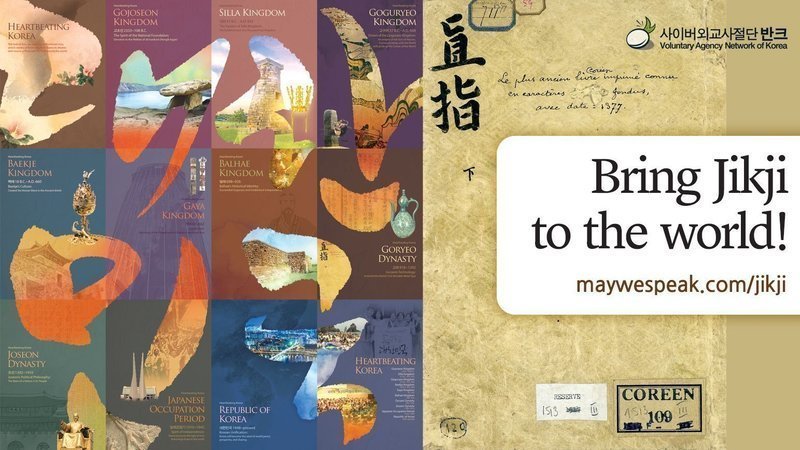
Bring Jikji to the world!
The Issue
Have you heard of Jikji?
(description available in English, Korean and French)
Jikji was printed in 1377 at Heungdeoksa Temple in Cheongju, Korea during the Goryeo dynasty (918~1392), and is the world's oldest existing book printed with movable metal type.
Jikji was listed in the UNESCO Memory of the World Register on September 4th, 2001.
In order to be listed in the UNESCO Memory of the World Register
it is required to have integrity, originality, and irreplaceability,
have the global importance in time, venue, human, subject, and theme value,
and to be a case that contributes to the emotional attachment of a particular community to the records, or to the current communal identity and social cohesion.
UNESCO decided to register Jikji as it meets this standard,
and the reasons for registration are as follows:
"Jikji is the world's oldest existing book printed with movable metal type that has had a great influence on the spread of printing culture and human history.
Accordingly, it was recognized as a documentary heritage that had a worldwide influence, and currently only one copy is kept in France, so the rarity was largely considered in its selection as a UNESCO Memory of the World.
In addition, Jikji and the Gutenberg Bibles are the world's oldest surviving Eastern-Western book printed with movable metal types, the greatest heritage that has revolutionized the documentary culture of humankind. It was recommended to be listed in the spirit of the UNESCO Memory of the World Programme."
Where can we meet Jikji, a rare Memory of the World that has had global influence?
At this moment, we cannot directly meet the human experience and anguish embodied in Jikji.
The National Library of France, (Bibliothèque nationale de France, BnF) does not allow Jikji to be exhibited anywhere in the world, and Jikji is kept in its storage without being exhibited at the BnF.
Jikji, created in the Goryeo Dynasty in Korea, was brought to France by French diplomat Victor Collin de Plancy at the end of the 19th century, and was later sold to a collector and was donated to the BnF.
What is all known about Jikji is that in 1972, Dr. Park Byeongseon, a researcher at BnF found Jikji, which was mixed with books from other countries, and was submitted to a book fair held in Paris.
France is completely blocking the opportunity for the humanity to encounter Jikji, to learn from it, and to lead to new challenges and creativity.
We want to properly study the value of Jikji, a UNESCO Memory of the World, and as a future generation, we want to learn and engage in creative activities.
Furthermore, in consideration of the emotional attachment that Koreans have to the record of Jikji and the fact that Jikji contributes to the formation of the identity of the Korean community, we believe that it is necessary to keep and properly study it in Korea.
Therefore, we request the French Government and the BnF of the following:
First, the French government and the BnF should properly study and display Jikji.
Second, France should return or lend Jikji to Korea so that Koreans can encounter and understand the roots of their culture.
For more information about Jikji, please visit Jikji English web site
(한국어)
직지를 아시나요?
직지는 1377년 한국 고려시대(918~1392) 청주 흥덕사에서 인쇄된
현존하는 세계 최초 금속활자본입니다.
직지는 2001년 9월4일 유네스코 세계기록유산으로 등재되었습니다.
세계 기록 유산으로 지정되기 위해서는
진정성, 독창성, 대체불가능성을 요구하며,
시간, 장소, 사람, 대상, 주제적으로 세계적 중요성을 가지며,
특정 공동체가 기록물에 갖는 정서적 애착이나 현재시점의 공동체 정체성과 사회적 응집에 기여하는 경우일 것을 요합니다.
유네스코는 직지가 이 기준에 부합한다고 보아 등재를 결정하였으며,
등재 이유를 다음과 같이 밝힙니다.
“현존 세계 최고(最古) 금속활자본으로 인쇄문화 전파와 인류역사에 큰 영향을 주었다.
이에 세계적인 영향력을 준 기록유산으로 인정하게 되었고, 현재 프랑스에 단 한권만 보관되어 희귀성이 유네스코 기록유산으로 선정하는 데 크게 고려되었다.
아울러 직지와 구텐베르크 성서는 현존하는 세계에서 가장 오래된 동서양 금속 활자본으로 인류의 기록문화를 혁신적으로 바꾼 최대의 유산이다. 유네스코 기록유산 사업의 정신에 입각하여 등재를 권고한 것이다.”
우리는 세계적인 영향력을 준 희귀한 세계기록유산인 직지를 어디서 만나볼 수 있을까요?
우리는 현재, 직지에 담긴 인간의 경험과 고뇌를 직접 만나볼 수 없습니다.
프랑스 국립도서관은, 세계 어느 곳에서도 직지의 전시를 허용하지 않고, 국립도서관에서도 전시하지 않은 채 수장고에 보관하고 있습니다.
한국 고려시대 제작된 직지를 19세기 말 프랑스 외교관 빅토르 콜랭 드 플랑시가 프랑스로 가져갔고, 이후 수집가에 팔렸다가 프랑스 국립도서관에 기증되었고,
1972년 프랑스 국립도서관 연구원이었던 한국인 박병선 박사가 다른 나라 서적과 함께 섞여 있던 직지를 발견하고, 도서전에 출품된 것이 알려진 전부입니다.
프랑스는 세계기록유산을 인류가 직지를 접하고, 그로부터 배우고, 새로운 도전과 창조로 이어질 기회를 완전히 봉쇄하고 있는 것입니다.
우리는 세계기록유산인 직지의 가치를 제대로 연구하고, 미래세대로서 그로부터 배우고, 창조적인 활동을 하고 싶습니다.
더 나아가 한국인들이 직지라는 기록물에 갖는 정서적 애착이나, 직지가 한국 공동체의 정체성 형성에 기여하는 점을 고려하여, 한국에서 보관하고 제대로 연구할 필요가 있다고 생각합니다.
따라서, 우리는 프랑스 정부와 프랑스 국립도서관에 다음과 같이 요구합니다.
하나, 프랑스 정부와 프랑스 국립도서관은 직지를 제대로 연구하고 전시하라.
하나, 프랑스는 한국인들이 그들 문화의 뿌리를 접하고 이해할 수 있도록 직지를 한국에 반환하거나 대여하라.
직지에 대해 더 알고 싶으시다면 직지, 우리가 한국문화유산홍보대사 홈페이지를 참고해 주세요.
(français)
Faites connaître Jikji au monde entier !
Avez-vous entendu parler du Jikji ?
Le Jikji a été imprimé en 1377 au temple Heungdeoksa de Cheongju, en Corée, pendant la dynastie Goryeo (918~1392). C'est le livre existant le plus ancien au monde imprimé avec des caractères métalliques mobiles.
Le Jikji a été inscrit au registre "Mémoire du monde" de l'UNESCO le 4 septembre 2001.
Pour être inscrit au registre "Mémoire du monde" de l'UNESCO, le Jikji doit être intègre, original et irremplaçable. Il doit avoir une importance mondiale en termes de temps, de lieu, de valeur humaine, et être un document qui contribue à l'attachement émotionnel d'une communauté particulière ou à l'identité communautaire et à la cohésion sociale.
L'UNESCO a décidé d'enregistrer le Jikji car il répond à cette norme, et les raisons de cet enregistrement sont les suivantes :
« Le Jikji est le plus ancien livre connu comme ayant été imprimé à l'aide de caractères métalliques mobiles qui a eu une grande influence sur la diffusion de la culture de l'imprimerie et de l'histoire humaine.
En conséquence, il a été reconnu comme un patrimoine documentaire qui a eu une influence mondiale, et actuellement un seul exemplaire est conservé en France, de sorte que cette rareté a été largement prise en compte dans sa sélection comme Mémoire du monde de l'UNESCO »
En outre, le Jikji et les Bibles de Gutenberg sont les plus anciens livres au monde imprimés avec des caractères métalliques mobiles, le plus grand héritage qui a révolutionné la culture documentaire de l'humanité.
Il a été recommandé de les inscrire dans l'esprit du programme "Mémoire du monde" de l'UNESCO.
Où pouvons-nous rencontrer Jikji, une rare mémoire du monde qui a eu une influence mondiale ?
En ce moment, nous ne pouvons pas voir directement le Jikji.
La Bibliothèque nationale de France (BnF) n'autorise pas l'exposition du Jikji et il est conservé dans la réserve sans être exposé aux yeux du monde.
Le Jikji, créé sous la dynastie Goryeo en Corée, a été introduit en France par le diplomate français Victor Collin de Plancy à la fin du XIXe siècle, puis vendu à un collectionneur et donné à la BnF.
Ce que l'on sait de Jikji est qu'en 1972, le Dr Park Byeongseon, chercheuse à la BnF, a trouvé le Jikji, qui a été mélangé à des livres d'autres pays, et a été soumis à une foire du livre qui s'est tenue à Paris.
La France bloque complètement la possibilité pour l'humanité de voir le Jikji et d'en tirer des enseignements.
Nous voulons étudier correctement la valeur du Jikji, une mémoire du monde de l'UNESCO, et en tant que génération future, nous voulons apprendre du plus vieux livre imprimé de l’humanité.
En outre, compte tenu de l'attachement émotionnel des Coréens au dossier du Jikji et du fait qu’il contribue à la formation de l'identité de la communauté coréenne, nous pensons qu'il est nécessaire de le conserver et de l'étudier correctement en Corée.
Par conséquent, nous demandons au gouvernement français et à la BnF de :
Premièrement, le gouvernement français et la BnF doivent étudier et exposer correctement le Jikji.
Deuxièmement, la France devrait rendre ou prêter le Jikji à la Corée afin que les Coréens puissent rencontrer et comprendre les racines de leur culture.

Petition Closed
The Issue
Have you heard of Jikji?
(description available in English, Korean and French)
Jikji was printed in 1377 at Heungdeoksa Temple in Cheongju, Korea during the Goryeo dynasty (918~1392), and is the world's oldest existing book printed with movable metal type.
Jikji was listed in the UNESCO Memory of the World Register on September 4th, 2001.
In order to be listed in the UNESCO Memory of the World Register
it is required to have integrity, originality, and irreplaceability,
have the global importance in time, venue, human, subject, and theme value,
and to be a case that contributes to the emotional attachment of a particular community to the records, or to the current communal identity and social cohesion.
UNESCO decided to register Jikji as it meets this standard,
and the reasons for registration are as follows:
"Jikji is the world's oldest existing book printed with movable metal type that has had a great influence on the spread of printing culture and human history.
Accordingly, it was recognized as a documentary heritage that had a worldwide influence, and currently only one copy is kept in France, so the rarity was largely considered in its selection as a UNESCO Memory of the World.
In addition, Jikji and the Gutenberg Bibles are the world's oldest surviving Eastern-Western book printed with movable metal types, the greatest heritage that has revolutionized the documentary culture of humankind. It was recommended to be listed in the spirit of the UNESCO Memory of the World Programme."
Where can we meet Jikji, a rare Memory of the World that has had global influence?
At this moment, we cannot directly meet the human experience and anguish embodied in Jikji.
The National Library of France, (Bibliothèque nationale de France, BnF) does not allow Jikji to be exhibited anywhere in the world, and Jikji is kept in its storage without being exhibited at the BnF.
Jikji, created in the Goryeo Dynasty in Korea, was brought to France by French diplomat Victor Collin de Plancy at the end of the 19th century, and was later sold to a collector and was donated to the BnF.
What is all known about Jikji is that in 1972, Dr. Park Byeongseon, a researcher at BnF found Jikji, which was mixed with books from other countries, and was submitted to a book fair held in Paris.
France is completely blocking the opportunity for the humanity to encounter Jikji, to learn from it, and to lead to new challenges and creativity.
We want to properly study the value of Jikji, a UNESCO Memory of the World, and as a future generation, we want to learn and engage in creative activities.
Furthermore, in consideration of the emotional attachment that Koreans have to the record of Jikji and the fact that Jikji contributes to the formation of the identity of the Korean community, we believe that it is necessary to keep and properly study it in Korea.
Therefore, we request the French Government and the BnF of the following:
First, the French government and the BnF should properly study and display Jikji.
Second, France should return or lend Jikji to Korea so that Koreans can encounter and understand the roots of their culture.
For more information about Jikji, please visit Jikji English web site
(한국어)
직지를 아시나요?
직지는 1377년 한국 고려시대(918~1392) 청주 흥덕사에서 인쇄된
현존하는 세계 최초 금속활자본입니다.
직지는 2001년 9월4일 유네스코 세계기록유산으로 등재되었습니다.
세계 기록 유산으로 지정되기 위해서는
진정성, 독창성, 대체불가능성을 요구하며,
시간, 장소, 사람, 대상, 주제적으로 세계적 중요성을 가지며,
특정 공동체가 기록물에 갖는 정서적 애착이나 현재시점의 공동체 정체성과 사회적 응집에 기여하는 경우일 것을 요합니다.
유네스코는 직지가 이 기준에 부합한다고 보아 등재를 결정하였으며,
등재 이유를 다음과 같이 밝힙니다.
“현존 세계 최고(最古) 금속활자본으로 인쇄문화 전파와 인류역사에 큰 영향을 주었다.
이에 세계적인 영향력을 준 기록유산으로 인정하게 되었고, 현재 프랑스에 단 한권만 보관되어 희귀성이 유네스코 기록유산으로 선정하는 데 크게 고려되었다.
아울러 직지와 구텐베르크 성서는 현존하는 세계에서 가장 오래된 동서양 금속 활자본으로 인류의 기록문화를 혁신적으로 바꾼 최대의 유산이다. 유네스코 기록유산 사업의 정신에 입각하여 등재를 권고한 것이다.”
우리는 세계적인 영향력을 준 희귀한 세계기록유산인 직지를 어디서 만나볼 수 있을까요?
우리는 현재, 직지에 담긴 인간의 경험과 고뇌를 직접 만나볼 수 없습니다.
프랑스 국립도서관은, 세계 어느 곳에서도 직지의 전시를 허용하지 않고, 국립도서관에서도 전시하지 않은 채 수장고에 보관하고 있습니다.
한국 고려시대 제작된 직지를 19세기 말 프랑스 외교관 빅토르 콜랭 드 플랑시가 프랑스로 가져갔고, 이후 수집가에 팔렸다가 프랑스 국립도서관에 기증되었고,
1972년 프랑스 국립도서관 연구원이었던 한국인 박병선 박사가 다른 나라 서적과 함께 섞여 있던 직지를 발견하고, 도서전에 출품된 것이 알려진 전부입니다.
프랑스는 세계기록유산을 인류가 직지를 접하고, 그로부터 배우고, 새로운 도전과 창조로 이어질 기회를 완전히 봉쇄하고 있는 것입니다.
우리는 세계기록유산인 직지의 가치를 제대로 연구하고, 미래세대로서 그로부터 배우고, 창조적인 활동을 하고 싶습니다.
더 나아가 한국인들이 직지라는 기록물에 갖는 정서적 애착이나, 직지가 한국 공동체의 정체성 형성에 기여하는 점을 고려하여, 한국에서 보관하고 제대로 연구할 필요가 있다고 생각합니다.
따라서, 우리는 프랑스 정부와 프랑스 국립도서관에 다음과 같이 요구합니다.
하나, 프랑스 정부와 프랑스 국립도서관은 직지를 제대로 연구하고 전시하라.
하나, 프랑스는 한국인들이 그들 문화의 뿌리를 접하고 이해할 수 있도록 직지를 한국에 반환하거나 대여하라.
직지에 대해 더 알고 싶으시다면 직지, 우리가 한국문화유산홍보대사 홈페이지를 참고해 주세요.
(français)
Faites connaître Jikji au monde entier !
Avez-vous entendu parler du Jikji ?
Le Jikji a été imprimé en 1377 au temple Heungdeoksa de Cheongju, en Corée, pendant la dynastie Goryeo (918~1392). C'est le livre existant le plus ancien au monde imprimé avec des caractères métalliques mobiles.
Le Jikji a été inscrit au registre "Mémoire du monde" de l'UNESCO le 4 septembre 2001.
Pour être inscrit au registre "Mémoire du monde" de l'UNESCO, le Jikji doit être intègre, original et irremplaçable. Il doit avoir une importance mondiale en termes de temps, de lieu, de valeur humaine, et être un document qui contribue à l'attachement émotionnel d'une communauté particulière ou à l'identité communautaire et à la cohésion sociale.
L'UNESCO a décidé d'enregistrer le Jikji car il répond à cette norme, et les raisons de cet enregistrement sont les suivantes :
« Le Jikji est le plus ancien livre connu comme ayant été imprimé à l'aide de caractères métalliques mobiles qui a eu une grande influence sur la diffusion de la culture de l'imprimerie et de l'histoire humaine.
En conséquence, il a été reconnu comme un patrimoine documentaire qui a eu une influence mondiale, et actuellement un seul exemplaire est conservé en France, de sorte que cette rareté a été largement prise en compte dans sa sélection comme Mémoire du monde de l'UNESCO »
En outre, le Jikji et les Bibles de Gutenberg sont les plus anciens livres au monde imprimés avec des caractères métalliques mobiles, le plus grand héritage qui a révolutionné la culture documentaire de l'humanité.
Il a été recommandé de les inscrire dans l'esprit du programme "Mémoire du monde" de l'UNESCO.
Où pouvons-nous rencontrer Jikji, une rare mémoire du monde qui a eu une influence mondiale ?
En ce moment, nous ne pouvons pas voir directement le Jikji.
La Bibliothèque nationale de France (BnF) n'autorise pas l'exposition du Jikji et il est conservé dans la réserve sans être exposé aux yeux du monde.
Le Jikji, créé sous la dynastie Goryeo en Corée, a été introduit en France par le diplomate français Victor Collin de Plancy à la fin du XIXe siècle, puis vendu à un collectionneur et donné à la BnF.
Ce que l'on sait de Jikji est qu'en 1972, le Dr Park Byeongseon, chercheuse à la BnF, a trouvé le Jikji, qui a été mélangé à des livres d'autres pays, et a été soumis à une foire du livre qui s'est tenue à Paris.
La France bloque complètement la possibilité pour l'humanité de voir le Jikji et d'en tirer des enseignements.
Nous voulons étudier correctement la valeur du Jikji, une mémoire du monde de l'UNESCO, et en tant que génération future, nous voulons apprendre du plus vieux livre imprimé de l’humanité.
En outre, compte tenu de l'attachement émotionnel des Coréens au dossier du Jikji et du fait qu’il contribue à la formation de l'identité de la communauté coréenne, nous pensons qu'il est nécessaire de le conserver et de l'étudier correctement en Corée.
Par conséquent, nous demandons au gouvernement français et à la BnF de :
Premièrement, le gouvernement français et la BnF doivent étudier et exposer correctement le Jikji.
Deuxièmement, la France devrait rendre ou prêter le Jikji à la Corée afin que les Coréens puissent rencontrer et comprendre les racines de leur culture.
Petition Updates
Share this petition
Petition created on November 24, 2020