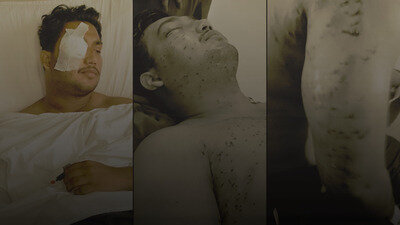

Ban the use of barbaric pellet guns in India
The Issue
The Supreme Court of India, on July 31, refused to impose a ban on pellet guns, stating that if a movement falls into the hands of “mischievous elements,” the use of pellet guns is acceptable!
This decision reflects the Modi government's desperation to arm itself with every instrument of repression out of fear of the growing public discontent.
The Revolutionary Workers' Party of India unequivocally opposes the Supreme Court's observation and decision that the use of pellet guns cannot be prohibited and that pellet guns may be used against a movement if it falls into the hands of “mischievous elements”, and in exceptional circumstances. Naturally, what constitutes exceptional circumstances will be defined by the very government that seeks to use pellet guns. And who the “mischievous elements” are will also be determined by the government. Consequently, this decision will, in effect, make the use of pellet guns a normal and regular occurrence.
Today, pellet guns are used in only two countries in the world: Israel and India. They were first used in the 1970s by the British colonial power in Northern Ireland. Their systematic use began in the 1980s, when the colonial settler state of Israel unleashed them against Palestinian freedom fighters. In India, pellet guns were first used in Kashmir in 2010, where, in the very first year, 112 people were killed as a result. Many of India's allies also condemned their use, but India did not permit any international agency to investigate the incident. Numerous instances of people participating in movements or protests in Kashmir being deliberately blinded with pellet guns have already been documented. For a period of time, this method of state terror was also used in Egypt, Tunisia, and Bahrain, but eventually it had to be withdrawn in these places. Today, pellet guns are used against participants in protests and movements only in Israel and India.
In light of this, we wish to ask the Supreme Court of India: Do the police and armed forces in the rest of the world not engage in crowd control? Why, then, is the use of pellet guns deemed indispensable? What is so natural or inevitable about their use? Prior to their introduction in the 1970s, did police and security forces across the world not control crowds? In the vast majority of countries around the world—many of which are far more “turbulent” than India—the use of pellet guns is prohibited. In fact, most countries have recognized that pellet guns are not weapons that must be used out of necessity for crowd control. Rather, they are a means of establishing state-sponsored terror among the people and of punishing critics and opponents of the government and the state even before any due process has begun. These countries have already acknowledged that the police and security forces possess every conceivable instrument and weapon necessary to control crowds of all kinds, and that the sole purpose of pellet guns is to teach the protesting masses a lesson, punish them, and instill fear of the government in their hearts.
Are the Hon'ble judges of the Supreme Court unaware of this? Do they not know that pellet guns are not an ‘instrument of necessity’ but rather an ‘instrument of choice’ for establishing state terror and instilling fear of the government and the police in the minds of the people? The Chief Justice of India, Suryakant, headed this bench that refused to impose a general ban on the use of pellet guns, stating that the police may use them against a protest if it comes under the influence of "mischievous elements”! The truth is that, at present, it is Parliament and the state legislatures themselves that have become gathering places for criminally "mischievous elements.” Does the Hon'ble CJI consider T. G. Mohandas a "mischievous element," when he advocated opening fire on students? Does Justice Suryakant regard the Hindutva brigade's lumpen element Pinky Chaudhary as a "mischievous element," when he repeatedly threatened violent attacks on protesters during the ongoing movement? Does he consider those Sangh-affiliated bots and social media accounts that issued gang rape threats against women protesters to be "mischievous elements"? Does he regard the hundreds of members of the Hindutva brigade involved in mob lynchings as "mischievous elements"? If the answer is yes, then why has the possibility of using pellet guns against them never been considered acceptable? Why has the use of pellet guns against them ever been considered justified? There are videos showing that the police themselves threw stones at peaceful demonstrators, or had stones thrown at the protestors; attacked them without any provocation; assaulted and abused women protesters; and escorted and protected thugs affiliated with the Sangh Parivar so that they could stand within the police cordon and hurl stones at the protesting students and youth. Would the Supreme Court also authorize the use of pellet guns against them? Or would they not be considered sufficiently "mischievous," and the Hon’ble CJI Surya Kant would graciously permit them to engage in a little more "mischief" first?
The matter is quite straightforward: the judiciary is also an organ of the ruling classes' state, just as the executive and the legislature are its organs. Ultimately, it too represents the interests of that very state.
Today, the country's rulers and their state are afraid of the growing discontent and anger among the people. They know that the public is afflicted by inflation, unemployment, hunger, malnutrition, illiteracy, the commercialisation of education, and pervasive social and economic insecurity and uncertainty. The ruling class and its state—whose stewardship, in this period of economic slowdown and crisis, has been entrusted by the country's wealthy ruling class to the fascist BJP—are terrified. The current student and youth movement has instilled fear in them. In just a few days, the country's students and youth demolished the image and aura that Narendra Modi had spent the past twelve years constructing by pouring hundreds of crores of rupees into the Godi media and propaganda. The fascist regime is driven not only by fear but also by a desire for revenge. That is why FIRs are being filed against young people on the basis of satirical social media posts about Narendra Modi, with the argument that they contain abusive language. But if the use of abusive language is grounds for filing an FIR, then Ramesh Bidhuri, Kapil Mishra, Parvesh Verma, Anurag Thakur, Giriraj Singh, Kangana Ranaut, Himanta Biswa Sarma, Suvendu Adhikari, and so-called fringe Hindutva figures such as Pinky Chaudhary, Ragini Tiwari, and Sadhvi Prachi should all have been in jail by now. Do BJP leaders have the freedom to use highly abusive language against protesters, demonstrators, Muslims, and Dalits? If not, then Narendra Modi and every other citizen of the country are equal before the law, and anyone who uses abusive language against any other citizen, whether on social media or in a public address, should have an FIR filed against them. Why, then, are FIRs being filed only against young people participating in the student and youth movement? Why are the police making undeclared visits to their homes, intimidating their parents? The truth is that this repressive attitude is rooted in the rulers' fear. They are afraid. And when they are afraid, they seek to intensify repression further.
In such a situation, the judiciary, too, is fully supporting the efforts to equip the state with every weapon of repression and to keep it fully armed with every instrument of oppression. The Supreme Court's refusal to ban pellet guns—which are absent, banned, or prohibited in almost every country in the world except India and the Israeli settler-colonial state—on the pretext of dealing with "mischievous elements”, shows that the methods that have long been used to suppress, crush, and terrorize Adivasis, workers, Kashmiri people and Manipuri people will now be inflicted on every citizen of India. This is also indicative of the Israelization of the state's repressive apparatus in nearly every country around the world.
The repressive and exploitative ruling classes of many countries are learning those inhuman and barbaric methods, which Israeli colonisers employ even against Palestinian children, to make their own states increasingly effective at repressing their own people. It is precisely why opposing the Israeli project and bringing it to an end is the duty and responsibility of all justice-loving, conscientious and progressive people, students, youth, and citizens around the world who are engaged in the struggle for justice.
No sensitive and justice-loving person can agree with the Supreme Court's decision to refuse to ban the use of pellet guns; they are bound to oppose it. An extensive, nationwide campaign to prohibit the use of pellet guns should be undertaken by democratic and civil rights organizations, student and youth groups, women's organizations, anti-caste organizations, and all progressive mass organizations. Tomorrow, these weapons will be used on a much larger scale against the people under similar pretexts—that "mischievous elements" had infiltrated a protest, made it violent, and so on. Even if such situations do arise, the police and security forces already have dozens of methods available for crowd control, and everyone knows this—whether they are in the judiciary, the government, the bureaucracy, Parliament, or the state legislatures.
The real reason is that the Indian government and the state are fearful of the growing public anger and dissatisfaction over exploitation, repression, unemployment, inflation, poverty, illiteracy, hunger, malnutrition, and the broader condition of rising economic insecurity and uncertainty. Out of this fear, they seek to equip themselves with every possible instrument of repression. It is the duty of the people to oppose this effort.
Sign this petition to demand the Indian government to immediately ban the usage of pellet guns.

76
The Issue
The Supreme Court of India, on July 31, refused to impose a ban on pellet guns, stating that if a movement falls into the hands of “mischievous elements,” the use of pellet guns is acceptable!
This decision reflects the Modi government's desperation to arm itself with every instrument of repression out of fear of the growing public discontent.
The Revolutionary Workers' Party of India unequivocally opposes the Supreme Court's observation and decision that the use of pellet guns cannot be prohibited and that pellet guns may be used against a movement if it falls into the hands of “mischievous elements”, and in exceptional circumstances. Naturally, what constitutes exceptional circumstances will be defined by the very government that seeks to use pellet guns. And who the “mischievous elements” are will also be determined by the government. Consequently, this decision will, in effect, make the use of pellet guns a normal and regular occurrence.
Today, pellet guns are used in only two countries in the world: Israel and India. They were first used in the 1970s by the British colonial power in Northern Ireland. Their systematic use began in the 1980s, when the colonial settler state of Israel unleashed them against Palestinian freedom fighters. In India, pellet guns were first used in Kashmir in 2010, where, in the very first year, 112 people were killed as a result. Many of India's allies also condemned their use, but India did not permit any international agency to investigate the incident. Numerous instances of people participating in movements or protests in Kashmir being deliberately blinded with pellet guns have already been documented. For a period of time, this method of state terror was also used in Egypt, Tunisia, and Bahrain, but eventually it had to be withdrawn in these places. Today, pellet guns are used against participants in protests and movements only in Israel and India.
In light of this, we wish to ask the Supreme Court of India: Do the police and armed forces in the rest of the world not engage in crowd control? Why, then, is the use of pellet guns deemed indispensable? What is so natural or inevitable about their use? Prior to their introduction in the 1970s, did police and security forces across the world not control crowds? In the vast majority of countries around the world—many of which are far more “turbulent” than India—the use of pellet guns is prohibited. In fact, most countries have recognized that pellet guns are not weapons that must be used out of necessity for crowd control. Rather, they are a means of establishing state-sponsored terror among the people and of punishing critics and opponents of the government and the state even before any due process has begun. These countries have already acknowledged that the police and security forces possess every conceivable instrument and weapon necessary to control crowds of all kinds, and that the sole purpose of pellet guns is to teach the protesting masses a lesson, punish them, and instill fear of the government in their hearts.
Are the Hon'ble judges of the Supreme Court unaware of this? Do they not know that pellet guns are not an ‘instrument of necessity’ but rather an ‘instrument of choice’ for establishing state terror and instilling fear of the government and the police in the minds of the people? The Chief Justice of India, Suryakant, headed this bench that refused to impose a general ban on the use of pellet guns, stating that the police may use them against a protest if it comes under the influence of "mischievous elements”! The truth is that, at present, it is Parliament and the state legislatures themselves that have become gathering places for criminally "mischievous elements.” Does the Hon'ble CJI consider T. G. Mohandas a "mischievous element," when he advocated opening fire on students? Does Justice Suryakant regard the Hindutva brigade's lumpen element Pinky Chaudhary as a "mischievous element," when he repeatedly threatened violent attacks on protesters during the ongoing movement? Does he consider those Sangh-affiliated bots and social media accounts that issued gang rape threats against women protesters to be "mischievous elements"? Does he regard the hundreds of members of the Hindutva brigade involved in mob lynchings as "mischievous elements"? If the answer is yes, then why has the possibility of using pellet guns against them never been considered acceptable? Why has the use of pellet guns against them ever been considered justified? There are videos showing that the police themselves threw stones at peaceful demonstrators, or had stones thrown at the protestors; attacked them without any provocation; assaulted and abused women protesters; and escorted and protected thugs affiliated with the Sangh Parivar so that they could stand within the police cordon and hurl stones at the protesting students and youth. Would the Supreme Court also authorize the use of pellet guns against them? Or would they not be considered sufficiently "mischievous," and the Hon’ble CJI Surya Kant would graciously permit them to engage in a little more "mischief" first?
The matter is quite straightforward: the judiciary is also an organ of the ruling classes' state, just as the executive and the legislature are its organs. Ultimately, it too represents the interests of that very state.
Today, the country's rulers and their state are afraid of the growing discontent and anger among the people. They know that the public is afflicted by inflation, unemployment, hunger, malnutrition, illiteracy, the commercialisation of education, and pervasive social and economic insecurity and uncertainty. The ruling class and its state—whose stewardship, in this period of economic slowdown and crisis, has been entrusted by the country's wealthy ruling class to the fascist BJP—are terrified. The current student and youth movement has instilled fear in them. In just a few days, the country's students and youth demolished the image and aura that Narendra Modi had spent the past twelve years constructing by pouring hundreds of crores of rupees into the Godi media and propaganda. The fascist regime is driven not only by fear but also by a desire for revenge. That is why FIRs are being filed against young people on the basis of satirical social media posts about Narendra Modi, with the argument that they contain abusive language. But if the use of abusive language is grounds for filing an FIR, then Ramesh Bidhuri, Kapil Mishra, Parvesh Verma, Anurag Thakur, Giriraj Singh, Kangana Ranaut, Himanta Biswa Sarma, Suvendu Adhikari, and so-called fringe Hindutva figures such as Pinky Chaudhary, Ragini Tiwari, and Sadhvi Prachi should all have been in jail by now. Do BJP leaders have the freedom to use highly abusive language against protesters, demonstrators, Muslims, and Dalits? If not, then Narendra Modi and every other citizen of the country are equal before the law, and anyone who uses abusive language against any other citizen, whether on social media or in a public address, should have an FIR filed against them. Why, then, are FIRs being filed only against young people participating in the student and youth movement? Why are the police making undeclared visits to their homes, intimidating their parents? The truth is that this repressive attitude is rooted in the rulers' fear. They are afraid. And when they are afraid, they seek to intensify repression further.
In such a situation, the judiciary, too, is fully supporting the efforts to equip the state with every weapon of repression and to keep it fully armed with every instrument of oppression. The Supreme Court's refusal to ban pellet guns—which are absent, banned, or prohibited in almost every country in the world except India and the Israeli settler-colonial state—on the pretext of dealing with "mischievous elements”, shows that the methods that have long been used to suppress, crush, and terrorize Adivasis, workers, Kashmiri people and Manipuri people will now be inflicted on every citizen of India. This is also indicative of the Israelization of the state's repressive apparatus in nearly every country around the world.
The repressive and exploitative ruling classes of many countries are learning those inhuman and barbaric methods, which Israeli colonisers employ even against Palestinian children, to make their own states increasingly effective at repressing their own people. It is precisely why opposing the Israeli project and bringing it to an end is the duty and responsibility of all justice-loving, conscientious and progressive people, students, youth, and citizens around the world who are engaged in the struggle for justice.
No sensitive and justice-loving person can agree with the Supreme Court's decision to refuse to ban the use of pellet guns; they are bound to oppose it. An extensive, nationwide campaign to prohibit the use of pellet guns should be undertaken by democratic and civil rights organizations, student and youth groups, women's organizations, anti-caste organizations, and all progressive mass organizations. Tomorrow, these weapons will be used on a much larger scale against the people under similar pretexts—that "mischievous elements" had infiltrated a protest, made it violent, and so on. Even if such situations do arise, the police and security forces already have dozens of methods available for crowd control, and everyone knows this—whether they are in the judiciary, the government, the bureaucracy, Parliament, or the state legislatures.
The real reason is that the Indian government and the state are fearful of the growing public anger and dissatisfaction over exploitation, repression, unemployment, inflation, poverty, illiteracy, hunger, malnutrition, and the broader condition of rising economic insecurity and uncertainty. Out of this fear, they seek to equip themselves with every possible instrument of repression. It is the duty of the people to oppose this effort.
Sign this petition to demand the Indian government to immediately ban the usage of pellet guns.
Petition Updates
Share this petition
Petition created on 31 July 2026