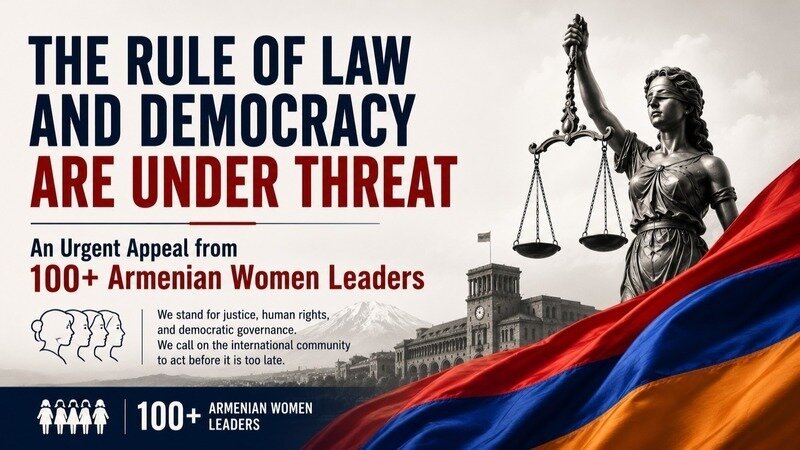
Appeal of 100+ Armenian Women to Defend Democracy and Justice
Проблема
To
The Ambassador of the United States of America to the Republic of Armenia
The Head of the Delegation of the European Union to Armenia
Their Excellencies, Ambassadors of the Member States of the European Union Accredited to the Republic of Armenia
The Resident Coordinator of the UN in Armenia
The Ambassador of the United Kingdom to the Republic of Armenia
The Secretary General of the Council of Europe
The Secretary General of the Organization for Security and Co-operation in Europe (OSCE)
The President of the Parliamentary Assembly of the Council of Europe (PACE)
The Secretary General of Amnesty International
The Chair of Transparency International]
APPEAL OF 100+ ARMENIAN WOMEN REGARDING THE SUBJUGATION OF THE JUDICIARY TO THE EXECUTIVE BRANCH, SEVERE VIOLATIONS OF CIVIL AND POLITICAL RIGHTS, AND THE EROSION OF DEMOCRATIC GOVERNANCE IN ARMENIA
Dear Excellencies, Dear Secretary General, Dear President, Dear Distinguished Representatives,
We, the undersigned members of the 100+ Armenian Women initiative—comprising professionals, academics, cultural figures, entrepreneurs, and civic leaders—are writing to convey our profound alarm regarding the systematic deterioration of democratic governance, the institutionalized erosion of the rule of law, and the escalating erosion of fundamental human rights in the Republic of Armenia
Our appeal is not motivated by political allegiance or partisan interests. Rather, it reflects our conviction that democratic institutions remain strong only when the rule of law is applied equally, fundamental rights are protected without discrimination, and all citizens are able to participate freely in public life.
In recent months, a series of developments has raised serious concerns regarding the protection of political freedoms, judicial independence, freedom of expression, and academic freedom in Armenia. Considered individually, each case may be presented as an isolated legal or administrative matter. Viewed collectively, however, they suggest a broader pattern that risks democratic backsliding, diminishing public confidence in state institutions, and narrowing the space for political pluralism.
We are particularly concerned by the increasing number of criminal prosecutions, arrests, and restrictive legal measures involving opposition politicians and activists, civil society representatives, government critics, public commentators, and other individuals expressing dissenting views.
1. Complete Subjugation of the Judiciary to the Executive Branch, Severe Violations of Civil and Political Rights.
Recent months have witnessed the arrest or criminal prosecution of numerous opposition figures, including Avetik Chalabyan, Coordinator of the HayaQve National Civil Union, alongside other prominent political leaders and public figures such as Armen Ashotyan (Republican Party), Davit Ghazinyan (Strong Armenia), Andranik Tevanyan (Mother Armenia Party), Gagik Tsarukyan (Prosperous Armenia Party), and others. While the Armenian authorities have presented legal charges in each case, the recurring use of lengthy pretrial detention—often for two months—together with restrictions on family visits and public engagement has generated widespread concern within Armenian society regarding the proportionality and consistency of these measures. The cumulative pattern has prompted questions as to whether criminal justice mechanisms are, in some politically sensitive cases, being used in ways that risk undermining confidence in their impartiality. The widespread, formulaic application of maximum pretrial detention periods raises serious questions regarding Armenia's compliance with the presumption of innocence (Article 14(2) ICCPR) and the right to liberty (Article 9 ICCPR).
2. Weaponization of the Law Against Women and Political Dissidents
As women leaders, we are deeply disturbed by the targeted degradation of women's rights and the particularly harsh treatment with which female critics of the government are treated. The state has increasingly relied on prolonged pretrial detention—historically reserved for violent offences—in circumstances that create the appearance that detention is being used as a coercive measure rather than solely to secure the proper administration of justice. A severe example of this trend is the recent two-month pretrial detention of former Member of Parliament Aregnaz Manukyan. Arrested on charges classified under Armenian law as a medium-gravity offense, Ms. Manukyan was subjected to strict isolation and restricted communication with the outside world. Crucially, the authorities chose to incarcerate her despite her status as the mother of a minor child who depends entirely on her care. Using separation from a minor child as a punitive mechanism appears inconsistent with the UN Convention on the Elimination of All Forms of Discrimination against Women (CEDAW), which obligates states to eliminate discrimination against women in political and public life, as well as the UN Mandela Rules regarding the treatment of female detainees.
3. We are also deeply concerned by the systematic attacks on the Armenian Apostolic Church and violation of freedom of expression.
We are deeply concerned by recent developments affecting the relationship between the executive authorities and the Armenian Apostolic Holy Church. As a religious institution that has played a central role in Armenia's historical, cultural, and national identity for centuries, the Church occupies a unique place in Armenian society. Article 18 of the Constitution of the Republic of Armenia recognizes the exclusive mission of the Armenian Apostolic Holy Church in the spiritual life of the Armenian people, the development of their national culture, and the preservation of their national identity, while also guaranteeing freedom of religion and the separation of religious organizations and the state. Recent public statements by senior government officials, reported incidents involving senior clergy, and public campaigns directed against Church leadership raise serious concerns regarding respect for the autonomy of religious communities, freedom of religion, freedom of expression of religious leaders, and the maintenance of constructive dialogue between state institutions and religious communities. Furthermore, senior executive officials have publicly called for the replacement of His Holiness the Catholicos of All Armenians, although the appointment and removal of the Catholicos are matters of internal church governance. These developments warrant careful scrutiny in light of Armenia's obligations under Article 18 of the International Covenant on Civil and Political Rights and Article 9 of the European Convention on Human Rights, as interpreted by the European Court of Human Rights, which protects the autonomy of religious communities from undue state interference
4. We are further concerned by developments affecting academic freedom and institutional autonomy.
The recent targeted dismissals of prominent, long-serving faculty members from Yerevan State University—including human rights lawyer and Associate Professor Ruben Melikyan, Professor Khachik Galstyan, and Associate Professor Alen Ghevondyan—have raised serious concerns regarding possible politically motivated dismissals and the protection of academic freedom.Terminating scholars explicitly due to their civic engagement or public dissent violates the right to freedom of expression and opinion under Article 19 of the ICCPR and Article 10 of the ECHR.
5. Political Exploitation of Economic Leverage, Mass Unemployment, and Violations of Property Rights
Furthermore, we draw your urgent attention to the devastating economic fallout of these politically motivated prosecutions, which are being used to inflict collective punishment on ordinary citizens. A striking example of this is the state’s targeted campaign following the detention of political figure and entrepreneur Gagik Tsarukyan. Rather than fostering economic stability and job creation, the authorities have forced the closure of major enterprises simply to execute political vendettas. This calculated destruction of economic infrastructure has directly resulted in tens of thousands of citizens losing their livelihoods, triggering a severe employment crisis.
Compounding these socio-economic violations is a deeply alarming assault on the fundamental right to property. In blatant violation of the presumption of innocence, the executive branch has initiated the de facto expropriation of private enterprises by appointing state-mandated external managers. Crucially, these aggressive corporate takeovers are being executed while individuals are merely in pretrial detention, long before any formal criminal charges have been proven in a court of law. This predatory practice constitutes a direct and egregious violation of Article 1 of Protocol No. 1 to the European Convention on Human Rights (ECHR), which guarantees the peaceful enjoyment of property, and represents an unconstitutional overreach that threatens the foundational pillars of economic security and due process in Armenia.
6. Last but not least, as women, we feel a particular responsibility to speak out against the increasingly hostile and polarized tone of Armenia's public life. We are particularly alarmed by the dangerous degradation of public discourse led by high-ranking state officials. At a time when political debate is increasingly dominated by aggressive confrontation, personal attacks, insults, and degrading rhetoric, we are deeply concerned by the example being set for future generations. We are especially astonished that such rhetoric has increasingly been directed at Armenians forcibly displaced from Artsakh—a population that has already endured war, persecution, and the loss of its homeland. The targeting of some of the most vulnerable members of our society is incompatible with the principles of dignity, solidarity, and national unity that should guide public leadership.
When offensive, demeaning, and inflammatory rhetoric becomes normalized in political life, it risks normalizing these behaviors throughout society, weakening the culture of mutual respect upon which every democracy depends. As mothers, educators, professionals, and members of civil society, we do not want future generations to grow up believing that hatred, humiliation, and verbal abuse are acceptable substitutes for reasoned debate and democratic disagreement. When the highest echelons of government utilize demeaning and inflammatory rhetoric, it incites societal polarization and gives state sanction to harassment, rendering public participation unsafe for women, youth, and independent voices. We therefore call on all those entrusted with the responsibilities of public office to demonstrate restraint, civility, and respect in both word and deed. Leadership should unite rather than divide, encourage dialogue rather than hostility, and set an example worthy of the democratic Armenia that our children deserve to inherit.
These developments contribute to a broader atmosphere in which many citizens increasingly fear that expressing views critical of the authorities may result in criminal prosecution, prolonged legal proceedings, professional consequences, public intimidation, or other forms of pressure. Such concerns extend beyond political actors and affect journalists, lawyers, academics, civil society representatives, and ordinary citizens who seek to participate in public debate. Regardless of political affiliation, every individual should be able to express opinions, participate peacefully in civic life, criticize those exercising public authority, and engage in professional activities without fear of retaliation.
Armenia has long been regarded by its international partners as a country committed to democratic development, human rights, and the rule of law. As a member of the Council of Europe and a State Party to the European Convention on Human Rights and the International Covenant on Civil and Political Rights, Armenia has undertaken to safeguard due process, judicial independence, freedom of expression, freedom of peaceful assembly, freedom of religion, and political pluralism. These commitments are fundamental to democratic governance and must be applied equally regardless of political affiliation or the identity of those exercising state power.
In light of these concerns, we respectfully urge your institution to:
1.Issue Public Assessments: Deliver explicit, public evaluations of the systemic degradation of the rule of law, executive control over the judiciary, and the rising occurrences of selective justice in Armenia.
2. Investigate and Monitor Violations: Establish strict monitoring mechanisms focusing on the state's use of excessive force, the misuse of pretrial detention, and the specific targeting of female political figures and human rights defenders.
3. Demand Judicial Reform Integrity: Condition international support and democratic partnerships on the verified independence of the Armenian judiciary from the Prime Minister’s office.
4. Engage with Broad Civil Society: Expand formal channels of communication with a diverse spectrum of Armenian civil society, ensuring that human rights assessments are not drawn solely from government-aligned entities.
5. Strengthen dialogue with representatives of Armenian civil society reflecting diverse political and civic perspectives regarding the state of democracy, the rule of law, and the protection of fundamental freedoms.
We remain convinced that Armenia's democratic future depends on protection of constitutional guarantees, independent institutions, and the equal application of the law to all.
We welcome the opportunity to meet with you or your designated representatives to present comprehensive documentation, legal analyses, and case files detailing the structural violations outlined in this appeal. A delegation from the 100 Armenian Women initiative stands ready to convene at your earliest convenience.Thank you for your rigorous attention to this crisis, and we look forward to your urgent response.
Respectfully,
100+ Armenian Women Initiative
Initial Signatories
Sona Hovhannisyan — Human Capital and Organizational Development Consultant, Executive Coach, Lecturer, Board Chairwoman (Yerevan)
Valya Shtoyan — Teacher (Yerevan)
Burastan Movsisyan — C-Level Executive, Physicist (Yerevan)
Sona Koshetsyan — Education Consultant and Project Manager (Yerevan)
Anna Kostanyan — English-Persian Languages Specialist, Pedagogue, Member of Parliament (7th Convocation of the National Assembly of the Republic of Armenia), Board Member at HayaQve National Civil Union (Yerevan)
Ani Apitonyan — Psychologist (Yerevan)
Lara Sargsyan — Teacher (Stepanakert, Yerevan)
Edith Jerejyan — Senior Project Manager, Teacher (Yerevan)
Lilit Tumanyan — Financial Planning and Analysis Professional (Yerevan)
Gayane Ayvazyan — PR and Communications Professional (Yerevan)
Sayida Poghosyan — Lawyer, President of Tracing Our Ancestors NGO (Yerevan)
Satine Andreasyan — Digital Marketing Manager (Yerevan)
Gohar Petrosyan — Sales Coordinator (Yerevan)
Emma Marashlyan — Artist, Designer, Photographer, Founder of Maison Marashlyan (Yerevan)
Anahit Adamyan — Business Consultant, Board Director (Yerevan)
Aza Babayan — Journalist, Film Director (Yerevan)
Marina Mkhitaryan — International Development Professional, Governance Innovation Consultant (Yerevan)
Anahit Yuzbashyan — Co-Founder and Director of BVIK Educational Foundation (Yerevan)
Nuné Melkoumian — Marketing & Communications Consultant, Political Influencer (Yerevan)
Lilit Bleyan — Singer, Songwriter, Translator (Yerevan)
Emma Baghdasaryan — Project Manager (Gyumri)
Zhanna Alexanyan — Human Rights Defender (Yerevan)
Anna Mayilyan — Singer, Honored Artist of Armenia (Yerevan)
Naira Margaryan — Business Consultant, Education Expert (Yerevan)
Inessa Vardanyan — Marketing and Communications Specialist (Yerevan)
Violet Grigoryan — Writer, Creative Writing Expert, Podcast Creator (Yerevan)
Mery Mamikonian — Chairwoman of the Board of Trustees of the "4090" Educational Foundation (Yerevan)
Inna Mkhitaryan — Documentary Photographer and Filmmaker (Yerevan)
Zara Gevorgyan — Musician, Vocalist of Dogma Rock Band (Yerevan)
Karine Yeghiazaryan — C-Level Executive (Yerevan)
Shushan Petrosyan — Singer, Honored Artist of Armenia (Yerevan)
Anush Sedrakyan — Political Scientist (Yerevan)
Gayane Harutyunyan — Music Theorist (Yerevan)
Roza Sahakyan — Mathematician, Public Servant, Diaspora Scholar (Yerevan)
Sirvard Hambaryan — Historian, Public Servant, Diaspora Scholar (Yerevan)
Silva Ghazaryan — Engineer, Public Servant, Diaspora Scholar (Yerevan)
Lyudmila Sahakyan — Human Resources Manager (Yerevan)
Narine Kroyan — Writer, Novelist (Yerevan)
Hripsime Arakelian — Journalist (Yerevan)
Marine Petrossian — Poet (Yerevan)
Maya Barkhudaryan — Political Scientist, Human Rights Defender (Yerevan)
Bella Margaryan — Teacher (Yerevan)
Ani Gharabaghtsyan — Educational Programs Manager (Yerevan)
Mane Tandilyan — Co-Founder and Leader of the "Country to Live" Party (Yerevan)
Mariam Chakhoyan — International Cooperation & Public Policy Specialist, Chair of Tookhmanook NGO (Yerevan)
Arpine Khachatryan — Chair of Nucleus Aygezard Youth and Community Development Center NGO (Koriz NGO) (Artashat, Aygezard)
Hripsime Khanzadyan — Education Expert (Yerevan)
Nare Simonyan — Economist, Human Rights Defender (Armenian Center for Political Rights NGO) (Yerevan)
Anna Galstyan — MD, PhD, Neurosurgeon (Abovian)
Armine Ohanyan — Editor of the Hraparak Newspaper (Yerevan)
Byurakn Ishkhanyan — MD, PhD, Scientist, Author (Copenhagen)
Gohar Abovyan — Linguist, Teacher, Translator (Yerevan)
Armine Vaghramyan — Teacher, Translator, Writer, Poetess, Publicist, International Lawyer (Yerevan)
Stella Mehrabyan — Translator (Yerevan)
Sofya Hovsepyan — Politician, Director of the Artsakh Development Foundation (Yerevan)
Arevik Ghalumyan — Interpreter, Business Developer (Yerevan)
Alvina Gyulumyan — Former Judge of the Constitutional Court of the Republic of Armenia and the European Court of Human Rights (ECHR) (Yerevan)
Shake Avoyan — Journalist (Yerevan)
Sarpuhi Kaprielyan — Lawyer, Board Member of the Arax Foundation (Bulgaria)
Anna Marutyan — Lecturer, Translator (Yerevan)
Shushan Yeritsyan — Historian (Yerevan)
Anahit Patatyan — Mother of a Fallen Soldier (Yerevan)
Arega Hovsepyan — Candidate for Member of the National Assembly of the Republic of Armenia (Yerevan)
Elinar Vardanyan — Member of Parliament of the Republic of Armenia, Lawyer (Yerevan)
Lilit Galstyan — Member of Parliament, Member of the Armenian Delegation to the OSCE Parliamentary Assembly, PhD (Yerevan)
Aspram Krpeyan — Member of the National Assembly of the Republic of Armenia (8th Convocation); International Lawyer Specializing in International Humanitarian Law and Human Rights; Diplomat; Captain in the Military Reserve (Yerevan)
Marina Malkhasyan — Governance, Human Rights and Rule of Law Expert; Senior Policy Consultant; Public Activist (Yerevan)
Liana Martirosyan — Lawyer, Scriptwriter, Public Activist (Yerevan)
Lilit Kocharyan — Human Rights Activist (Berlin)
Lilit Gevorgyan — International Development Consultant (Yerevan)
Lika Tumanyan — Journalist (Yerevan)
Anna Velitsyan — Psychologist, Podcaster (Yerevan)
Satik Seyranyan — President of the Union of Journalists of Armenia; Editor-in-Chief of 168 Hours (Yerevan)
Aline Masrelian — Civil Engineer, Entrepreneur (Yerevan)
Taguhi Tovmasyan — Member of the National Assembly of the Republic of Armenia; Political Scientist; Strategic Communications Specialist (Yerevan)
Karin Tonoyan — Educator (Yerevan)
Julia Davtyan — Translator (Yerevan)
Arzik Mkhitaryan — Psychologist, Professor, Honored Worker of Science (Yerevan)
Sirvard Margaryan — Writer, Journalist (Yerevan)
Anzhela Elibegova — Expert on the Geopolitics of the South Caucasus, Lecturer (Yerevan)
Hermine Avagyan — Poet and Prose Writer (Yerevan)
Armine Petrosyan — Director, HaySanta Charity Foundation (Yerevan)
Mery Davtyan — Journalist, Storyteller, Creator (Yerevan)
Gohar Ghalachyan — Children's Author (Yerevan)
Anahit Manasyan — Economist (Yerevan)
Arpi Topchyan — Doctor of Medicine, PhD (Yerevan)
Alvard Zakaryan — Researcher, Institute for Security and Analysis; PhD Student in Sociology, Yerevan State University (Yerevan)
Anna Astvatsaturian Turcotte — City Councilor, Westbrook, Maine (USA); Author; Human Rights Advocate (USA)
Dr. Kate Tairyan — Senior Lecturer, Faculty of Health Sciences, Simon Fraser University (Canada)
Gohar Jerbashian — Mathematician, Demography and Health Systems Specialist (Yerevan)
Marine Manucharyan — Education Manager, Civic Forum NGO (Yerevan)
Astghik Avetisyan — PhD, Associate Professor, Strategic Communication and Media Expert (Yerevan)
Marine Mikayelyan — SMM Specialist (Ararat)
Anahit Ghazanchyan — Manager, PhD, MPH (Yerevan)
Zaruhi Muradyan — Artist, Member of the Artists Union of Armenia (Yerevan)
Arax Margaryan — PhD in Art Studies, Associate Professor (Yerevan)
Siranush Martirosyan — Educator (Yerevan)
Hripsime Meliksetyan — Educator (Yerevan)
Lilya Avanesyan — Judge (Yerevan)
Susanna Mikayelyan — Engineer (Yerevan)
Susanna Chipkinyan — Engineer (Yerevan)
Zoya Julhakyan — Economist (Yerevan)
Susanna Melikyan — Historian, Ethnographer (Yerevan)
Margretta Mirzoyan — Economist, Founder & CEO, LAGARDEX LLC (Yerevan)
Lusine Martirosyan — Attorney (Yerevan)
Naira Paityan — Journalist (Yerevan)
Annie Abajyan — Economist, Politician (Yerevan)
Yeva Hakobyan — Political Scientist (Montreal)
Astghik Karapetyan — Human Rights Advocate, President of Point 33 NGO (Yerevan)
Melsida Hakobyan (Hakunts) — Founder and President of the House of Armenian Art and the Literary Melodies Public Organization; Journalist, Publicist, Poet; Member of the Armenian Writers' Association of the USA (Gyumri)
Larisa Alaverdyan — First Human Rights Defender (Ombudsperson) of the Republic of Armenia (Yerevan)
Nare Aramyan — Human Rights Defender (Yerevan)
Lilit Avanesyan — Singer, Vocal Teacher (Artsakh/Yerevan)
Lusine Mkhitaryan — Journalist (Yerevan)
Lala Abgaryan — Educator (Etchmiadzin)
Shushanik Abgaryan — Educator (Etchmiadzin)
Armine Sakhoyan — Journalist (Yerevan)
Makruhi (Ani) Nazareti Julfaryan — Economist (Etchmiadzin)
Lusine Julfaryan — Flight Attendant (Etchmiadzin)
Ashkhen Babayan (Etchmiadzin)
Susan Margaryan — Operator (Yerevan)
Hasmik Arakelyan — Pattern Maker (Yerevan)
Nubar Danielyan — Educator (Yerevan)
Ani Apresyan — Researcher (Yerevan)
Silva Adamyan — Head of the Ecological Public Society NGO (Yerevan)
Mariam Kanayan — Art Director in Publishing, Singer, Civil & Political Rights Advocate (Armenian Center for Political Rights) (Yerevan)
Arsineh Minasyan — Sports Physician, Blogger (Yerevan)
Ruzan Ghazaryan — Social Entrepreneur (Vayk)
Alisa Gevorgyan — Journalist (Yerevan)
Hilda Tchoboian — President of the Covcas Center for Law & Conflict Resolution NGO (France)
Anna Hess Sargsyan — Peace and Conflict Studies, Geneva Graduate Institute (Switzerland)
Ani Gasparyan — Producer and Artists' Delegate for International Festivals and Concert Series (Switzerland)
Elizabet Petrosyan — Mathematician (Yerevan)
Gayane Hovsepyan — Economist, Co-Founder of NISH Research Foundation (Yerevan)
Anais Sardaryan — Actress (Yerevan)
Lilit Mkhitaryan — Film Director (Yerevan)
Hasmik Mikayelyan — President of the Mayrut (Motherhood) NGO of Artsakh (Yerevan)
Sima Aprahamian, Ph.D. — Anthropologist (Montréal)
Lilit Petrosyan — Ethics and Integrity Consultant (Yerevan)
Ruzanna Khachatryan — Journalist (Yerevan)
Rosette Ostakarayan — Opera Singer, Graphic Designer, Painter (Syria/Yerevan)

73
Проблема
To
The Ambassador of the United States of America to the Republic of Armenia
The Head of the Delegation of the European Union to Armenia
Their Excellencies, Ambassadors of the Member States of the European Union Accredited to the Republic of Armenia
The Resident Coordinator of the UN in Armenia
The Ambassador of the United Kingdom to the Republic of Armenia
The Secretary General of the Council of Europe
The Secretary General of the Organization for Security and Co-operation in Europe (OSCE)
The President of the Parliamentary Assembly of the Council of Europe (PACE)
The Secretary General of Amnesty International
The Chair of Transparency International]
APPEAL OF 100+ ARMENIAN WOMEN REGARDING THE SUBJUGATION OF THE JUDICIARY TO THE EXECUTIVE BRANCH, SEVERE VIOLATIONS OF CIVIL AND POLITICAL RIGHTS, AND THE EROSION OF DEMOCRATIC GOVERNANCE IN ARMENIA
Dear Excellencies, Dear Secretary General, Dear President, Dear Distinguished Representatives,
We, the undersigned members of the 100+ Armenian Women initiative—comprising professionals, academics, cultural figures, entrepreneurs, and civic leaders—are writing to convey our profound alarm regarding the systematic deterioration of democratic governance, the institutionalized erosion of the rule of law, and the escalating erosion of fundamental human rights in the Republic of Armenia
Our appeal is not motivated by political allegiance or partisan interests. Rather, it reflects our conviction that democratic institutions remain strong only when the rule of law is applied equally, fundamental rights are protected without discrimination, and all citizens are able to participate freely in public life.
In recent months, a series of developments has raised serious concerns regarding the protection of political freedoms, judicial independence, freedom of expression, and academic freedom in Armenia. Considered individually, each case may be presented as an isolated legal or administrative matter. Viewed collectively, however, they suggest a broader pattern that risks democratic backsliding, diminishing public confidence in state institutions, and narrowing the space for political pluralism.
We are particularly concerned by the increasing number of criminal prosecutions, arrests, and restrictive legal measures involving opposition politicians and activists, civil society representatives, government critics, public commentators, and other individuals expressing dissenting views.
1. Complete Subjugation of the Judiciary to the Executive Branch, Severe Violations of Civil and Political Rights.
Recent months have witnessed the arrest or criminal prosecution of numerous opposition figures, including Avetik Chalabyan, Coordinator of the HayaQve National Civil Union, alongside other prominent political leaders and public figures such as Armen Ashotyan (Republican Party), Davit Ghazinyan (Strong Armenia), Andranik Tevanyan (Mother Armenia Party), Gagik Tsarukyan (Prosperous Armenia Party), and others. While the Armenian authorities have presented legal charges in each case, the recurring use of lengthy pretrial detention—often for two months—together with restrictions on family visits and public engagement has generated widespread concern within Armenian society regarding the proportionality and consistency of these measures. The cumulative pattern has prompted questions as to whether criminal justice mechanisms are, in some politically sensitive cases, being used in ways that risk undermining confidence in their impartiality. The widespread, formulaic application of maximum pretrial detention periods raises serious questions regarding Armenia's compliance with the presumption of innocence (Article 14(2) ICCPR) and the right to liberty (Article 9 ICCPR).
2. Weaponization of the Law Against Women and Political Dissidents
As women leaders, we are deeply disturbed by the targeted degradation of women's rights and the particularly harsh treatment with which female critics of the government are treated. The state has increasingly relied on prolonged pretrial detention—historically reserved for violent offences—in circumstances that create the appearance that detention is being used as a coercive measure rather than solely to secure the proper administration of justice. A severe example of this trend is the recent two-month pretrial detention of former Member of Parliament Aregnaz Manukyan. Arrested on charges classified under Armenian law as a medium-gravity offense, Ms. Manukyan was subjected to strict isolation and restricted communication with the outside world. Crucially, the authorities chose to incarcerate her despite her status as the mother of a minor child who depends entirely on her care. Using separation from a minor child as a punitive mechanism appears inconsistent with the UN Convention on the Elimination of All Forms of Discrimination against Women (CEDAW), which obligates states to eliminate discrimination against women in political and public life, as well as the UN Mandela Rules regarding the treatment of female detainees.
3. We are also deeply concerned by the systematic attacks on the Armenian Apostolic Church and violation of freedom of expression.
We are deeply concerned by recent developments affecting the relationship between the executive authorities and the Armenian Apostolic Holy Church. As a religious institution that has played a central role in Armenia's historical, cultural, and national identity for centuries, the Church occupies a unique place in Armenian society. Article 18 of the Constitution of the Republic of Armenia recognizes the exclusive mission of the Armenian Apostolic Holy Church in the spiritual life of the Armenian people, the development of their national culture, and the preservation of their national identity, while also guaranteeing freedom of religion and the separation of religious organizations and the state. Recent public statements by senior government officials, reported incidents involving senior clergy, and public campaigns directed against Church leadership raise serious concerns regarding respect for the autonomy of religious communities, freedom of religion, freedom of expression of religious leaders, and the maintenance of constructive dialogue between state institutions and religious communities. Furthermore, senior executive officials have publicly called for the replacement of His Holiness the Catholicos of All Armenians, although the appointment and removal of the Catholicos are matters of internal church governance. These developments warrant careful scrutiny in light of Armenia's obligations under Article 18 of the International Covenant on Civil and Political Rights and Article 9 of the European Convention on Human Rights, as interpreted by the European Court of Human Rights, which protects the autonomy of religious communities from undue state interference
4. We are further concerned by developments affecting academic freedom and institutional autonomy.
The recent targeted dismissals of prominent, long-serving faculty members from Yerevan State University—including human rights lawyer and Associate Professor Ruben Melikyan, Professor Khachik Galstyan, and Associate Professor Alen Ghevondyan—have raised serious concerns regarding possible politically motivated dismissals and the protection of academic freedom.Terminating scholars explicitly due to their civic engagement or public dissent violates the right to freedom of expression and opinion under Article 19 of the ICCPR and Article 10 of the ECHR.
5. Political Exploitation of Economic Leverage, Mass Unemployment, and Violations of Property Rights
Furthermore, we draw your urgent attention to the devastating economic fallout of these politically motivated prosecutions, which are being used to inflict collective punishment on ordinary citizens. A striking example of this is the state’s targeted campaign following the detention of political figure and entrepreneur Gagik Tsarukyan. Rather than fostering economic stability and job creation, the authorities have forced the closure of major enterprises simply to execute political vendettas. This calculated destruction of economic infrastructure has directly resulted in tens of thousands of citizens losing their livelihoods, triggering a severe employment crisis.
Compounding these socio-economic violations is a deeply alarming assault on the fundamental right to property. In blatant violation of the presumption of innocence, the executive branch has initiated the de facto expropriation of private enterprises by appointing state-mandated external managers. Crucially, these aggressive corporate takeovers are being executed while individuals are merely in pretrial detention, long before any formal criminal charges have been proven in a court of law. This predatory practice constitutes a direct and egregious violation of Article 1 of Protocol No. 1 to the European Convention on Human Rights (ECHR), which guarantees the peaceful enjoyment of property, and represents an unconstitutional overreach that threatens the foundational pillars of economic security and due process in Armenia.
6. Last but not least, as women, we feel a particular responsibility to speak out against the increasingly hostile and polarized tone of Armenia's public life. We are particularly alarmed by the dangerous degradation of public discourse led by high-ranking state officials. At a time when political debate is increasingly dominated by aggressive confrontation, personal attacks, insults, and degrading rhetoric, we are deeply concerned by the example being set for future generations. We are especially astonished that such rhetoric has increasingly been directed at Armenians forcibly displaced from Artsakh—a population that has already endured war, persecution, and the loss of its homeland. The targeting of some of the most vulnerable members of our society is incompatible with the principles of dignity, solidarity, and national unity that should guide public leadership.
When offensive, demeaning, and inflammatory rhetoric becomes normalized in political life, it risks normalizing these behaviors throughout society, weakening the culture of mutual respect upon which every democracy depends. As mothers, educators, professionals, and members of civil society, we do not want future generations to grow up believing that hatred, humiliation, and verbal abuse are acceptable substitutes for reasoned debate and democratic disagreement. When the highest echelons of government utilize demeaning and inflammatory rhetoric, it incites societal polarization and gives state sanction to harassment, rendering public participation unsafe for women, youth, and independent voices. We therefore call on all those entrusted with the responsibilities of public office to demonstrate restraint, civility, and respect in both word and deed. Leadership should unite rather than divide, encourage dialogue rather than hostility, and set an example worthy of the democratic Armenia that our children deserve to inherit.
These developments contribute to a broader atmosphere in which many citizens increasingly fear that expressing views critical of the authorities may result in criminal prosecution, prolonged legal proceedings, professional consequences, public intimidation, or other forms of pressure. Such concerns extend beyond political actors and affect journalists, lawyers, academics, civil society representatives, and ordinary citizens who seek to participate in public debate. Regardless of political affiliation, every individual should be able to express opinions, participate peacefully in civic life, criticize those exercising public authority, and engage in professional activities without fear of retaliation.
Armenia has long been regarded by its international partners as a country committed to democratic development, human rights, and the rule of law. As a member of the Council of Europe and a State Party to the European Convention on Human Rights and the International Covenant on Civil and Political Rights, Armenia has undertaken to safeguard due process, judicial independence, freedom of expression, freedom of peaceful assembly, freedom of religion, and political pluralism. These commitments are fundamental to democratic governance and must be applied equally regardless of political affiliation or the identity of those exercising state power.
In light of these concerns, we respectfully urge your institution to:
1.Issue Public Assessments: Deliver explicit, public evaluations of the systemic degradation of the rule of law, executive control over the judiciary, and the rising occurrences of selective justice in Armenia.
2. Investigate and Monitor Violations: Establish strict monitoring mechanisms focusing on the state's use of excessive force, the misuse of pretrial detention, and the specific targeting of female political figures and human rights defenders.
3. Demand Judicial Reform Integrity: Condition international support and democratic partnerships on the verified independence of the Armenian judiciary from the Prime Minister’s office.
4. Engage with Broad Civil Society: Expand formal channels of communication with a diverse spectrum of Armenian civil society, ensuring that human rights assessments are not drawn solely from government-aligned entities.
5. Strengthen dialogue with representatives of Armenian civil society reflecting diverse political and civic perspectives regarding the state of democracy, the rule of law, and the protection of fundamental freedoms.
We remain convinced that Armenia's democratic future depends on protection of constitutional guarantees, independent institutions, and the equal application of the law to all.
We welcome the opportunity to meet with you or your designated representatives to present comprehensive documentation, legal analyses, and case files detailing the structural violations outlined in this appeal. A delegation from the 100 Armenian Women initiative stands ready to convene at your earliest convenience.Thank you for your rigorous attention to this crisis, and we look forward to your urgent response.
Respectfully,
100+ Armenian Women Initiative
Initial Signatories
Sona Hovhannisyan — Human Capital and Organizational Development Consultant, Executive Coach, Lecturer, Board Chairwoman (Yerevan)
Valya Shtoyan — Teacher (Yerevan)
Burastan Movsisyan — C-Level Executive, Physicist (Yerevan)
Sona Koshetsyan — Education Consultant and Project Manager (Yerevan)
Anna Kostanyan — English-Persian Languages Specialist, Pedagogue, Member of Parliament (7th Convocation of the National Assembly of the Republic of Armenia), Board Member at HayaQve National Civil Union (Yerevan)
Ani Apitonyan — Psychologist (Yerevan)
Lara Sargsyan — Teacher (Stepanakert, Yerevan)
Edith Jerejyan — Senior Project Manager, Teacher (Yerevan)
Lilit Tumanyan — Financial Planning and Analysis Professional (Yerevan)
Gayane Ayvazyan — PR and Communications Professional (Yerevan)
Sayida Poghosyan — Lawyer, President of Tracing Our Ancestors NGO (Yerevan)
Satine Andreasyan — Digital Marketing Manager (Yerevan)
Gohar Petrosyan — Sales Coordinator (Yerevan)
Emma Marashlyan — Artist, Designer, Photographer, Founder of Maison Marashlyan (Yerevan)
Anahit Adamyan — Business Consultant, Board Director (Yerevan)
Aza Babayan — Journalist, Film Director (Yerevan)
Marina Mkhitaryan — International Development Professional, Governance Innovation Consultant (Yerevan)
Anahit Yuzbashyan — Co-Founder and Director of BVIK Educational Foundation (Yerevan)
Nuné Melkoumian — Marketing & Communications Consultant, Political Influencer (Yerevan)
Lilit Bleyan — Singer, Songwriter, Translator (Yerevan)
Emma Baghdasaryan — Project Manager (Gyumri)
Zhanna Alexanyan — Human Rights Defender (Yerevan)
Anna Mayilyan — Singer, Honored Artist of Armenia (Yerevan)
Naira Margaryan — Business Consultant, Education Expert (Yerevan)
Inessa Vardanyan — Marketing and Communications Specialist (Yerevan)
Violet Grigoryan — Writer, Creative Writing Expert, Podcast Creator (Yerevan)
Mery Mamikonian — Chairwoman of the Board of Trustees of the "4090" Educational Foundation (Yerevan)
Inna Mkhitaryan — Documentary Photographer and Filmmaker (Yerevan)
Zara Gevorgyan — Musician, Vocalist of Dogma Rock Band (Yerevan)
Karine Yeghiazaryan — C-Level Executive (Yerevan)
Shushan Petrosyan — Singer, Honored Artist of Armenia (Yerevan)
Anush Sedrakyan — Political Scientist (Yerevan)
Gayane Harutyunyan — Music Theorist (Yerevan)
Roza Sahakyan — Mathematician, Public Servant, Diaspora Scholar (Yerevan)
Sirvard Hambaryan — Historian, Public Servant, Diaspora Scholar (Yerevan)
Silva Ghazaryan — Engineer, Public Servant, Diaspora Scholar (Yerevan)
Lyudmila Sahakyan — Human Resources Manager (Yerevan)
Narine Kroyan — Writer, Novelist (Yerevan)
Hripsime Arakelian — Journalist (Yerevan)
Marine Petrossian — Poet (Yerevan)
Maya Barkhudaryan — Political Scientist, Human Rights Defender (Yerevan)
Bella Margaryan — Teacher (Yerevan)
Ani Gharabaghtsyan — Educational Programs Manager (Yerevan)
Mane Tandilyan — Co-Founder and Leader of the "Country to Live" Party (Yerevan)
Mariam Chakhoyan — International Cooperation & Public Policy Specialist, Chair of Tookhmanook NGO (Yerevan)
Arpine Khachatryan — Chair of Nucleus Aygezard Youth and Community Development Center NGO (Koriz NGO) (Artashat, Aygezard)
Hripsime Khanzadyan — Education Expert (Yerevan)
Nare Simonyan — Economist, Human Rights Defender (Armenian Center for Political Rights NGO) (Yerevan)
Anna Galstyan — MD, PhD, Neurosurgeon (Abovian)
Armine Ohanyan — Editor of the Hraparak Newspaper (Yerevan)
Byurakn Ishkhanyan — MD, PhD, Scientist, Author (Copenhagen)
Gohar Abovyan — Linguist, Teacher, Translator (Yerevan)
Armine Vaghramyan — Teacher, Translator, Writer, Poetess, Publicist, International Lawyer (Yerevan)
Stella Mehrabyan — Translator (Yerevan)
Sofya Hovsepyan — Politician, Director of the Artsakh Development Foundation (Yerevan)
Arevik Ghalumyan — Interpreter, Business Developer (Yerevan)
Alvina Gyulumyan — Former Judge of the Constitutional Court of the Republic of Armenia and the European Court of Human Rights (ECHR) (Yerevan)
Shake Avoyan — Journalist (Yerevan)
Sarpuhi Kaprielyan — Lawyer, Board Member of the Arax Foundation (Bulgaria)
Anna Marutyan — Lecturer, Translator (Yerevan)
Shushan Yeritsyan — Historian (Yerevan)
Anahit Patatyan — Mother of a Fallen Soldier (Yerevan)
Arega Hovsepyan — Candidate for Member of the National Assembly of the Republic of Armenia (Yerevan)
Elinar Vardanyan — Member of Parliament of the Republic of Armenia, Lawyer (Yerevan)
Lilit Galstyan — Member of Parliament, Member of the Armenian Delegation to the OSCE Parliamentary Assembly, PhD (Yerevan)
Aspram Krpeyan — Member of the National Assembly of the Republic of Armenia (8th Convocation); International Lawyer Specializing in International Humanitarian Law and Human Rights; Diplomat; Captain in the Military Reserve (Yerevan)
Marina Malkhasyan — Governance, Human Rights and Rule of Law Expert; Senior Policy Consultant; Public Activist (Yerevan)
Liana Martirosyan — Lawyer, Scriptwriter, Public Activist (Yerevan)
Lilit Kocharyan — Human Rights Activist (Berlin)
Lilit Gevorgyan — International Development Consultant (Yerevan)
Lika Tumanyan — Journalist (Yerevan)
Anna Velitsyan — Psychologist, Podcaster (Yerevan)
Satik Seyranyan — President of the Union of Journalists of Armenia; Editor-in-Chief of 168 Hours (Yerevan)
Aline Masrelian — Civil Engineer, Entrepreneur (Yerevan)
Taguhi Tovmasyan — Member of the National Assembly of the Republic of Armenia; Political Scientist; Strategic Communications Specialist (Yerevan)
Karin Tonoyan — Educator (Yerevan)
Julia Davtyan — Translator (Yerevan)
Arzik Mkhitaryan — Psychologist, Professor, Honored Worker of Science (Yerevan)
Sirvard Margaryan — Writer, Journalist (Yerevan)
Anzhela Elibegova — Expert on the Geopolitics of the South Caucasus, Lecturer (Yerevan)
Hermine Avagyan — Poet and Prose Writer (Yerevan)
Armine Petrosyan — Director, HaySanta Charity Foundation (Yerevan)
Mery Davtyan — Journalist, Storyteller, Creator (Yerevan)
Gohar Ghalachyan — Children's Author (Yerevan)
Anahit Manasyan — Economist (Yerevan)
Arpi Topchyan — Doctor of Medicine, PhD (Yerevan)
Alvard Zakaryan — Researcher, Institute for Security and Analysis; PhD Student in Sociology, Yerevan State University (Yerevan)
Anna Astvatsaturian Turcotte — City Councilor, Westbrook, Maine (USA); Author; Human Rights Advocate (USA)
Dr. Kate Tairyan — Senior Lecturer, Faculty of Health Sciences, Simon Fraser University (Canada)
Gohar Jerbashian — Mathematician, Demography and Health Systems Specialist (Yerevan)
Marine Manucharyan — Education Manager, Civic Forum NGO (Yerevan)
Astghik Avetisyan — PhD, Associate Professor, Strategic Communication and Media Expert (Yerevan)
Marine Mikayelyan — SMM Specialist (Ararat)
Anahit Ghazanchyan — Manager, PhD, MPH (Yerevan)
Zaruhi Muradyan — Artist, Member of the Artists Union of Armenia (Yerevan)
Arax Margaryan — PhD in Art Studies, Associate Professor (Yerevan)
Siranush Martirosyan — Educator (Yerevan)
Hripsime Meliksetyan — Educator (Yerevan)
Lilya Avanesyan — Judge (Yerevan)
Susanna Mikayelyan — Engineer (Yerevan)
Susanna Chipkinyan — Engineer (Yerevan)
Zoya Julhakyan — Economist (Yerevan)
Susanna Melikyan — Historian, Ethnographer (Yerevan)
Margretta Mirzoyan — Economist, Founder & CEO, LAGARDEX LLC (Yerevan)
Lusine Martirosyan — Attorney (Yerevan)
Naira Paityan — Journalist (Yerevan)
Annie Abajyan — Economist, Politician (Yerevan)
Yeva Hakobyan — Political Scientist (Montreal)
Astghik Karapetyan — Human Rights Advocate, President of Point 33 NGO (Yerevan)
Melsida Hakobyan (Hakunts) — Founder and President of the House of Armenian Art and the Literary Melodies Public Organization; Journalist, Publicist, Poet; Member of the Armenian Writers' Association of the USA (Gyumri)
Larisa Alaverdyan — First Human Rights Defender (Ombudsperson) of the Republic of Armenia (Yerevan)
Nare Aramyan — Human Rights Defender (Yerevan)
Lilit Avanesyan — Singer, Vocal Teacher (Artsakh/Yerevan)
Lusine Mkhitaryan — Journalist (Yerevan)
Lala Abgaryan — Educator (Etchmiadzin)
Shushanik Abgaryan — Educator (Etchmiadzin)
Armine Sakhoyan — Journalist (Yerevan)
Makruhi (Ani) Nazareti Julfaryan — Economist (Etchmiadzin)
Lusine Julfaryan — Flight Attendant (Etchmiadzin)
Ashkhen Babayan (Etchmiadzin)
Susan Margaryan — Operator (Yerevan)
Hasmik Arakelyan — Pattern Maker (Yerevan)
Nubar Danielyan — Educator (Yerevan)
Ani Apresyan — Researcher (Yerevan)
Silva Adamyan — Head of the Ecological Public Society NGO (Yerevan)
Mariam Kanayan — Art Director in Publishing, Singer, Civil & Political Rights Advocate (Armenian Center for Political Rights) (Yerevan)
Arsineh Minasyan — Sports Physician, Blogger (Yerevan)
Ruzan Ghazaryan — Social Entrepreneur (Vayk)
Alisa Gevorgyan — Journalist (Yerevan)
Hilda Tchoboian — President of the Covcas Center for Law & Conflict Resolution NGO (France)
Anna Hess Sargsyan — Peace and Conflict Studies, Geneva Graduate Institute (Switzerland)
Ani Gasparyan — Producer and Artists' Delegate for International Festivals and Concert Series (Switzerland)
Elizabet Petrosyan — Mathematician (Yerevan)
Gayane Hovsepyan — Economist, Co-Founder of NISH Research Foundation (Yerevan)
Anais Sardaryan — Actress (Yerevan)
Lilit Mkhitaryan — Film Director (Yerevan)
Hasmik Mikayelyan — President of the Mayrut (Motherhood) NGO of Artsakh (Yerevan)
Sima Aprahamian, Ph.D. — Anthropologist (Montréal)
Lilit Petrosyan — Ethics and Integrity Consultant (Yerevan)
Ruzanna Khachatryan — Journalist (Yerevan)
Rosette Ostakarayan — Opera Singer, Graphic Designer, Painter (Syria/Yerevan)
Новости этой петиции
Поделиться этой петицией
Петиция создана 24 июля 2026 г.