
A Species Can't Recover If It's Gone
The Issue
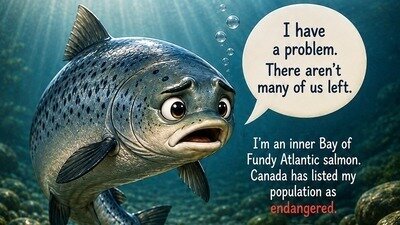
I'm an Inner Bay of Fundy Atlantic Salmon.
Fisheries and Oceans (DFO) is dismantling the Live Gene Bank that has helped keep my endangered inner Bay of Fundy Atlantic salmon population from disappearing. This petition asks Ecojustice to investigate that decision and consider legal action if the evidence and law warrant it.
We are asking DFO to immediately suspend further implementation of its decision to discontinue the Live Gene Bank and close the Coldbrook and Mactaquac biodiversity facilities until it publicly explains what has changed in the science, what will replace the conservation functions being lost, and how its decision is consistent with the recovery of an endangered species.
More than twenty years ago, scientists realized we were in serious trouble. They created a Live Gene Bank (LGB) to preserve our remaining families and the genetic diversity we would need if we were ever going to recover.
It wasn't simply a hatchery.
Scientists carefully managed our families and genetic diversity, combining releases into rivers with a captive family backup.
The river tested the fish. The hatchery protected the family.
And it worked.
DFO scientists found that the Live Gene Bank initially captured approximately 99% of the genetic variation represented by the original wild founders, and subsequent research found that it successfully maintained genetic diversity.
DFO scientists also concluded that inner Bay of Fundy Atlantic salmon would likely be extirpated—gone from the wild—without the Live Gene Bank.
But we haven't recovered.
Wild populations still aren't able to sustain themselves. The extraordinarily poor survival at sea that helped create this crisis has not been solved.
Yet in 2026, Fisheries and Oceans Canada (DFO) decided to discontinue the inner Bay of Fundy Live Gene Bank and close the Coldbrook and Mactaquac biodiversity facilities, which support Atlantic salmon conservation programs in Nova Scotia and New Brunswick.
DFO says operating the two facilities costs approximately $2.3 million annually, very few salmon are returning from the ocean, and there is “no evidence of recovery.”
But poor marine survival isn't something scientists discovered in 2026.
It is one of the reasons the Live Gene Bank existed in the first place.
The Live Gene Bank could preserve salmon families and genetic diversity while scientists searched for solutions.
It could not fix the ocean.
So before a conservation program maintained for more than two decades is dismantled, Canadians deserve an answer to a simple question:
WHAT CHANGED?
What new scientific evidence shows that the Live Gene Bank is no longer needed while the endangered salmon it was created to protect still haven't recovered?
PLEASE CONSIDER SIGNING THE PETITION
We are not asking you to decide whether DFO has broken the law.
We are asking you to join us in demanding answers from the government department responsible for both the recovery of these endangered salmon and the decision to dismantle the conservation program designed to help keep them from disappearing.
We, the undersigned, call on Fisheries and Oceans Canada to immediately suspend further implementation of its decision to discontinue the inner Bay of Fundy Atlantic salmon Live Gene Bank and close the Coldbrook and Mactaquac biodiversity facilities.
Before proceeding further, DFO should publicly explain the scientific basis for its decision, identify what will replace the conservation functions of the Live Gene Bank, and explain how ending the program is consistent with Canada’s Recovery Strategy and Action Plan and its obligations under the Species at Risk Act.
I can’t write to DFO.
I can’t demand answers.
I can’t sign this petition.
You can.
A SPECIES CAN’T RECOVER IF IT’S GONE.
Please sign.
If you'd like to know why this matters, keep reading...
The rest of this petition explains why the Live Gene Bank matters, what is happening at Mactaquac and Coldbrook, and why DFO's decisions deserve a closer look.
WHY SHOULD ANY OF US CARE?
Because this story is about more than salmon.
Atlantic salmon were once woven into life around the Bay of Fundy. They fed people, supported fisheries and helped shape communities along our rivers. For Indigenous peoples, salmon have relationships with culture, identity and place extending back generations.
They are also part of something much bigger that we are losing: biodiversity.
Biodiversity is the extraordinary variety of life on Earth—and the relationships that connect living things to one another and to the places where they live.
That includes us.
We often talk about nature as though it is somewhere else—a forest, a river, an ocean, a place we visit.
It isn't.
We are part of it.
Our food, water, climate and ultimately our own survival are bound up with the living systems around us.
But the world we have built puts enormous pressure on those systems.
We drive cars. We build dams and roads. We harvest forests and grow food. We use pesticides. We develop land. We burn fossil fuels and change the climate.
Most of us aren't prepared to stop doing all of those things.
But our choices come with a price.
If we want the benefits of modern society and want our children and grandchildren to inherit wild salmon, healthy rivers, forests, birds, insects and the extraordinary diversity of life around us, then sometimes we have to actively protect species that can no longer survive everything we have changed.
That is one reason Canada has a Species at Risk Act.
And it is why programs like the Live Gene Bank matter.
The Live Gene Bank couldn't fix poor survival at sea, repair every damaged river or stop climate change.
It could help keep these salmon from disappearing while we worked on those larger problems.
That comes at a cost.
But so do the choices that brought us here.
If we aren't prepared to give up the activities that contribute to biodiversity loss, then conservation is part of the price we pay for continuing those activities without allowing other species to disappear because of them.
And perhaps that is the larger question raised by the decision to dismantle the Live Gene Bank.
The question isn't simply whether maintaining it costs money.
The question is:
What are we prepared to lose to save that money?
WANT TO KNOW MORE?
Here’s why we’re so concerned.
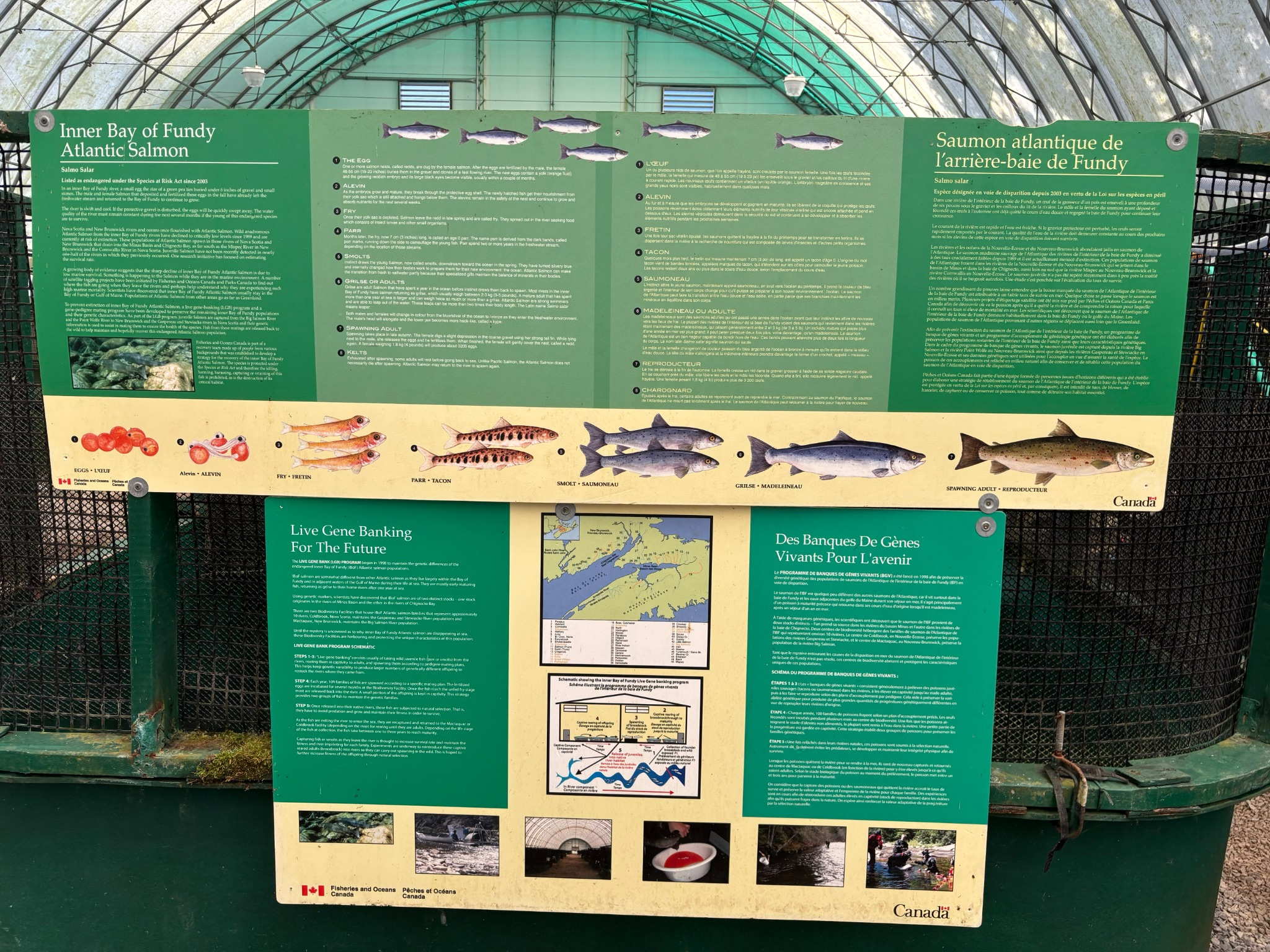
DFO’s own display at Coldbrook explains how the Live Gene Bank was designed to protect the genetic diversity of endangered inner Bay of Fundy Atlantic salmon. Photo: Coldbrook Biodiversity Facility, August 2026
WHAT EXACTLY IS A LIVE GENE BANK?
A Live Gene Bank is not simply a hatchery that produces more salmon.
It is a conservation program designed to preserve the genetic diversity of endangered salmon populations while exposing as much of each generation as possible to natural conditions.
Scientists collect young salmon from particular rivers, raise them to adulthood in the Live Gene Bank, and carefully track their family relationships.
When those salmon are bred, some of their offspring are returned to the river very early in life—often as unfed fry, before they begin feeding. From that point forward, they face the same natural pressures as wild salmon: finding food, avoiding predators, surviving floods and low water, competing for habitat and eventually migrating to sea.
In other words, nature does much of the selecting.
But scientists do not put every member of every family back into the river.
Some are retained in captivity as a family backup.
That matters because survival in the wild is uncertain. If every member of a particular family were released and none survived to reproduce, that family's genetic contribution could disappear.
By retaining representatives of salmon families in captivity, scientists can use carefully planned crosses to help prevent that loss and maintain genetic diversity across generations.
That is the basic idea behind the phrase we've been using:
The river tested the fish. The hatchery protected the family.
This wasn't theoretical.
DFO scientists reported that the Live Gene Bank captured approximately 99% of the genetic variation represented by the original wild founders, and subsequent research found that the program successfully maintained genetic diversity.
The system was never intended to replace wild salmon.
Its purpose was to help make sure there would still be genetically diverse salmon available for recovery while the conditions preventing them from surviving on their own were being addressed.
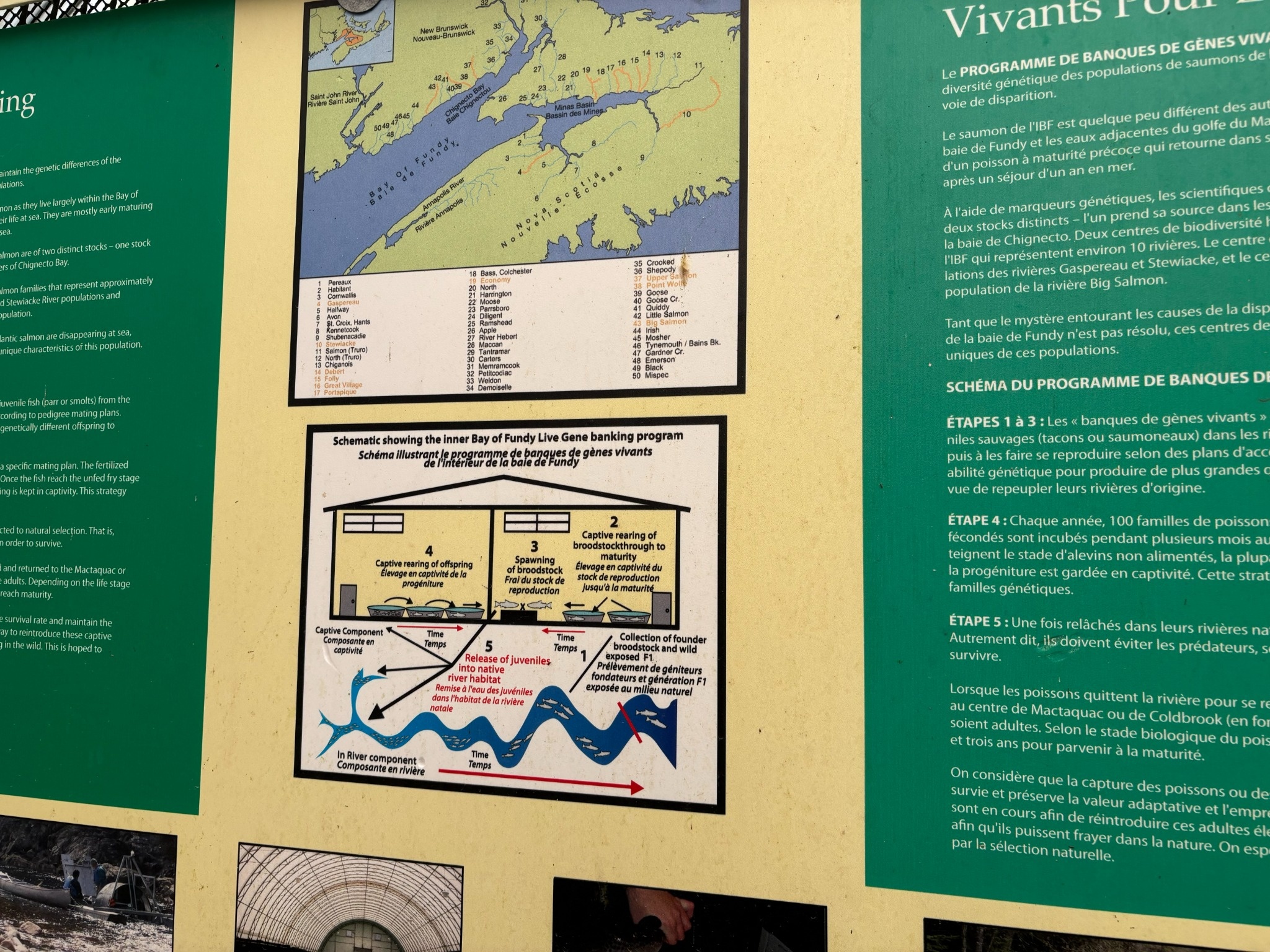
DFO’s schematic shows how the Live Gene Bank combined captive and river components: fish were released into their native rivers while other members of their families were maintained in captivity. Photo: Coldbrook Biodiversity Facility, August 2026
The river tested the fish.
The hatchery protected the family.
Together, those two parts helped preserve the genetic diversity of a population DFO scientists concluded might otherwise disappear.
DFO HAS WEIGHED THE COST OF THE PROGRAM BEFORE
This isn’t the first time DFO has considered the cost of the Live Gene Bank.
In 2004, senior DFO management ordered a technical review of the utility and costs of the program and the biodiversity facilities supporting it.
Closing facilities was expressly considered.
Scientists weighed the savings against the potential conservation consequences.
They concluded that maintaining inner Bay of Fundy salmon through live gene banking remained a “worthy objective.”
The program continued.
Subsequent scientific research demonstrated that the Live Gene Bank could preserve the genetic diversity it was created to protect.
More than twenty years later, DFO has reached a different conclusion.
This time, the Department points to extremely poor numbers of salmon returning from the ocean and says there has been “no evidence of recovery.”
That makes the comparison important.
Poor ocean returns haven’t suddenly appeared.
They were already central to the problem the Live Gene Bank was intended to bridge.
WHAT CHANGED IN THE SCIENCE?
Read-CBC:DFO explains its reasons for closing the biodiversity facility
INDIGENOUS COMMUNITIES ARE ALREADY FIGHTING FOR THESE SALMON
For Indigenous communities in New Brunswick and Nova Scotia, Atlantic salmon are much more than a conservation statistic.
For Wolastoqiyik, Atlantic salmon — Polamuwok — are part of their culture, identity and relationship with Wolastoq (Saint John River).
At Neqotkuk (Tobique First Nation), people have worked for years to restore Atlantic salmon to the Tobique River, one of the most important salmon-producing tributaries of Wolastoq.
The Mactaquac Biodiversity Facility plays a direct role in that work. Young wild salmon from the Tobique can be raised to adulthood and returned to the river to spawn naturally, helping them avoid the extraordinarily dangerous journey to sea and back.
When DFO announced that Mactaquac would close, the Wolastoqey Nation fought back.
Its petition to the House of Commons attracted 1,084 verified signatures from every province and territory in Canada and called on DFO to keep Mactaquac operating until viable alternatives are established and to meaningfully consult the Wolastoqey Nation.
Chief Justice Gruben of Bilijk (Kingsclear First Nation) subsequently told the House of Commons Fisheries Committee:
“The Mactaquac Biodiversity Facility is not a luxury. It is a lifeline.”
[WATCH — CBC: First Nations fight for Wolastoq salmon]
First Nations fighting to save St. John River salmon, as DFO closes support facility
In New Brunswick, Fort Folly First Nation has taken the federal government to court.
Fort Folly has filed an application for judicial review challenging DFO's decision to close the Mactaquac and Coldbrook biodiversity facilities, focusing on the Crown's alleged failure to consult Indigenous peoples before making the decision.
That case matters.
Fort Folly's case concerns the Crown's obligations toward Indigenous peoples. This petition also asks DFO to explain how its decision can be reconciled with the scientific evidence, the existing Recovery Strategy and Action Plan, and Canada's obligations under the Species at Risk Act.
The legal issues are different. And the salmon populations affected by the two facility closures are not all the same.
That is precisely the point.
Coldbrook and Mactaquac have supported conservation work involving different Atlantic salmon populations, different rivers and different communities.
Closing both facilities therefore reaches beyond a single salmon population or conservation program. The consequences extend across rivers and communities in both Nova Scotia and New Brunswick.
THERE IS SOME GOOD NEWS
Scientists and conservation partners have found a promising way to help more inner Bay of Fundy salmon survive one of the most dangerous parts of their lives: their time at sea.
Young salmon that have grown in Fundy National Park rivers are collected as they begin their migration toward the ocean.
Some are taken to a marine conservation farm at Dark Harbour on Grand Manan Island, where they grow to adulthood in seawater.
Then they come home.
The adults are returned to their rivers, where they spawn naturally.
And the results are encouraging.
A scientific study published in 2026 found that these marine-reared adults produced 4.1 times as many offspring per fish as freshwater-reared adults.
But this doesn’t make the Live Gene Bank obsolete.
The two approaches do different things.
Dark Harbour helps salmon survive the dangerous marine period and return to spawn.
The Live Gene Bank helps protect the remaining families and genetic diversity of the endangered population.
And the programs have worked together.
Dark Harbour demonstrates something important:
SMARTER CONSERVATION INTERVENTION CAN WORK.
The question should therefore be how we can improve and combine what works—not whether we should remove the genetic safety net before wild populations can sustain themselves.
THE PROBLEMS HAVEN’T GONE AWAY
DFO has estimated recent mortality at sea at approximately 99%.
Scientists are still trying to understand why so few salmon survive their ocean migration.
The Live Gene Bank could not solve those larger problems.
Its purpose was to help keep the population and its genetic diversity from disappearing while they remained unresolved.
What if restoring conditions capable of supporting self-sustaining wild salmon takes another ten years?
Twenty?
Fifty?
We may not know when—or whether—we will fix everything threatening these salmon.
But we do know we cannot restore them after we've allowed them to disappear.
SO WHAT IS REPLACING THE LIVE GENE BANK?
Some of the fish from Coldbrook have been moved to Dalhousie University's Aquaculture Centre in Truro.
During Jean Louis Deveau's August 2026 visit to the Centre, Paul MacIsaac explained that Dalhousie had agreed to accept some of the fish from Coldbrook at the request of the Confederacy of Mainland Mi'kmaq.
But there are serious limitations.
MacIsaac confirmed that the Truro facility does not have enough space to accommodate the Coldbrook broodstock that had been expected to move there.
During Deveau's subsequent visit to the Coldbrook Biodiversity Facility, he learned that the remaining Live Gene Bank broodstock are instead to be released into the wild as the program is wound down.
That is not simply a question of opening the tanks and finding a river.
Former Coldbrook manager Beth Lenentine explained that the number of fish from each salmon stock matters. So does the availability of suitable spawning and rearing habitat, river flows and water levels. Predators and invasive species may also affect the released adults and their offspring.
And these aren't simply fish that happened to be kept in tanks.
The Live Gene Bank maintained genetic diversity through carefully prescribed mating crosses developed by DFO's genetics specialists.
Earlier we explained the basic idea:
The river tested the fish; the hatchery protected the family.
The broodstock represented the captive side of that system. Scientists knew the fish and their family relationships and could use planned crosses to help maintain the genetic diversity of individual river populations.
Releasing the remaining broodstock will end their role as captive fish within that managed breeding system.
Lenentine told Deveau that the genetic and broader conservation implications of releasing the final broodstock were outside her expertise. She explained that the prescribed mating crosses were planned and developed by DFO's genetics unit.
Deveau has therefore sought further information from DFO to answer a fundamental question:
When the final broodstock are released and those prescribed crosses stop, what—if anything—is genetically lost, and can it ever be recovered?
The answer matters because releasing a salmon is not the same thing as preserving its genetic contribution within a controlled conservation program. A released fish may reproduce. It may also die without spawning.
What remains unclear is what ending controlled breeding means for family representation, prescribed crosses and the genetic diversity the Live Gene Bank was designed to protect.
There are therefore important questions that still need answers:
Where will the remaining broodstock be released, and is suitable spawning and rearing habitat available?
What happens to the captive family backup once those fish are released?
Will prescribed genetic crosses and managed breeding continue anywhere?
Who will maintain the genetic records and scientific expertise accumulated through more than two decades of Live Gene Bank operations?
What long-term arrangements are in place for the fish transferred from Coldbrook to Truro?
And, most importantly:
WHAT IS REPLACING THE LIVE GENE BANK?
WHAT ABOUT DFO’S NEW NATIONAL SALMON STRATEGY?
At almost the same time that DFO is closing the Mactaquac and Coldbrook Biodiversity Facilities and discontinuing the inner Bay of Fundy Live Gene Bank, it is introducing a new National Strategy to Ensure the Future of Atlantic Salmon 2024–2036.
Its stated vision is to:
“Create the conditions necessary for Atlantic salmon and the Atlantic salmon community to thrive.”
The Strategy calls for healthier and more climate-resilient watersheds, stronger Indigenous participation, better collaboration and information-sharing, improved management, climate monitoring and other conservation measures.
Those are important objectives.
But when former Coldbrook manager Beth Lenentine discussed the Strategy with Deveau during his August visit, she raised a remarkably simple question:
Once all that river restoration work is finished, where will the fish come from?
That question goes to the heart of the problem.
DFO's Strategy talks extensively about creating better conditions for Atlantic salmon. But it does not appear to explain how closing two federal biodiversity facilities and dismantling the Live Gene Bank will help achieve that objective—or what will replace the conservation functions they presently provide.
That omission is particularly striking because the Strategy acknowledges that some of Canada's most significant Atlantic salmon declines have occurred in the Bay of Fundy and along the Atlantic coast of Nova Scotia.
It goes further:
“In some rivers... it may not be feasible to restore salmon populations.”
Habitat restoration is essential.
We can improve water quality, reconnect rivers, remove barriers and improve fish passage. But some of that work may take decades.
Restoring habitat without preserving the biological resources needed to repopulate it is like carefully restoring a field after throwing away the seeds you intended to plant.
The Live Gene Bank has helped preserve those biological resources while the larger problems affecting salmon survival remain unresolved.
Yet DFO is closing Coldbrook and Mactaquac, releasing the remaining Coldbrook Live Gene Bank broodstock and winding down the controlled genetic-management system.
Nothing in the four strategic outcomes of the National Strategy appears to identify replacement biodiversity facilities, replacement captive conservation capacity, or another mechanism that performs the same genetic conservation function as the Live Gene Bank.
The Strategy does say DFO intends to develop future policy guidance for Atlantic salmon stocking activities.
But stocking requires fish.
Recovery requires something from which to recover.
Which brings us back to Beth Lenentine's question:
When the habitat is ready, where will the fish come from?
And that leaves an even larger question:
How does closing two biodiversity facilities and dismantling an existing conservation program fit within a National Strategy whose stated purpose is to “ensure the future of Atlantic salmon”?
The Strategy tells Canadians a great deal about the conditions DFO hopes to create for Atlantic salmon.
What it does not appear to tell us is how DFO intends to make sure the salmon themselves are still here to benefit from them.
WHAT ABOUT CANADA’S SPECIES AT RISK ACT?
Inner Bay of Fundy Atlantic salmon are legally listed as endangered under Canada’s Species at Risk Act (SARA).
DFO published a Recovery Strategy in 2010 and an Action Plan in 2019 setting out measures intended to prevent the population from disappearing and promote its recovery.
The Live Gene Bank is part of that recovery framework.
The 2019 Action Plan did not simply describe the Live Gene Bank as something that happened to be operating at the time. It recommended that the program continue while efforts were made to identify and remedy the causes of poor marine survival—or until alternative strategies had been identified, evaluated and supported.
The Action Plan also specifically called for continued Live Gene Bank activities at the Mactaquac and Coldbrook Biodiversity Facilities, explaining that the purpose was to preserve the genetic base of inner Bay of Fundy salmon and maintain their potential for recovery.
The salmon haven’t recovered.
The marine-survival problem hasn’t been solved.
Yet DFO is discontinuing the Live Gene Bank and closing Coldbrook and Mactaquac.
That raises some important questions:
- What changed?
- What scientific evidence supports the new approach?
- What is replacing the Live Gene Bank?
- Where has DFO publicly explained how ending the program is consistent with the recovery of an endangered species?
- The existing public recovery documents have not been replaced by an amended Recovery Strategy explaining how recovery will proceed without the Live Gene Bank, or by a scientifically supported alternative that has been publicly identified, evaluated and supported.
Those are questions DFO should answer before it dismantles a conservation program that its own recovery documents say should continue until alternative strategies have been identified, evaluated and supported.
We are asking DFO to provide those answers—and to suspend further implementation of its decision until it does.
WE’RE ASKING DFO TO ANSWER.
DFO does not need another twenty years of research to explain the decision it has already made.
It should tell Canadians what scientific evidence supports dismantling the Live Gene Bank now.
It should explain what will replace the genetic-conservation functions the program has provided for more than two decades.
It should explain what will happen when the remaining Coldbrook broodstock are released and the controlled family-management system ends.
And it should explain how these decisions are consistent with its own Recovery Strategy, Action Plan and National Strategy to Ensure the Future of Atlantic Salmon.
If DFO has the scientific evidence and a viable alternative recovery approach, it should make them public.
If it does not, it should not dismantle the existing conservation system first and answer these questions afterward.
Scientists can provide the evidence.
Conservation organizations can raise the alarm.
Lawyers can determine whether government complied with the law.
THIS PETITION ADDS THE PUBLIC’S VOICE.
WHY AM I STILL HERE?
My family has survived because, more than twenty years ago, people decided we were worth saving.
Now DFO is dismantling the conservation system those people built to give us a chance.
Before that happens, we deserve to know why.
Ask Fisheries and Oceans Canada to immediately suspend further implementation of its decision to discontinue the inner Bay of Fundy Atlantic salmon Live Gene Bank and close the Coldbrook and Mactaquac biodiversity facilities.
Before proceeding further, DFO should publicly explain what changed in the science, what will replace the conservation functions being lost, and how dismantling the Live Gene Bank is consistent with the recovery of an endangered species.
Add your name.
Then share it.
A SPECIES CAN’T RECOVER IF IT’S GONE.
852
The Issue
I'm an Inner Bay of Fundy Atlantic Salmon.
Fisheries and Oceans (DFO) is dismantling the Live Gene Bank that has helped keep my endangered inner Bay of Fundy Atlantic salmon population from disappearing. This petition asks Ecojustice to investigate that decision and consider legal action if the evidence and law warrant it.
We are asking DFO to immediately suspend further implementation of its decision to discontinue the Live Gene Bank and close the Coldbrook and Mactaquac biodiversity facilities until it publicly explains what has changed in the science, what will replace the conservation functions being lost, and how its decision is consistent with the recovery of an endangered species.
More than twenty years ago, scientists realized we were in serious trouble. They created a Live Gene Bank (LGB) to preserve our remaining families and the genetic diversity we would need if we were ever going to recover.
It wasn't simply a hatchery.
Scientists carefully managed our families and genetic diversity, combining releases into rivers with a captive family backup.
The river tested the fish. The hatchery protected the family.
And it worked.
DFO scientists found that the Live Gene Bank initially captured approximately 99% of the genetic variation represented by the original wild founders, and subsequent research found that it successfully maintained genetic diversity.
DFO scientists also concluded that inner Bay of Fundy Atlantic salmon would likely be extirpated—gone from the wild—without the Live Gene Bank.
But we haven't recovered.
Wild populations still aren't able to sustain themselves. The extraordinarily poor survival at sea that helped create this crisis has not been solved.
Yet in 2026, Fisheries and Oceans Canada (DFO) decided to discontinue the inner Bay of Fundy Live Gene Bank and close the Coldbrook and Mactaquac biodiversity facilities, which support Atlantic salmon conservation programs in Nova Scotia and New Brunswick.
DFO says operating the two facilities costs approximately $2.3 million annually, very few salmon are returning from the ocean, and there is “no evidence of recovery.”
But poor marine survival isn't something scientists discovered in 2026.
It is one of the reasons the Live Gene Bank existed in the first place.
The Live Gene Bank could preserve salmon families and genetic diversity while scientists searched for solutions.
It could not fix the ocean.
So before a conservation program maintained for more than two decades is dismantled, Canadians deserve an answer to a simple question:
WHAT CHANGED?
What new scientific evidence shows that the Live Gene Bank is no longer needed while the endangered salmon it was created to protect still haven't recovered?
PLEASE CONSIDER SIGNING THE PETITION
We are not asking you to decide whether DFO has broken the law.
We are asking you to join us in demanding answers from the government department responsible for both the recovery of these endangered salmon and the decision to dismantle the conservation program designed to help keep them from disappearing.
We, the undersigned, call on Fisheries and Oceans Canada to immediately suspend further implementation of its decision to discontinue the inner Bay of Fundy Atlantic salmon Live Gene Bank and close the Coldbrook and Mactaquac biodiversity facilities.
Before proceeding further, DFO should publicly explain the scientific basis for its decision, identify what will replace the conservation functions of the Live Gene Bank, and explain how ending the program is consistent with Canada’s Recovery Strategy and Action Plan and its obligations under the Species at Risk Act.
I can’t write to DFO.
I can’t demand answers.
I can’t sign this petition.
You can.
A SPECIES CAN’T RECOVER IF IT’S GONE.
Please sign.
If you'd like to know why this matters, keep reading...
The rest of this petition explains why the Live Gene Bank matters, what is happening at Mactaquac and Coldbrook, and why DFO's decisions deserve a closer look.
WHY SHOULD ANY OF US CARE?
Because this story is about more than salmon.
Atlantic salmon were once woven into life around the Bay of Fundy. They fed people, supported fisheries and helped shape communities along our rivers. For Indigenous peoples, salmon have relationships with culture, identity and place extending back generations.
They are also part of something much bigger that we are losing: biodiversity.
Biodiversity is the extraordinary variety of life on Earth—and the relationships that connect living things to one another and to the places where they live.
That includes us.
We often talk about nature as though it is somewhere else—a forest, a river, an ocean, a place we visit.
It isn't.
We are part of it.
Our food, water, climate and ultimately our own survival are bound up with the living systems around us.
But the world we have built puts enormous pressure on those systems.
We drive cars. We build dams and roads. We harvest forests and grow food. We use pesticides. We develop land. We burn fossil fuels and change the climate.
Most of us aren't prepared to stop doing all of those things.
But our choices come with a price.
If we want the benefits of modern society and want our children and grandchildren to inherit wild salmon, healthy rivers, forests, birds, insects and the extraordinary diversity of life around us, then sometimes we have to actively protect species that can no longer survive everything we have changed.
That is one reason Canada has a Species at Risk Act.
And it is why programs like the Live Gene Bank matter.
The Live Gene Bank couldn't fix poor survival at sea, repair every damaged river or stop climate change.
It could help keep these salmon from disappearing while we worked on those larger problems.
That comes at a cost.
But so do the choices that brought us here.
If we aren't prepared to give up the activities that contribute to biodiversity loss, then conservation is part of the price we pay for continuing those activities without allowing other species to disappear because of them.
And perhaps that is the larger question raised by the decision to dismantle the Live Gene Bank.
The question isn't simply whether maintaining it costs money.
The question is:
What are we prepared to lose to save that money?
WANT TO KNOW MORE?
Here’s why we’re so concerned.
DFO’s own display at Coldbrook explains how the Live Gene Bank was designed to protect the genetic diversity of endangered inner Bay of Fundy Atlantic salmon. Photo: Coldbrook Biodiversity Facility, August 2026
WHAT EXACTLY IS A LIVE GENE BANK?
A Live Gene Bank is not simply a hatchery that produces more salmon.
It is a conservation program designed to preserve the genetic diversity of endangered salmon populations while exposing as much of each generation as possible to natural conditions.
Scientists collect young salmon from particular rivers, raise them to adulthood in the Live Gene Bank, and carefully track their family relationships.
When those salmon are bred, some of their offspring are returned to the river very early in life—often as unfed fry, before they begin feeding. From that point forward, they face the same natural pressures as wild salmon: finding food, avoiding predators, surviving floods and low water, competing for habitat and eventually migrating to sea.
In other words, nature does much of the selecting.
But scientists do not put every member of every family back into the river.
Some are retained in captivity as a family backup.
That matters because survival in the wild is uncertain. If every member of a particular family were released and none survived to reproduce, that family's genetic contribution could disappear.
By retaining representatives of salmon families in captivity, scientists can use carefully planned crosses to help prevent that loss and maintain genetic diversity across generations.
That is the basic idea behind the phrase we've been using:
The river tested the fish. The hatchery protected the family.
This wasn't theoretical.
DFO scientists reported that the Live Gene Bank captured approximately 99% of the genetic variation represented by the original wild founders, and subsequent research found that the program successfully maintained genetic diversity.
The system was never intended to replace wild salmon.
Its purpose was to help make sure there would still be genetically diverse salmon available for recovery while the conditions preventing them from surviving on their own were being addressed.
DFO’s schematic shows how the Live Gene Bank combined captive and river components: fish were released into their native rivers while other members of their families were maintained in captivity. Photo: Coldbrook Biodiversity Facility, August 2026
The river tested the fish.
The hatchery protected the family.
Together, those two parts helped preserve the genetic diversity of a population DFO scientists concluded might otherwise disappear.
DFO HAS WEIGHED THE COST OF THE PROGRAM BEFORE
This isn’t the first time DFO has considered the cost of the Live Gene Bank.
In 2004, senior DFO management ordered a technical review of the utility and costs of the program and the biodiversity facilities supporting it.
Closing facilities was expressly considered.
Scientists weighed the savings against the potential conservation consequences.
They concluded that maintaining inner Bay of Fundy salmon through live gene banking remained a “worthy objective.”
The program continued.
Subsequent scientific research demonstrated that the Live Gene Bank could preserve the genetic diversity it was created to protect.
More than twenty years later, DFO has reached a different conclusion.
This time, the Department points to extremely poor numbers of salmon returning from the ocean and says there has been “no evidence of recovery.”
That makes the comparison important.
Poor ocean returns haven’t suddenly appeared.
They were already central to the problem the Live Gene Bank was intended to bridge.
WHAT CHANGED IN THE SCIENCE?
Read-CBC:DFO explains its reasons for closing the biodiversity facility
INDIGENOUS COMMUNITIES ARE ALREADY FIGHTING FOR THESE SALMON
For Indigenous communities in New Brunswick and Nova Scotia, Atlantic salmon are much more than a conservation statistic.
For Wolastoqiyik, Atlantic salmon — Polamuwok — are part of their culture, identity and relationship with Wolastoq (Saint John River).
At Neqotkuk (Tobique First Nation), people have worked for years to restore Atlantic salmon to the Tobique River, one of the most important salmon-producing tributaries of Wolastoq.
The Mactaquac Biodiversity Facility plays a direct role in that work. Young wild salmon from the Tobique can be raised to adulthood and returned to the river to spawn naturally, helping them avoid the extraordinarily dangerous journey to sea and back.
When DFO announced that Mactaquac would close, the Wolastoqey Nation fought back.
Its petition to the House of Commons attracted 1,084 verified signatures from every province and territory in Canada and called on DFO to keep Mactaquac operating until viable alternatives are established and to meaningfully consult the Wolastoqey Nation.
Chief Justice Gruben of Bilijk (Kingsclear First Nation) subsequently told the House of Commons Fisheries Committee:
“The Mactaquac Biodiversity Facility is not a luxury. It is a lifeline.”
[WATCH — CBC: First Nations fight for Wolastoq salmon]
First Nations fighting to save St. John River salmon, as DFO closes support facility
In New Brunswick, Fort Folly First Nation has taken the federal government to court.
Fort Folly has filed an application for judicial review challenging DFO's decision to close the Mactaquac and Coldbrook biodiversity facilities, focusing on the Crown's alleged failure to consult Indigenous peoples before making the decision.
That case matters.
Fort Folly's case concerns the Crown's obligations toward Indigenous peoples. This petition also asks DFO to explain how its decision can be reconciled with the scientific evidence, the existing Recovery Strategy and Action Plan, and Canada's obligations under the Species at Risk Act.
The legal issues are different. And the salmon populations affected by the two facility closures are not all the same.
That is precisely the point.
Coldbrook and Mactaquac have supported conservation work involving different Atlantic salmon populations, different rivers and different communities.
Closing both facilities therefore reaches beyond a single salmon population or conservation program. The consequences extend across rivers and communities in both Nova Scotia and New Brunswick.
THERE IS SOME GOOD NEWS
Scientists and conservation partners have found a promising way to help more inner Bay of Fundy salmon survive one of the most dangerous parts of their lives: their time at sea.
Young salmon that have grown in Fundy National Park rivers are collected as they begin their migration toward the ocean.
Some are taken to a marine conservation farm at Dark Harbour on Grand Manan Island, where they grow to adulthood in seawater.
Then they come home.
The adults are returned to their rivers, where they spawn naturally.
And the results are encouraging.
A scientific study published in 2026 found that these marine-reared adults produced 4.1 times as many offspring per fish as freshwater-reared adults.
But this doesn’t make the Live Gene Bank obsolete.
The two approaches do different things.
Dark Harbour helps salmon survive the dangerous marine period and return to spawn.
The Live Gene Bank helps protect the remaining families and genetic diversity of the endangered population.
And the programs have worked together.
Dark Harbour demonstrates something important:
SMARTER CONSERVATION INTERVENTION CAN WORK.
The question should therefore be how we can improve and combine what works—not whether we should remove the genetic safety net before wild populations can sustain themselves.
THE PROBLEMS HAVEN’T GONE AWAY
DFO has estimated recent mortality at sea at approximately 99%.
Scientists are still trying to understand why so few salmon survive their ocean migration.
The Live Gene Bank could not solve those larger problems.
Its purpose was to help keep the population and its genetic diversity from disappearing while they remained unresolved.
What if restoring conditions capable of supporting self-sustaining wild salmon takes another ten years?
Twenty?
Fifty?
We may not know when—or whether—we will fix everything threatening these salmon.
But we do know we cannot restore them after we've allowed them to disappear.
SO WHAT IS REPLACING THE LIVE GENE BANK?
Some of the fish from Coldbrook have been moved to Dalhousie University's Aquaculture Centre in Truro.
During Jean Louis Deveau's August 2026 visit to the Centre, Paul MacIsaac explained that Dalhousie had agreed to accept some of the fish from Coldbrook at the request of the Confederacy of Mainland Mi'kmaq.
But there are serious limitations.
MacIsaac confirmed that the Truro facility does not have enough space to accommodate the Coldbrook broodstock that had been expected to move there.
During Deveau's subsequent visit to the Coldbrook Biodiversity Facility, he learned that the remaining Live Gene Bank broodstock are instead to be released into the wild as the program is wound down.
That is not simply a question of opening the tanks and finding a river.
Former Coldbrook manager Beth Lenentine explained that the number of fish from each salmon stock matters. So does the availability of suitable spawning and rearing habitat, river flows and water levels. Predators and invasive species may also affect the released adults and their offspring.
And these aren't simply fish that happened to be kept in tanks.
The Live Gene Bank maintained genetic diversity through carefully prescribed mating crosses developed by DFO's genetics specialists.
Earlier we explained the basic idea:
The river tested the fish; the hatchery protected the family.
The broodstock represented the captive side of that system. Scientists knew the fish and their family relationships and could use planned crosses to help maintain the genetic diversity of individual river populations.
Releasing the remaining broodstock will end their role as captive fish within that managed breeding system.
Lenentine told Deveau that the genetic and broader conservation implications of releasing the final broodstock were outside her expertise. She explained that the prescribed mating crosses were planned and developed by DFO's genetics unit.
Deveau has therefore sought further information from DFO to answer a fundamental question:
When the final broodstock are released and those prescribed crosses stop, what—if anything—is genetically lost, and can it ever be recovered?
The answer matters because releasing a salmon is not the same thing as preserving its genetic contribution within a controlled conservation program. A released fish may reproduce. It may also die without spawning.
What remains unclear is what ending controlled breeding means for family representation, prescribed crosses and the genetic diversity the Live Gene Bank was designed to protect.
There are therefore important questions that still need answers:
Where will the remaining broodstock be released, and is suitable spawning and rearing habitat available?
What happens to the captive family backup once those fish are released?
Will prescribed genetic crosses and managed breeding continue anywhere?
Who will maintain the genetic records and scientific expertise accumulated through more than two decades of Live Gene Bank operations?
What long-term arrangements are in place for the fish transferred from Coldbrook to Truro?
And, most importantly:
WHAT IS REPLACING THE LIVE GENE BANK?
WHAT ABOUT DFO’S NEW NATIONAL SALMON STRATEGY?
At almost the same time that DFO is closing the Mactaquac and Coldbrook Biodiversity Facilities and discontinuing the inner Bay of Fundy Live Gene Bank, it is introducing a new National Strategy to Ensure the Future of Atlantic Salmon 2024–2036.
Its stated vision is to:
“Create the conditions necessary for Atlantic salmon and the Atlantic salmon community to thrive.”
The Strategy calls for healthier and more climate-resilient watersheds, stronger Indigenous participation, better collaboration and information-sharing, improved management, climate monitoring and other conservation measures.
Those are important objectives.
But when former Coldbrook manager Beth Lenentine discussed the Strategy with Deveau during his August visit, she raised a remarkably simple question:
Once all that river restoration work is finished, where will the fish come from?
That question goes to the heart of the problem.
DFO's Strategy talks extensively about creating better conditions for Atlantic salmon. But it does not appear to explain how closing two federal biodiversity facilities and dismantling the Live Gene Bank will help achieve that objective—or what will replace the conservation functions they presently provide.
That omission is particularly striking because the Strategy acknowledges that some of Canada's most significant Atlantic salmon declines have occurred in the Bay of Fundy and along the Atlantic coast of Nova Scotia.
It goes further:
“In some rivers... it may not be feasible to restore salmon populations.”
Habitat restoration is essential.
We can improve water quality, reconnect rivers, remove barriers and improve fish passage. But some of that work may take decades.
Restoring habitat without preserving the biological resources needed to repopulate it is like carefully restoring a field after throwing away the seeds you intended to plant.
The Live Gene Bank has helped preserve those biological resources while the larger problems affecting salmon survival remain unresolved.
Yet DFO is closing Coldbrook and Mactaquac, releasing the remaining Coldbrook Live Gene Bank broodstock and winding down the controlled genetic-management system.
Nothing in the four strategic outcomes of the National Strategy appears to identify replacement biodiversity facilities, replacement captive conservation capacity, or another mechanism that performs the same genetic conservation function as the Live Gene Bank.
The Strategy does say DFO intends to develop future policy guidance for Atlantic salmon stocking activities.
But stocking requires fish.
Recovery requires something from which to recover.
Which brings us back to Beth Lenentine's question:
When the habitat is ready, where will the fish come from?
And that leaves an even larger question:
How does closing two biodiversity facilities and dismantling an existing conservation program fit within a National Strategy whose stated purpose is to “ensure the future of Atlantic salmon”?
The Strategy tells Canadians a great deal about the conditions DFO hopes to create for Atlantic salmon.
What it does not appear to tell us is how DFO intends to make sure the salmon themselves are still here to benefit from them.
WHAT ABOUT CANADA’S SPECIES AT RISK ACT?
Inner Bay of Fundy Atlantic salmon are legally listed as endangered under Canada’s Species at Risk Act (SARA).
DFO published a Recovery Strategy in 2010 and an Action Plan in 2019 setting out measures intended to prevent the population from disappearing and promote its recovery.
The Live Gene Bank is part of that recovery framework.
The 2019 Action Plan did not simply describe the Live Gene Bank as something that happened to be operating at the time. It recommended that the program continue while efforts were made to identify and remedy the causes of poor marine survival—or until alternative strategies had been identified, evaluated and supported.
The Action Plan also specifically called for continued Live Gene Bank activities at the Mactaquac and Coldbrook Biodiversity Facilities, explaining that the purpose was to preserve the genetic base of inner Bay of Fundy salmon and maintain their potential for recovery.
The salmon haven’t recovered.
The marine-survival problem hasn’t been solved.
Yet DFO is discontinuing the Live Gene Bank and closing Coldbrook and Mactaquac.
That raises some important questions:
- What changed?
- What scientific evidence supports the new approach?
- What is replacing the Live Gene Bank?
- Where has DFO publicly explained how ending the program is consistent with the recovery of an endangered species?
- The existing public recovery documents have not been replaced by an amended Recovery Strategy explaining how recovery will proceed without the Live Gene Bank, or by a scientifically supported alternative that has been publicly identified, evaluated and supported.
Those are questions DFO should answer before it dismantles a conservation program that its own recovery documents say should continue until alternative strategies have been identified, evaluated and supported.
We are asking DFO to provide those answers—and to suspend further implementation of its decision until it does.
WE’RE ASKING DFO TO ANSWER.
DFO does not need another twenty years of research to explain the decision it has already made.
It should tell Canadians what scientific evidence supports dismantling the Live Gene Bank now.
It should explain what will replace the genetic-conservation functions the program has provided for more than two decades.
It should explain what will happen when the remaining Coldbrook broodstock are released and the controlled family-management system ends.
And it should explain how these decisions are consistent with its own Recovery Strategy, Action Plan and National Strategy to Ensure the Future of Atlantic Salmon.
If DFO has the scientific evidence and a viable alternative recovery approach, it should make them public.
If it does not, it should not dismantle the existing conservation system first and answer these questions afterward.
Scientists can provide the evidence.
Conservation organizations can raise the alarm.
Lawyers can determine whether government complied with the law.
THIS PETITION ADDS THE PUBLIC’S VOICE.
WHY AM I STILL HERE?
My family has survived because, more than twenty years ago, people decided we were worth saving.
Now DFO is dismantling the conservation system those people built to give us a chance.
Before that happens, we deserve to know why.
Ask Fisheries and Oceans Canada to immediately suspend further implementation of its decision to discontinue the inner Bay of Fundy Atlantic salmon Live Gene Bank and close the Coldbrook and Mactaquac biodiversity facilities.
Before proceeding further, DFO should publicly explain what changed in the science, what will replace the conservation functions being lost, and how dismantling the Live Gene Bank is consistent with the recovery of an endangered species.
Add your name.
Then share it.
A SPECIES CAN’T RECOVER IF IT’S GONE.The Decision Makers

Petition Updates
Share this petition
Petition created on August 25, 2026