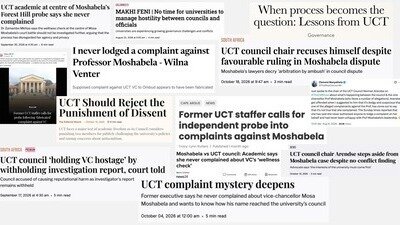
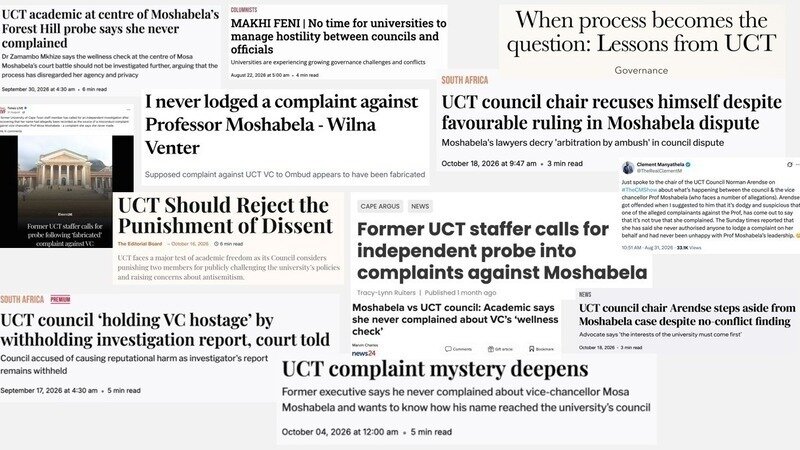
A Call to the UCT Council: Invite Adv Norman Arendse SC to Stand Down as Chair
The Issue
We, the undersigned stakeholders in the University of Cape Town, owe much to our university.
Those of us who are alumni and academics carry its name, its value and its values in our careers, our communities and our character, and we trust those who govern it to be careful stewards of its people and its reputation. Some of us are parents or loved ones of students attending UCT, others funders of our alma mater, extending our faith and commitment in the university to future generations of students. What unites us is our love for UCT.
We put our names to this Call because the conduct of the Chair of Council, Advocate Norman Arendse SC, has shaken that trust. We believe that Council must act urgently to restore it by urgently inviting the Chair to stand down.
Every member of Council, the Chair included, subscribes each year to a Code of Conduct. Council members undertake to act “in good faith, honestly, truthfully and for proper purpose,” to “exercise appropriate care and diligence in decision making,” to “preserve the dignity and respect of Council,” and “individually and collectively, to always act in the best interests of the University.” Council commits itself to “acting with the duty of care and skill that is owed to the University.” The Statement of Values attached to the Code commits every member of the UCT community to “fairness, consistency, and integrity” in all institutional relationships, and to “refrain from speech or conduct that demeans or humiliates people.”
The Chair, who presides over Council and speaks for it, should be the first to honour these commitments. Instead, the Chair’s repeated public conduct deeply troubles those who care about UCT and flagrantly flouts the Code.
On 31 August, for example, Arendse appeared on Radio 702 to discuss Council’s handling of complaints against the Vice-Chancellor. As has since been revealed, an investigation commissioned by Council had already cleared the Vice-Chancellor of alleged wrongdoings, only one of which was ever put to him and contained in a report that has never been shared with him.
Instead Arendse besmirched the reputation of the Vice-Chancellor by knowingly relaying allegations that he knew to be untrue, while breaching the very confidentiality that he demands of Professor Moshabela. What’s more, three people linked to UCT have since said that they simply never made complaints against the Vice-Chancellor that were in their names.
Arendse knows what fairness requires. He has said the following on the record about prior complaints made against himself: “the principles of natural justice require that an accused person be apprised of the case against him with sufficient clarity and particularity to enable a meaningful response .”
As further proof of his irresponsible leadership and poor judgement, on 20 October, the Chair took it upon himself to share reports by two retired judges into complaints against certain Council members by other Council colleagues and UCT academics with the entire university community. He did so knowingly and without consideration of the damaging material they contained. Those affected were given no notice that the reports would be published, and no chance to be heard on whether, or how, that should happen. They have since been removed from UCT’s website, but the damage has been done.
Among those that they briefly but irreversibly humiliated in public is the Dean of a Faculty, who was never a party to any complaint. Judge Wallis’s report, published on the website without a single redaction, reproduces word for word what was said about him in Council’s confidential deliberations on his appointment, including confidential material from his selection process.
Judge Navsa’s report reproduces stills from protest videos, faces unobscured, among them people he describes as what “appears to be young students.” The Code’s commitment to the dignity of individuals, and the University’s stated commitment to “the health and wellbeing and personal safety of all members of the community,” were not served by this report being shared widely without the images being redacted. The removal of the reports is a practical irrelevance at this stage.
As a Senior Counsel presiding over the University’s highest body, the Chair was better placed than anyone to consider the consequences of his actions. Instead, he is personally responsible for a grave failure of the care and diligence that the Code requires, and that responsible leadership demands.
Such reckless and irresponsible behaviour sends a clear message.
The Chair of Council cares not for the dignity of students and staff. The Chair of Council cares not for the reputation of the University. And the Chair of Council cannot be trusted.
We do not ask members of Council to take a side on the questions that divide it. They are entitled to hold and express views strongly. Our call is about stewardship and leadership. The University needs a Chair who can hold a divided Council together and, in time, help heal those divisions, rather than exacerbate them. A Chair who treats the confidences placed in the University as a matter of trust, and who places the reputation and interests of the university first. Norman Arendse has repeatedly shown that he is not that person.
We therefore call on the UCT Council to demand that Norman Arendse stand down as Chair so that it may elect a successor under the University’s Statute.
UCT deserves a Chair who will enhance its legacy, not destroy it.

862
The Issue
We, the undersigned stakeholders in the University of Cape Town, owe much to our university.
Those of us who are alumni and academics carry its name, its value and its values in our careers, our communities and our character, and we trust those who govern it to be careful stewards of its people and its reputation. Some of us are parents or loved ones of students attending UCT, others funders of our alma mater, extending our faith and commitment in the university to future generations of students. What unites us is our love for UCT.
We put our names to this Call because the conduct of the Chair of Council, Advocate Norman Arendse SC, has shaken that trust. We believe that Council must act urgently to restore it by urgently inviting the Chair to stand down.
Every member of Council, the Chair included, subscribes each year to a Code of Conduct. Council members undertake to act “in good faith, honestly, truthfully and for proper purpose,” to “exercise appropriate care and diligence in decision making,” to “preserve the dignity and respect of Council,” and “individually and collectively, to always act in the best interests of the University.” Council commits itself to “acting with the duty of care and skill that is owed to the University.” The Statement of Values attached to the Code commits every member of the UCT community to “fairness, consistency, and integrity” in all institutional relationships, and to “refrain from speech or conduct that demeans or humiliates people.”
The Chair, who presides over Council and speaks for it, should be the first to honour these commitments. Instead, the Chair’s repeated public conduct deeply troubles those who care about UCT and flagrantly flouts the Code.
On 31 August, for example, Arendse appeared on Radio 702 to discuss Council’s handling of complaints against the Vice-Chancellor. As has since been revealed, an investigation commissioned by Council had already cleared the Vice-Chancellor of alleged wrongdoings, only one of which was ever put to him and contained in a report that has never been shared with him.
Instead Arendse besmirched the reputation of the Vice-Chancellor by knowingly relaying allegations that he knew to be untrue, while breaching the very confidentiality that he demands of Professor Moshabela. What’s more, three people linked to UCT have since said that they simply never made complaints against the Vice-Chancellor that were in their names.
Arendse knows what fairness requires. He has said the following on the record about prior complaints made against himself: “the principles of natural justice require that an accused person be apprised of the case against him with sufficient clarity and particularity to enable a meaningful response .”
As further proof of his irresponsible leadership and poor judgement, on 20 October, the Chair took it upon himself to share reports by two retired judges into complaints against certain Council members by other Council colleagues and UCT academics with the entire university community. He did so knowingly and without consideration of the damaging material they contained. Those affected were given no notice that the reports would be published, and no chance to be heard on whether, or how, that should happen. They have since been removed from UCT’s website, but the damage has been done.
Among those that they briefly but irreversibly humiliated in public is the Dean of a Faculty, who was never a party to any complaint. Judge Wallis’s report, published on the website without a single redaction, reproduces word for word what was said about him in Council’s confidential deliberations on his appointment, including confidential material from his selection process.
Judge Navsa’s report reproduces stills from protest videos, faces unobscured, among them people he describes as what “appears to be young students.” The Code’s commitment to the dignity of individuals, and the University’s stated commitment to “the health and wellbeing and personal safety of all members of the community,” were not served by this report being shared widely without the images being redacted. The removal of the reports is a practical irrelevance at this stage.
As a Senior Counsel presiding over the University’s highest body, the Chair was better placed than anyone to consider the consequences of his actions. Instead, he is personally responsible for a grave failure of the care and diligence that the Code requires, and that responsible leadership demands.
Such reckless and irresponsible behaviour sends a clear message.
The Chair of Council cares not for the dignity of students and staff. The Chair of Council cares not for the reputation of the University. And the Chair of Council cannot be trusted.
We do not ask members of Council to take a side on the questions that divide it. They are entitled to hold and express views strongly. Our call is about stewardship and leadership. The University needs a Chair who can hold a divided Council together and, in time, help heal those divisions, rather than exacerbate them. A Chair who treats the confidences placed in the University as a matter of trust, and who places the reputation and interests of the university first. Norman Arendse has repeatedly shown that he is not that person.
We therefore call on the UCT Council to demand that Norman Arendse stand down as Chair so that it may elect a successor under the University’s Statute.
UCT deserves a Chair who will enhance its legacy, not destroy it.
The Decision Makers
Petition Updates
Share this petition
Petition created on 21 October 2026