
90 Days Means 90 Days: Fix Missouri Vocational Rehabilitation’s IPE Extension Rules
The Issue
90 Days Means 90 Days: Fix Missouri Vocational Rehabilitation’s IPE Extension Rules
Help require Missouri Vocational Rehabilitation to clearly follow the federal 90-day IPE timeline and define what “agreement” means before extending it.
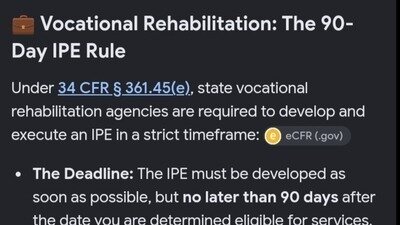
Missouri Vocational Rehabilitation (MoVR) serves Missourians with disabilities under the federal Rehabilitation Act and its implementing regulations. Federal law requires an Individualized Plan for Employment (IPE) to be developed as soon as possible and no later than 90 days after eligibility is determined, unless the State VR agency and the eligible individual agree to extend the deadline to a specific date.
34 CFR § 361.45(e).
Missouri's own Client Services Guide recognizes this requirement. CSG §120.8 states that when an IPE cannot be developed within 90 days, the case is placed in “Eligible–E (Plan Development Extension)” and requires a Plan Development Extension Agreement Date, a specific date to which development will be extended, and supporting documentation verifying the client's permission.
The problem is that Missouri's policies should be much clearer about what constitutes an actual agreement.
A client should not be considered to have agreed to an extension merely because the client continues communicating with a counselor, attends a meeting, participates in IPE discussions, provides documents, or remains willing to work toward an IPE. Participation in the rehabilitation process is not necessarily consent to waive or extend a federal deadline.
Missouri should establish a clear written procedure requiring that an IPE extension:
Be requested before the original 90-day deadline expires;
State the specific circumstances supporting the extension;
State the exact new date for completion;
Clearly explain that the individual has the right to agree or decline;
Require affirmative, documented agreement from both the counselor and eligible individual;
Provide the individual with a copy of the extension documentation;
Never treat a refusal to agree to an extension as proof that the individual is “non-compliant,” “uncooperative,” or unwilling to participate in VR; and
Require continued documentation of what services, assessments, decisions, and actions are occurring during the extension.
This clarification is especially important when an eligible individual has already spent many months in “plan development.” Federal regulations also require the IPE to be a written document, developed through informed choice, agreed to and signed by the eligible individual and the VR counselor, with a copy provided to the individual. 34 CFR §361.45(d).
If an individual is being asked to sign an IPE, amendment, extension, or other agreement, the individual should be allowed to receive a copy of the document and review it before signing. A disagreement with the contents of a proposed document should not automatically be characterized as refusal to cooperate.
RSA has already identified this issue
This request is not simply based on one individual's experience.
In its FY2025 monitoring of Missouri Vocational Rehabilitation, the Rehabilitation Services Administration (RSA) reported that MVR's initial IPE extensions occurred in approximately 14% of cases in PY2021, 14% in PY2022, and 18% in PY2023. RSA specifically advised MVR to consider including a description of extenuating circumstances and requirements for granting IPE extensions in its policies, including CSG 100, consistent with 34 CFR §361.45(e).
RSA also advised Missouri to analyze policies and practices concerning the prompt handling of IPE development and service delivery and to revise written policies concerning informed choice and participant engagement.
That makes this an important opportunity for Missouri to respond directly to RSA's concerns.
What should change
Missouri should revise its Client Services Guide to state plainly:
An IPE must be developed as soon as possible and no later than 90 days after eligibility determination. An extension is an exception to that deadline and requires affirmative agreement by both the eligible individual and the State VR agency to a specific completion date. Continued participation in counseling, assessment, meetings, communication, or IPE development does not by itself constitute agreement to extend the deadline. A refusal to agree to an extension shall not, by itself, be treated as non-compliance or lack of cooperation. All extension requests and agreements must be documented in writing and provided to the eligible individual.
Missouri should also establish a simple IPE Extension Agreement Form that identifies the original 90-day deadline, the reason for the requested extension, the proposed completion date, and the signatures or other affirmative confirmation of both parties.
This would provide protection for clients and counselors by eliminating disputes over whether an extension was actually agreed upon.
The goal is simple:
No more unclear extensions. No more indefinite “development” periods. No more confusion between cooperation and consent.
Missouri VR clients should know when their federal 90-day deadline expires, whether an extension is being requested, why it is being requested, exactly how long it will last, and what they are agreeing to.
90 days should remain the rule. Extensions should be documented exceptions — not an open-ended process.
Please support a clear, written Missouri VR policy requiring affirmative, documented agreement to any IPE extension and protecting clients from being labeled non-compliant simply because they decline to extend a federal deadline.

3
The Issue
90 Days Means 90 Days: Fix Missouri Vocational Rehabilitation’s IPE Extension Rules
Help require Missouri Vocational Rehabilitation to clearly follow the federal 90-day IPE timeline and define what “agreement” means before extending it.
Missouri Vocational Rehabilitation (MoVR) serves Missourians with disabilities under the federal Rehabilitation Act and its implementing regulations. Federal law requires an Individualized Plan for Employment (IPE) to be developed as soon as possible and no later than 90 days after eligibility is determined, unless the State VR agency and the eligible individual agree to extend the deadline to a specific date.
34 CFR § 361.45(e).
Missouri's own Client Services Guide recognizes this requirement. CSG §120.8 states that when an IPE cannot be developed within 90 days, the case is placed in “Eligible–E (Plan Development Extension)” and requires a Plan Development Extension Agreement Date, a specific date to which development will be extended, and supporting documentation verifying the client's permission.
The problem is that Missouri's policies should be much clearer about what constitutes an actual agreement.
A client should not be considered to have agreed to an extension merely because the client continues communicating with a counselor, attends a meeting, participates in IPE discussions, provides documents, or remains willing to work toward an IPE. Participation in the rehabilitation process is not necessarily consent to waive or extend a federal deadline.
Missouri should establish a clear written procedure requiring that an IPE extension:
Be requested before the original 90-day deadline expires;
State the specific circumstances supporting the extension;
State the exact new date for completion;
Clearly explain that the individual has the right to agree or decline;
Require affirmative, documented agreement from both the counselor and eligible individual;
Provide the individual with a copy of the extension documentation;
Never treat a refusal to agree to an extension as proof that the individual is “non-compliant,” “uncooperative,” or unwilling to participate in VR; and
Require continued documentation of what services, assessments, decisions, and actions are occurring during the extension.
This clarification is especially important when an eligible individual has already spent many months in “plan development.” Federal regulations also require the IPE to be a written document, developed through informed choice, agreed to and signed by the eligible individual and the VR counselor, with a copy provided to the individual. 34 CFR §361.45(d).
If an individual is being asked to sign an IPE, amendment, extension, or other agreement, the individual should be allowed to receive a copy of the document and review it before signing. A disagreement with the contents of a proposed document should not automatically be characterized as refusal to cooperate.
RSA has already identified this issue
This request is not simply based on one individual's experience.
In its FY2025 monitoring of Missouri Vocational Rehabilitation, the Rehabilitation Services Administration (RSA) reported that MVR's initial IPE extensions occurred in approximately 14% of cases in PY2021, 14% in PY2022, and 18% in PY2023. RSA specifically advised MVR to consider including a description of extenuating circumstances and requirements for granting IPE extensions in its policies, including CSG 100, consistent with 34 CFR §361.45(e).
RSA also advised Missouri to analyze policies and practices concerning the prompt handling of IPE development and service delivery and to revise written policies concerning informed choice and participant engagement.
That makes this an important opportunity for Missouri to respond directly to RSA's concerns.
What should change
Missouri should revise its Client Services Guide to state plainly:
An IPE must be developed as soon as possible and no later than 90 days after eligibility determination. An extension is an exception to that deadline and requires affirmative agreement by both the eligible individual and the State VR agency to a specific completion date. Continued participation in counseling, assessment, meetings, communication, or IPE development does not by itself constitute agreement to extend the deadline. A refusal to agree to an extension shall not, by itself, be treated as non-compliance or lack of cooperation. All extension requests and agreements must be documented in writing and provided to the eligible individual.
Missouri should also establish a simple IPE Extension Agreement Form that identifies the original 90-day deadline, the reason for the requested extension, the proposed completion date, and the signatures or other affirmative confirmation of both parties.
This would provide protection for clients and counselors by eliminating disputes over whether an extension was actually agreed upon.
The goal is simple:
No more unclear extensions. No more indefinite “development” periods. No more confusion between cooperation and consent.
Missouri VR clients should know when their federal 90-day deadline expires, whether an extension is being requested, why it is being requested, exactly how long it will last, and what they are agreeing to.
90 days should remain the rule. Extensions should be documented exceptions — not an open-ended process.
Please support a clear, written Missouri VR policy requiring affirmative, documented agreement to any IPE extension and protecting clients from being labeled non-compliant simply because they decline to extend a federal deadline.
The Decision Makers


Petition Updates
Share this petition
Petition created on September 23, 2026