日本政府への国際請願:政教分離を求める署名|Recovering Japan's politics from corruption & religion|English Below
署名活動の主旨
■ 署名活動の主旨
日本国憲法第21条は信教の自由と政教分離原則を明記しています。
しかし、世界平和統一家庭連合(旧統一教会)と主要与党議員との間の構造的関係が数十年にわたって維持されてきました。
宗教法人の解散命令が確定した今こそ、議員個人の説明責任と被害者救済に取り組む時です。
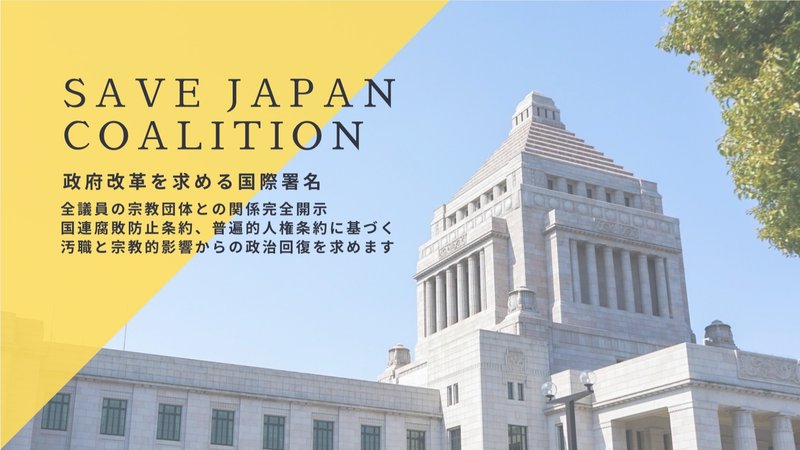
政府改革を求める国際署名では、国会議員の宗教団体との関係完全開示、国連腐敗防止条約、普遍的人権条約に基づく、汚職と宗教的影響からの政治的回復を求めます。
■ 重要な事実
- 霊感商法被害総額(1987〜2021年):約1,237億円
- 認定被害者数(2025年):1,559人以上
- 2025年3月:東京地裁が宗教法人解散命令
- 2026年3月:東京高裁が即時抗告を棄却。同決定は、2018〜2022年度に日本から海外へ650億円超が送金され、その約9割が韓国向けであると認定した
- 2026年6月:最高裁が教団側の特別抗告を棄却し、解散命令が確定
- 2026年:安全保障関連法成立から11年となる中、戦争反対・憲法改正反対のデモが全国330カ所で実施され、国会前では主催者発表で3万人以上が集結した
- 2026年11月4日:参議院憲法審査会において、いのちの党の奥田ふみよ議員が、旧統一教会の関連政治団体である国際勝共連合が以前から緊急事態条項の創設を主張してきたことを指摘し、その主張と自民党憲法改正案との類似性を問題視。憲法審査会の会長・幹事を務める議員と旧統一教会との関係について徹底した調査を求めた
『 解散命令は、法人格の消滅をもたらすが、議員と当該団体の関係の説明責任、および被害者への財産返還の課題は未解決のまま残されている 』
■ 民主的プロセスへの懸念
解散命令の確定後も、一部の議員が当該団体と有した関係について、いつ、どのような支援を受け、自らの名前と地位をどのように貸したのかについて、国民への十分な説明がなされていません。
憲法審査会で行われた調査要求は、この問題が過去の精算にとどまらず、現在進行中の憲法改正論議そのものに関わることを示しています。
世論調査での継続的な関心、市民社会による2万件を超える署名、大規模な全国抗議行動、国会での正式な提起にもかかわらず、これらの政治的関係に関する独立の調査はいまだ設置されていません。
公僕としての説明責任と透明性を担保する仕組みは、依然として存在しないままです。
■ 私たちが求める8つの改革
1. 全議員の宗教団体との関係の完全開示(過去10年分)
2. 統一教会系団体からの政治献金の完全禁止
3. 財産清算手続の透明化と、霊感商法被害者への返還を最優先とする体制の整備
4. 法人格喪失後の残余組織の資金移動・活動の監視体制整備
5. 政党助成金の受給条件への透明性要件の追加(宗教団体関係の申告義務化)
6. 与野党に偏らない第三者的監視委員会の設置(市民・学者・海外専門家を含む)
7. 参議院・衆議院憲法審査会の会長・幹事を含む全役員の宗教団体との関係に関する徹底調査の実施
8. 政治資金のオンラインリアルタイム公開データベースの構築、および選挙・献金規制の国際基準(OECD・UNCAC)整合性の向上
■ 法的根拠
- 国連腐敗防止条約(UNCAC)— 日本批准(2017年7月11日受諾書寄託・平成29年条約第24号)
- OECD外国公務員贈賄防止条約 — 日本加盟(1999年発効)
- 自由権規約(ICCPR)— 日本批准(1979年)
- 日本国憲法第21条(政教分離)
■ なぜ国際社会の関与が必要か
これは国内政治への批判ではなく、普遍的人権条約および国際的反汚職規範に基づく要請です。
文書化された市民の要求と政府の行動の間に存在するこの隙間は、日本の民主的制度の応答性に関わる重大な懸念であり、現在進行中の憲法改正論議の健全性にも関わるものです。
この問題はアジア太平洋地域のみならず、民主主義規範の世界的信頼性にも関わります。
■ 対象機関
日本政府、国会、衆参両議院事務局、総務省、法務省、外務省、参議院憲法審査会
■ 共通宣言
公正な選挙、透明な政治資金、宗教的中立性、説明責任の担保という人類共通の価値を守るために、私たちは国際的民主主義規範に基づく上述の要求に合意します。
■ 署名
現在までに2万件を超える署名が集まっています。(日本有志の方々の活動)
https://www.change.org/savejapan0307
■ 主催団体
SAVE JAPAN COALITION(セーブジャパン連合)
---
English Version
『 International Petition to the Government of Japan: Calling for the Strict Enforcement of the Separation of Religion and Politics 』
Full Disclosure of All Legislators' Ties to Religious Organizations, and the Recovery of Politics from Corruption and Religious Influence
■ Organizing entity
SAVE JAPAN COALITION
■ Purpose of this petition
Article 21 of the Constitution of Japan guarantees freedom of religion and the principle of separation of religion and state. Yet a structural relationship between the Family Federation for World Peace and Unification (formerly the Unification Church) and key members of the ruling party has persisted for decades. Now that the court-ordered dissolution of the organization has become final, it is time to address the accountability of individual legislators and the redress of victims.
In this international petition calling for government reform, we demand the full disclosure of all Diet members' ties to religious organizations, and the political recovery of Japan from corruption and religious influence, in accordance with the UN Convention against Corruption and universal human rights conventions.
■ Key facts
- Total damages from unlawful solicitation ("reikan shōhō") claimed in Japanese courts, 1987–2021: approx. 123.7 billion yen
- Certified victims (2025): more than 1,559 persons
- March 2025: the Tokyo District Court ordered the dissolution of the religious corporation
- March 2026: the Tokyo High Court dismissed the appeal. Its decision found that over 65 billion yen had been remitted abroad from Japan between fiscal years 2018 and 2022, with approximately 90% sent to South Korea
- June 2026: the Supreme Court of Japan rejected the organization's final appeal, making the dissolution order final and binding
- 2026: eleven years after the enactment of Japan's security-related legislation, protests opposing war and constitutional revision were held in 330 locations nationwide, with more than 30,000 people reported by organizers gathering in front of the National Diet
- November 4, 2026: at a session of the House of Councillors' Commission on the Constitution, Ms. Okuda Fumiyo, a member of the Inochi-no-Tō party, noted that the International Federation for Victory over Communism (Kokusa Shōkyō Rengō), a political organization affiliated with the former Unification Church, has long advocated the inclusion of an emergency clause in the Constitution. She questioned the similarity between that advocacy and the constitutional amendment proposals of the Liberal Democratic Party, and demanded a thorough investigation into the ties between the former Unification Church and the legislators serving as Chair and Director-General of the Commission
『 The dissolution extinguishes the legal personality of the corporation, but the accountability of individual legislators regarding their ties to the organization, and the recovery of assets for victims, remain unresolved 』
■ Concerns regarding democratic process
Even after the dissolution order became final, many legislators who maintained ties with the organization have not provided adequate public explanations of when and what support they received, and how they lent their names and offices to its activities.
The call for an investigation raised at the Commission on the Constitution shows that this issue is not merely a matter of settling the past: it bears directly on the ongoing debate over constitutional revision itself.
Despite sustained public interest shown in opinion polls, a petition signed by more than 20,000 Japanese citizens, large-scale nationwide protest actions, and formal questions raised in the National Diet, no independent investigation into these political ties has been established.
From the perspective of the international community, this gap between public demand and government action raises serious concern about whether the will of the people is being reflected at all in Japan's democratic institutions.
■ The eight reforms we demand
1. Full disclosure by all legislators of their ties to religious organizations over the past ten years
2. A complete ban on political donations from organizations affiliated with the former Unification Church
3. A framework giving priority to transparency in asset liquidation proceedings and the restitution of victims of unlawful solicitation
4. Monitoring mechanisms for the fund transfers and activities of successor organizations following loss of legal personality
5. Transparency requirements attached to political party subsidies, including mandatory declarations of ties to religious organizations
6. Establishment of a politically neutral oversight committee including citizens, scholars, and international experts
7. A thorough investigation into the ties to religious organizations of all officers of the Commissions on the Constitution of both Houses, including their Chairs and Directors-General
8. A real-time online database of political funds, and bringing electoral and political-finance regulation into line with international standards (OECD, UNCAC)
■ Legal basis
- United Nations Convention against Corruption (UNCAC) — ratified by Japan (instrument deposited July 11, 2017; Treaty No. 24 of 2017)
- OECD Anti-Bribery Convention — acceded to by Japan (in force 1999)
- International Covenant on Civil and Political Rights (ICCPR) — ratified by Japan (1979)
- Article 21 of the Constitution of Japan (separation of religion and state)
■ Why international engagement is necessary
This is not mere domestic criticism: it is a request grounded in universal human rights treaties and international anti-corruption norms.
The documented gap between citizen demand and government response bears on the integrity of the ongoing constitutional debate in Japan, on the credibility of democratic norms worldwide, and on peace and stability in the Asia-Pacific region.
■ Addressees
The Government of Japan, the National Diet, the Secretariats of both Houses, the Ministry of Internal Affairs and Communications, the Ministry of Justice, the Ministry of Foreign Affairs, and the Commissions on the Constitution of both Houses
■ Joint declaration
To uphold the shared values of fair elections, transparent political finance, religious neutrality, and public accountability, we agree to the above demands grounded in international democratic norms.
■ Petition
Over 20,000 signatures have been collected to date (by volunteer citizens in Japan).
250
署名活動の主旨
■ 署名活動の主旨
日本国憲法第21条は信教の自由と政教分離原則を明記しています。
しかし、世界平和統一家庭連合(旧統一教会)と主要与党議員との間の構造的関係が数十年にわたって維持されてきました。
宗教法人の解散命令が確定した今こそ、議員個人の説明責任と被害者救済に取り組む時です。
政府改革を求める国際署名では、国会議員の宗教団体との関係完全開示、国連腐敗防止条約、普遍的人権条約に基づく、汚職と宗教的影響からの政治的回復を求めます。
■ 重要な事実
- 霊感商法被害総額(1987〜2021年):約1,237億円
- 認定被害者数(2025年):1,559人以上
- 2025年3月:東京地裁が宗教法人解散命令
- 2026年3月:東京高裁が即時抗告を棄却。同決定は、2018〜2022年度に日本から海外へ650億円超が送金され、その約9割が韓国向けであると認定した
- 2026年6月:最高裁が教団側の特別抗告を棄却し、解散命令が確定
- 2026年:安全保障関連法成立から11年となる中、戦争反対・憲法改正反対のデモが全国330カ所で実施され、国会前では主催者発表で3万人以上が集結した
- 2026年11月4日:参議院憲法審査会において、いのちの党の奥田ふみよ議員が、旧統一教会の関連政治団体である国際勝共連合が以前から緊急事態条項の創設を主張してきたことを指摘し、その主張と自民党憲法改正案との類似性を問題視。憲法審査会の会長・幹事を務める議員と旧統一教会との関係について徹底した調査を求めた
『 解散命令は、法人格の消滅をもたらすが、議員と当該団体の関係の説明責任、および被害者への財産返還の課題は未解決のまま残されている 』
■ 民主的プロセスへの懸念
解散命令の確定後も、一部の議員が当該団体と有した関係について、いつ、どのような支援を受け、自らの名前と地位をどのように貸したのかについて、国民への十分な説明がなされていません。
憲法審査会で行われた調査要求は、この問題が過去の精算にとどまらず、現在進行中の憲法改正論議そのものに関わることを示しています。
世論調査での継続的な関心、市民社会による2万件を超える署名、大規模な全国抗議行動、国会での正式な提起にもかかわらず、これらの政治的関係に関する独立の調査はいまだ設置されていません。
公僕としての説明責任と透明性を担保する仕組みは、依然として存在しないままです。
■ 私たちが求める8つの改革
1. 全議員の宗教団体との関係の完全開示(過去10年分)
2. 統一教会系団体からの政治献金の完全禁止
3. 財産清算手続の透明化と、霊感商法被害者への返還を最優先とする体制の整備
4. 法人格喪失後の残余組織の資金移動・活動の監視体制整備
5. 政党助成金の受給条件への透明性要件の追加(宗教団体関係の申告義務化)
6. 与野党に偏らない第三者的監視委員会の設置(市民・学者・海外専門家を含む)
7. 参議院・衆議院憲法審査会の会長・幹事を含む全役員の宗教団体との関係に関する徹底調査の実施
8. 政治資金のオンラインリアルタイム公開データベースの構築、および選挙・献金規制の国際基準(OECD・UNCAC)整合性の向上
■ 法的根拠
- 国連腐敗防止条約(UNCAC)— 日本批准(2017年7月11日受諾書寄託・平成29年条約第24号)
- OECD外国公務員贈賄防止条約 — 日本加盟(1999年発効)
- 自由権規約(ICCPR)— 日本批准(1979年)
- 日本国憲法第21条(政教分離)
■ なぜ国際社会の関与が必要か
これは国内政治への批判ではなく、普遍的人権条約および国際的反汚職規範に基づく要請です。
文書化された市民の要求と政府の行動の間に存在するこの隙間は、日本の民主的制度の応答性に関わる重大な懸念であり、現在進行中の憲法改正論議の健全性にも関わるものです。
この問題はアジア太平洋地域のみならず、民主主義規範の世界的信頼性にも関わります。
■ 対象機関
日本政府、国会、衆参両議院事務局、総務省、法務省、外務省、参議院憲法審査会
■ 共通宣言
公正な選挙、透明な政治資金、宗教的中立性、説明責任の担保という人類共通の価値を守るために、私たちは国際的民主主義規範に基づく上述の要求に合意します。
■ 署名
現在までに2万件を超える署名が集まっています。(日本有志の方々の活動)
https://www.change.org/savejapan0307
■ 主催団体
SAVE JAPAN COALITION(セーブジャパン連合)
---
English Version
『 International Petition to the Government of Japan: Calling for the Strict Enforcement of the Separation of Religion and Politics 』
Full Disclosure of All Legislators' Ties to Religious Organizations, and the Recovery of Politics from Corruption and Religious Influence
■ Organizing entity
SAVE JAPAN COALITION
■ Purpose of this petition
Article 21 of the Constitution of Japan guarantees freedom of religion and the principle of separation of religion and state. Yet a structural relationship between the Family Federation for World Peace and Unification (formerly the Unification Church) and key members of the ruling party has persisted for decades. Now that the court-ordered dissolution of the organization has become final, it is time to address the accountability of individual legislators and the redress of victims.
In this international petition calling for government reform, we demand the full disclosure of all Diet members' ties to religious organizations, and the political recovery of Japan from corruption and religious influence, in accordance with the UN Convention against Corruption and universal human rights conventions.
■ Key facts
- Total damages from unlawful solicitation ("reikan shōhō") claimed in Japanese courts, 1987–2021: approx. 123.7 billion yen
- Certified victims (2025): more than 1,559 persons
- March 2025: the Tokyo District Court ordered the dissolution of the religious corporation
- March 2026: the Tokyo High Court dismissed the appeal. Its decision found that over 65 billion yen had been remitted abroad from Japan between fiscal years 2018 and 2022, with approximately 90% sent to South Korea
- June 2026: the Supreme Court of Japan rejected the organization's final appeal, making the dissolution order final and binding
- 2026: eleven years after the enactment of Japan's security-related legislation, protests opposing war and constitutional revision were held in 330 locations nationwide, with more than 30,000 people reported by organizers gathering in front of the National Diet
- November 4, 2026: at a session of the House of Councillors' Commission on the Constitution, Ms. Okuda Fumiyo, a member of the Inochi-no-Tō party, noted that the International Federation for Victory over Communism (Kokusa Shōkyō Rengō), a political organization affiliated with the former Unification Church, has long advocated the inclusion of an emergency clause in the Constitution. She questioned the similarity between that advocacy and the constitutional amendment proposals of the Liberal Democratic Party, and demanded a thorough investigation into the ties between the former Unification Church and the legislators serving as Chair and Director-General of the Commission
『 The dissolution extinguishes the legal personality of the corporation, but the accountability of individual legislators regarding their ties to the organization, and the recovery of assets for victims, remain unresolved 』
■ Concerns regarding democratic process
Even after the dissolution order became final, many legislators who maintained ties with the organization have not provided adequate public explanations of when and what support they received, and how they lent their names and offices to its activities.
The call for an investigation raised at the Commission on the Constitution shows that this issue is not merely a matter of settling the past: it bears directly on the ongoing debate over constitutional revision itself.
Despite sustained public interest shown in opinion polls, a petition signed by more than 20,000 Japanese citizens, large-scale nationwide protest actions, and formal questions raised in the National Diet, no independent investigation into these political ties has been established.
From the perspective of the international community, this gap between public demand and government action raises serious concern about whether the will of the people is being reflected at all in Japan's democratic institutions.
■ The eight reforms we demand
1. Full disclosure by all legislators of their ties to religious organizations over the past ten years
2. A complete ban on political donations from organizations affiliated with the former Unification Church
3. A framework giving priority to transparency in asset liquidation proceedings and the restitution of victims of unlawful solicitation
4. Monitoring mechanisms for the fund transfers and activities of successor organizations following loss of legal personality
5. Transparency requirements attached to political party subsidies, including mandatory declarations of ties to religious organizations
6. Establishment of a politically neutral oversight committee including citizens, scholars, and international experts
7. A thorough investigation into the ties to religious organizations of all officers of the Commissions on the Constitution of both Houses, including their Chairs and Directors-General
8. A real-time online database of political funds, and bringing electoral and political-finance regulation into line with international standards (OECD, UNCAC)
■ Legal basis
- United Nations Convention against Corruption (UNCAC) — ratified by Japan (instrument deposited July 11, 2017; Treaty No. 24 of 2017)
- OECD Anti-Bribery Convention — acceded to by Japan (in force 1999)
- International Covenant on Civil and Political Rights (ICCPR) — ratified by Japan (1979)
- Article 21 of the Constitution of Japan (separation of religion and state)
■ Why international engagement is necessary
This is not mere domestic criticism: it is a request grounded in universal human rights treaties and international anti-corruption norms.
The documented gap between citizen demand and government response bears on the integrity of the ongoing constitutional debate in Japan, on the credibility of democratic norms worldwide, and on peace and stability in the Asia-Pacific region.
■ Addressees
The Government of Japan, the National Diet, the Secretariats of both Houses, the Ministry of Internal Affairs and Communications, the Ministry of Justice, the Ministry of Foreign Affairs, and the Commissions on the Constitution of both Houses
■ Joint declaration
To uphold the shared values of fair elections, transparent political finance, religious neutrality, and public accountability, we agree to the above demands grounded in international democratic norms.
■ Petition
Over 20,000 signatures have been collected to date (by volunteer citizens in Japan).
オンライン署名の最新情報
このオンライン署名をシェアする
2026年7月3日に作成されたオンライン署名