And yet another major news paper describing our petition agains Anti-Semitism

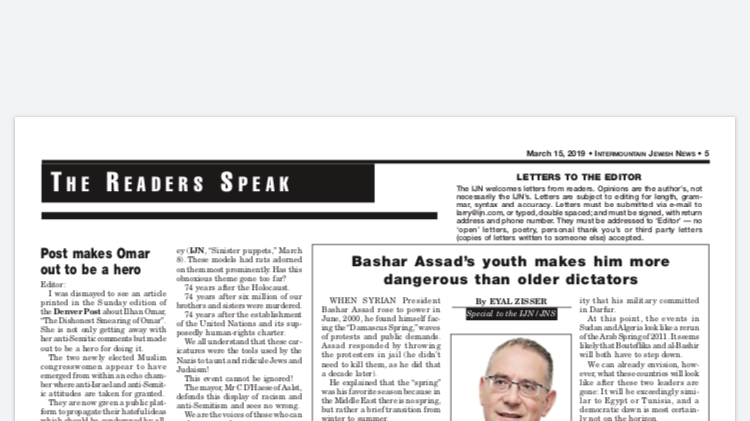
SEE THE BOLD MARKINGS
March 15, 2019, • INTERMOUNTAIN JEWISH NEWS • 5
Post makes Omar
out to be a hero
Editor:
I was dismayed to see an article
printed in the Sunday edition of
the Denver Post about Ilhan Omar,
“The Dishonest Smearing of Omar”.
She is not only getting away with
her anti-Semitic comments but made
out to be a hero for doing it.
The two newly elected Muslim
congresswomen appear to have
emerged from within an echo chamber
where anti-Israel and anti-Semitic
attitudes are taken for granted.
They are now given a public platform
to propagate their hateful ideas
which should be condemned by all.
The Democratic party seems to be
protecting them. If so it is heading
to a dark place.
They seem to know nothing of
American history and it’s Judaeo-
Christian ethic and the mutually
valuable US-Israel relationship as
they pollute the atmosphere with
their hateful anti-Jewish and anti-
Israel attitudes.
Then they and their supporters
cry “Islamophobia” when confronted!
We should not be intimidated
by this assault on our safety and the
values we cherish, by false accusations
of discrimination. We must
challenge the purveyors of hatred
and make it clear that there is no
place for these ideas in our society.
HERZL MELMED MD
Englewood, Colo.
Worried in Belgium
about anti-Semitism
Editor:
Concerned citizen, children of survivors,
grandchildren and greatgrandchildren
of survivors and all
humanity who support and cry out
zero tolerance toward anti-Semitism:
We are all well aware that anti-
Semitism has again raised its ugly
head in Europe.
We know anti-Semitism constantly
lies low but grabs the opportunity
to manifest itself in many different
guises.
Aalst, a small city in Belgium holds
an annual parade. At this event
everyone and everything is shamelessly
mocked, ridiculed and mercilessly
attacked.Political correctness
has never been adhered to at this
event.
This past year, the carnival showed
floats depicting caricatures of Orthodox
Jews standing on sacks of money
(IJN, “Sinister puppets,” March
8). These models had rats adorned
on them most prominently. Has this
obnoxious theme gone too far?
74 years after the Holocaust.
74 years after six million of our
brothers and sisters were murdered.
74 years after the establishment
of the United Nations and its supposedly
human-rights charter.
We all understand that these caricatures
were the tools used by the
Nazis to taunt and ridicule Jews and
Judaism!
This event cannot be ignored!
The mayor, Mr C D’Haese of Aalst,
defends this display of racism and
anti-Semitism and sees no wrong.
We are the voices of those who can
no longer speak.
We are the ears of those who can
no longer hear.
We are absolutely compelled to
show our revulsion, disgust, and
anger at this blatant display of
hatred, racism and anti-Semitism
against the Jewish people.
To say we did not know or to ignore
is no longer an answer! Please join
our campaign and show solidarity
by signing our petition at http://
chng.it/CJry6ynV.
In addition, register your protest
by calling the following numbers,
or sending them letters.
Mayor of Aalst Mr. C D’Haese
Stad Aalst
+32 53 77 9300
burgemeester@aalst.be
Unia Against Racism and Antisemitism
+32 22 12 30 00
https://www.unia.be/en/report-discrimination
Belgium Embassy United Kingdom
+44 20 74 70 3700
London@diplobel.fed.be
Belgium Embassy Israel
+972 3 613 81 30
telaviv@diplobel.fed.be
Belgium Embassy United States
+1 202 333 69 00
washington@diplobel.fed.be
We sincerely hope that you will
give just a moment of your time to
voice your indignation, revulsion and
protest to avoid further escalation
of these abominable manifestations
of hate.
The writer is the grandchild of
Holocaust survivors and lives in
Belgium. He supplied his named
to the INTERMOUNTAIN JEWISH
NEWS but requested that it be withheld
due to his conceerns for his
own safety.
LETTERS TO THE EDITOR
The IJN welcomes letters from readers. Opinions are the author’s, not
necessarily the IJN’s. Letters are subject to editing for length, grammar,
syntax and accuracy. Letters must be submitted via e-mail to
larry@ijn.com, or typed, double spaced; and must be signed, with return
address and phone number. They must be addressed to ‘Editor’ — no
‘open’ letters, poetry, personal thank you’s or third party letters
(copies of letters written to someone else) accepted.
T H E R E A D E R S S P E A K
WHEN SYRIAN President
Bashar Assad rose to power in
June, 2000, he found himself facing
the “Damascus Spring,”waves
of protests and public demands.
Assad responded by throwing
the protesters in jail (he didn’t
need to kill them, as he did that
a decade later).
He explained that the “spring”
was his favorite season because in
the Middle East there is no spring,
but rather a brief transition from
winter to summer.
A decade later, many believed
the Syrian president had erred:
Waves of popular unrest flooded
a number of Arab countries and
toppled regimes previously perceived
as strong and impervious
to harm.
Everyone rushed to cheer the
“Arab Spring,” which they said
would usher in an era of progress,
prosperity and mainly democracy.
Before long, however, it became
apparent that the Arab Spring had
become an Islamist winter, after
Islamist movements, some of them
radical, seized power in several
of these Arab countries.
We know how the story ended.
In some of these countries,
such as Egypt and Tunisia, the
clock was reversed to where it
stood before the protests erupted,
as if no revolution had ever
occurred.
In Yemen and Libya, however,
the central governments collapsed
and the people there are still
engaged in bloody civil wars.
NOW, AFTER an eight-year
delay, a false Arab Spring similar
to its predecessors is knocking
on the door of the Arab countries
it previously spared, chief among
them Algeria and Sudan.
In Algeria, the masses have taken
to the streets to protest President
Abdelaziz Bouteflika’s
intention to vie for a fifth term in
the country’s April presidential
election.
The 82-year-old Bouteflika,who
is unwell and detached from reality,
has spent most of his time
outside the country for medical
treatment after suffering a stroke
six years ago.
When he ascended to power in
1999, he was perceived as a savior.
Algeria at the time had just
emerged from a bloody civil war
in which the army and the elites
battled the Islamist movement.
Although the latter won a democratic
election, its representatives
were booted from power by
the army and its supporters, similar
to the revolution spearheaded
in Egypt by then-general and
current President Abdel Fattah El-
Sisi. But years have passed, and
the younger generation is demanding
change.
IN SUDAN, protests erupted
two months ago following a government
price hike on bread.Thousands
poured into the streets
and clashed with security forces.
Dozens of people have been killed
in the violence.
The unrest has persisted amid
calls to oust 75-year-old dictator
Omar al-Bashir, who has ruled the
country for 30 years.
The International Criminal
Court at The Hague has issued a
warrant for his arrest for war
crimes and crimes against humanity
that his military committed
in Darfur.
At this point, the events in
Sudan and Algeria look like a rerun
of the Arab Spring of 2011. It seems
likely that Bouteflika and al-Bashir
will both have to step down.
We can already envision, however,
what these countries will look
like after these two leaders are
gone: It will be exceedingly similar
to Egypt or Tunisia, and a
democratic dawn is most certainly
not on the horizon.
ULTIMATELY, the common
denominator among all the dictators
toppled during the Arab
Spring was their old age and their
failure to find powerful allies within
the system to help them maintain
their grip on power.
This is the main difference
between Hosni Mubarak in Egypt
and Zine El Abidine Ben Ali in
Tunisia, who were both 83 when
the protests broke out in their
countries, and Bashar Assad in
Syria, who was 45 at the start of
the Syrian civil war.
After Ali and Mubarak were
ousted, however, the ruling apparatuses
in Tunisia and Egypt, especially
the militaries and social
elites, regained control.
The Middle East still isn’t ripe
for democracy. In the eyes of many
of its inhabitants, the right to a
slice of bread,a home,a living wage
and protection from terrorism,
supersedes the rights to freedom
of expression, liberty and democracy.
Still, economic distress in the
region is growing worse, and the
younger generation is losing any
remaining hope for a better future.
So unrest will continue to simmer
beneath the surface, threatening
to explode every time a ruler
shows weakness.
It appears,however, that instead
of leading the region forward, these
demonstrations will only entrench
the past.
Eyal Zisser is a lecturer in the
Middle East History Department
at Tel Aviv University.
Bashar Assad’s youth makes him more
dangerous than older dictators
By EYAL ZISSER
Special to the IJN/JNS
has been called G-d.”3
That is the significance of the
word that gives our parsha,and
the third book of the Torah,
its name: Vayikra, “And He called.”
The precise meaning of this opening
verse is difficult to understand.
Literally translated it reads: “And
He called to Moses, and G-d spoke
to him from the Tent of Meeting,
saying . . . ” The first phrase seems
to be redundant. If we are told
that G-d spoke to Moses, why say
in addition, “And He called”?
Rashi explains as follows:
“And He called to Moses: Every
[time G-d communicated with Moses,
whether signalled by the expression]
‘And He spoke’ or ‘and He said’ or
‘and He commanded,’ it was always
preceded by [G-d] calling [to Moses
by name].4 ‘Calling’ is an expression
of endearment. It is the expression
employed by the ministering angels,
as it says, ‘And one called to the
other . . . ’” (Isaiah 6:3).
Vayikra, Rashi is telling us,means
to be called to a task in love. This
is the source of one of the key ideas
of Western thought, namely the concept
of a vocation or a calling, that
is, the choice of a career or way of
life not just because you want to
do it, or because it offers certain benefits,
but because you feel summoned
to it. You feel this is your meaning
and mission in life. This is what
you were placed on earth to do.
There are many such calls in
Tanach.
There was the call Abraham
received, telling to leave his land
and family.
There was the call to Moses at the
burning bush (Ex. 3:4).
There was the one experienced by
Isaiah when he saw in a mystical
vision G-d enthroned and surrounded
by angels:
“Then I heard the voice of the
L-rd saying, ‘Whom shall I send?
And who will go for us?’ And I said,
‘Here am I. Send me!’” (Isaiah 6:8)
One of the most touching is the
story of the young Samuel, dedicated
by his mother Hannah to serve
in the sanctuary at Shiloh where
he acted as an assistant to Eli the
priest.
In bed at night he heard a voice
calling his name. He assumed it was
Eli. He ran to see what he wanted,
but Eli told him he had not called.
This happened a second time and
then a third, and by then Eli realised
that it was G-d calling the child.
He told Samuel that the next time
the voice called his name, he should
reply, “Speak, L-rd, for Your servant
is listening.” It did not occur
to the child that it might be G-d summoning
him to a mission, but it was.
Thus began his career as a prophet,
judge and anointer of Israel’s first
two kings, Saul and David (1 Samuel
3).
When we see a wrong to be righted,
a sickness to be healed, a need
to be met, and we feel it speaking
to us, that is when we come as
close as we can in a post-prophetic
age to hearing Vayikra, G-d’s call.
Why does the word appear here,
at the beginning of the third and
central book of the Torah? Because
the book of Vayikra is about sacrifices,
and a vocation is about sacrifices.
We are willing to make sacrifices
when we feel they are part of the task
we are called on to do.
From the perspective of eternity
we may sometimes be overwhelmed
by a sense of our own
insignificance. We are no more
than a wave in the ocean, a grain
of sand on the sea shore, a speck of
dust on the surface of infinity. Yet
we are here because G-d wanted us
to be, because there is a task He wants
us to perform. The search for meaning
is the quest for this task.
Each of us is unique. Even genetically
identical twins are different.
There are things only we can do,
we who are what we are, in this time,
this place and these circumstances.
For each of us G-d has a task: work
to perform, a kindness to show, a gift
to give, love to share, loneliness to
ease, pain to heal, or broken lives
to help mend. Discerning that task,
hearing Vayikra, G-d’s call, is one
of the great spiritual challenges
for each of us.
How do we know what it is? Some
years ago, in To Heal a Fractured
World, I offered this as a guide,
and it still seems to me to make
sense: Where what we want to do
meets what needs to be done, that
is where G-d wants us to be.
Shabbat Shalom.
1. See Roy F. Baumeister, Kathleen
D. Vohs, Jennifer Aaker, and
Emily N.Garbinsky, “Some Key
Differences between a Happy Life
and a Meaningful Life.” Journal of
Positive Psychology 2013, Vol. 8,
Issue 6, Pages 505-516.
2. Emily Smith, “There’s more to
life than being happy,”The Atlantic,
9 Jan. 2013.
3. Viktor Frankl, The Doctor and
the Soul: from Psychotherapy to
Logotherapy, New York:A.A. Knopf,
1965, 13.
4. Rashi to Vayikra 1:1.
T O R A H W I T H R A B B I S A C K S
SACKS
Continued from Page 4
We are here because G-d wanted us to be
Eyal Zisser