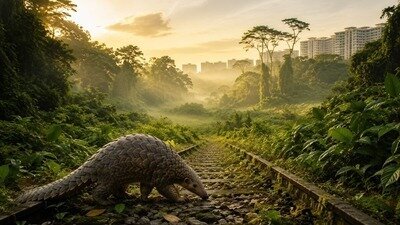
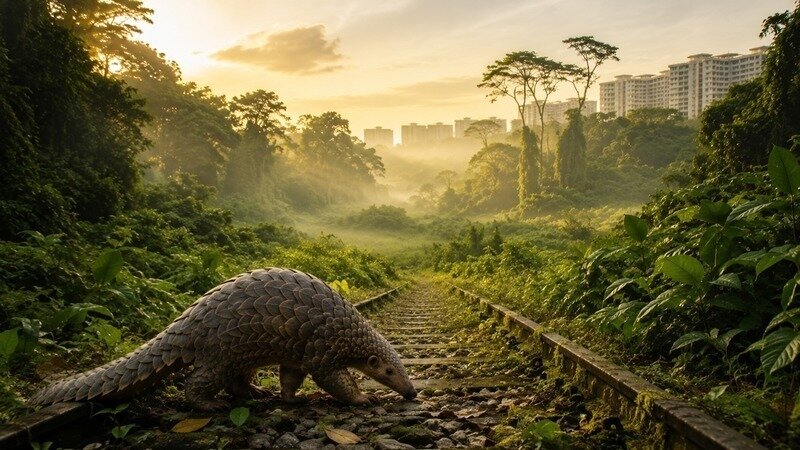
What HDB's own studies show about Maju Forest and Gillman Barracks.
The Issue
To :
Housing & Development Board, the Ministry of National Development, the Urban Redevelopment Authority, and the National Parks Board, and to the MPs who can raise it in Parliament, to Singapore's nature and heritage community, and to every resident who believes a City in Nature should keep its promises — please, read, sign, pass on this petition.
There has been much debate about Maju Forest and Gillman Barracks. Two petitions are already asking Singapore to build elsewhere — I support both, and I've linked them at the bottom. This one is different. I am not asking where to build. The whole conversation is about the decision — and almost no one is talking about what HDB's own studies actually say.
When HDB announced it would clear about 15 of Maju Forest's 23 hectares and much of the forest at Gillman Barracks, it did something to its credit: it published the full environmental studies behind the decision. You can read them here:
https://www.hdb.gov.sg/about-us/our-role/plan-and-design-towns/planning-with-the-environment-in-mind
But it's over a thousand pages!
So I asked Claude.AI to read them.
Then I checked everything it found against the original documents myself, dug deeper, and pulled out six issues I think are critical — for HDB to weigh, and for you to raise in your feedback.
What I found genuinely troubled me:
HDB did thorough studies. They found the Critically Endangered species, the ancient trees, the globally significant songbird. They even wrote a pangolin protection plan. And yet, reading the plans, it is hard to see how any of it changed the outcome.
I am not against building homes. Singapore needs them. I am asking six questions that come straight from HDB's own documents — every one answerable before 6 August. The references are inline. Please check me.
HDB's chief town planner said last week that the plans are "not final." I am taking him at his word.
Six questions, from HDB's own environmental studies of Maju Forest (Sunset Way) and Gillman Barracks:
-
What happens to everything else that lives here?
HDB's own studies counted the plant and animal residents.
The animals. At Maju, the Critically Endangered Sunda pangolin — the most trafficked mammal on Earth — recorded in 2022 (Sunset Way EIA Report, Table 3-23, p.74), alongside six other species of conservation significance. At Gillman, eleven (Gillman EIA Report, Table 4-9, p.49). And at both forests, the Straw-headed Bulbul — a songbird trapped to the edge of extinction for its voice, of which NParks says Singapore is now "the only known global stronghold, supporting about one third of its global population." Not one population among many. The most important one left on Earth.
The plants. 71 protected species across the two forests — 49 at Maju, five of them Critically Endangered (Table 3-9, p.39), and 22 at Gillman. Some are one step from extinction; a Critically Endangered plant, once cleared, cannot simply be replanted. And their value is not only ecological. Many of our medicines began as compounds found in wild plants — one species on Maju's list is Eurycoma longifolia, the tongkat ali, still studied today for its medicinal properties. We do not know what the others may hold. You cannot ask a species what it was worth after it is gone.
The studies identified all of this. What they do not explain is what becomes of it. Salvaging a few plants and shepherding a few animals across a road is not the same as a home. What is the plan for the pangolin, the bulbul, and the 71 plant species these forests shelter — beyond recording that they were here?
-
Why does the forest with no pangolins get a pangolin protection plan — and the forest with pangolins doesn't?
At Gillman Barracks, where the Sunda pangolin was never recorded, HDB's report still assesses its roadkill risk and adds road-calming measures to protect it (Gillman EIA Report, p.91, p.105). At Maju, where the pangolin was recorded in 2022 (Sunset Way EIA Report, Table 3-23, p.74), the plan contains none of this. HDB has already written the protocol. Please apply it at Maju.
3. Why does the summary say there is no data, when the full report says there is?
The Maju Executive Summary says desktop searches "yielded no relevant data" (p.4). The main report records two pangolin roadkills within 1 km of the site (section 3.3.3, p.60). Please correct the summary.
4. Why commission a finding if nothing about the plan can change in response to it?
HDB's own table scores the biodiversity impact as "Major Negative" before mitigation, and still "Major Negative" after (Table 1-4, p.11). The clearing is going ahead regardless. If there is a threshold that would have been enough to stop this, please name it. If there isn't, please say so.
5. Where is the alternatives study?
Singapore told the UN it studies "the trade-offs and alternatives" before developing greenfield sites. This study has no alternatives chapter. HDB says brownfield sites were considered — so please publish that analysis: which sites, what they would yield, and what shortfall only this forest can fill.
6. Who is counting what we have already lost?
About 3.6 hectares of Maju was cleared in 2024 for Brookvale Drive, and an MRT station is going up in the site. Now 15 more hectares are proposed. Each parcel assessed on its own — none added together, here or across Tengah, Dover, Kranji and Turf City. Which study adds up what Singapore is losing in total?
TWO THINGS SAVE THESE FORESTS — PLEASE DO BOTH:
1. Sign this petition. It shows HDB the scale of concern.
2. Submit your feedback to HDB — this is the step that actually counts. 15 minutes, by 6 August, 6pm:
3. See what I have submitted: https://bit.ly/savemajuform
🌳 Maju Forest / Sunset Way: https://form.gov.sg/6a261f944a21fe7c804deebc
🏛️ Gillman Barracks (environment): https://form.gov.sg/69f06794cd34ddef1bc75c8d
WHAT WE ARE ASKING FOR
Answer the six questions publicly. Extend the feedback period, as HDB did for Dover Forest in 2021. Pause the clearing until the answers are public — not cancel, pause.
CONCLUSION
This August, Singapore turns 61. In six decades we built one of the most remarkable cities on Earth — on a small island where every hectare had to be argued for. We promised ourselves we would not become only concrete. We planted a Garden City, then chose to go further and become a City in Nature — a nation that makes room, even under pressure, for the wild at its edges.
A promise is measured by what we keep when it costs us something. It is easy to value nature when there is land to spare. The real test is a forest like this one — wanted for housing, on an island always short of land. What we decide here says more about who we are at 61 than any speech will.
Because a forest is a home too. It is the home of a pangolin that curls into a ball at the sound of a footstep, of a bulbul whose song Singapore holds in trust for the whole world, of 71 kinds of plant — some nearly gone, one or two perhaps holding a medicine we have not yet found. They do not get a vote. They cannot write to HDB. Their home is Singapore too, and they were here long before any of us.
The feedback window closes on 6 August, 3 days before National Day. As stewards of this land, we will decide the fate of one of the last stretches of forest in this part of the island for all the animals, plants and insects that make the forests home. May our children and grandchildren have the privilege of standing at dawn to hear a bulbul sing. And may we be the generation that chose to pass it on — rather than the one that had to explain why it was gone.
⸻
SIGNING IS NOT ENOUGH — PLEASE READ THIS
Dover Forest, 2021: 50,000 signed a petition. Around 1,800 also filled in HDB's official form. HDB reopened the consultation and kept the western half.
Tengah: the same process drew twelve responses on Tengah North and four on Tengah South. Sixteen. Tengah is gone.
Both numbers are HDB's own. The petition opens the door. The form walks through it.
⸻
HERE IS MY OWN SUBMISSION — USE ANY PART OF IT
I have filled in the HDB feedback form myself, and I've shared it here: https://bit.ly/savemajuform
There is no rule against copying. Every submission counts toward the number HDB reports — at Dover, that number saved half a forest. So do whichever you can manage: copy mine whole and add your name; take the parts that speak to you and add a line of your own; or read the studies and write it yourself. Any of these is worth doing. The only wasted option is signing and stopping there.
(If you write your own — even a sentence — it counts for more, because identical submissions get bundled and counted once. But a copied submission still counts. Do the version you'll actually finish.)
YOUR 15 MINUTES — closes 6 August, 6pm:
Maju: https://form.gov.sg/6a261f944a21fe7c804deebc
Gillman (environment): https://form.gov.sg/69f06794cd34ddef1bc75c8d
A submission to one form is not a submission to the others. Do whichever you care about, or all three.
Links to the other petition:
1. Save Maju Forest — build the homes without erasing the wild
https://c.org/HczkMvw9Ym
2. save Gillman Barracks/Forest - build homes in GSW instead
https://c.org/J4CycNNZZp
UN Studies:
https://www.ohchr.org/sites/default/files/documents/issues/environment/srenvironment/cfis/eia/subm-environmental-impact-assessments-sta-34-singapore.docx

457
The Issue
To :
Housing & Development Board, the Ministry of National Development, the Urban Redevelopment Authority, and the National Parks Board, and to the MPs who can raise it in Parliament, to Singapore's nature and heritage community, and to every resident who believes a City in Nature should keep its promises — please, read, sign, pass on this petition.
There has been much debate about Maju Forest and Gillman Barracks. Two petitions are already asking Singapore to build elsewhere — I support both, and I've linked them at the bottom. This one is different. I am not asking where to build. The whole conversation is about the decision — and almost no one is talking about what HDB's own studies actually say.
When HDB announced it would clear about 15 of Maju Forest's 23 hectares and much of the forest at Gillman Barracks, it did something to its credit: it published the full environmental studies behind the decision. You can read them here:
https://www.hdb.gov.sg/about-us/our-role/plan-and-design-towns/planning-with-the-environment-in-mind
But it's over a thousand pages!
So I asked Claude.AI to read them.
Then I checked everything it found against the original documents myself, dug deeper, and pulled out six issues I think are critical — for HDB to weigh, and for you to raise in your feedback.
What I found genuinely troubled me:
HDB did thorough studies. They found the Critically Endangered species, the ancient trees, the globally significant songbird. They even wrote a pangolin protection plan. And yet, reading the plans, it is hard to see how any of it changed the outcome.
I am not against building homes. Singapore needs them. I am asking six questions that come straight from HDB's own documents — every one answerable before 6 August. The references are inline. Please check me.
HDB's chief town planner said last week that the plans are "not final." I am taking him at his word.
Six questions, from HDB's own environmental studies of Maju Forest (Sunset Way) and Gillman Barracks:
-
What happens to everything else that lives here?
HDB's own studies counted the plant and animal residents.
The animals. At Maju, the Critically Endangered Sunda pangolin — the most trafficked mammal on Earth — recorded in 2022 (Sunset Way EIA Report, Table 3-23, p.74), alongside six other species of conservation significance. At Gillman, eleven (Gillman EIA Report, Table 4-9, p.49). And at both forests, the Straw-headed Bulbul — a songbird trapped to the edge of extinction for its voice, of which NParks says Singapore is now "the only known global stronghold, supporting about one third of its global population." Not one population among many. The most important one left on Earth.
The plants. 71 protected species across the two forests — 49 at Maju, five of them Critically Endangered (Table 3-9, p.39), and 22 at Gillman. Some are one step from extinction; a Critically Endangered plant, once cleared, cannot simply be replanted. And their value is not only ecological. Many of our medicines began as compounds found in wild plants — one species on Maju's list is Eurycoma longifolia, the tongkat ali, still studied today for its medicinal properties. We do not know what the others may hold. You cannot ask a species what it was worth after it is gone.
The studies identified all of this. What they do not explain is what becomes of it. Salvaging a few plants and shepherding a few animals across a road is not the same as a home. What is the plan for the pangolin, the bulbul, and the 71 plant species these forests shelter — beyond recording that they were here?
-
Why does the forest with no pangolins get a pangolin protection plan — and the forest with pangolins doesn't?
At Gillman Barracks, where the Sunda pangolin was never recorded, HDB's report still assesses its roadkill risk and adds road-calming measures to protect it (Gillman EIA Report, p.91, p.105). At Maju, where the pangolin was recorded in 2022 (Sunset Way EIA Report, Table 3-23, p.74), the plan contains none of this. HDB has already written the protocol. Please apply it at Maju.
3. Why does the summary say there is no data, when the full report says there is?
The Maju Executive Summary says desktop searches "yielded no relevant data" (p.4). The main report records two pangolin roadkills within 1 km of the site (section 3.3.3, p.60). Please correct the summary.
4. Why commission a finding if nothing about the plan can change in response to it?
HDB's own table scores the biodiversity impact as "Major Negative" before mitigation, and still "Major Negative" after (Table 1-4, p.11). The clearing is going ahead regardless. If there is a threshold that would have been enough to stop this, please name it. If there isn't, please say so.
5. Where is the alternatives study?
Singapore told the UN it studies "the trade-offs and alternatives" before developing greenfield sites. This study has no alternatives chapter. HDB says brownfield sites were considered — so please publish that analysis: which sites, what they would yield, and what shortfall only this forest can fill.
6. Who is counting what we have already lost?
About 3.6 hectares of Maju was cleared in 2024 for Brookvale Drive, and an MRT station is going up in the site. Now 15 more hectares are proposed. Each parcel assessed on its own — none added together, here or across Tengah, Dover, Kranji and Turf City. Which study adds up what Singapore is losing in total?
TWO THINGS SAVE THESE FORESTS — PLEASE DO BOTH:
1. Sign this petition. It shows HDB the scale of concern.
2. Submit your feedback to HDB — this is the step that actually counts. 15 minutes, by 6 August, 6pm:
3. See what I have submitted: https://bit.ly/savemajuform
🌳 Maju Forest / Sunset Way: https://form.gov.sg/6a261f944a21fe7c804deebc
🏛️ Gillman Barracks (environment): https://form.gov.sg/69f06794cd34ddef1bc75c8d
WHAT WE ARE ASKING FOR
Answer the six questions publicly. Extend the feedback period, as HDB did for Dover Forest in 2021. Pause the clearing until the answers are public — not cancel, pause.
CONCLUSION
This August, Singapore turns 61. In six decades we built one of the most remarkable cities on Earth — on a small island where every hectare had to be argued for. We promised ourselves we would not become only concrete. We planted a Garden City, then chose to go further and become a City in Nature — a nation that makes room, even under pressure, for the wild at its edges.
A promise is measured by what we keep when it costs us something. It is easy to value nature when there is land to spare. The real test is a forest like this one — wanted for housing, on an island always short of land. What we decide here says more about who we are at 61 than any speech will.
Because a forest is a home too. It is the home of a pangolin that curls into a ball at the sound of a footstep, of a bulbul whose song Singapore holds in trust for the whole world, of 71 kinds of plant — some nearly gone, one or two perhaps holding a medicine we have not yet found. They do not get a vote. They cannot write to HDB. Their home is Singapore too, and they were here long before any of us.
The feedback window closes on 6 August, 3 days before National Day. As stewards of this land, we will decide the fate of one of the last stretches of forest in this part of the island for all the animals, plants and insects that make the forests home. May our children and grandchildren have the privilege of standing at dawn to hear a bulbul sing. And may we be the generation that chose to pass it on — rather than the one that had to explain why it was gone.
⸻
SIGNING IS NOT ENOUGH — PLEASE READ THIS
Dover Forest, 2021: 50,000 signed a petition. Around 1,800 also filled in HDB's official form. HDB reopened the consultation and kept the western half.
Tengah: the same process drew twelve responses on Tengah North and four on Tengah South. Sixteen. Tengah is gone.
Both numbers are HDB's own. The petition opens the door. The form walks through it.
⸻
HERE IS MY OWN SUBMISSION — USE ANY PART OF IT
I have filled in the HDB feedback form myself, and I've shared it here: https://bit.ly/savemajuform
There is no rule against copying. Every submission counts toward the number HDB reports — at Dover, that number saved half a forest. So do whichever you can manage: copy mine whole and add your name; take the parts that speak to you and add a line of your own; or read the studies and write it yourself. Any of these is worth doing. The only wasted option is signing and stopping there.
(If you write your own — even a sentence — it counts for more, because identical submissions get bundled and counted once. But a copied submission still counts. Do the version you'll actually finish.)
YOUR 15 MINUTES — closes 6 August, 6pm:
Maju: https://form.gov.sg/6a261f944a21fe7c804deebc
Gillman (environment): https://form.gov.sg/69f06794cd34ddef1bc75c8d
A submission to one form is not a submission to the others. Do whichever you care about, or all three.
Links to the other petition:
1. Save Maju Forest — build the homes without erasing the wild
https://c.org/HczkMvw9Ym
2. save Gillman Barracks/Forest - build homes in GSW instead
https://c.org/J4CycNNZZp
UN Studies:
https://www.ohchr.org/sites/default/files/documents/issues/environment/srenvironment/cfis/eia/subm-environmental-impact-assessments-sta-34-singapore.docx
Supporter Voices
Petition Updates
Share this petition
Petition created on 21 July 2026