
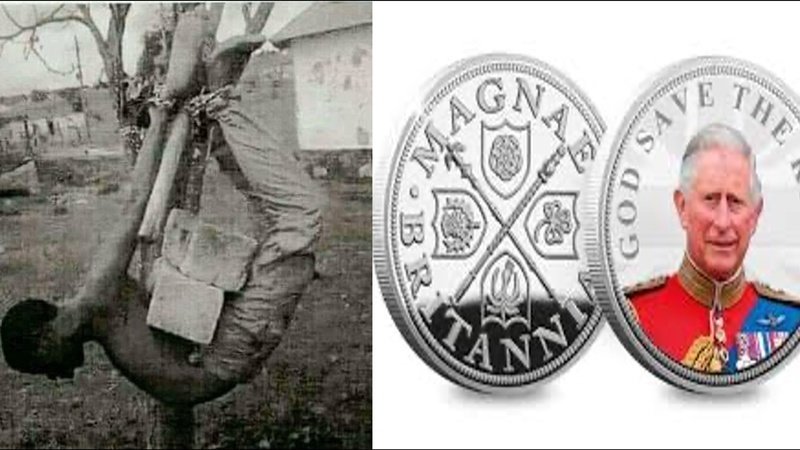
We, the Yoruba Descendants send you belated birthday greetings.
There is also a certain important matter that we wish to bring to your attention as the new British monarch.
The history of the British monarchy is inseparable from the history of the enslavement of Africans. The British monarchy was involved right from the beginning, with the reign of Queen Elizabeth I. She was an enthusiastic supporter of John Hawkins’ slaving expeditions to West Africa made respectively in 1562, 1564 and 1567. The queen donated The Jesus of Lubeck, a 700-ton vessel purchased for Henry VIII for the Royal Navy, for Hawkins’ second voyage. Indeed, the queen honoured Hawkins with a coat of arms and crest featuring a nude African bound with rope. On 11 July 1596, the queen issued a proclamation that Africans living in England as freemen be arrested and used to pay Caspar van Senden, a German slave trader, for ‘duties’ he had performed.
Between 1660 and 1685, King Charles II and other members of the Royal family invested heavily in the enslavement of Africans. Immediately after he became king, Charles II granted charter to the ‘Company of the Royal Adventurers of England Trading into Africa’ to deal directly with enslaved Africans and sell them to the new world. The company charter had a 1,000-year monopoly over trade, land, and islands along the west coast of Africa. The king even lent the company a number of Royal ships including the Blackamoor. That chartered company at that time shipped more enslaved African children, men, and women to the Americas than others. The company seal was of an elephant bearing a castle, flanked by two enslaved African men, with the figures surrounded by the company logo of ‘By Royal patronage commerce flourishes, by commerce the realm’.
Between 1672 and 1688, King James II (formerly Duke of York) was the largest shareholder and governor of the Royal African Company of England. He saw the slave trade as a good and safe investment. As Lord High Admiral, he exercised punitive power over anyone who challenged the company’s monopoly. Before being shipped to the Americas, his slaves, like animals, had the letters 'DY' branded with hot iron on their right shoulder or breast to denote his personal ownership whilst company-owned slaves were branded with the letters 'RACE'.
Although James II was dethroned by the Glorious Revolution of 1689, the Royal African Company of England up until 1712 continued to charge independent traders 10% duty to use its African ports. Queen Anne continued the tradition of royal support for the British slave trade. In 1712 she announced that she had secured an exclusive contract for the British nation to provide enslaved Africans for the Spanish West Indies for thirty years.
Between 1690 and 1807, up to 10 million enslaved Yoruba children, men, and women were transported to the Americas mostly in British or Anglo-American ships. Protected by the Crown and Parliament, the slave trade became one of Britain’s most profitable industries. Worsley reckoned that all properties used by the Stuart dynasty in the 17th century had ‘an element of money derived from slavery’ within them. This includes Kensington Palace and Hampton Court Palace, which have connections to King William III, another part owner of the Royal African Company.
The Royal family opposed the abolition of African enslavement, particularly King George III and his sons. Prince William (the future William IV) witnessed slavery in Jamaica first-hand and approved of it. In 1799, as Duke of Clarence, he used his maiden speech to the House of Lords to oppose abolition. Despite enactment of the Slave Trade Act of 1807, ships built or outfitted, and financed in Britain were used by European slavers. The Slavery Abolition Act of 1833 ended slavery in British colonies, but slaves were not immediately freed. There was a negotiated settlement, which required slaves to work as unpaid ‘apprentices’, and for slave owners to be paid compensation of £20 million, 40% of the national budget. It was only after this settlement that the British monarchy publicly aligned itself with the anti-slavery cause.
Sir, to the British peoples, your role as monarch is largely ceremonial; a quirky ancient tradition to be preserved. Most in fact have no idea that the monarchy is part of the British political structure. The Commonwealth peoples by contrast, perceive the monarchy to be the seat of British power. Thus, whilst the monarchy may have no ‘real’ function in Britain itself, Commonwealth peoples perceive it as something much more than ‘ceremonial’. Your responsibility as the British monarch is totally different and separate from your responsibility as Head of the Commonwealth.
Sir, we Yoruba expect you as the British monarch to acknowledge our past enslavement and inhuman treatment by the Royal family, and to apologise for it formally and unreservedly. Thereafter, we expect you to address the issue of restitution for those wrong doings. The Royal family must with despatch sponsor settlement negotiations with descendants of those enslaved and of those whose peoples were enslaved.
nb:
Sir, we Yoruba occupy an area of West Africa that we have occupied uninterrupted from time immemorial. We Yoruba speak one language, have a common custom and tradition, and believe in one ancestral origin, Oduduwa. Before colonisation, the Yoruba lived in city states within one of the largest indigenous empires on the continent of Africa. In 1888, Queen Victoria signed a treaty of friendship with the Alaafin of Oyo, Head of Yorubaland. Over 50 million Yoruba currently live in the ancestral home in West Africa and a similar number are in the diaspora most notably in America, Brazil, Cuba and the Caribbean.