WARD 4 - Candidate Evaluation - What they have said and done

WARD 4 - Candidate Evaluation - What they have said and done (4 minute read)
On Monday, your vote will matter, and your actions to date are valid proof. Nearly 2,500 signatures have been gathered across two petitions for proper community consultation and environmental assessment at Swansea Mews, the Toronto Community Housing site at 21 Windermere Avenue (the corner of The Queensway and Windermere), with just over half of them from Ward 4 postal codes.
The most recent Ward 4 election was decided by 1,230 votes. You are in a position to make the change you desire, and to send a strong message that Ward 4 voices matter at the ballot boxes on Monday.
Methodical research: how this information was assembled
The SwanseaMatters.com coalition, whose members live in every neighbourhood of the ward and favour none over another, attended all three major all-candidates debates and recorded them for accuracy and thoroughness. Swansea Mews was raised as THE hot button issue at each one.
The coalition engaged directly with every candidate after each debate, and further engaged candidates on their platforms to ensure accuracy. Every candidate was then given the courtesy of the same five key questions in writing, with the opportunity to comment. Every reply has been published word for word. Of note, The Toronto Star, CBC and the Toronto Sun have contacted the coalition for its input.
Why one site tells the whole story of the ward
Swansea Mews brings together every critical issue in Ward 4: community consultation, the environment, density, schools, recreation, health services, transit and infrastructure, and how it is all paid for across three levels of government. It also impacts High Park directly, and the water we drink.
The consultation on the plan was described as negligent by a designate from the local Member of Parliament’s office who attended it. In April 2025, Council mandated a Stage 2 Actions Report, the business case setting out partners, the number of homes, affordability, funding and financial implications. Council adopted a 639-unit rezoning in March 2026 without it, and it has still not been produced.
The owner’s own testing found lead at 30.4 times the provincial residential standard, 50 metres from Grenadier Pond in High Park, and no Risk Assessment has been completed.
The five questions:
1) Will you call for a review of the 21 Windermere Avenue plan before any further approvals are given?
2) Will you seek to hold site plan approval until the Stage 2 Actions Report is produced?
3) Will you seek to have the site’s environmental condition established and made public, and a Risk Assessment completed, before demolition or construction proceeds?
4) Will you seek an assessment of its impact on transportation, schools and services, including the combined effect of nearby developments?
5)Will you meet the SwanseaMatters.com coalition within 30 days of taking office?
The findings
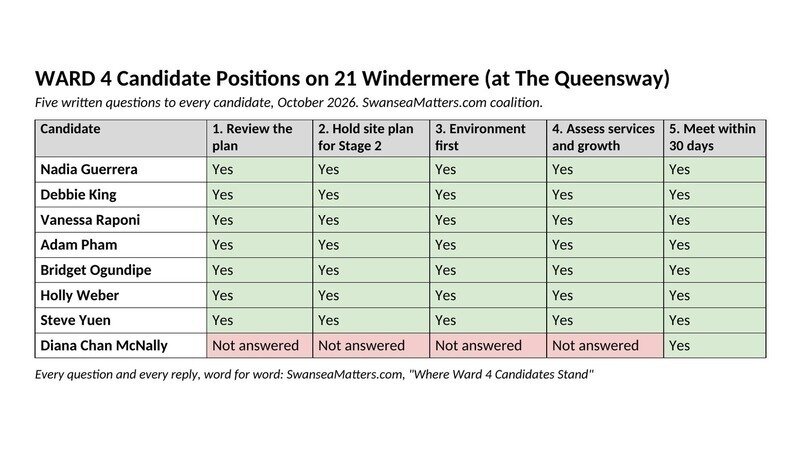
YES to all five : Nadia Guerrera, Debbie King, Vanessa Raponi, Adam Pham, Bridget Ogundipe, Holly Weber and Steve Yuen.
Did not answer four of the five: Diana Chan McNally, the candidate backed by outgoing councillor Gord Perks.
Beyond the survey, Nadia Guerrera, Debbie King, Vanessa Raponi and Adam Pham engaged directly with coalition members to discuss this site and more. Diana Chan McNally’s campaign, invited seventeen days before the vote, declined to meet until after it.
The petitions you signed explicitly acknowledged that the community consultation was negligent. Every candidate who replied has now acknowledged it, except one.
Promised then declined
Chan McNally’s platform promises to “expand opportunities for public consultation on land-use decisions.” Asked to commit to exactly that, she would not, in writing or in person. Her campaign wrote that “without being in office, Diana is unable to consult the expertise of City staff,” and that she would answer the community’s questions once elected.
A printed copy of the full site report prepared by the community was delivered to Chan McNally’s office, for ease of use and in preparation for a discussion. Again, she declined the request to meet.
It was stated to the outgoing councillor that deferring the community to civil servants, or deciding for the electorate unilaterally was unacceptable. To promise consultation, then decline it when asked, is known as a bait and switch.
A prospective councillor’s actions now are the measure of their actions in the future. If a candidate ignores the ward’s request for a pause and review of these matters, starting with the required, fully accessible, real community consultation, then that is what they are measured against. Every future discussion is then limited before it even begins.
We also have to ask: if a candidate does not believe it is the electorate that matters, then who do they report to? That is a deep concern for everyone in the ward.
Whether candidates call themselves progressive, moderate or otherwise, the test was simple: respond to the ward. Seven did. One did not.
Beyond the site
The coalition also appraised each candidate’s positions on High Park access, which CBC has covered as a primary concern in the ward, along with density on Bloor and the corridor, and community consultation, drawn from the debates and their stated platforms. Residents want a councillor whose balance includes every neighbourhood of the ward: Parkdale, Roncesvalles, High Park North, Swansea, Runnymede-Bloor West Village, Lambton Baby Point and the Junction. That councillor should not put personal preference ahead of the diversity of the ward.
What a councillor is elected to do
CBC News explained this week who does what at each level of government.* On housing, all three levels overlap, and the City controls local zoning and development approvals.
In the City of Toronto’s own words, a councillor’s job includes “consulting with the constituents of their ward” and “ensuring that all sides of an issue are considered in the decision-making process.” As CBC put it: “Knowing who does what helps you hold the right leaders accountable.”
We are looking for facts, a track record that holds up to examination for truth, accuracy and clarity, and a councillor who will take our voices to City Hall as verified and valid, not picking what suits a narrow set of personal likes and dislikes.
From petition to ballot
You may have asked whether a petition gets anywhere. This one has. What began with a few neighbours trying to understand what was happening at this site became a public record at SwanseaMatters.com, documenting voices that were unacknowledged, overlooked and diminished. It has been put before current and future elected officials, the media and the public. Your petition was the pathway. Monday’s vote is where it leads.
Vote on Monday, October 26. Bring a neighbour. Not in Ward 4? Forward this to someone who is.
Ward 4 voices matter. This is what you petitioned for.
Vote for consultation and responsible development.
Swansea Neighbourhood Group
SwanseaMatters.com coalition
Links
The full record: SwanseaMatters.com
Where Ward 4 candidates stand: the questions, every reply word for word, and a fuller appraisal:
https://drive.google.com/file/d/1crEMRLHR_FqM9EHAyk5VOi9qmXSkMSDr/view?usp=sharing
[If you have trouble opening the link, the same document is available as a button at the very front of SwanseaMatters.com, labelled “Where Ward 4 Candidates Stand”.]
The petitions, to share:
Community consultation: https://c.org/h8LzG4YpbN
Environment: https://c.org/RVzBCWbw7X
The role of a councillor, City of Toronto:
https://www.toronto.ca/wp-content/uploads/2017/12/94af-roles-of-the-mayor-city-council-learning-guide-brochure.pdf
The role of City Council, City of Toronto Act, 2006:
https://www.ontario.ca/laws/statute/06c11
* Appendix: Who does what. CBC News election explainer, October 2026 (transcribed)
“Municipal election is this coming Monday, but what is the mayor actually responsible for? The mayor leads the City Council and oversees over 44,000 public employees. The city handles your day-to-day services, things like public transit, police, paramedics, fire services, homeless shelters, water, sewage, by-law enforcement, rec centres, libraries and local parks. Then there’s our provincial government.
Premier Doug Ford and MPPs in the provincial assembly handle large-scale public services like healthcare, education, highways, natural resources and social services like disability support and assistance for food and housing. And finally, there’s the federal level.
Prime Minister Mark Carney works with Parliament to handle national and international affairs: think national defence, immigration, foreign trade, citizenship, banking, postal service and drafting Canada’s criminal laws.
There are a couple of spots that overlap, for example, housing. Municipalities control local zones and development approvals. The province sets landlord-tenant laws and manages a tribunal that can overturn city council’s planning decisions. This division of power goes all the way back to the Constitution Act of 1867.
Knowing who does what helps you hold the right leaders accountable. So if something in your neighbourhood needs fixing, you know whose door to knock on."