IS ‘ANTI-HUMANOID ROBOT’ EQUAL TO ‘PRO-WORK’? PART II

(the following was written without ChatGPT, etc.)
What do we humans need in order to survive? We need food, water, shelter, clothes, means of hygiene, medical treatment, opportunity to meaningfully express our various intellectual / animalistic energies, and of course we need the opportunity to breed (and more broadly have human connection).
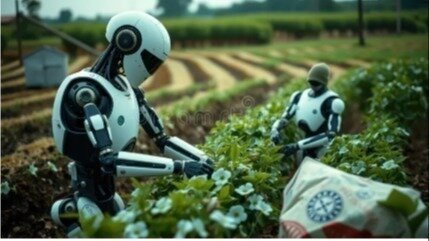
Could the humanoid robot provide us with the things we need to survive? Certainly any of the things that could be tied to material resources, yes. A humanoid robot can, in principle, grow food, get water, build shelter, weave clothing, clean us (or provide us the materials to do so), perform medical treatment - and leave us to our devices to figure out the rest.
But - as implied in the previous email update - the ability to automate, say, farming, is not an impossibly difficult task. Certainly not so difficult that it requires as yet to exist super technology in order to automate. I would stake a good deal on the speculation that top engineers of the 1970s or 1980s - using the technology of their day - could surely have automated farming to a meaningful extent. As long as they had had machines that could faithfully perform the necessary repetitive tasks - and do so remotely / autonomously.
Furthermore, and what I believe important to observe, farming (and other essential industries) are not yet automated - despite the basic capabilities theoretically long being present. There are clearly socioeconomic forces at play that overwhelm our mere technological capacity.
Slavery (a horrible cultural infection in the human species) provides a grim analog for the picture I’m attempting to paint. Though it ended as a legal institution in 1865, there is now nevertheless more slavery in the world than ever - festering underground in black markets.
Why invoke this as an analog? Because behaviors, systems, or inclinations that run deep in human society don’t go away simply because we say they do - or because they appear to go away.
Whatever socioeconomic phenomena there are holding back the full automation of farming (or what have you) - and whether the phenomena is some combination of people holding on to their wealth, or status, or security, their work opportunities at the expense of real progress - it is clearly a force crucial to a conversation about humanoid robots.
To sum up, before we figure out humanoid robots, we must first figure out why it is we haven't made full use of the technology that we DO have.
Thank you for working with me to curtail these tools.
Sincerely,
Michael Christensen