Frequently Asked Questions about why the San Joaquin River dried up in 2022

1. What is the San Joaquin River Restoration Program?
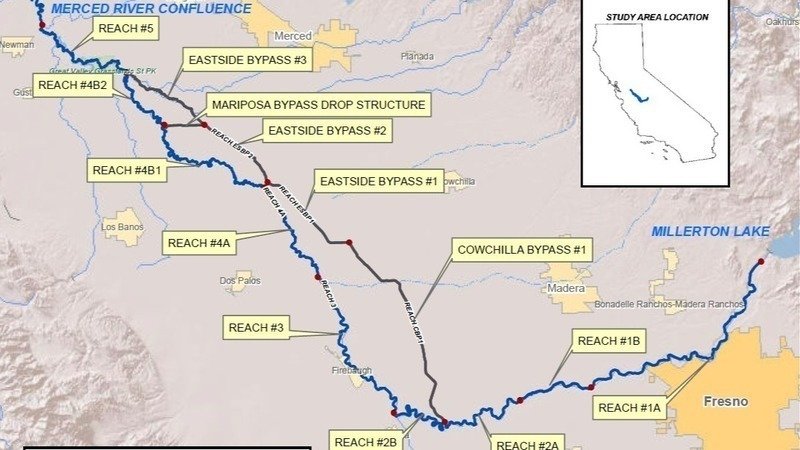
· The San Joaquin River is California’s second-longest river and the southernmost extent of the range of Chinook salmon. Prior to 1950 it supported tens of thousands of anadromous fall run and spring-run Chinook salmon (a record 56,000 Spring-run returned in 1948). Following the construction of Friant Dam, the river had over sixty miles of dry, disconnected reaches, initially limited to summers in the 1940s, extending to all year in 80% of years until court-approved settlement flows began in 2009. The 2006 settlement negotiated by NRDC, TBI, and others was authorized by Congress in 2009 and has resulted in the San Joaquin River Restoration Program (SJRRP) returning water to all [Footnote 1] reaches in non-Critical year-types since 2009.
· The SJRRP has had promising success restoring flows and Spring-run Chinook Salmon to the San Joaquin River. The Program reintroduced Spring-run in 2017 and each year since, and despite major obstacles, these fish and their offspring have spawned, reproduced, and migrated out to sea every year since then, with natural returns every year since 2019 (49 in 2017, 441 in 2019, 57 in 2020, 93 in 2021, 11 in 2022).
2. What is happening in 2022?
· On April 17, 2022 the river was turned off at Sack Dam, preventing juvenile salmon from migrating out to the ocean and limiting the ability of returning salmon to find and return to their spawning grounds. Over 40 miles of the migration corridor had little or no flow until early July. [Footnote 2] Peak adult salmon returns usually center around the first week in May, but with little flow to provide migration cues, only eleven fish returned prior to May 8th, with 10 surviving to be trapped and hauled by biologists to a still-flowing reach of river upstream below Friant Dam.
3. Why was the river turned off?
· The Bureau of Reclamation (Reclamation), the operator of Friant Dam/Millerton Reservoir, has a contract to deliver Sacramento River water to the Exchange Contractors (ECs)—the senior water rights holders on the San Joaquin River—and in exchange, in most years Reclamation stores San Joaquin River water in Millerton Reservoir and delivers that water to the Friant division of the CVP.
· In 2022, due to extreme drought conditions in Northern California, the Bureau of Reclamation was unable to deliver the full supply to the ECs from the Sacramento River through the Delta, meaning San Joaquin River water was delivered from Friant Dam via the San Joaquin River channel to make up the shortfall. There was not enough room in the river channel for both Restoration Flows and EC deliveries—and the Bureau of Reclamation prioritized the deliveries.
· Restoration flows must comply with the SJRRP Seepage Management Plan limiting river flows so that crops planted too close to the river are not impacted by river seepage. The ECs are not being required to comply with the Seepage Management Plan, or Fish and Game Code section 5937 requiring dam operators to keep fish in good condition below their dams. In addition, the levees in certain reaches of river can’t hold both Restoration Flows and EC deliveries, and EC deliveries are given full use of the river capacity, causing the river to dry up downstream of the lowest diversion point at Sack Dam. This policy combined with the ECs diverting all the water in the river at Sack Dam violates Fish and Game code section 5937 and killed all the fish in a 30 mile stretch of now dry riverbed. Delivery of some of the ECs water right could coexist with Restoration Flows—if the Seepage Management Plan were implemented equitably, and if Fish and Game Code 5937 were followed at Sack Dam, keeping fish in good condition downstream.
· In July, Exchange Contractor deliveries via the river ended, but the greatly-reduced cold water pool in the reservoir was saved for the salmon spawning and incubation season. Because Exchange Contractor deliveries expended most of the cold water pool, Restoration Flows were held back until fall, resulting in multiple dry river reaches all summer.
4. How will the salmon do that were trucked upstream to the flowing portion of the river?
· The large volume of water delivery from the San Joaquin River to the ECs between April and July drained the cold water pool in Millerton Reservoir, resulting in warmer water releases below Friant Dam that could be detrimental to incubating salmon eggs in September, October, and November. In addition to the ten natural adult salmon returns, an additional 90 salmon were released from a conservation hatchery into the still-flowing river immediately below Friant Dam. In order to prevent the loss of an entire generation of spring-run due to the delivery of excessive amounts of water to senior water rights holders, cold restoration flows were held in the reservoir until fall, resulting in dry river reaches July-September. This is a failure of Friant Dam operators to keep fish in good condition below the dam as required by Fish and Game code section 5937.
· The river is being turned back on starting October 1st. Once the river reconnects and cools by late November, flows and temperatures should be adequate for any surviving salmon through the fall and winter months.
5. What can be done?
· The Restoration Program has tremendous potential to restore the San Joaquin River and its salmon runs, however too many obstacles are being put in the way of getting the job done. Lack of enforcement of the Fish and Game code and prioritization of land and water right holders’ interests over the public interest in a well-managed flowing river are delaying the achievement of the Restoration Goal.
· Public support for adequate state and federal funding for the Program, as well as enforcement of our laws, and better agency policies that prioritize the public’s interest in natural, free flowing rivers will help. Contact your state and federal representatives and express your support for the San Joaquin River Restoration Program!
· The Exchange Contract combined with limited river capacity resulted in the river going dry in 4 of the last 10 years—when the Restoration Settlement was signed, an “EC Call” on Friant had never happened and was not anticipated to be a frequent occurrence in the future. The Exchange Contract can be renegotiated this year—if the Bureau requests renegotiation before October 18th. Tell the Bureau of Reclamation that it’s time to renegotiate the San Joaquin River Exchange Contract and bring the river and its salmon runs back to life again. Sign the Petition at https://tinyurl.com/sjsalmon !
Footnotes
[1] Reach 4B has been illegally blocked for many decades by local landowners and the local flood control district. The temporary route flowing water and migrating fish take past this blocked section is through the Eastside Bypass, a flood control bypass.
[2] Leaky gates on Sack Dam kept minimal water in the river on May 3rd, when Baykeeper captured drone footage of the dwindling river. By May 26 the river was dry at Highway 152, documented in the June 8th drone flight.