PETITION TO SAFEGUARD UKRAINE’S CULTURAL HERITAGE AND ARTISTIC INTEGRITY
The Issue
PETITION TO SAFEGUARD UKRAINE’S
CULTURAL HERITAGE AND ARTISTIC INTEGRITY
This petition is addressed to: The European Parliament • The Council of the European Union • All Ministers of Culture of the European Union member states.
A Call for Immediate Sanctions and the Suspension of Russian State Participation in International Cultural Events.
We, the undersigned, demand immediate and decisive action.
On the night of 24 May 2026, the Russian Federation launched a massive aerial attack on Kyiv, deploying about 70 missiles and 600 drones. The attack was directed not against clearly identifiable military objectives, but against the capital of a sovereign state and its civilian population.
The missiles and drones struck the historic heart of Kyiv — a district densely built with museums, theatres, universities, libraries, churches, and architectural monuments. Many of these sites are formally registered cultural heritage properties and are marked with the Blue Shield, the internationally recognized emblem protecting cultural property under the 1954 Hague Convention for the Protection of Cultural Property in the Event of Armed Conflict.
The Convention makes it mandatory for all States Parties to respect and safeguard cultural property, including monuments of architecture, art, and history; museums; libraries; archives; and centres containing cultural property of great importance to humanity. The Russian Federation is a State Party to the Convention. It is also bound by the broader principles of international humanitarian law, which require parties to an armed conflict to distinguish between military objectives and civilian objects and to take all feasible precautions to avoid damage to protected cultural heritage.
The scale of the attack and the concentration of strikes within one of Europe's most significant historic urban landscapes make it increasingly difficult to regard the resulting damage to cultural heritage as merely incidental. The attack put at risk not only individual buildings and collections, but an entire cultural ecosystem that embodies centuries of Ukrainian history and forms part of the shared heritage of humanity.
This was an attack on more than a city. It was an attack on memory, identity, and culture. The museums, libraries, archives, theatres, and monuments of Kyiv are not military targets. They are repositories of human experience and historical continuity. Their destruction serves no legitimate military purpose. It diminishes not only Ukraine, but the cultural heritage of the world.
I. The Attack of 24 May 2026: Institutions Struck in a Single Night
Museums:
National Chornobyl Museum — near-total destruction
National Art Museum of Ukraine — severe blast damage; doors and windows torn from frames, collections displaced
Museum of Outstanding Figures of Ukrainian Culture
National Museum of the History of Ukraine in the Second World War
Pavlo Tychyna Literary and Memorial Museum
Performing Arts & Cultural Centers:
National Philharmonic of Ukraine
Taras Shevchenko National Academic Opera and Ballet Theatre of Ukraine
Kyiv Small Opera
Lesya Ukrainka National Academic Theater
Kyiv Academic Theater of Drama and Comedy
“Suzirya” Academic Theater
Ukrainian House
Universities & Academies:
Taras Shevchenko National University of Kyiv
Ukrainian National Academy of Music
Kyiv National University of Culture and Arts
National Academy of Fine Arts and Architecture
Borys Grinchenko Kyiv Metropolitan University
Architectural Heritage:
Contract House in Podil (18th century)
Postal Square (19th Century)
Yaroslav the Wise National Library of Ukraine (1911)
St. Nicholas Church (17th-Century baroque)
Church of the Intercession
The destruction of the National Chornobyl Museum deserves to be condemned in the most forceful terms. For more than three decades, the museum stood among the world's most important institutions dedicated to documenting the 1986 nuclear disaster — serving simultaneously as a national archive for remembrance, a center of research, and an educational platform of international significance.
In early May 2026, after 18months of refurbishment ahead of the fortieth anniversary of the Chornobyl disaster, the museum reopened its doors to the public. Within weeks, Russian missiles reduced much of the institution to rubble.
The loss extends far beyond that of a
building. The museum preserved the material evidence of one of the defining tragedies of the 20th Century and provided a space where the consequences of technological failure, state secrecy, and human sacrifice could be studied and remembered by future generations.
As Ukraine's Minister of Culture observed: “A museum that we opened just a month ago after a lengthy restoration. A deliberate attack on history, memory, and truth.” Few descriptions could be more accurate. The destruction of the Chornobyl Museum was not merely an attack on cultural property; it was an attack on the preservation of historical knowledge itself.
Since the petition was drafted
Russian forces have:
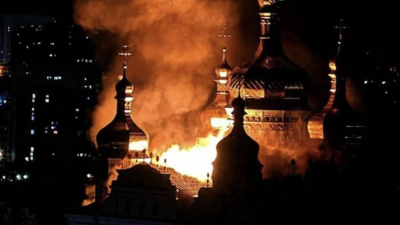
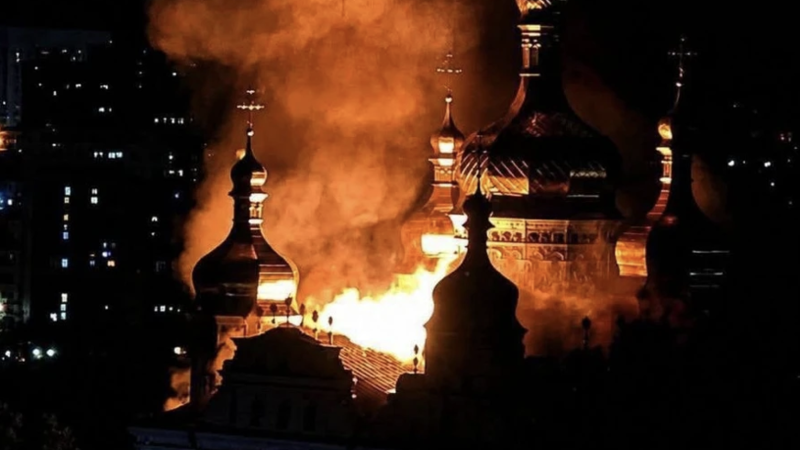
· On 15 June 2026, the Dormition Cathedral of the Kyiv Pechersk Lavra was damaged in a drone strike. More than 80% of its roof was burned or otherwise damaged, while the masonry and surrounding structures within the UNESCO World Heritage complex sustained severe damage.
· A Shahed attack drone directly hit the Mystetskyi Arsenal National Cultural, Arts and Museum Complex, sparking a major fire that engulfed approximately 1,000–2,000 square meters.
· A heavy missile and drone attack sparked a major fire at the Dovzhenko Film Studio, destroying its costume workshop and Ukraine’s oldest costume collection, comprising approximately 100,000 costumes and three million props.
· On 1 August 2026, a drone attack destroyed the Holy Presentation Church (Sviato-Vvedenska) in Beryslav, Kherson region. The wooden Cossack-era church, built in 1726, burned down following the strike.
· On 20 August 2026, an FPV drone strike damaged the Oleksiy Shovkunenko Kherson Regional Art Museum. The resulting fire affected the building’s right wing and adjacent utility structures.
· On 4 September 2026, the blast wave from a drone attack damaged the Consistory House (Khlibnia) within the UNESCO-listed Saint Sophia Cathedral complex in Kyiv.
· On 28 September 2026, a direct strike by a jet-powered drone severely damaged the historic Presidium building of the National Academy of Sciences of Ukraine in central Kyiv. The attack killed two people and sparked a fire that engulfed the upper floors, forcing people to escape through windows.
II. Our Demands
The European Parliament and the Council of the European Union must impose immediate and comprehensive sanctions on the Ministry of Culture of the Russian Federation — not merely on individual directors or institutions, but on the Ministry itself as the directing organ of systematic cultural crimes.
Russian state participation in all European and international cultural structures, events, partnerships, and platforms must be suspended without delay — and must remain suspended until the Russian Federation ends its war of aggression and ceases the systematic destruction of Ukrainian cultural heritage.
All Ministers of Culture are called upon to refuse participation in any international cultural forum in which Russian state representatives are permitted to attend unchallenged, while Ukrainian institutions burn.
III. A Pattern of Systematic Destruction: The Record Since 2014
This attack did not occur in isolation. According to Ukraine's Ministry of Culture, since the beginning of the full-scale invasion Russia has destroyed or damaged 1,707 cultural heritage sites and 2,503 cultural infrastructure facilities. More than 2.1 million museum exhibits remain in territories currently under Russian occupation.
The Mariupol Drama Theatre, bombed on 16 March 2022 while sheltering hundreds of civilians, became one of the most notorious symbols of this campaign. The word “CHILDREN” had been painted in giant letters outside the building, clearly visible from the air. Rather than preserving the site as evidence, Russian authorities later demolished most of the structure — a move Ukrainian officials denounced as an attempt both to conceal the deaths of civilians and to erase a landmark of Ukrainian cultural life.
The looting of museum collections has been equally systematic. From six museums in territories liberated by Ukraine in 2022 alone, Russian forces stole nearly 35,000 artefacts — the largest museum theft in Europe since the Second World War. Among the institutions plundered were the Mariupol Museum of Local Lore, the Museum of Folk Life, and the Kuindzhi Art Museum, from which more than 2,000 objects disappeared. The Melitopol Museum of Local History lost its entire collection of Scythian archaeological treasures, including 198 gold artefacts.
The Kherson Regional Art Museum was stripped of nearly 15,000 works of art, including Western European, Oriental, Ukrainian, and Russian paintings, icons, decorative arts, and other museum objects spanning several centuries. The collection was illegally transferred to occupied Crimea. In accordance with the Federal Constitutional Laws adopted on 3–4 October 2022 and signed by Vladimir Putin on 5 October 2022, which purported to annex the Donetsk, Luhansk, Kherson, and Zaporizhzhia regions of Ukraine, cultural property removed from these occupied territories is retrospectively treated under Russian law as Russian state property. This legal framework seeks to legitimize the transfer of Ukrainian cultural heritage to Russian institutions and creates substantial obstacles to the future restitution of looted artefacts.
The Council of Europe, in its declaration of October 2024, emphasized the broader significance of these actions, describing them as part of a campaign aimed at undermining the foundations of Ukrainian identity. The destruction of monuments, the looting of museums, and the appropriation of cultural heritage are not merely by-products of war. They form part of a deliberate effort to erase historical memory and weaken the cultural continuity of a nation.
IV. The Blue Shield and the Violation of International Law
The buildings struck on 24 May bore the Blue Shield — the internationally recognized emblem established by the 1954 Hague Convention to identify cultural property protected during armed conflict. That emblem was not respected. It was disregarded.
The Convention's 1999 Second Protocol provides for Enhanced Protection of cultural property of the greatest importance to humanity and recognizes the intentional targeting of such property as serious violation that may entail individual criminal responsibility. The pattern of destruction witnessed in Ukraine raises grave concerns regarding compliance with these obligations. The repeated attacks on museums, monuments, religious sites, historic buildings, and other cultural institutions cannot be explained solely as accidental consequences of military operations.
As of January 2026, UNESCO had verified damage to 515 cultural sites since the beginning of the full-scale invasion in February 2022, including 153 religious sites, 268 buildings of historical and artistic significance, 38 museums, and 33 monuments. Taken together, these figures reveal a pattern too extensive and too consistent to be dismissed as mere collateral damage. The claim that the destruction of Ukraine's cultural heritage is simply an unavoidable by-product of war has become increasingly difficult to sustain.
V. The Failure of Existing Mechanisms
More than four years into Russia's full-scale war against Ukraine, UNESCO and the International Council of Museums (ICOM) have proven unable either to halt the destruction of cultural heritage or even to suspend Russian state representatives from international cultural platforms. This institutional paralysis is not merely a procedural failure. It is a moral failure with tangible consequences for both human lives and irreplaceable cultural heritage.
At the same time, the Russian Federation continues to pursue a systematic strategy of international cultural rehabilitation. The most striking recent example was the 2026 Venice Biennale, where the Russian Federation returned after its own artists had withdrawn in 2022, declaring that “there is no place for art when civilians are dying under the fire of missiles.” The European Commission warned that covering costs associated with Russia's participation could violate EU sanctions. Members of the European Parliament called for the suspension of EU funding. Ministers and senior officials from 22 EU member states signed a joint letter opposing Russia's inclusion. None of these objections altered the decision.
The consequences were immediate. The entire five-member jury resigned collectively, refusing to participate in awarding prizes to national representations that included states whose leaders face arrest warrants issued by the International Criminal Court, among them the Russian Federation. The Biennale replaced the jury with a public vote and proceeded as planned. In response, more than 70 artists participating in the International Exhibition and representatives of 22 national pavilions withdrew from consideration for the Biennale awards.
Three days before the bombardment of Kyiv, Russian Foreign Ministry spokesperson Maria Zakharova accused peaceful demonstrators in Venice of embracing “the logic of constant, total, endless destruction of everything and everyone.” Days later, Russian missiles reduced the National Museum “Chornobyl” — reopened only weeks earlier after 18 months of restoration — to rubble. The psychological projection could hardly have been more transparent, or more grotesque.
VI. The Ministry of Culture of the Russian Federation Is Not a Neutral Player
The European Union and Canada have imposed sanctions on a number of Russian museum directors and cultural institutions. Yet these individuals and organizations are not the architects of policy; they are its implementers. The Ministry of Culture of the Russian Federation serves as the central coordinating body behind the systematic attack on Ukraine's cultural heritage. It has overseen the looting of museums in occupied territories, directed the forced Russification of cultural and educational institutions, facilitated the transfer of cultural property to Russian institutions, and promoted state propaganda narratives while sheltering behind the convenient fiction that “culture is outside politics.”
Culture is not outside politics when museums are looted, monuments demolished, and cultural institutions turned into instruments of occupation. Culture is not outside politics when the destruction of heritage becomes a method of war. Nor are international cultural platforms neutral when they confer legitimacy, visibility, and prestige upon representatives of a state engaged in the systematic erasure of another nation's cultural identity.
The question is no longer whether culture and politics can be separated. Russia's war against Ukraine has answered that question with devastating clarity. The question is whether international cultural institutions are prepared to acknowledge that reality and act accordingly.
The time for statements of concern has passed. The time for symbolic gestures has passed.
Ukrainian cultural heritage is European cultural heritage. Every archive burned, every theatre gutted, every museum shelled is an assault on the shared memory of humanity. War crimes against culture must have consequences. Institutions that continue to normalize these crimes — that extend legitimacy to a state actively engaged in the systematic erasure of another nation’s heritage — become complicit in that destruction.
We will not be silent. We will not stand aside. We demand action now.
This petition is addressed to: The European Parliament • The Council of the European Union • All national Ministers of Culture of the European Union.
Museums for Ukraine is an informal association of high-level museum directors, curators, collectors, activists, thinkers, and art historians who support and defend the fundamental right of Ukraine to maintain its independence by securing and protecting Ukrainian cultural heritage and supporting Ukrainian cultural institutions.
FOUNDING MEMBERS
Konstantin Akinsha, The Avant-garde Art Research Project, UK; Bjorn Geldhof, PinchukArtCentre, Kyiv; Maria Isserlis, Cultural Foundation Ukraine; Gianluigi Ricuperati, Milan Triennale; Francesca Thyssen Bornemisza, TBA2, Madrid, Venice.
SIGNATORIES
Ministers of Culture of EU Member States:
Nauris Puntulis, Minister for Culture of the Republic of Latvia.
Lukas Alsys, Minister of Culture of the Republic of Lithuania.
Hanna Wróblewska, the former Minister of Culture of Poland.
Members of the European Parliament:
Pina Picierno
Italy
Vice-President: European Parliament. Member: EUDS — Special Committee on the European Democracy Shield. Substitute: AFET — Foreign Affairs; LIBE — Civil Liberties, Justice and Home Affairs
Giorgio Goro
Italy
Vice-Chair: ITRE — Industry, Research and Energy. Substitute: AFET — Foreign Affairs
Alessandra Moretti
Italy
Member: ENVI — Environment, Climate and Food Safety; SANT — Public Health; FEMM — Women’s Rights and Gender Equality. Substitute: AFET — Foreign Affairs
Magdalena Adamowicz
Poland
Member: LIBE — Civil Liberties, Justice and Home Affairs; PETI — Petitions. Substitute: CULT — Culture and Education
Bartosz Arłukowicz
Poland
Member: ENVI — Environment, Climate and Food Safety; SANT — Public Health. Substitute: PECH — Fisheries
Krzysztof Brejza
Poland
Member: LIBE — Civil Liberties, Justice and Home Affairs. Substitute: JURI — Legal Affairs
Borys Budka
Poland
Chair: ITRE — Industry, Research and Energy. Substitute: AFET — Foreign Affairs
Andrzej Buła
Poland
Member: REGI — Regional Development. Substitute: TRAN — Transport and Tourism
Kamila Gasiuk-Pihowicz
Poland
Member: LIBE — Civil Liberties, Justice and Home Affairs. Substitute: JURI — Legal Affairs
Hanna Beata Gronkiewicz-Waltz
Poland
Member: ECON — Economic and Monetary Affairs. Substitute: FISC — Tax Matters
Hannes Heide
Austria
Member: CULT — Culture and Education; REGI — Regional Development. Substitute:CONT — Budgetary Control
Krzysztof Hetman
Poland
Member: EMPL — Employment and Social Affairs. Substitute: REGI — Regional Development
Adam Jarubas
Poland
Member: ENVI — Environment, Climate and Food Safety; SANT — Public Health. Substitute: ITRE — Industry, Research and Energy
Dariusz Joński
Poland
Member: TRAN — Transport and Tourism. Substitute: CONT — Budgetary Control
Karin Karlsbro
Sweden
Vice-Chair: INTA — International Trade. Substitute: ENVI — Environment, Climate and Food Safety; PECH — Fisheries
Łukasz Kohut
Poland
Member: ITRE — Industry, Research and Energy. Substitute: CULT — Culture and Education
Ewa Kopacz
Poland
Member: ENVI — Environment, Climate and Food Safety; SANT — Public Health. Substitute: FEMM — Women’s Rights and Gender Equality
Janusz Lewandowski
Poland
Member: BUDG — Budgets. Substitute: ECON — Economic and Monetary Affairs
Elżbieta Łukacijewska
Poland
Member: TRAN — Transport and Tourism. Substitute: ENVI — Environment, Climate and Food Safety
Jagna Kinga Marczułajtis-Walczak
Poland
Member: CULT — Culture and Education. Substitute: FEMM — Women’s Rights and Gender Equality
Mirosława Nykiel
Poland
Member: IMCO — Internal Market and Consumer Protection. Substitute: TRAN — Transport and Tourism
Urmas Paet
Estonia
Member: AFET — Foreign Affairs; SEDE — Security and Defence. Substitute: INTA — International Trade
Reinis Pozņaks
Latvia
Member: TRAN — Transport and Tourism. Substitute: SEDE — Security and Defence
Jacek Protas
Poland
Member: REGI — Regional Development. Substitute: BUDG — Budgets
Paulius Saudargas
Lithuania
Member: ECON — Economic and Monetary Affairs; ITRE — Industry, Research and Energy. Substitute: IMCO — Internal Market and Consumer Protection
Joanna Scheuring-Wielgus
Poland
Member: CULT — Culture and Education; FEMM — Women’s Rights and Gender Equality. Substitute: IMCO — Internal Market and Consumer Protection; PETI — Petitions; HOUS — Special Committee on the Housing Crisis in the European Union
Bartłomiej Sienkiewicz
Poland
Member: CULT — Culture and Education. Substitute: LIBE — Civil Liberties, Justice and Home Affairs
Michał Szczerba
Poland
Member: CONT — Budgetary Control. Substitute: AFET — Foreign Affairs
Marta Wcisło
Poland
Member: IMCO — Internal Market and Consumer Protection. Substitute: AGRI — Agriculture and Rural Development
Michał Wawrykiewicz
Poland
Member: JURI — Legal Affairs. Substitute: LIBE — Civil Liberties, Justice and Home Affairs
Bogdan Zdrojewski
Poland
Member: CULT — Culture and Education. Substitute: AFET — Foreign Affairs
Roberts Zīle
Latvia
Member: TRAN — Transport and Tourism. Substitute: ECON — Economic and Monetary Affairs
----------------------------------------------------------------------------------------------------
Filippo Sensi, Senator of the Republic; Democratic Party (PD), Italy.
Lia Quartapelle Procopio, Member of the Chamber of Deputies; Democratic Party (PD), Italy.
Simona Flavia Malpezzi, Senator of the Republic; Democratic Party (PD), Italy.
Graziano Delrio, Senator of the Republic; Democratic Party (PD), Italy.
Lorenzo Guerini, Member of the Chamber of Deputies; Democratic Party (PD), Italy.
Piero Fassino, Member of the Chamber of Deputies; Democratic Party (PD), Italy.
Sandra Zampa, Senator of the Republic; Democratic Party (PD), Italy.
Nicola Carè, Member of the Chamber of Deputies; Democratic Party (PD), Italy.
Benedetto Della Vedova, Member of the Chamber of Deputies; More Europe (+Europa), Italy.
Virginio Merola, Member of the Chamber of Deputies; Democratic Party (PD), Italy.
Igor Boni, President of Europa Radicale, Italy.
Luigi Spagnolli, Senator of the Republic; For the Autonomies Group, Italy.
Walter Verini, Senator of the Republic; Democratic Party (PD), Italy.
Roberto Montanari, Member of the National Guarantee Commission of the Democratic Party (PD), Italy.
Riccardo Magi, Member of the Chamber of Deputies; Secretary of More Europe (+Europa), Italy.
Claude Malhuret, Sénateur de l'Allier, Président du groupe Les Indépendants au Sénat (Senator for Allier, President of the Independents Group in the French Senate), Paris.France.
Nadia Sollogoub, Sénatrice, présidente du groupe d'amitié France–Ukraine au Sénat. (Senator and Chair of the French Senate’s France-Ukraine Friendship Group, Paris, France.
Sylvie Rollet, President of association Pour l'Ukraine, pour leur liberté et la nôtre! Paris, France.
Marie-Laure Bernadac, Conservateur général du patrimoine. (Chief Curator of Heritage). Paris, France.
Prof Donna Yates, UNESCO Chair in Cultural Heritage and Emerging Crime, Maastricht University, the Netherlands.
Will Korner, The Cultural Heritage at Risk Database Foundation, the Netherlands.
Henny Houben-Sipman, former Member of the Senate of the Netherlands (CDA); former CDA parliamentary group leader in Eindhoven; former Mayor of Eersel (Brainport region), The Netherlands.
Tomás de la Quadra-Salcedo Fernández del Castillo, Politician lawyer, former Minister of Justice of Spain, Madrid, Spain.
Miguel Satrústegui Gil-Delgado, Economist, lawyer, professor, the former Undersecretary of State of Spain, member of the board of the Board of Trustees of Thyssen-Bornemysza Collection Foundation, Madrid, Spain.
Carmen Cardin, Senior Non-resident Fellow CIDOB, Barcelona Centre for International Affairs, Barcelona, Spain.
Joan Subirats, Professor of Political Science, University of Barcelona.
Pere Vilanova, Professor of Political Science and the Administration, University of Barcelona. Barcelona, Spain.
Johannes Nathan, Member of the Steering Committee of Ukraine Art Aid Center. Berlin, Germany.
Wesley A. Fisher, Director of Research and Head of Claims Conference-WJRO Looted Art and Cultural Property Initiative, USA.
Tess Davis, Executive Director, The Antiquities Coalition, USA.
Irina Tarsis, J.D., Founder, Center for Art Law, USA / Switzerland
Patty Gerstenblith, Ph.D., J.D., President of the US Committee of the Blue Shield, Distinguished Research Professor Emerita, DePaul University College of Law, USA.
Sanjay Sethi and Ashley Tucker, Executive Directors, Artistic Freedom Initiative, New York, USA
Corine Wegener, Military Cultural Property Protection Specialist, USA.
Vitaliy Tytych, Chairman of the Board of the Raphael Lemkin Society; Head of the Legal Section of ICOM Ukraine; Managing Partner of the law firm Vitaliy Tytych & Partners. Kyiv, Ukraine.
Mykyta Poturaiev, Chair of the Committee on Humanitarian and Information Policy, Verkhovna Rada of Ukraine, Kyiv, Ukraine.
Anne Applebaum, Journalist and historian, USA/Poland.
Katia Margolis, Founder, Arts Against Aggression, Venice, Italy.
Piotr Cywiński, Director, Auschwitz-Birkenau State Museum, Oświęcim, Poland.
Iveta Derkusova, Director, Latvian National Museum of Art, Riga, Latvia.
Yulia Lytvynets. Director, National Art Museum of Ukraine. Kyiv, Ukraine.
Daniel Muzyczuk. Director, Muzeum Sztuki Łódź (MSL) the Museum of Art in Łódź, Poland.
Olena Siyanko. Director, Ukrainian Museum, New York. USA.
Sieje Helmi, Director, KUMU Art Museum, Tallinn, Estonia.
Solvita Krese, Director of the Latvian Centre for Contemporary Art (LCCA), Riga, Latvia.
Harald Binder, Founder, Jam Factory Art Center, Lviv, Ukraine.
Fabienne Servan-Schreiber, Film and television producer. Paris, France.
Laurent Jaoui, Screenwriter and film director. Paris, France.
Bashkim Shehu, Writer, Barcelona, Spain.
Nada Đermanović, Fim actress, Serbia.
Aimée Brown Price, Art Historian, New York, USA.
Deborah Rosenthal, Artist and Professor Emeritus; NEA Critic's Grant Recipient, USA.
Jed Perl, Art critic, Author, and International Association of Art Critics (AICA) member. USA.Solvita Krese, Director of the Latvian Center for Contemporary Art (LCCA), Riga, Latvia.
Dr. Alexis Nouss, Professor Emeritus of general and comparative literature at Aix-Marseille University, member of the Interdisciplinary Center for Literary Studies in Aix-Marseille (CIELAM), Marseille, France.

277
The Issue
PETITION TO SAFEGUARD UKRAINE’S
CULTURAL HERITAGE AND ARTISTIC INTEGRITY
This petition is addressed to: The European Parliament • The Council of the European Union • All Ministers of Culture of the European Union member states.
A Call for Immediate Sanctions and the Suspension of Russian State Participation in International Cultural Events.
We, the undersigned, demand immediate and decisive action.
On the night of 24 May 2026, the Russian Federation launched a massive aerial attack on Kyiv, deploying about 70 missiles and 600 drones. The attack was directed not against clearly identifiable military objectives, but against the capital of a sovereign state and its civilian population.
The missiles and drones struck the historic heart of Kyiv — a district densely built with museums, theatres, universities, libraries, churches, and architectural monuments. Many of these sites are formally registered cultural heritage properties and are marked with the Blue Shield, the internationally recognized emblem protecting cultural property under the 1954 Hague Convention for the Protection of Cultural Property in the Event of Armed Conflict.
The Convention makes it mandatory for all States Parties to respect and safeguard cultural property, including monuments of architecture, art, and history; museums; libraries; archives; and centres containing cultural property of great importance to humanity. The Russian Federation is a State Party to the Convention. It is also bound by the broader principles of international humanitarian law, which require parties to an armed conflict to distinguish between military objectives and civilian objects and to take all feasible precautions to avoid damage to protected cultural heritage.
The scale of the attack and the concentration of strikes within one of Europe's most significant historic urban landscapes make it increasingly difficult to regard the resulting damage to cultural heritage as merely incidental. The attack put at risk not only individual buildings and collections, but an entire cultural ecosystem that embodies centuries of Ukrainian history and forms part of the shared heritage of humanity.
This was an attack on more than a city. It was an attack on memory, identity, and culture. The museums, libraries, archives, theatres, and monuments of Kyiv are not military targets. They are repositories of human experience and historical continuity. Their destruction serves no legitimate military purpose. It diminishes not only Ukraine, but the cultural heritage of the world.
I. The Attack of 24 May 2026: Institutions Struck in a Single Night
Museums:
National Chornobyl Museum — near-total destruction
National Art Museum of Ukraine — severe blast damage; doors and windows torn from frames, collections displaced
Museum of Outstanding Figures of Ukrainian Culture
National Museum of the History of Ukraine in the Second World War
Pavlo Tychyna Literary and Memorial Museum
Performing Arts & Cultural Centers:
National Philharmonic of Ukraine
Taras Shevchenko National Academic Opera and Ballet Theatre of Ukraine
Kyiv Small Opera
Lesya Ukrainka National Academic Theater
Kyiv Academic Theater of Drama and Comedy
“Suzirya” Academic Theater
Ukrainian House
Universities & Academies:
Taras Shevchenko National University of Kyiv
Ukrainian National Academy of Music
Kyiv National University of Culture and Arts
National Academy of Fine Arts and Architecture
Borys Grinchenko Kyiv Metropolitan University
Architectural Heritage:
Contract House in Podil (18th century)
Postal Square (19th Century)
Yaroslav the Wise National Library of Ukraine (1911)
St. Nicholas Church (17th-Century baroque)
Church of the Intercession
The destruction of the National Chornobyl Museum deserves to be condemned in the most forceful terms. For more than three decades, the museum stood among the world's most important institutions dedicated to documenting the 1986 nuclear disaster — serving simultaneously as a national archive for remembrance, a center of research, and an educational platform of international significance.
In early May 2026, after 18months of refurbishment ahead of the fortieth anniversary of the Chornobyl disaster, the museum reopened its doors to the public. Within weeks, Russian missiles reduced much of the institution to rubble.
The loss extends far beyond that of a
building. The museum preserved the material evidence of one of the defining tragedies of the 20th Century and provided a space where the consequences of technological failure, state secrecy, and human sacrifice could be studied and remembered by future generations.
As Ukraine's Minister of Culture observed: “A museum that we opened just a month ago after a lengthy restoration. A deliberate attack on history, memory, and truth.” Few descriptions could be more accurate. The destruction of the Chornobyl Museum was not merely an attack on cultural property; it was an attack on the preservation of historical knowledge itself.
Since the petition was drafted
Russian forces have:
· On 15 June 2026, the Dormition Cathedral of the Kyiv Pechersk Lavra was damaged in a drone strike. More than 80% of its roof was burned or otherwise damaged, while the masonry and surrounding structures within the UNESCO World Heritage complex sustained severe damage.
· A Shahed attack drone directly hit the Mystetskyi Arsenal National Cultural, Arts and Museum Complex, sparking a major fire that engulfed approximately 1,000–2,000 square meters.
· A heavy missile and drone attack sparked a major fire at the Dovzhenko Film Studio, destroying its costume workshop and Ukraine’s oldest costume collection, comprising approximately 100,000 costumes and three million props.
· On 1 August 2026, a drone attack destroyed the Holy Presentation Church (Sviato-Vvedenska) in Beryslav, Kherson region. The wooden Cossack-era church, built in 1726, burned down following the strike.
· On 20 August 2026, an FPV drone strike damaged the Oleksiy Shovkunenko Kherson Regional Art Museum. The resulting fire affected the building’s right wing and adjacent utility structures.
· On 4 September 2026, the blast wave from a drone attack damaged the Consistory House (Khlibnia) within the UNESCO-listed Saint Sophia Cathedral complex in Kyiv.
· On 28 September 2026, a direct strike by a jet-powered drone severely damaged the historic Presidium building of the National Academy of Sciences of Ukraine in central Kyiv. The attack killed two people and sparked a fire that engulfed the upper floors, forcing people to escape through windows.
II. Our Demands
The European Parliament and the Council of the European Union must impose immediate and comprehensive sanctions on the Ministry of Culture of the Russian Federation — not merely on individual directors or institutions, but on the Ministry itself as the directing organ of systematic cultural crimes.
Russian state participation in all European and international cultural structures, events, partnerships, and platforms must be suspended without delay — and must remain suspended until the Russian Federation ends its war of aggression and ceases the systematic destruction of Ukrainian cultural heritage.
All Ministers of Culture are called upon to refuse participation in any international cultural forum in which Russian state representatives are permitted to attend unchallenged, while Ukrainian institutions burn.
III. A Pattern of Systematic Destruction: The Record Since 2014
This attack did not occur in isolation. According to Ukraine's Ministry of Culture, since the beginning of the full-scale invasion Russia has destroyed or damaged 1,707 cultural heritage sites and 2,503 cultural infrastructure facilities. More than 2.1 million museum exhibits remain in territories currently under Russian occupation.
The Mariupol Drama Theatre, bombed on 16 March 2022 while sheltering hundreds of civilians, became one of the most notorious symbols of this campaign. The word “CHILDREN” had been painted in giant letters outside the building, clearly visible from the air. Rather than preserving the site as evidence, Russian authorities later demolished most of the structure — a move Ukrainian officials denounced as an attempt both to conceal the deaths of civilians and to erase a landmark of Ukrainian cultural life.
The looting of museum collections has been equally systematic. From six museums in territories liberated by Ukraine in 2022 alone, Russian forces stole nearly 35,000 artefacts — the largest museum theft in Europe since the Second World War. Among the institutions plundered were the Mariupol Museum of Local Lore, the Museum of Folk Life, and the Kuindzhi Art Museum, from which more than 2,000 objects disappeared. The Melitopol Museum of Local History lost its entire collection of Scythian archaeological treasures, including 198 gold artefacts.
The Kherson Regional Art Museum was stripped of nearly 15,000 works of art, including Western European, Oriental, Ukrainian, and Russian paintings, icons, decorative arts, and other museum objects spanning several centuries. The collection was illegally transferred to occupied Crimea. In accordance with the Federal Constitutional Laws adopted on 3–4 October 2022 and signed by Vladimir Putin on 5 October 2022, which purported to annex the Donetsk, Luhansk, Kherson, and Zaporizhzhia regions of Ukraine, cultural property removed from these occupied territories is retrospectively treated under Russian law as Russian state property. This legal framework seeks to legitimize the transfer of Ukrainian cultural heritage to Russian institutions and creates substantial obstacles to the future restitution of looted artefacts.
The Council of Europe, in its declaration of October 2024, emphasized the broader significance of these actions, describing them as part of a campaign aimed at undermining the foundations of Ukrainian identity. The destruction of monuments, the looting of museums, and the appropriation of cultural heritage are not merely by-products of war. They form part of a deliberate effort to erase historical memory and weaken the cultural continuity of a nation.
IV. The Blue Shield and the Violation of International Law
The buildings struck on 24 May bore the Blue Shield — the internationally recognized emblem established by the 1954 Hague Convention to identify cultural property protected during armed conflict. That emblem was not respected. It was disregarded.
The Convention's 1999 Second Protocol provides for Enhanced Protection of cultural property of the greatest importance to humanity and recognizes the intentional targeting of such property as serious violation that may entail individual criminal responsibility. The pattern of destruction witnessed in Ukraine raises grave concerns regarding compliance with these obligations. The repeated attacks on museums, monuments, religious sites, historic buildings, and other cultural institutions cannot be explained solely as accidental consequences of military operations.
As of January 2026, UNESCO had verified damage to 515 cultural sites since the beginning of the full-scale invasion in February 2022, including 153 religious sites, 268 buildings of historical and artistic significance, 38 museums, and 33 monuments. Taken together, these figures reveal a pattern too extensive and too consistent to be dismissed as mere collateral damage. The claim that the destruction of Ukraine's cultural heritage is simply an unavoidable by-product of war has become increasingly difficult to sustain.
V. The Failure of Existing Mechanisms
More than four years into Russia's full-scale war against Ukraine, UNESCO and the International Council of Museums (ICOM) have proven unable either to halt the destruction of cultural heritage or even to suspend Russian state representatives from international cultural platforms. This institutional paralysis is not merely a procedural failure. It is a moral failure with tangible consequences for both human lives and irreplaceable cultural heritage.
At the same time, the Russian Federation continues to pursue a systematic strategy of international cultural rehabilitation. The most striking recent example was the 2026 Venice Biennale, where the Russian Federation returned after its own artists had withdrawn in 2022, declaring that “there is no place for art when civilians are dying under the fire of missiles.” The European Commission warned that covering costs associated with Russia's participation could violate EU sanctions. Members of the European Parliament called for the suspension of EU funding. Ministers and senior officials from 22 EU member states signed a joint letter opposing Russia's inclusion. None of these objections altered the decision.
The consequences were immediate. The entire five-member jury resigned collectively, refusing to participate in awarding prizes to national representations that included states whose leaders face arrest warrants issued by the International Criminal Court, among them the Russian Federation. The Biennale replaced the jury with a public vote and proceeded as planned. In response, more than 70 artists participating in the International Exhibition and representatives of 22 national pavilions withdrew from consideration for the Biennale awards.
Three days before the bombardment of Kyiv, Russian Foreign Ministry spokesperson Maria Zakharova accused peaceful demonstrators in Venice of embracing “the logic of constant, total, endless destruction of everything and everyone.” Days later, Russian missiles reduced the National Museum “Chornobyl” — reopened only weeks earlier after 18 months of restoration — to rubble. The psychological projection could hardly have been more transparent, or more grotesque.
VI. The Ministry of Culture of the Russian Federation Is Not a Neutral Player
The European Union and Canada have imposed sanctions on a number of Russian museum directors and cultural institutions. Yet these individuals and organizations are not the architects of policy; they are its implementers. The Ministry of Culture of the Russian Federation serves as the central coordinating body behind the systematic attack on Ukraine's cultural heritage. It has overseen the looting of museums in occupied territories, directed the forced Russification of cultural and educational institutions, facilitated the transfer of cultural property to Russian institutions, and promoted state propaganda narratives while sheltering behind the convenient fiction that “culture is outside politics.”
Culture is not outside politics when museums are looted, monuments demolished, and cultural institutions turned into instruments of occupation. Culture is not outside politics when the destruction of heritage becomes a method of war. Nor are international cultural platforms neutral when they confer legitimacy, visibility, and prestige upon representatives of a state engaged in the systematic erasure of another nation's cultural identity.
The question is no longer whether culture and politics can be separated. Russia's war against Ukraine has answered that question with devastating clarity. The question is whether international cultural institutions are prepared to acknowledge that reality and act accordingly.
The time for statements of concern has passed. The time for symbolic gestures has passed.
Ukrainian cultural heritage is European cultural heritage. Every archive burned, every theatre gutted, every museum shelled is an assault on the shared memory of humanity. War crimes against culture must have consequences. Institutions that continue to normalize these crimes — that extend legitimacy to a state actively engaged in the systematic erasure of another nation’s heritage — become complicit in that destruction.
We will not be silent. We will not stand aside. We demand action now.
This petition is addressed to: The European Parliament • The Council of the European Union • All national Ministers of Culture of the European Union.
Museums for Ukraine is an informal association of high-level museum directors, curators, collectors, activists, thinkers, and art historians who support and defend the fundamental right of Ukraine to maintain its independence by securing and protecting Ukrainian cultural heritage and supporting Ukrainian cultural institutions.
FOUNDING MEMBERS
Konstantin Akinsha, The Avant-garde Art Research Project, UK; Bjorn Geldhof, PinchukArtCentre, Kyiv; Maria Isserlis, Cultural Foundation Ukraine; Gianluigi Ricuperati, Milan Triennale; Francesca Thyssen Bornemisza, TBA2, Madrid, Venice.
SIGNATORIES
Ministers of Culture of EU Member States:
Nauris Puntulis, Minister for Culture of the Republic of Latvia.
Lukas Alsys, Minister of Culture of the Republic of Lithuania.
Hanna Wróblewska, the former Minister of Culture of Poland.
Members of the European Parliament:
Pina Picierno
Italy
Vice-President: European Parliament. Member: EUDS — Special Committee on the European Democracy Shield. Substitute: AFET — Foreign Affairs; LIBE — Civil Liberties, Justice and Home Affairs
Giorgio Goro
Italy
Vice-Chair: ITRE — Industry, Research and Energy. Substitute: AFET — Foreign Affairs
Alessandra Moretti
Italy
Member: ENVI — Environment, Climate and Food Safety; SANT — Public Health; FEMM — Women’s Rights and Gender Equality. Substitute: AFET — Foreign Affairs
Magdalena Adamowicz
Poland
Member: LIBE — Civil Liberties, Justice and Home Affairs; PETI — Petitions. Substitute: CULT — Culture and Education
Bartosz Arłukowicz
Poland
Member: ENVI — Environment, Climate and Food Safety; SANT — Public Health. Substitute: PECH — Fisheries
Krzysztof Brejza
Poland
Member: LIBE — Civil Liberties, Justice and Home Affairs. Substitute: JURI — Legal Affairs
Borys Budka
Poland
Chair: ITRE — Industry, Research and Energy. Substitute: AFET — Foreign Affairs
Andrzej Buła
Poland
Member: REGI — Regional Development. Substitute: TRAN — Transport and Tourism
Kamila Gasiuk-Pihowicz
Poland
Member: LIBE — Civil Liberties, Justice and Home Affairs. Substitute: JURI — Legal Affairs
Hanna Beata Gronkiewicz-Waltz
Poland
Member: ECON — Economic and Monetary Affairs. Substitute: FISC — Tax Matters
Hannes Heide
Austria
Member: CULT — Culture and Education; REGI — Regional Development. Substitute:CONT — Budgetary Control
Krzysztof Hetman
Poland
Member: EMPL — Employment and Social Affairs. Substitute: REGI — Regional Development
Adam Jarubas
Poland
Member: ENVI — Environment, Climate and Food Safety; SANT — Public Health. Substitute: ITRE — Industry, Research and Energy
Dariusz Joński
Poland
Member: TRAN — Transport and Tourism. Substitute: CONT — Budgetary Control
Karin Karlsbro
Sweden
Vice-Chair: INTA — International Trade. Substitute: ENVI — Environment, Climate and Food Safety; PECH — Fisheries
Łukasz Kohut
Poland
Member: ITRE — Industry, Research and Energy. Substitute: CULT — Culture and Education
Ewa Kopacz
Poland
Member: ENVI — Environment, Climate and Food Safety; SANT — Public Health. Substitute: FEMM — Women’s Rights and Gender Equality
Janusz Lewandowski
Poland
Member: BUDG — Budgets. Substitute: ECON — Economic and Monetary Affairs
Elżbieta Łukacijewska
Poland
Member: TRAN — Transport and Tourism. Substitute: ENVI — Environment, Climate and Food Safety
Jagna Kinga Marczułajtis-Walczak
Poland
Member: CULT — Culture and Education. Substitute: FEMM — Women’s Rights and Gender Equality
Mirosława Nykiel
Poland
Member: IMCO — Internal Market and Consumer Protection. Substitute: TRAN — Transport and Tourism
Urmas Paet
Estonia
Member: AFET — Foreign Affairs; SEDE — Security and Defence. Substitute: INTA — International Trade
Reinis Pozņaks
Latvia
Member: TRAN — Transport and Tourism. Substitute: SEDE — Security and Defence
Jacek Protas
Poland
Member: REGI — Regional Development. Substitute: BUDG — Budgets
Paulius Saudargas
Lithuania
Member: ECON — Economic and Monetary Affairs; ITRE — Industry, Research and Energy. Substitute: IMCO — Internal Market and Consumer Protection
Joanna Scheuring-Wielgus
Poland
Member: CULT — Culture and Education; FEMM — Women’s Rights and Gender Equality. Substitute: IMCO — Internal Market and Consumer Protection; PETI — Petitions; HOUS — Special Committee on the Housing Crisis in the European Union
Bartłomiej Sienkiewicz
Poland
Member: CULT — Culture and Education. Substitute: LIBE — Civil Liberties, Justice and Home Affairs
Michał Szczerba
Poland
Member: CONT — Budgetary Control. Substitute: AFET — Foreign Affairs
Marta Wcisło
Poland
Member: IMCO — Internal Market and Consumer Protection. Substitute: AGRI — Agriculture and Rural Development
Michał Wawrykiewicz
Poland
Member: JURI — Legal Affairs. Substitute: LIBE — Civil Liberties, Justice and Home Affairs
Bogdan Zdrojewski
Poland
Member: CULT — Culture and Education. Substitute: AFET — Foreign Affairs
Roberts Zīle
Latvia
Member: TRAN — Transport and Tourism. Substitute: ECON — Economic and Monetary Affairs
----------------------------------------------------------------------------------------------------
Filippo Sensi, Senator of the Republic; Democratic Party (PD), Italy.
Lia Quartapelle Procopio, Member of the Chamber of Deputies; Democratic Party (PD), Italy.
Simona Flavia Malpezzi, Senator of the Republic; Democratic Party (PD), Italy.
Graziano Delrio, Senator of the Republic; Democratic Party (PD), Italy.
Lorenzo Guerini, Member of the Chamber of Deputies; Democratic Party (PD), Italy.
Piero Fassino, Member of the Chamber of Deputies; Democratic Party (PD), Italy.
Sandra Zampa, Senator of the Republic; Democratic Party (PD), Italy.
Nicola Carè, Member of the Chamber of Deputies; Democratic Party (PD), Italy.
Benedetto Della Vedova, Member of the Chamber of Deputies; More Europe (+Europa), Italy.
Virginio Merola, Member of the Chamber of Deputies; Democratic Party (PD), Italy.
Igor Boni, President of Europa Radicale, Italy.
Luigi Spagnolli, Senator of the Republic; For the Autonomies Group, Italy.
Walter Verini, Senator of the Republic; Democratic Party (PD), Italy.
Roberto Montanari, Member of the National Guarantee Commission of the Democratic Party (PD), Italy.
Riccardo Magi, Member of the Chamber of Deputies; Secretary of More Europe (+Europa), Italy.
Claude Malhuret, Sénateur de l'Allier, Président du groupe Les Indépendants au Sénat (Senator for Allier, President of the Independents Group in the French Senate), Paris.France.
Nadia Sollogoub, Sénatrice, présidente du groupe d'amitié France–Ukraine au Sénat. (Senator and Chair of the French Senate’s France-Ukraine Friendship Group, Paris, France.
Sylvie Rollet, President of association Pour l'Ukraine, pour leur liberté et la nôtre! Paris, France.
Marie-Laure Bernadac, Conservateur général du patrimoine. (Chief Curator of Heritage). Paris, France.
Prof Donna Yates, UNESCO Chair in Cultural Heritage and Emerging Crime, Maastricht University, the Netherlands.
Will Korner, The Cultural Heritage at Risk Database Foundation, the Netherlands.
Henny Houben-Sipman, former Member of the Senate of the Netherlands (CDA); former CDA parliamentary group leader in Eindhoven; former Mayor of Eersel (Brainport region), The Netherlands.
Tomás de la Quadra-Salcedo Fernández del Castillo, Politician lawyer, former Minister of Justice of Spain, Madrid, Spain.
Miguel Satrústegui Gil-Delgado, Economist, lawyer, professor, the former Undersecretary of State of Spain, member of the board of the Board of Trustees of Thyssen-Bornemysza Collection Foundation, Madrid, Spain.
Carmen Cardin, Senior Non-resident Fellow CIDOB, Barcelona Centre for International Affairs, Barcelona, Spain.
Joan Subirats, Professor of Political Science, University of Barcelona.
Pere Vilanova, Professor of Political Science and the Administration, University of Barcelona. Barcelona, Spain.
Johannes Nathan, Member of the Steering Committee of Ukraine Art Aid Center. Berlin, Germany.
Wesley A. Fisher, Director of Research and Head of Claims Conference-WJRO Looted Art and Cultural Property Initiative, USA.
Tess Davis, Executive Director, The Antiquities Coalition, USA.
Irina Tarsis, J.D., Founder, Center for Art Law, USA / Switzerland
Patty Gerstenblith, Ph.D., J.D., President of the US Committee of the Blue Shield, Distinguished Research Professor Emerita, DePaul University College of Law, USA.
Sanjay Sethi and Ashley Tucker, Executive Directors, Artistic Freedom Initiative, New York, USA
Corine Wegener, Military Cultural Property Protection Specialist, USA.
Vitaliy Tytych, Chairman of the Board of the Raphael Lemkin Society; Head of the Legal Section of ICOM Ukraine; Managing Partner of the law firm Vitaliy Tytych & Partners. Kyiv, Ukraine.
Mykyta Poturaiev, Chair of the Committee on Humanitarian and Information Policy, Verkhovna Rada of Ukraine, Kyiv, Ukraine.
Anne Applebaum, Journalist and historian, USA/Poland.
Katia Margolis, Founder, Arts Against Aggression, Venice, Italy.
Piotr Cywiński, Director, Auschwitz-Birkenau State Museum, Oświęcim, Poland.
Iveta Derkusova, Director, Latvian National Museum of Art, Riga, Latvia.
Yulia Lytvynets. Director, National Art Museum of Ukraine. Kyiv, Ukraine.
Daniel Muzyczuk. Director, Muzeum Sztuki Łódź (MSL) the Museum of Art in Łódź, Poland.
Olena Siyanko. Director, Ukrainian Museum, New York. USA.
Sieje Helmi, Director, KUMU Art Museum, Tallinn, Estonia.
Solvita Krese, Director of the Latvian Centre for Contemporary Art (LCCA), Riga, Latvia.
Harald Binder, Founder, Jam Factory Art Center, Lviv, Ukraine.
Fabienne Servan-Schreiber, Film and television producer. Paris, France.
Laurent Jaoui, Screenwriter and film director. Paris, France.
Bashkim Shehu, Writer, Barcelona, Spain.
Nada Đermanović, Fim actress, Serbia.
Aimée Brown Price, Art Historian, New York, USA.
Deborah Rosenthal, Artist and Professor Emeritus; NEA Critic's Grant Recipient, USA.
Jed Perl, Art critic, Author, and International Association of Art Critics (AICA) member. USA.Solvita Krese, Director of the Latvian Center for Contemporary Art (LCCA), Riga, Latvia.
Dr. Alexis Nouss, Professor Emeritus of general and comparative literature at Aix-Marseille University, member of the Interdisciplinary Center for Literary Studies in Aix-Marseille (CIELAM), Marseille, France.
Petition Updates
Share this petition
Petition created on October 21, 2026