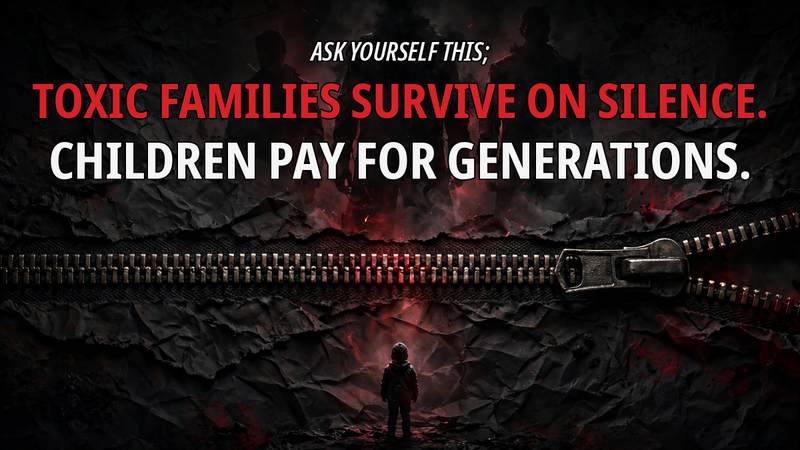
Toxic Families Survive on Silence. Children Pay for Generations

"Don't embarrass the family."
Read it again slowly. What it really says is: "Please keep absorbing this so the rest of us don't have to deal with it."
That is how toxic family systems survive. Not because nobody sees the problem. Everyone sees it. They survive because everybody has quietly agreed that the victim is easier to pressure than the abuser is to confront.
This update is about the enablers. Not the person doing the alienating, but the family members and friends around them who know exactly what is happening and say nothing. They don't want to stir the pot. They're afraid of the lash-out. So they choose comfort over courage, and the child pays the price.
Don't bring it up. Don't confront him. Don't tell her. Don't ruin the holiday. Don't make Mom cry. Don't embarrass the family. Every one of these is a demand for silence, dressed up as keeping the peace. But that is not peace. That is surrender. And your boundary, your refusal to stay silent, feels like violence to a dysfunctional system, because it forces everyone else to finally deal with what your silence used to hide.
Ask yourself this;
- What will you say to that child one day when they ask why you said nothing?
- If a child's wellbeing is on the line, what excuse is big enough for your silence?
- Are you protecting the child, or just protecting yourself?
- If you know and you say nothing, are you a bystander or an accomplice?
- How bad does it have to get before your silence feels heavier than your fear?
Here is what Canada itself says about this. Under the federal Divorce Act, "family violence" is not limited to physical harm. It explicitly includes psychological abuse, financial abuse, harassment, and patterns of coercive and controlling behaviour. The Government of Canada lists emotional and psychological abuse, including isolation, manipulation, humiliation, and intimidation, as forms of family violence. Coercive control, the ongoing pattern of domination through threats, isolation, and manipulation, is recognized in Canadian family law as a serious harm in its own right.
The research backs this up. Dr. Amy J.L. Baker, Ph.D., studied 38 adults who were alienated from a parent as children and found seven major areas of long-term damage: low self-esteem, depression, substance abuse, inability to trust, divorce, alienation from their own children, and other lasting emotional harm. Half of the people in her study ended up alienated from their own children. The cycle repeats. Researchers have compared alienating parents' tactics to those of cult leaders: the indoctrination, the isolation, the demand for absolute loyalty at the expense of the targeted parent. There is now scholarly consensus that severe alienation is abusive to children and a largely overlooked form of child abuse.
This is also a mental health matter, and it is where family members have a choice that matters. When someone in a family is struggling, when patterns of manipulation and control are visible, standing by them and insisting on accountability is not cruelty. It is care. Dysfunctional patterns are learned, and what is learned can be passed down. A child raised in an environment of conditional love, where affection must be earned through loyalty and silence, learns that love is a transaction. Every child deserves to be loved for who they are, unconditionally.
Breaking the silence is how we stop these patterns from reaching the next generation.
If speaking about this openly draws attacks, that says more about the discomfort with truth than about the people speaking it. The truth does not stop being true because it is inconvenient.
That is why this petition exists, and why Bill C-223 must not silence families. Sign, share, and refuse to be quiet.
References:
- Government of Canada, "What is family violence?": https://www.canada.ca/en/public-health/services/health-promotion/stop-family-violence/family-violence.html
- Department of Justice Canada, HELP Toolkit (Divorce Act definition of family violence): https://justice.canada.ca/eng/fl-df/help-aide/docs/help-overview.pdf
- Dr. Amy J.L. Baker on the impact of parental alienation on children: https://www.psychologytoday.com/us/blog/co-parenting-after-divorce/201304/the-impact-of-parental-alienation-on-children
- Dr. Amy J.L. Baker on identifying parental alienation (17 alienating behaviors): https://www.psychologytoday.com/ie/blog/mind-games/202109/identifying-parental-alienation
- Family Violence and Family Law brief on coercive control (citing Dr. Evan Stark): https://www.fvfl-vfdf.ca/briefs/Briefs PDF/Family_Violence_Family_Law_Brief-3.pdf