Do you have something to say for Peace? Add your 2 cents to the Treatises of World Peace.

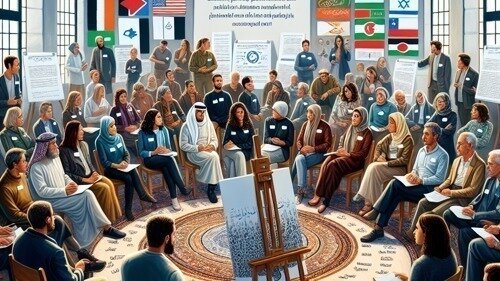
You may be thinking, why is the World Peace Catalysts Fund, the strongest force for peace? You may be questioning, why would it work?
I wanted to let you know, that I've written out the logic and the different aspects that need to be considered and comprised it into articles, called the Treatises of World Peace. They are made available on github for you to edit and contribute to, if you have an angle that needs to be considered. More work is needed, and I've listed out a few more articles that need to be written - mainly establishing why the peace economy would be better than a war economy.
This can be considered a philosophical piece on World Peace, and can be compared to some other peace philosophy. The main difference, is that WPCF works from a bottom up approach, providing leaders with the image/text representasiams, vocabulary and conversational pathways to bring mass groups of people from one level of understanding to another.
https://github.com/WorldPeaceCatalystFund/Treatises-of-World-Peace
1. Social Contract Theories (Hobbes, Locke, Rousseau)
The Classical View: Hobbes (Leviathan) and Locke posited that peace is established when individuals surrender certain liberties to a central sovereign (state power) to end the chaos of the "state of nature."
WPCF Contrast: The WPCF model does not rely on a top-down sovereign or central legal authority to maintain order. Instead, it assumes that macro-level societal conflict stems from unaddressed micro-level polarization. Its Treatises approach peace by building self-sustaining decentralized networks of mutual understanding across polarized divisions.
2. Perpetual Peace & Institutionalism (Immanuel Kant)
The Classical View: Kant (Perpetual Peace, 1795) proposed that lasting peace requires structural political mechanisms: republican governance, international law, and a federation of interdependent free states.
WPCF Contrast: While Kantian peace focuses on macro-political design, state sovereignty, and legal obligations, the WPCF framework focuses on relational infrastructure. Rather than depending on formal treaties between state leaders, WPCF’s Treatises prioritize grass-roots cross-cultural communication, leveraging social tools to surface shared values among citizens directly.
3. Modern Peace Research: Positive vs. Negative Peace (Johan Galtung)
The Modern View: Galtung distinguished between Negative Peace (the mere absence of active military violence) and Positive Peace (the elimination of structural violence, inequality, and systemic injustice).
WPCF Contrast: The WPCF’s Treatises align closely with Galtung's concept of Positive Peace, but focus on the communicative and psychological drivers of structural division. While Galtung emphasizes reforming social institutions and economic structures, WPCF prioritizes de-escalating cultural polarization and psychological hostility as the prerequisite for systemic stability.
Please share this and keep us in mind. WPCF needs your donations to finish the semiotic social media platform Icebreakers.