AND THEN MY PHONE RANG: Byron’s Voice Entered the Classroom

AND THEN MY PHONE RANG: Byron’s Voice Entered the Classroom
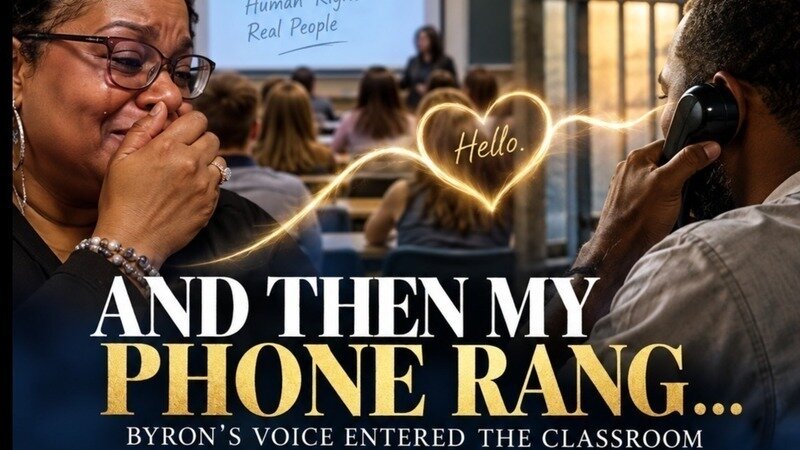
Last week, I had the privilege of speaking with Professor Michèle Schlehofer’s psychology students at Salisbury University about A Mother’s Cry, mass incarceration, advocacy, and the families who live with the consequences of incarceration every single day.
Because I am still recovering from hip replacement surgery, I joined the class by Zoom. I was disappointed that my new hip was not quite ready to carry me across campus, but perhaps I was exactly where I needed to be.
Because almost as soon as Professor Schlehofer introduced me, my phone rang. It was Byron. For anyone else, it might have been an inconvenient interruption. For me, it was the reason I was there.
I answered.
I explained to the students that when you love someone behind the wall, a telephone call is not “just a phone call.” For many incarcerated people, family members are their connection to the outside world—their source of encouragement, information, advocacy, reassurance and sometimes hope during their darkest moments.
I told them that I am one of Byron’s lifelines. Not answering a call may seem insignificant to someone on the outside. But when someone behind the wall is struggling, frightened, sick, in crisis, or simply needs to hear the voice of someone who loves them, that connection can carry a weight we should never minimize.
Later, I read a statement Byron had prepared for them.
He told the students that he feels “honored and empowered” knowing that the painful circumstances surrounding his incarceration helped give birth to A Mother’s Cry and that his story is now being used to help others.
He spoke about his pride in me as his mother and advocate. He acknowledged the tears behind this work and the strength it sometimes takes to continue through them.
He also spoke about changes he has witnessed behind the wall, including increased opportunities for time outside of cells, recreation, fresh air and sunshine. He expressed his appreciation for A Mother’s Cry continuing to focus attention on the human rights and dignity of incarcerated people.
Then Byron gave the students a charge.
He wanted them to understand that incarcerated people are human beings—not numbers and cases.
They are former classmates. Neighbors. Sons and daughters. Mothers and fathers. Friends. Family members.
And then he reminded those college students of something that reached far beyond that classroom: “You are the future decision-makers.”
I cried while reading his words. Some of the students cried with me.
Not because tears were the goal, but because for a few moments, mass incarceration was no longer simply an academic subject. It had a voice. It had a mother. It had a son. It had a family.
Afterward, Professor Schlehofer shared that Byron’s call to action had been especially impactful. She asked whether Byron and I would consider allowing his statement to be shared with her colleagues and potentially with other students studying the impact of mass incarceration.
Think about that.
A man speaking from behind prison walls may now help educate people in university classrooms he has never physically entered.
The system may have placed Byron behind a wall. But it did not put his voice behind one.
And this experience also reminded me why A Mother’s Cry exists. Our work is not simply about one mother and one son. It is about insisting that incarcerated individuals retain their humanity. It is about helping families find their voices. It is about bringing lived experience into rooms where policies, practices, professions and perspectives are being shaped.
Professor Schlehofer’s students are now working in teams to create real-world projects and deliverables for A Mother’s Cry—work designed not simply to earn a grade, but potentially to be used beyond their classroom.
That gives me tremendous hope.
Because education can do more than teach people about systems. It can prepare people to change them.
To every person who has signed this petition, shared Byron’s story, prayed, written a letter, attended a meeting, supported A Mother’s Cry, or simply refused to forget about the human beings behind prison walls: thank you.
The work continues. And this week, Byron reminded a classroom of future decision-makers exactly why.
— Rev. Jamesina Greene
Founder & President, A Mother’s Cry
Mother of Byron J. Greene