
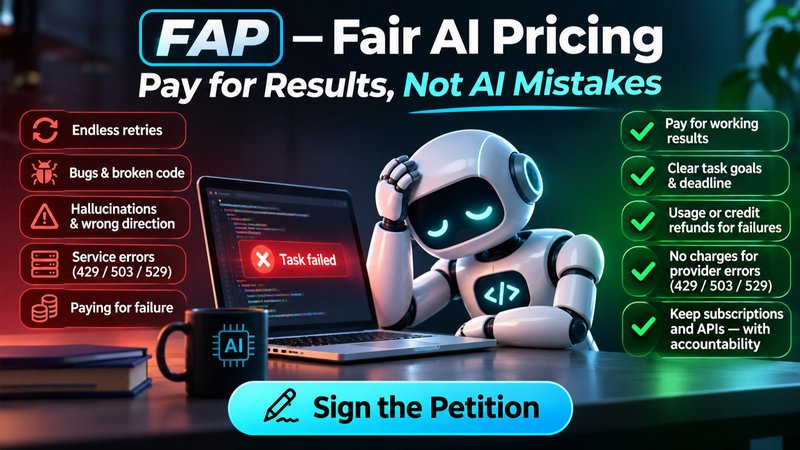
FAP — Fair AI Pricing — Pay for Results, Not AI Mistakes
The Issue
Protect AI subscriptions. Make API billing fair. Stop charging customers for agents’ failures.
To OpenAI, Anthropic, Google, xAI and all commercial AI-agent providers:
AI agents are marketed as tools that save time and complete real work. Yet paying users can lose substantial subscription allowance or API credits while an agent hallucinates, takes the wrong approach, breaks working code, repeats failed fixes, or returns a deliverable that does not meet agreed functional requirements.
The customer then pays again — in usage, time and effort — to repair the agent’s mistakes.
Customers should not bear all the cost of AI agents learning through failure. We pay for productive work, not endless attempts.
Recent pricing proposals show why safeguards are needed.
In September 2026, OpenAI announced a reduction in included Work/Codex usage for its $200 Pro plan at the same price; it reversed the reduction on October 29.
In May 2026, Anthropic proposed moving Claude Agent SDK and headless claude -p workloads from subscription limits toward separately billed credits/API usage; it paused that change on June 15.
Neither change is currently in effect. But both illustrate how easily paying customers' automation options and effective allowances could be squeezed without corresponding accountability for delivered quality.
These concerns are especially troubling when paying users spend their allowances discovering and correcting model defects. Where users voluntarily permit their conversations or feedback to improve models, providers may also learn from that experience.
Consumers should not have to finance the entire correction cycle and receive no meaningful remedy when an accepted task fails.
What we demand
1. Preserve meaningful subscription and API choices.
Keep fairly priced plans for interactive and supported automated personal use alongside metered APIs.
Do not force users into a more expensive billing channel without clear notice, justification and a workable alternative. Disclose usage allowances and changes before they take effect.
2. Offer outcome-based pricing for scoped agent work.
Let customers propose functional acceptance criteria, a deadline and a budget; the provider can accept or decline the scope before execution.
Internal detours and retries should be included in the agreed price or allowance, not become an unlimited bill.
3. Restore usage or credits for verified agent-caused failures.
When an accepted task misses its agreed functional requirements, introduces material regressions or corrupts previously working work because of the agent, provide proportionate credits, subscription-usage restoration, or an appropriate remedy.
Provide an independent dispute path.
4. Protect users from provider-side technical waste.
Failed service requests, provider outages or overload (such as applicable 503 or 529 errors), malfunctioning retry mechanisms, duplicate billing, and verified provider-caused cache misses should not drain paid allowances or trigger avoidable charges.
Distinguish these from valid user-side rate limits (some 429 errors), ordinary cache expiry, or changed prompts.
Publish transparent itemized usage and credit adjustments.
5. Prove completion, not activity.
Report functional test results, material regressions, remaining known issues, and whether the agreed outcome was delivered.
Subjective UI preferences are not functional failures unless explicitly included in the accepted criteria.
We do not demand an impossible universal zero-bug guarantee, unlimited free inference, or refunds for every disagreement.
We ask for clear agreements, accurate accounting, meaningful remedies and a fair share of responsibility when the provider’s own agent fails.
Keep subscriptions. Keep APIs. Give consumers a genuine choice. And make AI providers accountable for results — not mistakes.
Sign to demand an outcome-based option, transparent usage accounting, and enforceable failure-credit policies.

6
The Issue
Protect AI subscriptions. Make API billing fair. Stop charging customers for agents’ failures.
To OpenAI, Anthropic, Google, xAI and all commercial AI-agent providers:
AI agents are marketed as tools that save time and complete real work. Yet paying users can lose substantial subscription allowance or API credits while an agent hallucinates, takes the wrong approach, breaks working code, repeats failed fixes, or returns a deliverable that does not meet agreed functional requirements.
The customer then pays again — in usage, time and effort — to repair the agent’s mistakes.
Customers should not bear all the cost of AI agents learning through failure. We pay for productive work, not endless attempts.
Recent pricing proposals show why safeguards are needed.
In September 2026, OpenAI announced a reduction in included Work/Codex usage for its $200 Pro plan at the same price; it reversed the reduction on October 29.
In May 2026, Anthropic proposed moving Claude Agent SDK and headless claude -p workloads from subscription limits toward separately billed credits/API usage; it paused that change on June 15.
Neither change is currently in effect. But both illustrate how easily paying customers' automation options and effective allowances could be squeezed without corresponding accountability for delivered quality.
These concerns are especially troubling when paying users spend their allowances discovering and correcting model defects. Where users voluntarily permit their conversations or feedback to improve models, providers may also learn from that experience.
Consumers should not have to finance the entire correction cycle and receive no meaningful remedy when an accepted task fails.
What we demand
1. Preserve meaningful subscription and API choices.
Keep fairly priced plans for interactive and supported automated personal use alongside metered APIs.
Do not force users into a more expensive billing channel without clear notice, justification and a workable alternative. Disclose usage allowances and changes before they take effect.
2. Offer outcome-based pricing for scoped agent work.
Let customers propose functional acceptance criteria, a deadline and a budget; the provider can accept or decline the scope before execution.
Internal detours and retries should be included in the agreed price or allowance, not become an unlimited bill.
3. Restore usage or credits for verified agent-caused failures.
When an accepted task misses its agreed functional requirements, introduces material regressions or corrupts previously working work because of the agent, provide proportionate credits, subscription-usage restoration, or an appropriate remedy.
Provide an independent dispute path.
4. Protect users from provider-side technical waste.
Failed service requests, provider outages or overload (such as applicable 503 or 529 errors), malfunctioning retry mechanisms, duplicate billing, and verified provider-caused cache misses should not drain paid allowances or trigger avoidable charges.
Distinguish these from valid user-side rate limits (some 429 errors), ordinary cache expiry, or changed prompts.
Publish transparent itemized usage and credit adjustments.
5. Prove completion, not activity.
Report functional test results, material regressions, remaining known issues, and whether the agreed outcome was delivered.
Subjective UI preferences are not functional failures unless explicitly included in the accepted criteria.
We do not demand an impossible universal zero-bug guarantee, unlimited free inference, or refunds for every disagreement.
We ask for clear agreements, accurate accounting, meaningful remedies and a fair share of responsibility when the provider’s own agent fails.
Keep subscriptions. Keep APIs. Give consumers a genuine choice. And make AI providers accountable for results — not mistakes.
Sign to demand an outcome-based option, transparent usage accounting, and enforceable failure-credit policies.
Petition Updates
Share this petition
Petition created on November 9, 2026