George Double's Dedham Mill bridge being tested by a steam roller 1901

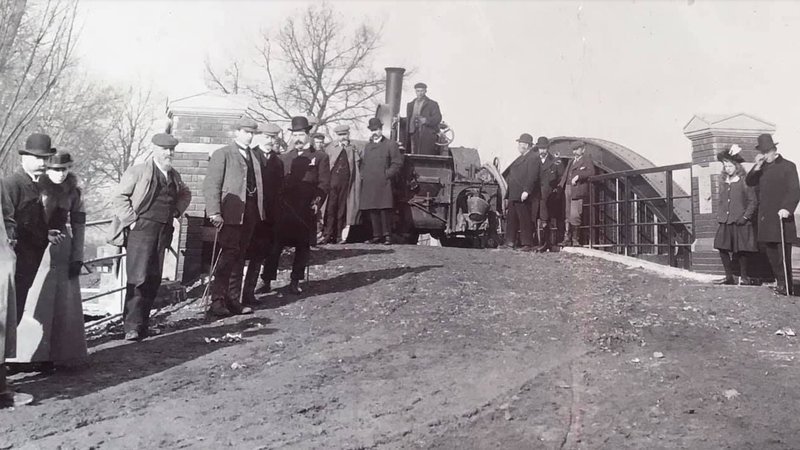
This photograph has recently been discovered of George Double's Dedham Mill bridge (1900) being tested by a steam roller in 1901. "The County Surveyor, in his report on county bridges, mentioned that Dedham Mill Bridge had been tested by a steam roller, and found to be satisfactory." (East Anglian Daily Times 20 February 1901) It seems fair to presume that a similar method of assessing the weight capacity was carried on Boxted bridge (1897).
The only quantitative, properly technical assessment of Boxted bridge was in 1992. The 3T weight limit proposed then was a result of concerns with the demonstrable load bearing capacity of the deck, notably the torsion resistance of the edge girders. This was a common problem, identified in the 1992 EU-wide inspections, with half-through girder bridges of the Boxted type: but it was more a result of crude, pre-computer quantitative methods used in assessment than a problem with the actual load bearing capacity of the bridges. Better methods [1] resulted in many bridges, initially assessed as ‘substandard’, being re-assessed as fit for purpose. Boxted Bridge was not re-assessed: but even the deck was considered to have sufficient ‘hidden strengths’ for the 3T weight limit to be ignored; and for the bridge to be allowed to carry unrestricted, i.e. 40T traffic for the next 30 years.
[1] See the report: Saving Half Through Girder Bridges using Non-Linear Finite Element Analysis S. MEHRKAR-ASL, C. L. BROOKES, W. G. DUCKETT Gifford and Partners Ltd, Southampton, UK. This ‘saving’ re-assessment was much used by Network Rail.
Photo with many thanks to Paul Gallifant