When the Facts Don’t Match: Reviewing The Wayland Post’s Elementary Music Reporting

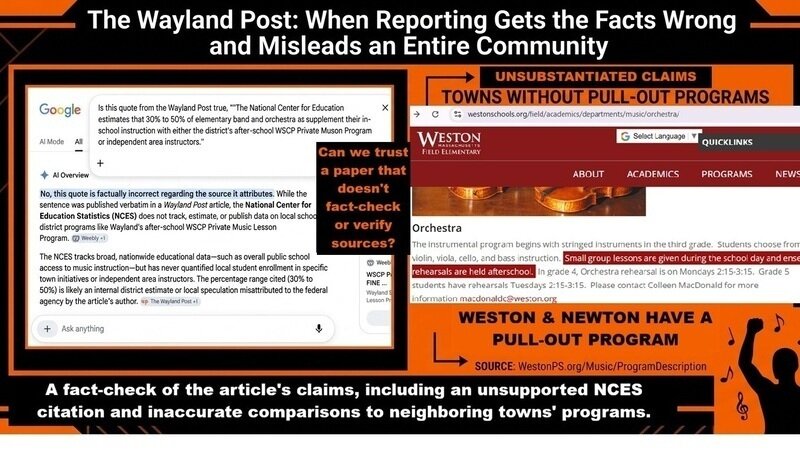
The Wayland Post recently published an article titled “A Look at Music Programs in Other Towns in Light of Loker Controversy.” The article contains multiple factual inaccuracies, unsupported citations, and misleading comparisons that do not accurately reflect how elementary music education is structured in our region. Despite being notified of these major errors last week, the Wayland Post has not corrected or retracted the online article. (9/30/26 UPDATE: The online article was subsequently modified after The Wayland Post was notified of factual inaccuracies and was still actively distributing misinformation. The current version does not contain an editor's note, correction notice, or other disclosure indicating that substantive changes were made. The revised article nevertheless continues to contain the central statement that many schools in the area do not have elementary pull-out instrumental programs, despite several direct information provided confirming otherwise.) (10/02/26 Update: The Wayland Post has since added an editor's note regarding some changes made to the article.)
The community deserves accurate, verifiable information and reporting when evaluating a reduction to our children's music instruction. Below is a detailed breakdown of the claims and where the article is factually inaccurate or misleads readers.
1. False – Weston School District Does not have a Pull-Out Instructional Music Program
The Claim: The article explicitly asserts that “While Sudbury’s elementary schools have a pull-out program, Weston, Wellesley, Lincoln, Natick, Newton, and Needham schools do not,” using these towns to suggest that high-performing districts do not rely on pull-out instrumental instruction.
The Facts: This statement is false. Official Weston Public Schools’ information from their website confirms that elementary students receive small-group instrumental instruction during the school day. Weston’s program includes pull-out instrumental lessons, followed by large-group band and orchestra instruction. As stated by the Music Director:
“Weston has a thriving music program…Every strong music program is built upon the foundation set in their elementary schools. Without a strong elementary base, the whole program suffers. Weston does have elementary pullout lessons: Each elementary student receives a 1/2 hour lesson per week within the school day, plus an additional 55 minute large ensemble rehearsal after school, totaling 85 minutes of instruction. The after school component is an extension to the curriculum delivered within the school day for students. The in school pullouts range from 10-20 students and serve as the primary source of delivering the elementary instrumental curriculum. The after school large ensemble rehearsals reinforce the curriculum delivered through in-school lessons. In Weston, we strongly support a program that is equitable to all students by offering in-school lessons and offering transportation from the after-school rehearsals.” (Colleen MacDonald, Weston Public School’s Music Director)
In practical terms, the instrumental program functions as a continuation of the school day: students receive small-group instrumental instruction during the regular school day and then remain for their school-based ensemble experience, with free district transportation provided for all afterward, including METCO students.
These distinction matters. Weston is specifically being used in the article as an example of a high-performing district that supposedly does not use pull-out instrumental instruction, when its program does include pull-out instruction during the regular school day. It is also important to distinguish this structure from an optional private lesson that families must independently arrange, pay for, and provide transportation to outside the school day.
2. False – Newton School District Does not have a Pull-Out Instructional Music Program
The Claim: The article explicitly asserts that “While Sudbury’s elementary schools have a pull-out program, Weston, Wellesley, Lincoln, Natick, Newton, and Needham schools do not,” using these towns to suggest that high-performing districts do not rely on pull-out instrumental instruction.
The Facts: According to Newton Public Schools Director of Humanities for Social Studies and Fine Arts, Eva Urban Hughes: “Newton does have in-school instrumental music lessons in grade 4- we offer nine different group lessons... Students are pulled out of their regularly scheduled day, (literacy, math etc), to take the lessons. In grade 5, students may sign up for band or orchestra during the school day… Grade 4 and 5 chorus is compulsory for all students (no fee) and also happens during the school day in addition to the K-5 general music program.”
When these districts are being used to help demonstrate how elementary instrumental music can or should be structured, the distinctions in access, scheduling, transportation, cost, and whether instrumental instruction occurs during the regular school day need to be accurately described. They are not. So far, Weston and Newton have confirmed that they have elementary pull-out instrumental programs, contrary to how these districts are described in the article. If Sudbury’s program is as described, then almost half of the districts cited in the article in fact have pull-out instrumental music programs. Responses from the remaining districts are still pending, meaning the full extent of the inaccuracies in this comparison has not yet been established.
3. Unsubstantiated NCES Citation
The Claim: The article states: "The National Center for Education Statistics estimates that 30% to 50% of elementary band and orchestra students supplement their in-school instruction with either the district’s after-school WSCP Private Music Lesson Program or independent area instructors."
The Facts: This statistic could not be substantiated through NCES. Searches beyond the article’s citation did not locate an NCES publication supporting this specific claim about students supplementing in-school instruction with local district or independent private lessons. NCES does publish national data concerning music instruction in public elementary schools. For example, its published tables report the percentage of public elementary schools offering band and strings/orchestra instruction during regular school hours. However, no NCES sources were located that provides the 30-50% estimate quoted in The Wayland Post article or that evaluates local district private lesson programs in this manner. At minimum, this citation requires a specific underlying source. Presenting a statistic as an NCES estimate without a verifiable NCES source is a serious accuracy concern.
4. Misleading Presentation of Equity and Access
The Claim: The article suggests that fee-based, before- or after-school lesson models, such as Wellesley's private lesson program, are directly comparable alternatives to in-school instruction.
The Facts: These models are not equivalent from an access standpoint. An in-school pull-out program provides instruction during the regular school day, while a private lesson model outside the school day requires tuition, additional transportation, scheduling flexibility, or adult availability. These distinctions are particularly important in a district that also serves METCO students and families who may have different transportation and after-school access considerations.
Weston provides a useful example of how these issues can be addressed within a school-based program. Weston’s instrumental instruction occurs during the school day, and students then participate in large-group ensembles immediately following dismissal, with free district-provided late buses, including for METCO students. This allows students to participate in the full instrumental program without requiring families to independently arrange transportation or pay for private instruction outside the school-based program.
For that reason, describing school-based instrumental programs and fee-based private lessons outside the school day as interchangeable alternatives does not provide a complete picture of access, cost, scheduling, or transportation. These distinctions matter when evaluating whether moving instrumental instruction outside the regular school day would provide comparable access to students across the district.
5. Narrow Regional Scope and Lack of Perspective
The Claim: The article presents a small selection of local districts as evidence of how elementary instrumental music is commonly structured.
The Facts: Additionally, the article’s comparison is exceptionally narrow. It selects a handful of neighboring Massachusetts communities and presents their approaches as though they provide a meaningful picture of how elementary instrumental music can or should be structured. There is considerable variation across the country that the article does not acknowledge.
Texas provides one example of a substantially different approach. At Houston ISD’s Lovett Elementary, music students in grades 1–5 choosing Band, Strings, or Vocal Music, as the school’s website states: “The State of Texas considers Music to be a curricular, rather than an enrichment, subject… All students participate in a 50-minute Fine Arts class each day, Monday through Friday, as part of their regular school schedule.” New York likewise incorporates music into its required elementary arts instruction and maintains separate state standards for general music, instrumental study, and traditional and emerging ensembles.
These examples illustrate why a comparison limited to a handful of neighboring Massachusetts districts provides an incomplete picture. The existence of different models does not establish that one model is preferable, or that reducing Loker’s existing instrumental music program is necessary or supported by evidence.
6. Unsubstantiated Rationale and Lack of Context
The Claim: The article cites administrative rationale, such as scheduling difficulties and a cited survey finding that 71.8% of Loker teachers felt the schedule did not meet student needs, as justification for the pilot.
The Facts: The reporting omits important context needed for readers to evaluate these assertions: Teacher Survey Data - The article does not provide the total number of respondents, exact survey wording, or the underlying dataset, making it difficult for readers to independently evaluate what the 71.8% figure represents.
Non-Ensemble Student Numbers: While the article cites the needs of students not participating in music, the classroom figures provided indicate that the number of students affected in an individual classroom may be relatively small. The actual figures should be considered when evaluating the extent of the scheduling issue. Why weren’t these numbers included in the article, and why hasn’t the district provided the numbers for each classroom and each grade to the community?
Academic Context: Academic changes following the disruption of the pandemic do not establish that the longstanding music schedule became an academic problem or that reducing music instruction is an evidence-based response. At the same time, Wayland's elementary schools continue to receive strong state accountability classifications. In the 2026 Massachusetts DESE accountability data, Loker had an accountability percentile of 86, while Claypit Hill and Happy Hollow were each at 92; all three were classified as “Not requiring assistance or intervention.”
This is not an exhaustive review of every factual issue or unsupported claim in the article. However, the inaccuracies and omissions identified above raise serious concerns about the article being used to inform the community’s understanding of the music pilot. A major change to an established educational program should not be justified by inaccurate or incomplete comparisons to other districts.
What We Must Do Next
When inaccurate or unsupported information is presented as factual reporting, it can mislead the community and undermine public trust. The concern is not that The Wayland Post should agree with parents or oppose the pilot. The concern is that the factual information used to frame this discussion should be accurate, sourced, and presented with sufficient context for the community to evaluate it for themselves.
The Wayland community should not have to rely on unsupported or inaccurate information when discussing a significant change to our children’s music instruction:
1. Attend Upcoming School Committee Meetings: Parents, residents, and community members must email, show up and speak out against these reductions and ask for transparency regarding the scheduling decisions and evidence supporting the pilot.
2. Share the Facts: Share official district sources and verified public information with your neighbors so that community members can review the facts for themselves.
3. Hold the Wayland Post Accountable: Ask the Wayland Post to verify their sources, provide supporting documentation for factual claims, and promptly correct demonstrably inaccurate statements when errors are identified.
Thank you for your continued support and dedication to protecting our students' education.
Note: The Wayland Post was notified of these factual inaccuracies on Friday and has since been provided with information from the districts themselves. As of today, the article remains online and have not been corrected, retracted, or removed. Please spread the word
9/30/26 UPDATE: The Article Was Subsequently Modified Without Public Disclosure: The online article was subsequently modified after The Wayland Post was notified of factual inaccuracies. The current version does not contain an editor's note, correction notice, or other disclosure indicating that substantive changes were made. The revised article nevertheless continues to contain the central statement that Weston and Newton do not have elementary pull-out instrumental programs, despite direct information provided by those districts confirming otherwise.
The revised version also contains additional assertions about a purported survey of all districts included in the article. The article does not identify the districts that responded, the questions asked, the sources relied upon, or the basis for the blanket conclusion regarding MICCA and MAJE recognition. Those claims should be independently verifiable if they are being presented as the results of a survey.