One Year After “Dirty Badges”: Phoenix VA Executives Know — And the Same Problems Remain

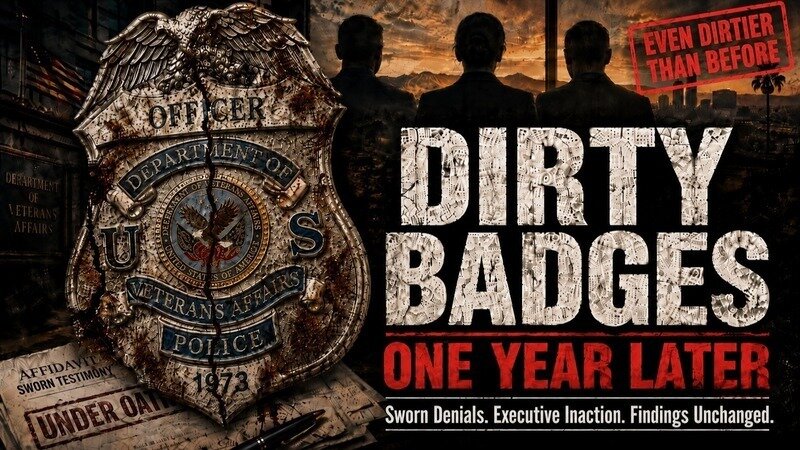
PHOENIX (PVAHCS) — One year after “Dirty Badges,” Phoenix VA’s top executives — Director Elijah Ditter, Associate Director Stacey Scherpf, and the Office of Security and Law Enforcement (OS&LE) Director — are aware of the article and the problem within their police department. Despite that awareness, why does a Phoenix VA Police Leadership Official with substantiated racial discrimination and sexual harassment findings still hold influence — and why do they continue to let him "sit in their morning meetings"? The failure belongs to PVAHCS Executive Leadership, OS&LE, and the Office of Operations, Security, and Preparedness (OSP).
ONE YEAR LATER, THEY KNOW
Awareness Exists. The Problem Remains.
One year after the article known as “Dirty Badges” first documented patterns of protected misconduct inside the Phoenix VA Police, the facility’s highest-ranking executives — Medical Center Director Elijah Ditter, Associate Director of Operations Stacey Scherpf, and the Director of the Office of Security and Law Enforcement — are aware of it.
- This matters, because they held oversight of the Phoenix VA Police during the period (2020–2025/2026) when racial harassment and sexual harassment permeated the Police department and infected it with “R.O.T.” — which later turned to “R.O.T.T.E.N(ess).”
The Real Story After Awareness
Despite that awareness, Phoenix VA Executive Leadership has continued to tolerate a Phoenix VA Police Leadership Official already found responsible by the agency for both racial discrimination and sexual harassment remaining in a position of influence — and continuing to sit in their morning meetings.
The Original Diagnosis
“Dirty Badges” was never only about individual wrongdoing. It described a system of selective justice in which supervisors with serious substantiated findings were shielded while other officers—particularly officers of color—faced aggressive discipline, reassignments, and career damage. One year later, that core diagnosis still holds.
- And to the first "Black Supervisory Police Officer" hired in the last known 26 years — in a department already found responsible for racial harassment against Black officers — a man who brings the experience, education, and capability (not merely his race) and could easily change a compromised police department: we wish you the best.
THE FINDINGS STAND UNCHALLENGED
The Official Record Is Closed
The official at the center of this matter does not face open allegations. He faces completed findings.
Phoenix VA Health Care System processes sustained a determination of inappropriate conduct of a "sexual nature" after the official simulated a sexual act directed at a younger female employee. Associate Director Stacey Scherpf issued the official Harassment Prevention Program (HPP) Memorandum of Record for HPP Case No. 6210 that sustained that finding. In a separate action, the VA’s Office of Employment Discrimination Complaint Adjudication issued a Final Agency Decision establishing agency liability for a racially hostile work environment in violation of Title VII of the Civil Rights Act of 1964.
Closed Findings. Open Influence.
Both determinations are final. Both form part of the agency’s own official record. They are not pending reviews, not unresolved complaints, and not matters still under investigation. They are closed agency conclusions.
AUTHORITY EXISTED. AWARENESS ARRIVED. INFLUENCE REMAINED.
Oversight Belonged To Them
For years prior to the broader realignment of VA Police under the Office of Operations, Security, and Preparedness, facility-level executives held direct oversight of the police service. Issues of conduct, discipline, and workplace climate fell squarely within their responsibility. When the substantiated findings emerged, the authority to act rested with the same leadership structure that continues to guide the organization today.
Once They Knew, the Equation Changed
Once Ditter, Scherpf, and the OS&LE Director became aware of “Dirty Badges,” the organization crossed a critical threshold. Continued tolerance after that point is no longer the product of unawareness. It becomes a matter of choice.
They Kept Him in the Room Anyway
Yet the essential arrangement did not change. The official retained influence and continued to sit in executive morning meetings. In recent instances, he was appointed "Acting Chief of Police" by the agency — representing one of the most powerful positions in the Department of Veterans Affairs . The same executives who are aware of the record continued to operate as though the findings were manageable rather than disqualifying.
THE COST OF EXECUTIVE INACTION
Liability Compounds Over Time
Liability does not end with the original misconduct. It compounds with every decision to leave the responsible official in a position of authority.
The ongoing costs are measurable and cumulative:
- Continued EEO, HPP, OAWP activity inside the facility
- Elevated exposure to federal litigation
- Erosion of internal trust among employees who have watched the findings produce no meaningful change in influence
- A clear institutional signal that substantiated findings of sexual harassment and racial discrimination do not automatically end influence
- Ongoing loss of taxpayer money that could have gone toward Veterans, instead diverted to EEO investigations driven by negative influences in Police Leadership
The Lesson Leadership Is Teaching
That signal originates at the top. When executive leadership permits a Phoenix VA Police Leadership Official carrying these findings to retain authority and sit in their morning meetings, the rest of the organization absorbs a precise lesson about the practical limits of accountability.
A CULTURE SUSTAINED BY TOLERANCE
What The Organization Is Willing To Live With
Institutions reveal their true priorities by what they are prepared to accommodate.
By declining to treat the agency’s own completed findings as disqualifying, Phoenix VA Executive Leadership has allowed conditions of hostility to persist under its direct watch. Employees who might otherwise report problems begin to weigh personal risk against the likelihood of meaningful correction. The internal narrative gains strength. The formal record loses force.
How Hostility Becomes Permanent
This is how discriminatory environments become entrenched—not through a single overt decision, but through sustained executive refusal to act on determinations the agency itself has already made. The longer the arrangement continues after awareness, the more deliberate the tolerance appears.
The Problem Still Stands
One year after “Dirty Badges” first named the pattern of protected supervisors and selective justice, the same fundamental problem remains visible in the leadership environment of the Phoenix VA Health Care System.
THE RESPONSIBILITY IS NOT DIFFUSE
They Had Everything. They Did Nothing Effective.
The distance between those facts measures the scope of executive inaction. Phoenix VA Executive Leadership possessed the information, the authority, and awareness of the record. They have not closed the gap. The liability that flows from that failure belongs to them and now OSP's leadership.
That Absence Is the Story
The public record now shows awareness at the highest levels of the facility. It shows the completed findings. It shows the continued access and influence. What it does not show is any decisive corrective action that would have removed the official from a position of power after the agency itself had already spoken.
That absence is the story. And the responsibility for it sits with the executives who had every opportunity to act and chose not to do anything effective.
- One year later, the badges are still dirty.
--------------------------------------------------------------------------------------------------------------
Concerned Citizens AZ Investigative Team — Building the Paper Trail That Turns “We Didn’t Know” Into Evidence.
--------------------------------------------------------------------------------------------------------------
READER NOTICE
Concerned Citizens Media encourages readers to independently verify the information contained in this publication, including through public records, official sources, or AI-assisted research tools. For additional information or clarification, readers are encouraged to contact appropriate Department of Veterans Affairs officials or their local VA facility directly.
----------------------------------------------------------------------------------------------------------------
DISCLAIMER
Any attempt to retaliate against current or former VA employees, officers, contractors, or witnesses for engaging in protected whistleblower or EEO activity related to the matters discussed herein may constitute a violation of federal law, including 5 U.S.C. § 2302(b)(8)–(9), Title VII of the Civil Rights Act of 1964, and applicable VA anti‑retaliation policies. Documentation, reporting, or public discussion of substantiated misconduct, harassment, discrimination, or policy violations is protected activity.