
Clock Kit Plans
Clock Kit Plans
The Issue
Selecting and Assembling Clock Parts for All Occasions
Putting together selected clock components offers one the joy of developing an unique convenient watch more or less from square one. Standard as well as specialized clock parts offer the do-it-yourself with a means to construct clocks that exhibit all the features truly desired, both functional and cosmetic, and also nothing extraneous. The resulting timepieces are for all purposes, all seasons, and all occasions.
Selecting clock parts is a task done by both hobbyists and clock sellers. The latter might be curious about establishing a niche market for customers who can't find what they want off the shelf. The former could be making gifts or clocks for their own needs, and their motive may be to do something creative with their hands or to get a specialized function that would be otherwise unobtainable.
Such specialized parts extend temporal reporting in some way, furnish non-temporal and/or quasi-temporal data, or serve as novelties. Large clock manufacturers tend to avoid these specialties because of the limited demand. The individual therefore usually has to handle the task himself if he really wants a certain special feature.
Parts are organized according to concerning four categories: clock movements (also known as motors), clock dials, clock hands, as well as devices. The motion rotates its shafts at their appropriate rates, all established by quartz crystals or electronic counters. The dial provides a carefully calibrated referral display, and the hands, which position comfortably on the shafts, point to the different numbers (or symbols).
Accessory components are additions such as chimes, pendulums, and also certain specialty products. Besides strictly novelties, special parts include means to reveal sweep 2nd hands, 24-hour time as opposed to 12-hour, the day of the week, the day on a 31-day schedule, the temperature, as well as the tide degree.
The presumption is that the individual constructs his very own situation (or makes use of something preexisting) and afterwards orders and assembles parts from each category to produce his masterpiece clock. Two nice things about this endeavor are that it doesn't require a lot of fancy tools which anyone with just the most basic ability of dealing with the hands can do it.
Selection begins with the identification of a manufacturer. The Internet is the best way to accomplish this in today's world. You will want to devise your very own selection criteria, but some consideration ought to be provided quality of workmanship, years in business, the breadth of selection, and whether items are made here in the US or not.
Another valuable source to speak with is the set of how-to instructional videos you can find on YouTube and somewhere else. These can explain subtle but important points that the neophyte often misses.
Now we look at each parts category in turn to give the reader some idea of just what to expect.
In choosing a clock activity, first think through exactly what feature(s) you really want. There are a bunch of options around as well as you need some systematic method for narrowing the list of prospects down to something workable.
For instance, if you want to show the trend together with traditional timekeeping, begin your search with climate motions. If you want to reveal the temperature, you will probably have to choose in between an analog electric motor that does just that (with corresponding temperature dials and hand) and a digital clock that includes temperature as one of a number of screens.
Actually, if you desire to include any kind of kind of specialized component, start your search there, as this will limit your option considerably. Except for temperature movements that often be strictly stand-alone, activities usually integrate all preferred time expansion includes right into one bundle.
If your clock has hands longer than about 6 inches, the movement will require to offer high twist. Often you will have a choice in between clock motors powered by an AA battery and also those powered by a C cell.
Dials come in all kinds of sizes, styles, as well as products. For the most part they can be purchased independently of the motors, as the angle subtended is always the exact same for any given time. Naturally, they do need to fit into the chosen situations.
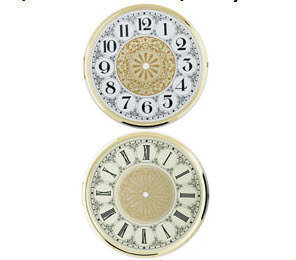
Dials come round or square, and also they can have Roman or Arabic numerals (or place holders rather than numbers). Some are made of plastic and some are made of metal. You usually want the top quality of the face to match the quality of the case.
We have seen at least one supplier market a reverse time dial. This has the numbers in reverse and left/right swapped to ensure that it appears to be a conventional dial when viewed in a mirror. A normal movement hence makes the hands seem to travel counterclockwise!
Hands also can be found in all type of sizes and also styles, and commonly you have an option of shades. The major thing to bear in mind is that clock hands should be proportioned to the dial. Specialty hands, such as those used to point at the day, the date, or the temperature level, need to work with the movement and calibrated to the dial.
Here is a note about second hands. Some clocks do without (virtually all activities fit a second hand if preferred), but if you choose to include one consider whether you really want a (soundless) continuous sweep or the traditional ticking version.
Finally, we concern accessory components. The pendulum, once central to clock procedure, is no more functional in modern clocks. Nonetheless, it is still valued for its looks, as well as lots of electric motors supply accessories for solitary and/or dual pendulums.
An additional accessory the reader may be interested in is the clock chime. This used to be routinely featured in mantle clocks, however nowadays it is a lot less popular. Still, one could obtain chiming clock movements with Westminster or Whittington chiming that seems on the hr with or without a following hr count chime.

The Issue
Selecting and Assembling Clock Parts for All Occasions
Putting together selected clock components offers one the joy of developing an unique convenient watch more or less from square one. Standard as well as specialized clock parts offer the do-it-yourself with a means to construct clocks that exhibit all the features truly desired, both functional and cosmetic, and also nothing extraneous. The resulting timepieces are for all purposes, all seasons, and all occasions.
Selecting clock parts is a task done by both hobbyists and clock sellers. The latter might be curious about establishing a niche market for customers who can't find what they want off the shelf. The former could be making gifts or clocks for their own needs, and their motive may be to do something creative with their hands or to get a specialized function that would be otherwise unobtainable.
Such specialized parts extend temporal reporting in some way, furnish non-temporal and/or quasi-temporal data, or serve as novelties. Large clock manufacturers tend to avoid these specialties because of the limited demand. The individual therefore usually has to handle the task himself if he really wants a certain special feature.
Parts are organized according to concerning four categories: clock movements (also known as motors), clock dials, clock hands, as well as devices. The motion rotates its shafts at their appropriate rates, all established by quartz crystals or electronic counters. The dial provides a carefully calibrated referral display, and the hands, which position comfortably on the shafts, point to the different numbers (or symbols).
Accessory components are additions such as chimes, pendulums, and also certain specialty products. Besides strictly novelties, special parts include means to reveal sweep 2nd hands, 24-hour time as opposed to 12-hour, the day of the week, the day on a 31-day schedule, the temperature, as well as the tide degree.
The presumption is that the individual constructs his very own situation (or makes use of something preexisting) and afterwards orders and assembles parts from each category to produce his masterpiece clock. Two nice things about this endeavor are that it doesn't require a lot of fancy tools which anyone with just the most basic ability of dealing with the hands can do it.
Selection begins with the identification of a manufacturer. The Internet is the best way to accomplish this in today's world. You will want to devise your very own selection criteria, but some consideration ought to be provided quality of workmanship, years in business, the breadth of selection, and whether items are made here in the US or not.
Another valuable source to speak with is the set of how-to instructional videos you can find on YouTube and somewhere else. These can explain subtle but important points that the neophyte often misses.
Now we look at each parts category in turn to give the reader some idea of just what to expect.
In choosing a clock activity, first think through exactly what feature(s) you really want. There are a bunch of options around as well as you need some systematic method for narrowing the list of prospects down to something workable.
For instance, if you want to show the trend together with traditional timekeeping, begin your search with climate motions. If you want to reveal the temperature, you will probably have to choose in between an analog electric motor that does just that (with corresponding temperature dials and hand) and a digital clock that includes temperature as one of a number of screens.
Actually, if you desire to include any kind of kind of specialized component, start your search there, as this will limit your option considerably. Except for temperature movements that often be strictly stand-alone, activities usually integrate all preferred time expansion includes right into one bundle.
If your clock has hands longer than about 6 inches, the movement will require to offer high twist. Often you will have a choice in between clock motors powered by an AA battery and also those powered by a C cell.
Dials come in all kinds of sizes, styles, as well as products. For the most part they can be purchased independently of the motors, as the angle subtended is always the exact same for any given time. Naturally, they do need to fit into the chosen situations.
Dials come round or square, and also they can have Roman or Arabic numerals (or place holders rather than numbers). Some are made of plastic and some are made of metal. You usually want the top quality of the face to match the quality of the case.
We have seen at least one supplier market a reverse time dial. This has the numbers in reverse and left/right swapped to ensure that it appears to be a conventional dial when viewed in a mirror. A normal movement hence makes the hands seem to travel counterclockwise!
Hands also can be found in all type of sizes and also styles, and commonly you have an option of shades. The major thing to bear in mind is that clock hands should be proportioned to the dial. Specialty hands, such as those used to point at the day, the date, or the temperature level, need to work with the movement and calibrated to the dial.
Here is a note about second hands. Some clocks do without (virtually all activities fit a second hand if preferred), but if you choose to include one consider whether you really want a (soundless) continuous sweep or the traditional ticking version.
Finally, we concern accessory components. The pendulum, once central to clock procedure, is no more functional in modern clocks. Nonetheless, it is still valued for its looks, as well as lots of electric motors supply accessories for solitary and/or dual pendulums.
An additional accessory the reader may be interested in is the clock chime. This used to be routinely featured in mantle clocks, however nowadays it is a lot less popular. Still, one could obtain chiming clock movements with Westminster or Whittington chiming that seems on the hr with or without a following hr count chime.
Petition Closed
Share this petition
The Decision Makers
Petition Updates
Share this petition
Petition created on July 27, 2015