Over 500 signatures! Yay for chickens (hens) in Regina!
We are now over the 500-signature mark -- wow! Thank you to all our supporters! Let's try to get to 1000!
A motion for a pilot of a backyard hen bylaw in Regina, Saskatchewan will be at Council in the near future. Let's show them that Regina citizens support this project that will give us real data about the benefits and pitfalls (if there are any) of allowing residents to keep up to six hens (no roosters) in a regulated, safe, humane, manner. With this data they can then decide what to do regarding legalizing hens in Regina. Without this data, the issue will continue to return to Council every few years, as it has. It's time to test out what so many other Canadian municipalities are already doing successfully!
Please sign and share as widely as you can, and please promote (support financially) if possible (Change.org uses funds raised to advertise this petition, and it works).
Follow us at Queen City Chickens on Facebook or send us an email at queencitychickens@gmail.com if you have any questions or would like to help us reach our goal.
For those interested, below is information about food security and food sovereignty, and how wonderful it is to collect your own fresh eggs :)
Food security and food sovereignty, what's the difference? Food security means that “all people, at all times, have physical and economic access to sufficient, safe and nutritious food to meet their dietary needs and food preferences for an active and healthy life.” However, it "does not distinguish where food comes from, or the conditions under which it is produced and distributed." National food security targets do not consider the environmental harmful, anti-humanitarian (to animals and people alike), and generally exploitative practices that benefit major corporations to the determent of local food produces.
Food sovereignty, on the other hand, "emphasizes ecologically appropriate production, distribution and consumption, social-economic justice and local food systems as ways to tackle hunger and poverty and guarantee sustainable food security for all peoples." It is "the right of peoples to healthy and culturally appropriate food produced through ecologically sound and sustainable methods, and their right to define their own food and agriculture systems. It puts those who produce, distribute and consume food at the heart of food systems and policies rather than the demands of markets and corporations. It defends the interests and inclusion of the next generation... Food sovereignty prioritises local and national economies and markets and empowers peasant and family farmer-driven agriculture, artisanal-fishing, pastoralist-led grazing, and food production, distribution and consumption based on environmental, social and economic sustainability... Food sovereignty implies new social relations free of oppression and inequality between men and women, peoples, racial groups, social classes and generations."
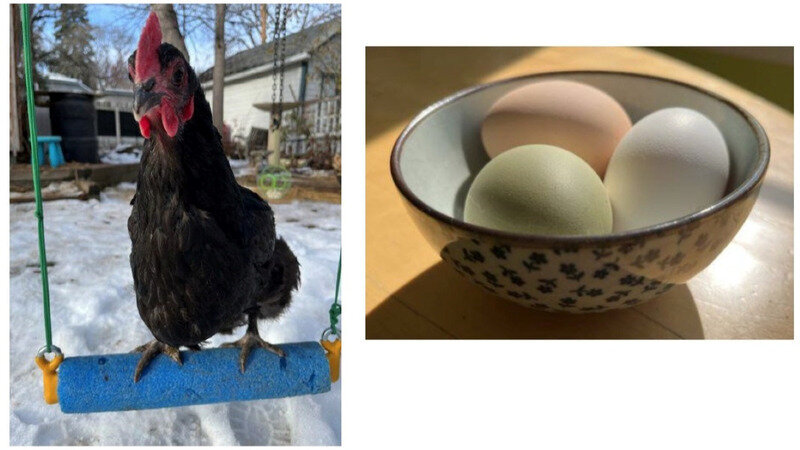
These are eggs from my urban hens in Regina. Though food security and food sovereignty are not my reasons for keeping hens, we so appreciate the eggs we collect from them daily. It gives us an appreciation for our food that store-bought products does not. Buying your food in a store, you may have very little knowledge of what goes into creating it. Did you know that hens lay eggs regardless of whether they've been near a rooster? The rooster simply means the eggs are fertile (which makes no difference to how edible they are). Did you know that many breeds of chicken lay roughly one egg each day? Did you know that eggs can come in many different colours? Did you know that hens only lay eggs for around 2-4 years, but they can easily live to be 8 if well cared for?
Today, my hen Scrambled left a green egg in the nest box. She hadn't laid for a few weeks as she was molting. It was an extra little excitement in the day to discover her beautiful green egg.
Is it economically better to get eggs from your own hens? That really depends on many things, such as how much you spend on the coop (upfront costs can be significant). Here's what I've spent on my own set-up. I built my own coop using salvaged materials I got off of VarageSale (second-hand shopping app) for next to nothing. I had to purchase a coop heater ($100) and a heated dog bowl for their water in winter ($20, used). These items use a little bit of electricity. I've purchased a few other things for them, like a treadle (feeder) that keeps mice out, and a steel garbage bin to store their feed ($42). I've also bought the swing featured in a recent post ($10 used). Oh, and recently some beautiful wallpaper as I'm now prettying up the coop (optional).
But, putting those costs aside for a moment, I'll share some economically beneficial news regarding hens. I have four hens. Only three of them lay. (The blue eggs here are from Omelette, and she quit laying after these two, presumably knowing she'd reached perfection and didn't need to keep trying
From May 5th to August 17th this year, my four hens pecked up exactly one bag of chicken feed I'd purchased for about $24 from Peavey Mart. During that period of nearly 3.5 months, the three egg-layers produced an astonishing 278 eggs. That's 278 eggs per one bag of feed! (It would be more if all four of my ladies were laying).
Before having hens, I purchased free-range eggs from farmers (when in a pinch, from grocery stores, though you never know for certain how those hens really live). I'd pay about $7 at the grocery store for a dozen eggs. 278 divided by 12 = 23. For 23 dozen eggs at $7/dozen, I would have paid $161. That means that looking at their food alone, I saved $137 in just 2.5 months. If I'd spent $5/dozen on eggs, the savings would have been $139.
Now, there are also the upfront costs I mentioned, and that chickens do not lay 12 months of the year (you could provide them light in their coop during the winter months to keep them laying all year; I give my girls a rest then, as nature intended). There will also come a time when my girls quit laying regularly. I'll then have them as wonderful pets. If I needed to, I'd find another home for them on a farm where they'd be able to live out their lives (I have a couple in mind already, just in case people ask).
But still. I feel good knowing my eggs come from what have to be some of the happiest hens in the prairies, if not the country. Also, given the bugs they eat, the food scraps I give them, and their quality feed, these eggs are highly nutritious.
On top of all this, my hens give me joy and relaxation on a daily basis. I can go outside anytime of the day and watch them go about their business. They're always busy doing something, unlike cats or dogs in the house, who sleep a lot. My girls can put a smile on my face no matter how down I'm feeling.
Did I mention that my garden loves my composted chicken poop?
Did I mention that I've gotten to know my neighbours better through our very positive chicken-related chats over the fence?
So, is it worth it to keep hens for egg production? I'd say yes! However, from a purely financial perspective, the answer is complicated — there are many variables that influence this calculation. Food security and food sovereignty can be increased with a few backyard hens, but with the understanding that there will be up-front expenses and other considerations. The other many benefits of keeping hens is also a part of the equation for people interested in having chickens as pets.
Please sign, share, and support (donate to Change.org so they'll broadcast for us) this petition asking Regina Council for a pilot backyard hen project project (two years) for twenty residences in the City.
Thank you!
Sources: