Bridge’s Strategy – Legal Chess on Environmental Chessboard

A quick Google search shed more troubling light on our new neighbors, Bridge Industrial. They have a total lack of integrity and ethics when it comes to community and environment.
Bridge Industrial had become a familiar name across the country—wherever logistics met land, Bridge followed with blueprints and bulldozers. Their specialty? Warehouses. Lots of them. In cities scrambling to keep up with e-commerce, few officials stopped to ask whether the land should be built on in the first place.
But in Florida, the ground tells a different story.
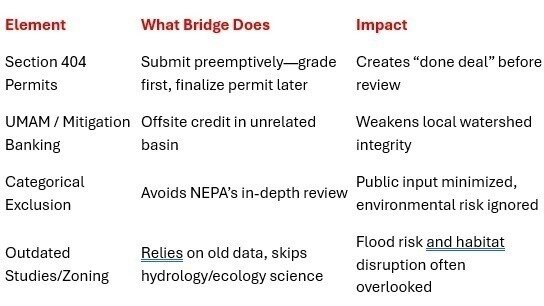
In 2024, Bridge Industrial submitted plans to develop a large logistics facility on the edge of a critical wetland zone in Broward County, Florida—just outside the western suburbs of Fort Lauderdale. The site was within proximity to state and federally protected wetlands, which fall under the jurisdiction of Section 404 of the Clean Water Act. That meant any dredging or filling of wetlands required a 404 permit from the U.S. Army Corps of Engineers, and potentially a 401 Water Quality Certification from the Florida Department of Environmental Protection.
But environmental groups raised red flags. The proposed facility—over 300,000 square feet—sat on land that contributed to the Everglades’ recharge basin, essential for flood control and habitat for migratory birds. The Endangered Species Act (ESA) was triggered when evidence surfaced that the land was used seasonally by the wood stork, a federally protected species.
Yet, rather than pause or meaningfully engage with the permitting process, Bridge began preliminary grading and site prep—well before any final 404 permit had been issued.
“They’re treating the permit like a formality,” said an Army Corps staffer off record. “It’s supposed to be the gatekeeper.”
Bridge’s environmental consultant submitted a functional assessment of wetlands using UMAM (Uniform Mitigation Assessment Method), but critics noted it downplayed the ecological importance of the site. When challenged, the company offered off-site mitigation banking—effectively trading one wetland for another, often miles away.
Meanwhile, on the other side of the country, a pattern had emerged.
In Burr Ridge, Illinois, Bridge had proposed a warehouse facility near wetlands connected to Flagg Creek. The Illinois Department of Natural Resources and local homeowners warned of stormwater impacts, increased truck traffic, and the lack of a full Environmental Impact Statement (EIS) under NEPA. Instead, Bridge submitted a Categorical Exclusion—a loophole often used by developers to avoid deeper environmental review.
At the same time, near Chicago O’Hare International Airport, Bridge acquired land for another industrial park. The site was just downstream of flood-prone areas and adjacent to a remnant wetland corridor. Instead of conducting full hydrologic studies or engaging with local municipalities, Bridge leaned on outdated zoning entitlements and minimal public input. “They met the letter of the law, not the spirit,” said a village trustee from Bensenville.
The core issue was never just legal—it was ethical.
Bridge’s strategy appeared consistent: exploit gaps in federal and state oversight, push the boundaries of wetland permitting, and downplay long-term environmental costs. By the time enforcement caught up—if it ever did—the concrete was already set.
In Florida, a coalition of environmental groups sued under the Clean Water Act, alleging that Bridge had begun fill operations without a valid Section 404 permit. They filed for an injunction. Bridge, in turn, filed motions to dismiss.
And while the legal chess game played out in courtrooms and permitting offices, the land sat exposed—its muck drying into dust, its egrets and herons gone, and its voice lost under the hum of diesel engines and the ambition of those who saw land not as an ecosystem, but as a spreadsheet cell.