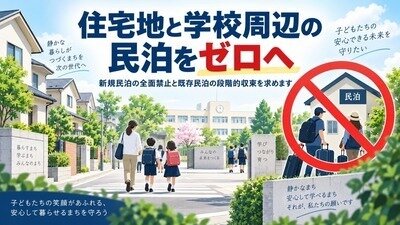
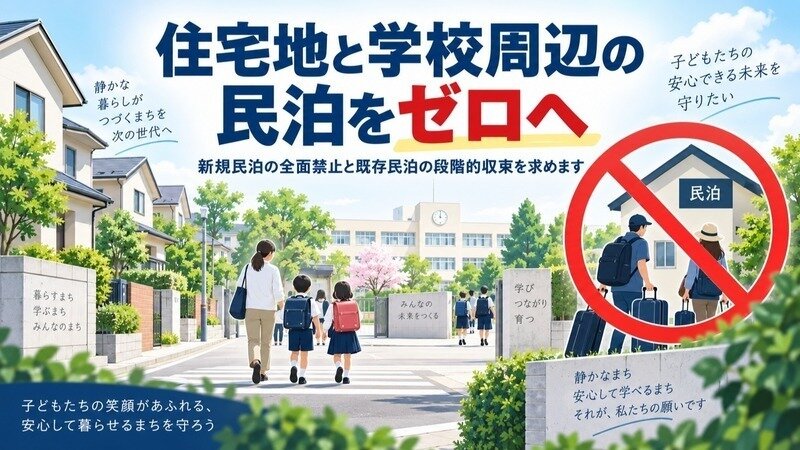
住宅地と学校周辺の民泊をゼロへ / No Minpaku (Short-Term Rentals) in Residential Areas and Around Schools
署名活動の主旨
(English version follows below.)
以下に述べる「民泊」をめぐる課題について、国内にとどまらず広く国際社会に発信し、各国・各地域の皆さまから多様なご意見、ご経験、制度上の知見をお寄せいただきたいと考え、このたび日本語版に加えて英語版を併せて発信することといたしました。
なお、本活動は、外国人旅行者や特定の国籍・文化を排斥することを目的とするものではありません。私たちが問題としているのは宿泊者の国籍ではなく、住宅地や学校周辺において、不特定多数の短期滞在者が反復継続して出入りする宿泊事業を、どのような場所に、どのような条件で認めるべきかという、住環境・教育環境・土地利用の制度設計です。
日本人・外国人を問わず旅行者を歓迎しながら、観光振興と地域住民の生活、そして子どもたちの教育環境を持続的に両立できる制度のあり方について、国内外の皆さまと建設的に議論していきたいと考えています。
To bring the issues surrounding minpaku and short-term rentals described below to a wider international audience, I have decided to publish an English version alongside the Japanese text and to invite views, experiences, and regulatory perspectives from people in different countries and communities around the world.
This campaign is not directed against foreign visitors, any nationality, or any culture. Our concern is not who the guests are, but rather where short-term lodging businesses should be permitted to operate and under what conditions, particularly in residential neighborhoods and around schools where there is a continuous turnover of short-term guests.
We welcome travelers from Japan and abroad alike. Our aim is to encourage constructive discussion on how tourism can be promoted while also protecting residential communities and educational environments in a sustainable and balanced manner.
(日本語版)
住宅地・教育施設周辺における新規民泊の全面禁止と、既存民泊の段階的収束を求めます
住宅地は、安心して暮らすための場所です。
学校周辺は、子どもたちが安心して学び、通うための場所です。
そこに、不特定多数の短期滞在者が継続的に出入りする宿泊事業を、どこまで認めるべきなのでしょうか。
私たちは、全国の住宅地域及び学校をはじめとする教育施設周辺において、住宅宿泊事業、いわゆる「民泊」の新規営業を認めない「ゼロ日規制」を広げることを求めます。
また、すでに営業している民泊についても、直ちに営業を禁止するのではなく、事業者の法的安定性にも十分配慮した合理的な経過措置を設けた上で、住宅地域及び教育施設周辺から段階的に営業を終了・収束させていく制度を求めます。
私たちは、観光そのものに反対しているわけではありません。
国内外から多くの旅行者が日本を訪れることには、大きな経済的・文化的意義があります。
問題は、「宿泊事業をどこで行うべきなのか」ということです。
私たちが求める5つの制度改革
私たちは、国及び全国の地方自治体に対し、次の施策を求めます。
- 住環境の保護を主目的とする住宅地域(第一種・第二種低層住居専用地域、第一種・第二種中高層住居専用地域など)では、家主居住型・家主不在型、個人・法人を問わず、新規民泊の営業可能日数を年間0日とすること。
- 小学校、中学校その他の教育施設周辺についても、児童・生徒の安全と教育環境を守る観点から、一定範囲を民泊禁止区域とすること。
- 既存民泊についても実態調査を行い、住宅地域や教育環境への影響が大きい地域では、合理的な経過措置を設けた上で新たな規制を適用し、段階的に営業を収束させること。
- 民泊から簡易宿所等へ形式的に業態変更することで同じ問題が継続しないよう、宿泊事業全体について整合的な立地規制を整備すること。
- 条例の制定・改正にあたっては、地域住民、町会、学校関係者等の意見を十分に聴取し、生活環境と教育環境の保護を重視すること。
住宅地は、まず「暮らす場所」であるべきです
第一種低層住居専用地域をはじめとする住宅地域は、人々が安心して暮らし、子どもを育て、静かな生活を維持するためにつくられてきた地域です。
ところが、住宅宿泊事業では、通常の住宅が短期宿泊施設として使われ、不特定多数の利用者が数日単位で入れ替わることがあります。
一般の賃貸住宅とは、ここに大きな違いがあります。
通常の賃貸住宅であれば、同じ人が一定期間そこに生活し、地域のルールや近隣関係を理解しながら暮らします。
一方、民泊では、宿泊者は短期間で入れ替わり、地域のごみ出しルール、喫煙ルール、夜間の静穏性、生活道路の使い方などを十分に理解しないまま滞在する可能性があります。
宿泊者は数日でその地域を去ります。
しかし、近隣住民は、その場所で毎日生活し続けます。
だからこそ住宅地域における民泊は、単なる「観光ビジネスの一形態」ではなく、地域住民の生活環境に継続的な影響を及ぼし得る土地利用の問題として考える必要があります。
騒音、ごみ、防犯上の不安、交通――問題は一つではありません
民泊をめぐっては、全国各地でさまざまな懸念が指摘されています。
深夜・早朝の話し声、スーツケースの走行音、路上での飲酒や喫煙、ごみの不適切な排出、タクシーや送迎車の停車、不特定多数の短期滞在者の出入りに伴う防犯上の不安、火災時の避難や初期対応などです。
もちろん、民泊利用者の大多数が問題を起こすわけではありません。
しかし、住宅地にとって重要なのは、こうした問題が反復継続して起こり得るという点です。
また、問題が起きた際に管理会社へ連絡したとしても、必ずしも直ちに現場対応できるとは限りません。
「ハウスルールに書いてあります」
「宿泊者には注意しています」
「問題が起きたら迅速に対応します」
という説明だけでは、静穏な住環境を守る十分な保証にはなりません。
住民が求めているのは、問題が起きてから謝罪や改善を受けることではなく、重大な生活環境上の問題が起こりにくい制度をあらかじめつくることです。
学校周辺では、さらに慎重な配慮が必要です
学校や通学路の周辺では、住宅地以上に慎重な判断が必要です。
毎日、多くの児童・生徒が登下校します。
そのような場所に、不特定多数の短期滞在者が継続的に出入りする宿泊施設を設けることが、本当に適切なのでしょうか。
教育環境や子どもの安全については、問題が起きてから対応するのではなく、予防的に安全側へ制度を設計することが重要です。
学校周辺や通学路に近接する地域については、単に営業日数を制限するだけではなく、民泊そのものを認めない区域を設けるべきだと考えます。
「年間180日までならよい」という問題ではありません
住宅地域について問うべきなのは、
「年間何日までなら宿泊事業を認めるか」
という日数だけではありません。
本質的な問題は、
「そもそも、静穏な居住を目的として形成された地域に、不特定多数の短期宿泊者を反復継続して受け入れる宿泊事業を立地させることが適切なのか」
という点です。
ホテルや旅館の建築・営業が制限される住宅地域において、住宅という形式を利用することで実質的な宿泊事業が可能になるのであれば、都市計画上の住環境保護との整合性についても、改めて議論する必要があります。
新規民泊だけを止めても、問題は解決しません
今後新たにできる民泊だけを禁止し、すでに営業している民泊を永久にそのまま認めれば、住宅地域の環境を将来的に回復することはできません。
もちろん、現在適法に営業している事業者について、突然営業を禁止することは適切ではありません。
だからこそ私たちは、即時全面停止ではなく、合理的な経過措置を設けた上での段階的な営業収束を求めています。
事業者側にも十分な準備期間を確保しながら、将来的には住宅地域を本来の「暮らす場所」に戻していく。
そのような出口政策が必要です。
観光振興と住環境保護は両立できます
私たちは、観光客を排除したいのではありません。
ホテルや旅館を適切に立地できる商業地域、業務地域、観光地域などでは、十分な設備と管理体制を備えた宿泊施設によって観光需要に対応することができます。
一方で、住民が日常生活を営む住宅地域、そして子どもたちが学ぶ学校周辺については、生活と教育を優先する。
このように地域の役割を明確に分けることこそ、住民にとっても旅行者にとっても持続可能なまちづくりにつながるのではないでしょうか。
民泊そのものを否定する必要はありません。
しかし、民泊に適した場所と、民泊を認めるべきではない場所は区別すべきです。
問題が深刻化する前に、今こそ制度を見直してください
一度、住宅地域に多数の民泊が定着してしまえば、静穏な住環境を取り戻すことは容易ではありません。
地域社会の性格は、短期間で変化してしまうことがあります。
だからこそ、問題が深刻化してから事後的に対応するのではなく、今の段階で予防的なルールを整備する必要があります。
住宅地を、本来の住宅地として次の世代に引き継ぐために。
学校周辺を、子どもたちが安心して学び、通学できる場所として守るために。
そして、観光と住民生活が互いに対立するのではなく、それぞれに適した場所で共存できる社会をつくるために。
国に対しては、住宅宿泊事業制度の見直しと、地方自治体による適切なゼロ日規制を後押しする制度整備を求めます。
全国の地方自治体に対しては、住宅地域及び教育施設周辺における民泊規制の強化と、地域の実情に応じた条例整備を求めます。
全国の皆さまのご理解とご賛同をお願いいたします。
ご賛同いただけましたら、ぜひ署名のうえ、この署名活動をお知り合いの方にも共有してください。
一人ひとりの賛同が、制度を動かす力になります。
(English version)
We Call for a Complete Ban on New Minpaku in Residential Areas and Around Educational Facilities, and for the Gradual Phase-Out of Existing Minpaku
Residential neighborhoods are places where people should be able to live in safety and peace.Areas around schools are places where children should be able to learn and commute safely.
To what extent should lodging businesses that continuously bring in an unspecified number of short-term guests be permitted in such areas?
We call for the expansion of “zero-day restrictions”, under which no new private lodging businesses—commonly known in Japan as minpaku—would be permitted to operate in residential areas or around schools and other educational facilities nationwide.
We also call for a framework under which existing minpaku would not be shut down immediately, but would instead be gradually phased out from residential areas and around educational facilities after a reasonable transition period, with due consideration given to the legal stability and legitimate expectations of existing operators.
We are not opposed to tourism itself.
There is great economic and cultural value in welcoming travelers from around the world to Japan.
The real question is:
“Where should lodging businesses be allowed to operate?”
The Five Reforms We Are Calling For
We call on the national government and local governments throughout Japan to implement the following measures.
- In residential zones whose primary purpose is the protection of the living environment—such as Category I and II Exclusively Low-Rise Residential Zones and Category I and II Mid/High-Rise Oriented Residential Zones—new minpaku operations should be limited to zero operating days per year, regardless of whether they are owner-occupied or owner-absent, and regardless of whether they are operated by individuals or corporations.
- Around elementary schools, junior high schools, and other educational facilities, designated zones should also be established where minpaku are prohibited within a specified radius, in order to protect the safety of children and students and preserve the educational environment.
- Existing minpaku should also be subject to fact-finding investigations. In areas where the impact on residential or educational environments is significant, new regulations should be applied after a reasonable transition period, with the aim of gradually phasing out such operations.
- To prevent the same problems from continuing through nominal changes of business category—for example, converting a minpaku into a simple lodging facility—Japan should establish coherent location-based regulations covering lodging businesses as a whole.
- When ordinances are enacted or amended, the views of local residents, neighborhood associations, school representatives, and other stakeholders should be fully heard, with priority given to the protection of living and educational environments.
Residential Areas Should First and Foremost Be Places to Live
Residential areas, including exclusively low-rise residential zones, were established so that people can live with peace of mind, raise children, and maintain a quiet living environment.
However, under Japan’s private lodging system, ordinary homes may be used as short-term accommodation, with different guests arriving and departing every few days.
This is fundamentally different from ordinary rental housing.
In ordinary rental housing, the same residents usually live there for an extended period and gradually become familiar with local rules and neighborhood relationships.
In minpaku, by contrast, guests rotate frequently and may stay without fully understanding local rules regarding garbage disposal, smoking, nighttime noise, or the use of narrow residential streets.
Guests leave after a few days.
Local residents, however, continue to live there every day.
That is why minpaku in residential areas should not be treated merely as one form of tourism business. They should also be considered a land-use issue capable of having ongoing effects on the daily lives of local residents.
Noise, Garbage, Security Concerns, Traffic — The Issues Are Not Limited to One Area
Concerns surrounding minpaku have been raised in communities throughout Japan.
They include late-night and early-morning conversations, the noise of rolling suitcases, drinking and smoking in the street, improper garbage disposal, taxis and pickup vehicles stopping on residential roads, security concerns arising from the constant arrival and departure of unspecified short-term guests, and questions about evacuation and emergency response in the event of fire.
Of course, the vast majority of minpaku guests do not cause problems.
The key issue for residential communities, however, is that such problems can occur repeatedly and continuously.
Moreover, even when residents contact a management company after a problem occurs, immediate on-site intervention cannot always be guaranteed.
Statements such as:
“The rules are written in the house manual.”
“We have instructed the guests.”
“We will respond promptly if a problem occurs.”
do not, by themselves, provide sufficient assurance that a quiet residential environment will be protected.
Residents should not have to wait until a problem occurs and then receive an apology or corrective action.
What they need is a system designed in advance to reduce the likelihood of serious impacts on the living environment.
Areas Around Schools Require Even Greater Caution
Greater caution is needed around schools and along school routes.
Every day, large numbers of children and students travel to and from school.
Is it truly appropriate to locate lodging facilities in such areas where an unspecified number of short-term guests continuously come and go?
When children’s safety and the educational environment are involved, systems should be designed preventively and on the side of caution, rather than waiting until an incident occurs.
In areas near schools and school routes, we believe that simply limiting operating days is not enough. There should be designated zones where minpaku themselves are not permitted.
This Is Not Simply a Question of Whether “Up to 180 Days per Year” Is Acceptable
The key question in residential areas is not merely:
“How many days per year should lodging businesses be allowed to operate?”
The more fundamental question is:
“Is it appropriate in the first place to locate a lodging business that repeatedly accommodates unspecified short-term guests in an area originally designed to ensure quiet residential living?”
If hotel and ryokan construction and operation are restricted in residential zones, but a business can effectively operate as a lodging facility simply by using the legal form of a residence, then the consistency of that system with urban planning and residential-environment protections should be reconsidered.
Stopping Only New Minpaku Will Not Solve the Problem
If new minpaku are prohibited while existing ones are allowed to continue indefinitely, the residential environment cannot be restored over the long term.
At the same time, it would not be appropriate to suddenly prohibit businesses that are currently operating lawfully.
That is why we are not calling for an immediate blanket shutdown.
Instead, we call for a gradual phase-out after a reasonable transition period.
Existing operators should be given adequate time to prepare, while residential areas are gradually returned to their original function as places to live.
A clear exit policy is necessary.
Tourism Promotion and Residential-Environment Protection Can Coexist
We are not seeking to exclude tourists.
In commercial, business, and tourism districts where hotels and ryokan can be appropriately located, tourism demand can be met by accommodation facilities with adequate infrastructure and management systems.
At the same time, residential areas where people live their daily lives—and areas around schools where children study—should place priority on daily life and education.
Clearly distinguishing the roles of different areas can lead to more sustainable communities for both residents and travelers.
There is no need to reject minpaku itself.
However, places that are suitable for minpaku and places where minpaku should not be permitted must be clearly distinguished.
Now Is the Time to Review the System Before the Problems Become More Serious
Once large numbers of minpaku become established in residential areas, restoring a quiet living environment becomes difficult.
The character of a local community can change in a relatively short period of time.
That is why preventive rules should be put in place now, rather than waiting until problems become severe and responding only afterward.
To pass residential neighborhoods on to the next generation as true residential communities.
To protect areas around schools as places where children can learn and travel safely.
And to create a society in which tourism and residential life do not come into conflict, but can coexist in places appropriate to each.
We call on the national government to review Japan’s private lodging system and establish a framework that enables local governments to adopt appropriate zero-day restrictions.
We call on local governments throughout Japan to strengthen regulations on minpaku in residential areas and around educational facilities, and to develop ordinances that reflect local conditions.
We ask for the understanding and support of people throughout Japan.
If you agree, please sign this petition and share it with your family, friends, and others who may be interested.
Every individual voice adds strength to the movement for meaningful reform.

469
署名活動の主旨
(English version follows below.)
以下に述べる「民泊」をめぐる課題について、国内にとどまらず広く国際社会に発信し、各国・各地域の皆さまから多様なご意見、ご経験、制度上の知見をお寄せいただきたいと考え、このたび日本語版に加えて英語版を併せて発信することといたしました。
なお、本活動は、外国人旅行者や特定の国籍・文化を排斥することを目的とするものではありません。私たちが問題としているのは宿泊者の国籍ではなく、住宅地や学校周辺において、不特定多数の短期滞在者が反復継続して出入りする宿泊事業を、どのような場所に、どのような条件で認めるべきかという、住環境・教育環境・土地利用の制度設計です。
日本人・外国人を問わず旅行者を歓迎しながら、観光振興と地域住民の生活、そして子どもたちの教育環境を持続的に両立できる制度のあり方について、国内外の皆さまと建設的に議論していきたいと考えています。
To bring the issues surrounding minpaku and short-term rentals described below to a wider international audience, I have decided to publish an English version alongside the Japanese text and to invite views, experiences, and regulatory perspectives from people in different countries and communities around the world.
This campaign is not directed against foreign visitors, any nationality, or any culture. Our concern is not who the guests are, but rather where short-term lodging businesses should be permitted to operate and under what conditions, particularly in residential neighborhoods and around schools where there is a continuous turnover of short-term guests.
We welcome travelers from Japan and abroad alike. Our aim is to encourage constructive discussion on how tourism can be promoted while also protecting residential communities and educational environments in a sustainable and balanced manner.
(日本語版)
住宅地・教育施設周辺における新規民泊の全面禁止と、既存民泊の段階的収束を求めます
住宅地は、安心して暮らすための場所です。
学校周辺は、子どもたちが安心して学び、通うための場所です。
そこに、不特定多数の短期滞在者が継続的に出入りする宿泊事業を、どこまで認めるべきなのでしょうか。
私たちは、全国の住宅地域及び学校をはじめとする教育施設周辺において、住宅宿泊事業、いわゆる「民泊」の新規営業を認めない「ゼロ日規制」を広げることを求めます。
また、すでに営業している民泊についても、直ちに営業を禁止するのではなく、事業者の法的安定性にも十分配慮した合理的な経過措置を設けた上で、住宅地域及び教育施設周辺から段階的に営業を終了・収束させていく制度を求めます。
私たちは、観光そのものに反対しているわけではありません。
国内外から多くの旅行者が日本を訪れることには、大きな経済的・文化的意義があります。
問題は、「宿泊事業をどこで行うべきなのか」ということです。
私たちが求める5つの制度改革
私たちは、国及び全国の地方自治体に対し、次の施策を求めます。
- 住環境の保護を主目的とする住宅地域(第一種・第二種低層住居専用地域、第一種・第二種中高層住居専用地域など)では、家主居住型・家主不在型、個人・法人を問わず、新規民泊の営業可能日数を年間0日とすること。
- 小学校、中学校その他の教育施設周辺についても、児童・生徒の安全と教育環境を守る観点から、一定範囲を民泊禁止区域とすること。
- 既存民泊についても実態調査を行い、住宅地域や教育環境への影響が大きい地域では、合理的な経過措置を設けた上で新たな規制を適用し、段階的に営業を収束させること。
- 民泊から簡易宿所等へ形式的に業態変更することで同じ問題が継続しないよう、宿泊事業全体について整合的な立地規制を整備すること。
- 条例の制定・改正にあたっては、地域住民、町会、学校関係者等の意見を十分に聴取し、生活環境と教育環境の保護を重視すること。
住宅地は、まず「暮らす場所」であるべきです
第一種低層住居専用地域をはじめとする住宅地域は、人々が安心して暮らし、子どもを育て、静かな生活を維持するためにつくられてきた地域です。
ところが、住宅宿泊事業では、通常の住宅が短期宿泊施設として使われ、不特定多数の利用者が数日単位で入れ替わることがあります。
一般の賃貸住宅とは、ここに大きな違いがあります。
通常の賃貸住宅であれば、同じ人が一定期間そこに生活し、地域のルールや近隣関係を理解しながら暮らします。
一方、民泊では、宿泊者は短期間で入れ替わり、地域のごみ出しルール、喫煙ルール、夜間の静穏性、生活道路の使い方などを十分に理解しないまま滞在する可能性があります。
宿泊者は数日でその地域を去ります。
しかし、近隣住民は、その場所で毎日生活し続けます。
だからこそ住宅地域における民泊は、単なる「観光ビジネスの一形態」ではなく、地域住民の生活環境に継続的な影響を及ぼし得る土地利用の問題として考える必要があります。
騒音、ごみ、防犯上の不安、交通――問題は一つではありません
民泊をめぐっては、全国各地でさまざまな懸念が指摘されています。
深夜・早朝の話し声、スーツケースの走行音、路上での飲酒や喫煙、ごみの不適切な排出、タクシーや送迎車の停車、不特定多数の短期滞在者の出入りに伴う防犯上の不安、火災時の避難や初期対応などです。
もちろん、民泊利用者の大多数が問題を起こすわけではありません。
しかし、住宅地にとって重要なのは、こうした問題が反復継続して起こり得るという点です。
また、問題が起きた際に管理会社へ連絡したとしても、必ずしも直ちに現場対応できるとは限りません。
「ハウスルールに書いてあります」
「宿泊者には注意しています」
「問題が起きたら迅速に対応します」
という説明だけでは、静穏な住環境を守る十分な保証にはなりません。
住民が求めているのは、問題が起きてから謝罪や改善を受けることではなく、重大な生活環境上の問題が起こりにくい制度をあらかじめつくることです。
学校周辺では、さらに慎重な配慮が必要です
学校や通学路の周辺では、住宅地以上に慎重な判断が必要です。
毎日、多くの児童・生徒が登下校します。
そのような場所に、不特定多数の短期滞在者が継続的に出入りする宿泊施設を設けることが、本当に適切なのでしょうか。
教育環境や子どもの安全については、問題が起きてから対応するのではなく、予防的に安全側へ制度を設計することが重要です。
学校周辺や通学路に近接する地域については、単に営業日数を制限するだけではなく、民泊そのものを認めない区域を設けるべきだと考えます。
「年間180日までならよい」という問題ではありません
住宅地域について問うべきなのは、
「年間何日までなら宿泊事業を認めるか」
という日数だけではありません。
本質的な問題は、
「そもそも、静穏な居住を目的として形成された地域に、不特定多数の短期宿泊者を反復継続して受け入れる宿泊事業を立地させることが適切なのか」
という点です。
ホテルや旅館の建築・営業が制限される住宅地域において、住宅という形式を利用することで実質的な宿泊事業が可能になるのであれば、都市計画上の住環境保護との整合性についても、改めて議論する必要があります。
新規民泊だけを止めても、問題は解決しません
今後新たにできる民泊だけを禁止し、すでに営業している民泊を永久にそのまま認めれば、住宅地域の環境を将来的に回復することはできません。
もちろん、現在適法に営業している事業者について、突然営業を禁止することは適切ではありません。
だからこそ私たちは、即時全面停止ではなく、合理的な経過措置を設けた上での段階的な営業収束を求めています。
事業者側にも十分な準備期間を確保しながら、将来的には住宅地域を本来の「暮らす場所」に戻していく。
そのような出口政策が必要です。
観光振興と住環境保護は両立できます
私たちは、観光客を排除したいのではありません。
ホテルや旅館を適切に立地できる商業地域、業務地域、観光地域などでは、十分な設備と管理体制を備えた宿泊施設によって観光需要に対応することができます。
一方で、住民が日常生活を営む住宅地域、そして子どもたちが学ぶ学校周辺については、生活と教育を優先する。
このように地域の役割を明確に分けることこそ、住民にとっても旅行者にとっても持続可能なまちづくりにつながるのではないでしょうか。
民泊そのものを否定する必要はありません。
しかし、民泊に適した場所と、民泊を認めるべきではない場所は区別すべきです。
問題が深刻化する前に、今こそ制度を見直してください
一度、住宅地域に多数の民泊が定着してしまえば、静穏な住環境を取り戻すことは容易ではありません。
地域社会の性格は、短期間で変化してしまうことがあります。
だからこそ、問題が深刻化してから事後的に対応するのではなく、今の段階で予防的なルールを整備する必要があります。
住宅地を、本来の住宅地として次の世代に引き継ぐために。
学校周辺を、子どもたちが安心して学び、通学できる場所として守るために。
そして、観光と住民生活が互いに対立するのではなく、それぞれに適した場所で共存できる社会をつくるために。
国に対しては、住宅宿泊事業制度の見直しと、地方自治体による適切なゼロ日規制を後押しする制度整備を求めます。
全国の地方自治体に対しては、住宅地域及び教育施設周辺における民泊規制の強化と、地域の実情に応じた条例整備を求めます。
全国の皆さまのご理解とご賛同をお願いいたします。
ご賛同いただけましたら、ぜひ署名のうえ、この署名活動をお知り合いの方にも共有してください。
一人ひとりの賛同が、制度を動かす力になります。
(English version)
We Call for a Complete Ban on New Minpaku in Residential Areas and Around Educational Facilities, and for the Gradual Phase-Out of Existing Minpaku
Residential neighborhoods are places where people should be able to live in safety and peace.Areas around schools are places where children should be able to learn and commute safely.
To what extent should lodging businesses that continuously bring in an unspecified number of short-term guests be permitted in such areas?
We call for the expansion of “zero-day restrictions”, under which no new private lodging businesses—commonly known in Japan as minpaku—would be permitted to operate in residential areas or around schools and other educational facilities nationwide.
We also call for a framework under which existing minpaku would not be shut down immediately, but would instead be gradually phased out from residential areas and around educational facilities after a reasonable transition period, with due consideration given to the legal stability and legitimate expectations of existing operators.
We are not opposed to tourism itself.
There is great economic and cultural value in welcoming travelers from around the world to Japan.
The real question is:
“Where should lodging businesses be allowed to operate?”
The Five Reforms We Are Calling For
We call on the national government and local governments throughout Japan to implement the following measures.
- In residential zones whose primary purpose is the protection of the living environment—such as Category I and II Exclusively Low-Rise Residential Zones and Category I and II Mid/High-Rise Oriented Residential Zones—new minpaku operations should be limited to zero operating days per year, regardless of whether they are owner-occupied or owner-absent, and regardless of whether they are operated by individuals or corporations.
- Around elementary schools, junior high schools, and other educational facilities, designated zones should also be established where minpaku are prohibited within a specified radius, in order to protect the safety of children and students and preserve the educational environment.
- Existing minpaku should also be subject to fact-finding investigations. In areas where the impact on residential or educational environments is significant, new regulations should be applied after a reasonable transition period, with the aim of gradually phasing out such operations.
- To prevent the same problems from continuing through nominal changes of business category—for example, converting a minpaku into a simple lodging facility—Japan should establish coherent location-based regulations covering lodging businesses as a whole.
- When ordinances are enacted or amended, the views of local residents, neighborhood associations, school representatives, and other stakeholders should be fully heard, with priority given to the protection of living and educational environments.
Residential Areas Should First and Foremost Be Places to Live
Residential areas, including exclusively low-rise residential zones, were established so that people can live with peace of mind, raise children, and maintain a quiet living environment.
However, under Japan’s private lodging system, ordinary homes may be used as short-term accommodation, with different guests arriving and departing every few days.
This is fundamentally different from ordinary rental housing.
In ordinary rental housing, the same residents usually live there for an extended period and gradually become familiar with local rules and neighborhood relationships.
In minpaku, by contrast, guests rotate frequently and may stay without fully understanding local rules regarding garbage disposal, smoking, nighttime noise, or the use of narrow residential streets.
Guests leave after a few days.
Local residents, however, continue to live there every day.
That is why minpaku in residential areas should not be treated merely as one form of tourism business. They should also be considered a land-use issue capable of having ongoing effects on the daily lives of local residents.
Noise, Garbage, Security Concerns, Traffic — The Issues Are Not Limited to One Area
Concerns surrounding minpaku have been raised in communities throughout Japan.
They include late-night and early-morning conversations, the noise of rolling suitcases, drinking and smoking in the street, improper garbage disposal, taxis and pickup vehicles stopping on residential roads, security concerns arising from the constant arrival and departure of unspecified short-term guests, and questions about evacuation and emergency response in the event of fire.
Of course, the vast majority of minpaku guests do not cause problems.
The key issue for residential communities, however, is that such problems can occur repeatedly and continuously.
Moreover, even when residents contact a management company after a problem occurs, immediate on-site intervention cannot always be guaranteed.
Statements such as:
“The rules are written in the house manual.”
“We have instructed the guests.”
“We will respond promptly if a problem occurs.”
do not, by themselves, provide sufficient assurance that a quiet residential environment will be protected.
Residents should not have to wait until a problem occurs and then receive an apology or corrective action.
What they need is a system designed in advance to reduce the likelihood of serious impacts on the living environment.
Areas Around Schools Require Even Greater Caution
Greater caution is needed around schools and along school routes.
Every day, large numbers of children and students travel to and from school.
Is it truly appropriate to locate lodging facilities in such areas where an unspecified number of short-term guests continuously come and go?
When children’s safety and the educational environment are involved, systems should be designed preventively and on the side of caution, rather than waiting until an incident occurs.
In areas near schools and school routes, we believe that simply limiting operating days is not enough. There should be designated zones where minpaku themselves are not permitted.
This Is Not Simply a Question of Whether “Up to 180 Days per Year” Is Acceptable
The key question in residential areas is not merely:
“How many days per year should lodging businesses be allowed to operate?”
The more fundamental question is:
“Is it appropriate in the first place to locate a lodging business that repeatedly accommodates unspecified short-term guests in an area originally designed to ensure quiet residential living?”
If hotel and ryokan construction and operation are restricted in residential zones, but a business can effectively operate as a lodging facility simply by using the legal form of a residence, then the consistency of that system with urban planning and residential-environment protections should be reconsidered.
Stopping Only New Minpaku Will Not Solve the Problem
If new minpaku are prohibited while existing ones are allowed to continue indefinitely, the residential environment cannot be restored over the long term.
At the same time, it would not be appropriate to suddenly prohibit businesses that are currently operating lawfully.
That is why we are not calling for an immediate blanket shutdown.
Instead, we call for a gradual phase-out after a reasonable transition period.
Existing operators should be given adequate time to prepare, while residential areas are gradually returned to their original function as places to live.
A clear exit policy is necessary.
Tourism Promotion and Residential-Environment Protection Can Coexist
We are not seeking to exclude tourists.
In commercial, business, and tourism districts where hotels and ryokan can be appropriately located, tourism demand can be met by accommodation facilities with adequate infrastructure and management systems.
At the same time, residential areas where people live their daily lives—and areas around schools where children study—should place priority on daily life and education.
Clearly distinguishing the roles of different areas can lead to more sustainable communities for both residents and travelers.
There is no need to reject minpaku itself.
However, places that are suitable for minpaku and places where minpaku should not be permitted must be clearly distinguished.
Now Is the Time to Review the System Before the Problems Become More Serious
Once large numbers of minpaku become established in residential areas, restoring a quiet living environment becomes difficult.
The character of a local community can change in a relatively short period of time.
That is why preventive rules should be put in place now, rather than waiting until problems become severe and responding only afterward.
To pass residential neighborhoods on to the next generation as true residential communities.
To protect areas around schools as places where children can learn and travel safely.
And to create a society in which tourism and residential life do not come into conflict, but can coexist in places appropriate to each.
We call on the national government to review Japan’s private lodging system and establish a framework that enables local governments to adopt appropriate zero-day restrictions.
We call on local governments throughout Japan to strengthen regulations on minpaku in residential areas and around educational facilities, and to develop ordinances that reflect local conditions.
We ask for the understanding and support of people throughout Japan.
If you agree, please sign this petition and share it with your family, friends, and others who may be interested.
Every individual voice adds strength to the movement for meaningful reform.

賛同者からのコメント
オンライン署名の最新情報
このオンライン署名をシェアする
2026年9月13日に作成されたオンライン署名