The Spread of Invasive Species in NS is Out of Control

What are alien invasive species (AIS)?
An invasive alien species is one introduced outside its normal distribution, whose establishment and spread can affect ecosystems, habitats, or other species.
The two aquatic AIS in freshwater ecosystems of greatest concern in Nova Scotia are the Chain Pickerel (Esox niger) and Smallmouth Bass (Micropterus dolomieu).
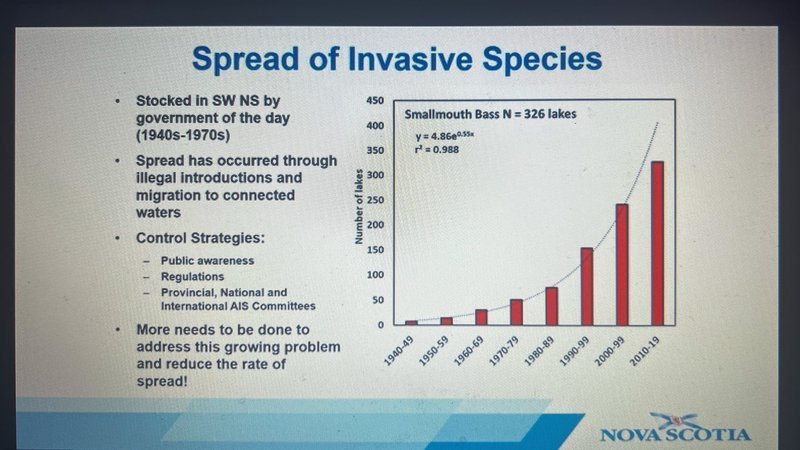
Smallmouth Bass were legally introduced to a handful of Nova Scotian lakes in the 1940s; since then, they have spread into at least 326 lakes and rivers.
Chain Pickerel were illegally introduced into three lakes in 1945 and are now in at least 166 lakes. Both have spread either through further intentional introduction between watersheds or via natural dispersal within watersheds. Smallmouth bass and chain pickerel transform freshwater ecosystems by occupying the niche of top fish predator.
Although smallmouth bass is a favourite of some anglers, it directly consumes small-bodied fish or out-competes them for food. Chain pickerel and smallmouth bass rapidly displace native speckled trout (Salvelinus fontinalis), along with other species favoured by sport fishers. Chain pickerel is a voracious predator, and few soft-bodied fish can coexist with this species. Besides its effect on fish populations, the ecological changes caused by chain pickerel could negatively impact birds and mammals, such as mergansers, cormorants, kingfishers, eagles, mink, and otter.
Despite stewardship and education, smallmouth bass and chain pickerel continue to spread through illegal transfers between watersheds.
Please sign the petition to let our provincial government know we need stronger regulations and actions to help control the spread of AIS.