Sacred Djab Wurrung birthing trees are still in danger of being killed by MRPV

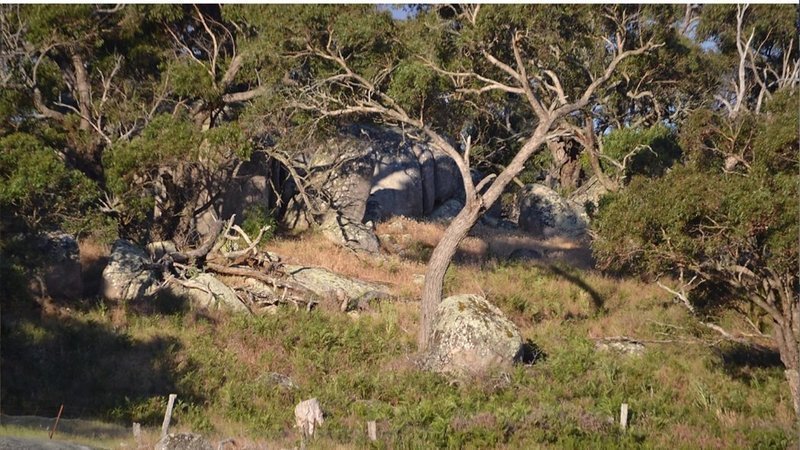
Culturally modified habitation trees—hollowed and massive—grow near this rich bushland. Some of the trees are over 800 years old. This whole cultural precinct at the foot of Mount Langi Ghiran, in Djab Wurrung country is not hard to protect. It just needs the say so of a responsible minister. So take you pick of ministers and drop them a line.
Readers who have followed this story know the Djab Wurrung Protection Embassy was set up in June 2018 to protect sacred Djab Wurrung cultural heritage: both landscape and trees. Approximately 3000 trees will be destroyed by the new road, with 260 large old growth trees included.
Government has the reports of eminent cultural heritage assessors including from Dr Heather Builth whose PhD topic opened up a new field in Australian Cultural Heritage research. Dr Builth studies home places such as the one at the heart of this struggle: culturally modified trees, habitation trees with their many past uses. The ones on Djab Wurrung country may have been for birthing, cooking, smoking eels. Dr Builth's work and the On Country report of Natasha Saunders speak to the cultural importance of the precinct at Langi Ghiran showing why the choices of authorities, so far, are burdened by error and mistake.
These trees are irreplaceable: as culture of the Djab Wurrung people, also as habitat for a growing number of threatened species, not to forget the many folk from the mainstream who naturally feel awestruck by grand old trees or who respect the endurance of Djab Wurrung people. The redevelopment of the Western Highway planned by Major Roads Projects Victoria (MRPV) can and should be located elsewhere.
Djab Wurrung people await a fresh decision from Environment Minister Ley, following their request to protect all land where the new road would be built. The Federal Court quashed two prior decisions of Environment Ministers that had denied this place protection. The fresh decision must be well. Submissions and reports of experts such as the On Country report of Natasha Sanders, and Heather Builth's reports. need to go to Minster Ley. Her decision must be congruent with environmental law as well.
Minister Ley was forced to take back her refusal to protect the area and make a fresh decision following full consideration of all relevant matters provided to her. she is still cogitating, but time is nearly up. if you want to write to Minister Ley to emphasise some part of this campaign get your skates on. submissions are open until COB 9/4/20 (Thursday, TODAY!). they need to go to the person named below who will collate them for the minister.
Ms Jo Nathan, Acting Assistant Secretary,
Heritage Branch, Department of Agriculture,
Water and the Environment GPO Box 858 Canberra ACT 2601
email: ATSIHPA@environment.gov.au
If, finally, people, their cultural heritage, and environment are recognised, MRPV must find a new route: perhaps the safer route with slim off-road construction impacts, suggested elsewhere. But until then MRPV is pursuing massive construction relentlessly.
Elsewhere in this campaign, last year, as concern that an injunction to protect this place was risky, Traditional Owners felt forced to agree to a State Government proposal permitting roadworks on a small area of land using an alignment described as the ‘least culturally invasive’. A court ordered agreement set out the terms and conditions to be followed.
So, legal requirements restrict current works to carriageway duplication within a 3.85 km stretch at the western end of the defended cultural precinct, close to Ararat. The work must avoid six significant trees, for the time being. Please note, this is no death sentence. These and many more trees could be saved by Minister Ley’s decision. The works are on land common to both the route planned by the MRPV –Option 1– and also a less destructive alternative route that shadows the existing highway, as proposed by KORS Inc.
Since this work began, Djab Wurrung people applied to protect a large old tree, 400 - 500 years old, in the area subject to the agreement. The tree is culturally significant but regardless Major Road Projects Victoria (MRPV) announced their intention to fell the tree, unsurprisingly.
Representatives of the Djab Wurrung community have been denied access to the tree. The tree has cultural significance, and is owed protection under environmental heritage law. It stands inside a “No Go Zone” established by the Threatened Species Management Plan written for the project. The Zone boundaries protect a federally-listed vegetation community called Grassy Eucalypt Woodland. MRPV contracted workers are breaching the rule book they wrote for themselves ! The threat to this tree was reported to the Department of Agriculture, Water and Environment (DAWE).
Remember why we have Australian environmental laws: to protect the environment. Law does not exist to provide costly red tape that authorities should use to thwart good people, destroy nature, or line the pockets of road magnates and local firewood lords. Habitat and life enclosed inside No Go Zones are owed protection by law because they are life, biodiversity. This supports all people ultimately. Still, further defying this MRPV cleared two areas of roadside trees inside No Go Zones. It is believed both clearances breach approval conditions set down by the Environment Protection and Biodiversity Conservation Act 1999 (Cth). The affidavit of an employee of MRPV confirms that 79 trees were destroyed. The works area must clash with the rangelands of the Tree Goanna, Powerful Owl, Brush Tailed Phascogale and Squirrel Glider that have been observed living within 10 kilometres of it. So the web of life supporting and supported by these species will have been damaged by the tree loss. DAWE is investigating.
So, looking to the future across country on the rest of the route where the plans of MRPV remain unchanged: without successful political intervention the plan to further desecrate Djab Wurrung land is approved by MRPV and state and federal authorities. Land with habitat for endangered species on farmland and bush blocks will be severed and excavated.
To the East, the planned road duplication splits off from the existing highway to make a wide fresh cut into the landscape 5.7kms long. The bushland and farmland to be severed and gouged is dense with many large old habitat trees that stand in protected woodland-grassland habitats where endangered species survive. Construction of this deviation would involve bulldozing through a hill, filling a valley, removing large submerged boulders and destroying federally protected plants and animals and other unique natural features.
Now that 1300 flora species and 450 fauna species are threatened with extinction and we have the latest bleaching event on the Great Barrier Reef, Australia stands as a world leader in biodiversity loss. Remarkably this pocket of Western Victoria / Djab Wurrung country where these trees stand is preserved from fire devastation, unlike Eastern and Northern Victoria.
We need to exert people power to force change.
Encouragingly, an investigation by the Victorian Ombudsman into the Western Highway duplication project has begun. Particular attention is to be given to Aboriginal sites and their protection or desecration, as the case maybe. The Djab Wurrung Traditional Owners have strongly asserted that neither Martang Pty Ltd (the defunct Registered Aboriginal Party for the area) nor the Eastern Maar Aboriginal Corporation (EMAC) speak for, or represent, the Traditional Owners. Many Aboriginal people have for decades attempted to stop the destruction of their homelands, to no avail. Too much damage has been done already.
Now is the time to demand a political intervention to cause MRPV to drop its chainsaws and stop its excavators. Now is the time for supporters of Djab Wurrung to demand protection of the disputed 5.7km of Djab Wurrung country including all the many beings that live there. Representations to the Victorian Ombudsman are timely, now.
The process of route selection needs to be publicly reviewed. In this time of uncertainty and anxiety a good news story of cultural and environment protection and respectful decision making is needed from leaders. We can make this happen. To support the Djab Wurrung, wildlife and wild places, and an Independent Route Review write to or telephone
Premier Daniel Andrews daniel.andrews@parliament.vic.gov.au (03) 9651 5000 Jacinta Allan Minister for Road Infrastructure jacinta.allan@parliament.vic.gov.au (03) 8392 6100 Federal Environment Minister Sussan Ley sussan.ley.mp@aph.gov.au (02) 6277 7920
If you have raised concerns with state administrators earlier and you felt fobbed off, you can submit these again as an unresolved complaint in the form of a written or spoken submission to the Victorian Ombudsman, who currently is conducting an investigation.
The final date for receipt of submissions is expected to be April 15th 2020. So, we have one week to write or speak up. The lead investigator is Corey Stevens. You can make a written submission to corey.stevens@ombudsman.vic.gov.au. Alternatively, oral/aural submissions can be made. call Corey Stevens on (03) 9613 6269.
For queries, or to arrange for an interview, or to arrange having a statement taken - call Corey Stevens on (03) 9613 6269. Say you are concerned at the damage planned, and want no more damage!
endorsed by
Sandra and Christine Onus, DjapWurrung Elders 6th April 2020
(written by Iona Mackenzie)