
Support H.F. 3327 designating Kensington Rune Stone Park a State Historic Site.
The Issue
The Kensington Rune Stone was found by farmer and Swedish immigrant Olof Olsson Ohman in 1898 while he was clearing his land in rural Solem Township, Douglas County.
It was named after the nearest settlement, Kensington.
The stone is currently on display at the Runestone Museum in Alexandria, a private enterprise.
The runes on the Kensington Rune Stone have been translated as: Eight Götalanders and 22 Northmen on (this?) acquisition journey from Vinland far to the west. We had a camp by two (shelters?) one day's journey north from this stone. We were fishing one day. After we came home, found 10 men red from blood and dead. Ave Maria save from evil. There are 10 men by the inland sea to look after our ships fourteen days journey from this peninsula (or island). Year 1362
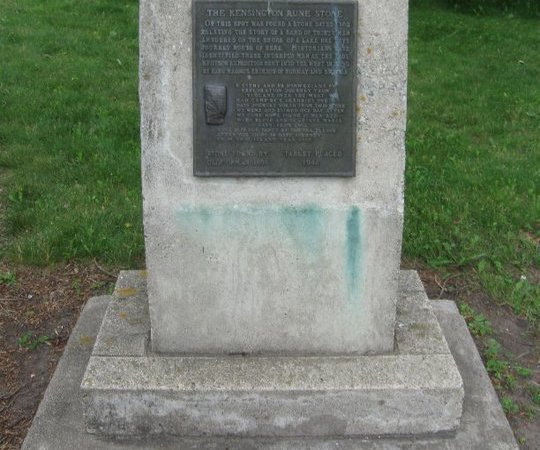
The discovery site of the Kensington Rune Stone, the 193-acre Kensington Rune Stone Park, is the homestead farm of the Ohman family.
Designating Kensington Rune Stone Park a Minnesota Historic Site will raise awareness and curiosity about the colorful and controversial history of the Kensington Rune Stone.
Greater awareness will encourage more people from Minnesota, from across the country and from across the world to learn about the Kensington Rune Stone and visit the park, increasing tourism.
Whether one believes the stone’s runic message to be true or not, its history is interesting and part of our state’s colorful history. It’s thoroughly Minnesotan.
Designating Kensington Rune Stone Park a Minnesota Historic Site will allow the park and discovery site to be developed and maintained in the same manner as the other state historic sites.
While the Kensington Rune Stone Discovery Site in Douglas County is currently a State Historic Place, with a simple marker, the Kensington Rune Stone Park is currently only a county park. While it offers beautiful views and recreational offerings to county residents and visitors, raising its profile will allow the park and discovery site to be developed in the future into a first-class historic site, providing more options and interest to visitors.
Designating Kensington Rune Stone Park a Minnesota Historic site will be a fitting tribute to Olof Ohman, the man who discovered the stone, and his family.
Newton H. Winchell, a renowned geologist and the first State Geologist of Minnesota (1875-1900) studied the Kensington Rune Stone and concluded it was genuine.
There is no factual evidence that calls into question the veracity of the discovery by Olof Ohman.
Designating Kensington Rune Stone Park a Minnesota Historic Site will encourage people to learn more about history: the explorers from Scandinavia and the brave men and women who immigrated here.
Learning about Minnesota history will encourage people to learn more about immigrants, their struggles and successes and how they have and are currently contributing to our state’s progress.
Learning about our state’s history will encourage people to learn more about Native Americans, the first people to live in Minnesota, and the Norsemen who visited our state hundreds of years ago.
The Kensington Rune Stone is a key symbol of Scandinavian identity. A piece of living history people around the world can visit to claim their identity as an immigrant, a Scandinavian, an explorer, a Minnesotan, a Viking, etc. etc.
Petition Closed
The Issue
The Kensington Rune Stone was found by farmer and Swedish immigrant Olof Olsson Ohman in 1898 while he was clearing his land in rural Solem Township, Douglas County.
It was named after the nearest settlement, Kensington.
The stone is currently on display at the Runestone Museum in Alexandria, a private enterprise.
The runes on the Kensington Rune Stone have been translated as: Eight Götalanders and 22 Northmen on (this?) acquisition journey from Vinland far to the west. We had a camp by two (shelters?) one day's journey north from this stone. We were fishing one day. After we came home, found 10 men red from blood and dead. Ave Maria save from evil. There are 10 men by the inland sea to look after our ships fourteen days journey from this peninsula (or island). Year 1362
The discovery site of the Kensington Rune Stone, the 193-acre Kensington Rune Stone Park, is the homestead farm of the Ohman family.
Designating Kensington Rune Stone Park a Minnesota Historic Site will raise awareness and curiosity about the colorful and controversial history of the Kensington Rune Stone.
Greater awareness will encourage more people from Minnesota, from across the country and from across the world to learn about the Kensington Rune Stone and visit the park, increasing tourism.
Whether one believes the stone’s runic message to be true or not, its history is interesting and part of our state’s colorful history. It’s thoroughly Minnesotan.
Designating Kensington Rune Stone Park a Minnesota Historic Site will allow the park and discovery site to be developed and maintained in the same manner as the other state historic sites.
While the Kensington Rune Stone Discovery Site in Douglas County is currently a State Historic Place, with a simple marker, the Kensington Rune Stone Park is currently only a county park. While it offers beautiful views and recreational offerings to county residents and visitors, raising its profile will allow the park and discovery site to be developed in the future into a first-class historic site, providing more options and interest to visitors.
Designating Kensington Rune Stone Park a Minnesota Historic site will be a fitting tribute to Olof Ohman, the man who discovered the stone, and his family.
Newton H. Winchell, a renowned geologist and the first State Geologist of Minnesota (1875-1900) studied the Kensington Rune Stone and concluded it was genuine.
There is no factual evidence that calls into question the veracity of the discovery by Olof Ohman.
Designating Kensington Rune Stone Park a Minnesota Historic Site will encourage people to learn more about history: the explorers from Scandinavia and the brave men and women who immigrated here.
Learning about Minnesota history will encourage people to learn more about immigrants, their struggles and successes and how they have and are currently contributing to our state’s progress.
Learning about our state’s history will encourage people to learn more about Native Americans, the first people to live in Minnesota, and the Norsemen who visited our state hundreds of years ago.
The Kensington Rune Stone is a key symbol of Scandinavian identity. A piece of living history people around the world can visit to claim their identity as an immigrant, a Scandinavian, an explorer, a Minnesotan, a Viking, etc. etc.


Petition Updates
Share this petition
Petition created on April 19, 2014