Legalize Hemp- Creates Jobs*Biofuel*Housing*Farms*Food*Textiles*Paper*Plastic
Legalize Hemp- Creates Jobs*Biofuel*Housing*Farms*Food*Textiles*Paper*Plastic
The Issue
Literally millions of wild hemp plants grow throughout the entire Midwest today. Wild hemp, like hemp grown for commercial use, is USELESS as an intoxicant. It makes no sense to keep a ban on growing a plant that has enormous economic and environmental potential, grows naturally by the millions, and is impossible to exterminate.
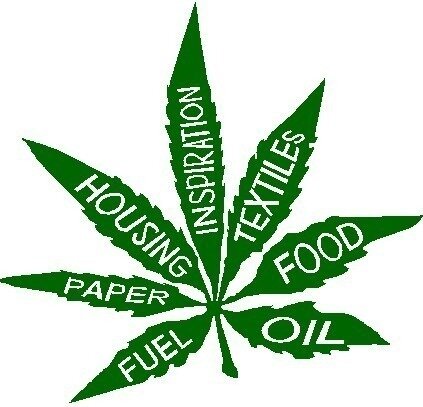
The potential of hemp for paper production is enormous. According to the U.S. Dept. of Agriculture, one acre of hemp can produce 4 times more paper than one acre of trees! All types of paper products can be produced from hemp: newsprint, computer paper, stationary, cardboard, envelopes, toilet paper, even tampons.
Paper production from hemp would eliminate the need to chop down BILLIONS of trees! MILLIONS of acres of forests and huge areas of wildlife habitat could be preserved.
Trees must grow for 20 to 50 years after planting before they can be harvested for commercial use. Within 4 months after it is planted, hemp grows 10 to 20 feet tall and it is ready for harvesting! Hemp can be grown on most farmland throughout the U.S., where forests require large tracts of land available in few locations. Substituting hemp for trees would save forests and wildlife habitats and would eliminate erosion of topsoil due to logging. Reduction of topsoil erosion would also reduce pollution of lakes, rivers and streams.
Fewer caustic and toxic chemicals are used to make paper from hemp than are used to make paper from trees - LESS POLLUTION!
Hemp naturally repels weed growth. Few insect enemies and no weed problems means hemp requires NO HERBICIDES and FEW or NO PESTICIDES!
Cotton requires enormous pesticide use. 50% of all pesticides used in the U.S. are used on cotton. Substituting hemp for cotton would drastically reduce pesticide usage!
Building materials that substitute for wood can be made from hemp. These wood-like building materials are stronger than wood and can be manufactured cheaper than wood from trees. Using these hemp- derived building materials would reduce building costs and save even more trees!
Hemp seeds are a source of nutritious high-protien oil that can be used for human and animal consumption. Hemp oil is NOT intoxicating. Extracting protein from hemp is less expensive than extracting protein from soybeans. Hemp protein can be processed and flavored in any way soybean protein can. Hemp oil can also be used to make highly nutritious tofu, butter, cheese, salad oils, and other foods. Hemp oil can also be used to produce paint, varnish, ink, lubricating oils, and plastic susbstitues. Because 50% of the weight of a mature hemp plant is seeds, hemp could become a significant source for these products.
Unlike many crops, hemp puts little strain on the soil and requires only moderate amounts of fertilizer. Less fertilizer use results in less runoff into waterways and groundwater; therefore, less water pollution.
Hemp produces more biomass than any plant that can be grown in the U.S. This biomass can be converted to fuel in the form of clean-burning alcohol, or no-sulphur man-made coal. Hemp has more potential as a clean and renewable energy source than any crop on earth! It is estimated that if hemp was widely grown in the U.S. for fuel/energy, it could supply 100% of all U.S. energy needs!
http://www.youtube.com/watch?v=A9dV7Ej2H4A
http://www.youtube.com/watch?v=PSKJrgGqx_E&feature=related
http://www.wonderknack.com/hemp.cfm
http://www.natural-environment.com/blog/2008/01/31/environmental-benefits-of-hemp/
http://brucealanblock.com/why-marijuana-became-legal/
"Make the most of the hemp seed, sow it everywhere"- George Washington
"Why use up the forest which were centuries in the making and the mines which required ages to lay down, if we can get the equivalent of forest and mineral products in the ANNUAL GROWTH of the hemp fields" - Henry Ford

The Issue
Literally millions of wild hemp plants grow throughout the entire Midwest today. Wild hemp, like hemp grown for commercial use, is USELESS as an intoxicant. It makes no sense to keep a ban on growing a plant that has enormous economic and environmental potential, grows naturally by the millions, and is impossible to exterminate.
The potential of hemp for paper production is enormous. According to the U.S. Dept. of Agriculture, one acre of hemp can produce 4 times more paper than one acre of trees! All types of paper products can be produced from hemp: newsprint, computer paper, stationary, cardboard, envelopes, toilet paper, even tampons.
Paper production from hemp would eliminate the need to chop down BILLIONS of trees! MILLIONS of acres of forests and huge areas of wildlife habitat could be preserved.
Trees must grow for 20 to 50 years after planting before they can be harvested for commercial use. Within 4 months after it is planted, hemp grows 10 to 20 feet tall and it is ready for harvesting! Hemp can be grown on most farmland throughout the U.S., where forests require large tracts of land available in few locations. Substituting hemp for trees would save forests and wildlife habitats and would eliminate erosion of topsoil due to logging. Reduction of topsoil erosion would also reduce pollution of lakes, rivers and streams.
Fewer caustic and toxic chemicals are used to make paper from hemp than are used to make paper from trees - LESS POLLUTION!
Hemp naturally repels weed growth. Few insect enemies and no weed problems means hemp requires NO HERBICIDES and FEW or NO PESTICIDES!
Cotton requires enormous pesticide use. 50% of all pesticides used in the U.S. are used on cotton. Substituting hemp for cotton would drastically reduce pesticide usage!
Building materials that substitute for wood can be made from hemp. These wood-like building materials are stronger than wood and can be manufactured cheaper than wood from trees. Using these hemp- derived building materials would reduce building costs and save even more trees!
Hemp seeds are a source of nutritious high-protien oil that can be used for human and animal consumption. Hemp oil is NOT intoxicating. Extracting protein from hemp is less expensive than extracting protein from soybeans. Hemp protein can be processed and flavored in any way soybean protein can. Hemp oil can also be used to make highly nutritious tofu, butter, cheese, salad oils, and other foods. Hemp oil can also be used to produce paint, varnish, ink, lubricating oils, and plastic susbstitues. Because 50% of the weight of a mature hemp plant is seeds, hemp could become a significant source for these products.
Unlike many crops, hemp puts little strain on the soil and requires only moderate amounts of fertilizer. Less fertilizer use results in less runoff into waterways and groundwater; therefore, less water pollution.
Hemp produces more biomass than any plant that can be grown in the U.S. This biomass can be converted to fuel in the form of clean-burning alcohol, or no-sulphur man-made coal. Hemp has more potential as a clean and renewable energy source than any crop on earth! It is estimated that if hemp was widely grown in the U.S. for fuel/energy, it could supply 100% of all U.S. energy needs!
http://www.youtube.com/watch?v=A9dV7Ej2H4A
http://www.youtube.com/watch?v=PSKJrgGqx_E&feature=related
http://www.wonderknack.com/hemp.cfm
http://www.natural-environment.com/blog/2008/01/31/environmental-benefits-of-hemp/
http://brucealanblock.com/why-marijuana-became-legal/
"Make the most of the hemp seed, sow it everywhere"- George Washington
"Why use up the forest which were centuries in the making and the mines which required ages to lay down, if we can get the equivalent of forest and mineral products in the ANNUAL GROWTH of the hemp fields" - Henry Ford
Petition Closed
Share this petition
The Decision Makers

Petition Updates
Share this petition
Petition created on August 28, 2011