

Reduce Harm for All New Yorkers - Keep Drug Use Away from Children
The Issue
New York State Officials should reject Safer Consumption Act, bill s399/a338, unless 6 Safety Guardrails are added to the bills.
In November 2021, New York City Mayor Bill DeBlasio unilaterally placed a Safe Consumption Site, or Overdose Prevention Center (OPC) in Harlem across the street from a Pre-K school WITHOUT community consultation. Within two blocks from this site are 9 schools with +4250 students and nearly 4000 residents, most are people of color. Such a location would not have been sited in wealthier neighborhoods.
A year later, despite the negative impacts of the current site on the community, New York officials hope to legalize such sites via legislative bill s399/a338, the "Safer Consumption Act," which would allow the site to be funded by the government.
Clearly, New York City is putting the cart before the horse - the implementation of the OPC is premature as safety guardrails are missing to protect local community and to promote treatment for users.
Sign this petition to tell your officials to amend the bill. Remember to describe your own experience with the site in the comments. In addition, you can also help by voting NO to the bills S399 and A338 on the NY Senate website and telling your officials why.
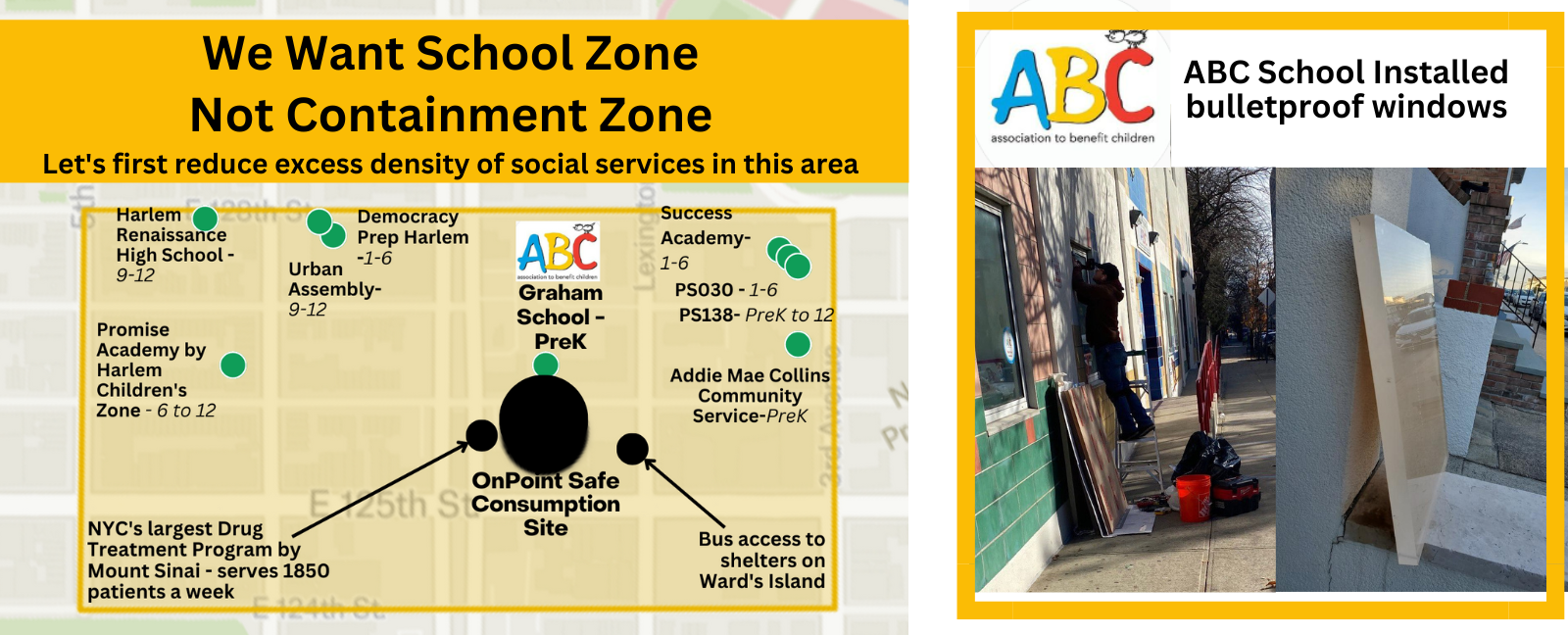
As an example to illustrate the issue with the site, there are 9 schools within 2 blocks of the Safe Consumption Site. ABC Graham School, the school directly across, installed bulletproof windows a few months after. For decades, this area has been used as NYC's Containment Zone to host excessive number of large-scale social programs. Such excessive density should be reduced first and zoning regulation of such sites and more security cameras are needed.
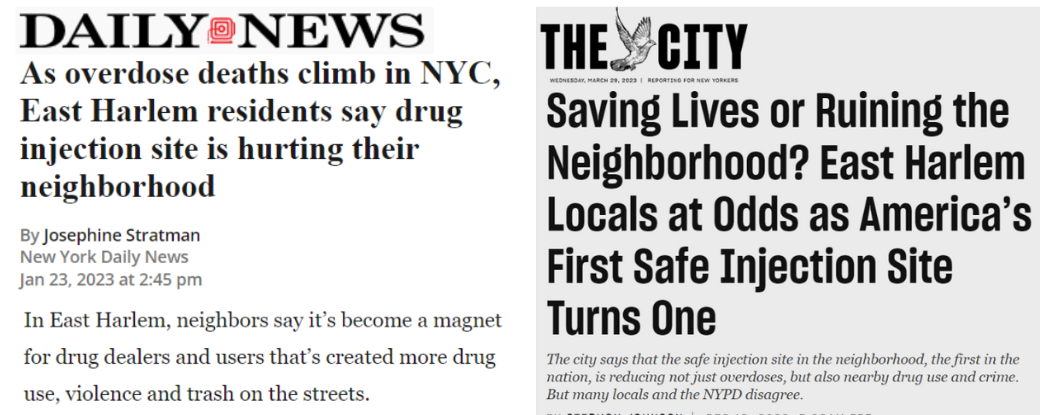
Above are some news articles that reported on the safety issues that concerns local residents
About us
The Greater Harlem Coalition is a grassroots community organization in Harlem comprised of 150+ local organizations, including block associations, faith-based organizations, and businesses. We strive for an environment where all people in our community can thrive. To be clear, Harlem residents are not against harm reduction services, but we demand Community Harm Reduction - Harm Reduction for All New Yorkers, including the most vulnerable population and all community members. With proper planning and adequate investments, this goal is achievable.
Proposed Amendments to the Safer Consumption Act
Reviewing best practices in Europe, we learned there are two main issues with the current implementation in NYC:
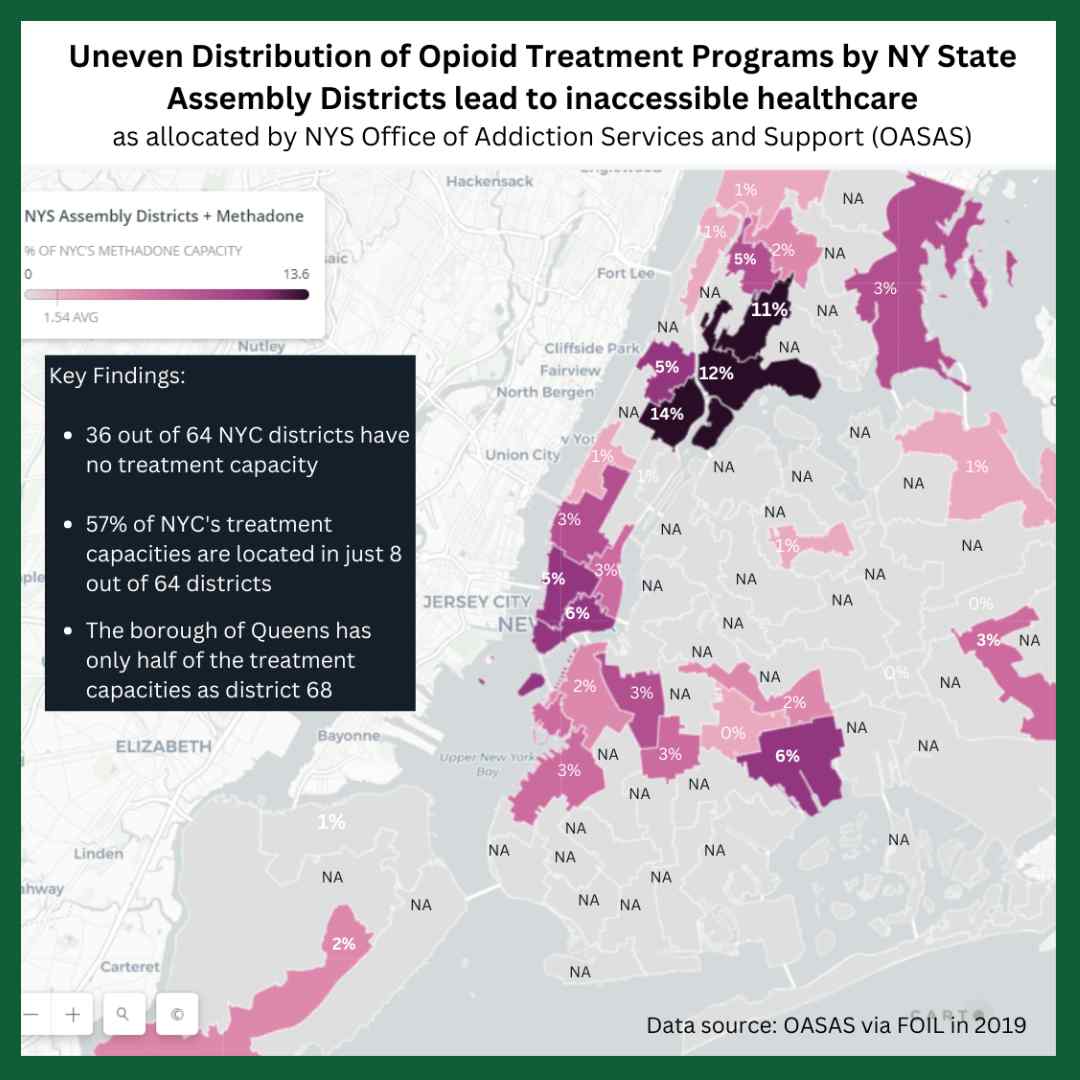
(1) New York City currently lacks key pieces of infrastructure in our healthcare system to support the OPC. New York City first needs to improve accessibility to drug treatment to all districts and a healthcare system that proactively direct drug users to treatment. (The graph below shows 36 out of 64 NY Assembly Districts have no treatment capacities at all)
(2) The cost of responsibly operating an OPC is grossly underestimated. Once an OPC is installed, the government must heavily invest in other agencies to mitigate harmful impact, such as increasing funding for sanitation, out-reach workers, security cameras, community engagement, data collection, and narcotics police. All the above are missing in the budget for such site.
If you favor legalizing such sites, urge your elected officials to amend the bill a338/ s399 to add these Safety Guardrails:
(1) Have many sites or none. If these sites are to be legalized, they must be spread widely throughout New York. Otherwise, drug dealers would congregate near the sites, exacerbating existing drug dealing conditions in those communities. As in many sites in Europe, only local residents are eligible to use them and not drug-buying commuters. (see P.3 of the reference document). Also, ahead of placing such a site, the government should de-densify the excessive social services not needed by Harlem residents as currently many of the drug users in Harlem are not from Harlem.
(2) Impose zoning restrictions & regulations. Develop zoning restrictions to restrict the distance between OPCs and schools, playgrounds, and faith-based organizations to 1000 feet. (For reference, in NYC, the distance restriction for adult establishments is 500 feet). Improve accountability and quality control by requiring the sites to be operated with a government granted license that requires renewal, like drug treatment programs.
(3) Drastically increase funding to arrest predatory drug dealers and deter open-air drug scenes. Currently, the real cost to responsibly operate these sites is grossly underestimated. Funding is needed for other government agencies in the nearby area such as sanitation, police, and social services to reduce drug dealing activities and other negative impacts on the community. In addition, the Health Department should establish a Dissuasion Committee staffed with healthcare workers, as did Portgual 10+ years before OPC opens. There, drug users using in public are indeed ticketed by the police and are asked to appear before the committee, so healthcare workers can proactively assess whether the drug user is a danger to themselves and others. In addition, a small percentage of users are sanctioned to treatment if they are deemed a danger to themselves. (see P.22 of the referenced document)
(4) Community engagement and impact assessment: Independent community impact studies must be conducted before the site is established and continue to monitor the community impact. In addition, as in Alberta Canada, each site must establish a formal community engagement plan to address issues arising from the community on an ongoing basis.
(5) Require standardized data collection: Put in place a centralized data system that tracks whether the OPC is serving local residents and if they are successful in referring patients to treatment. For example, Alberta (in Canada) tracks all users of OPCs in their healthcare system (see rule #33). Periodically, healthcare workers evaluate the patients and assign a health score to monitor patients' progress towards recovery and hold OPCs accountable for directly patients to treatment.
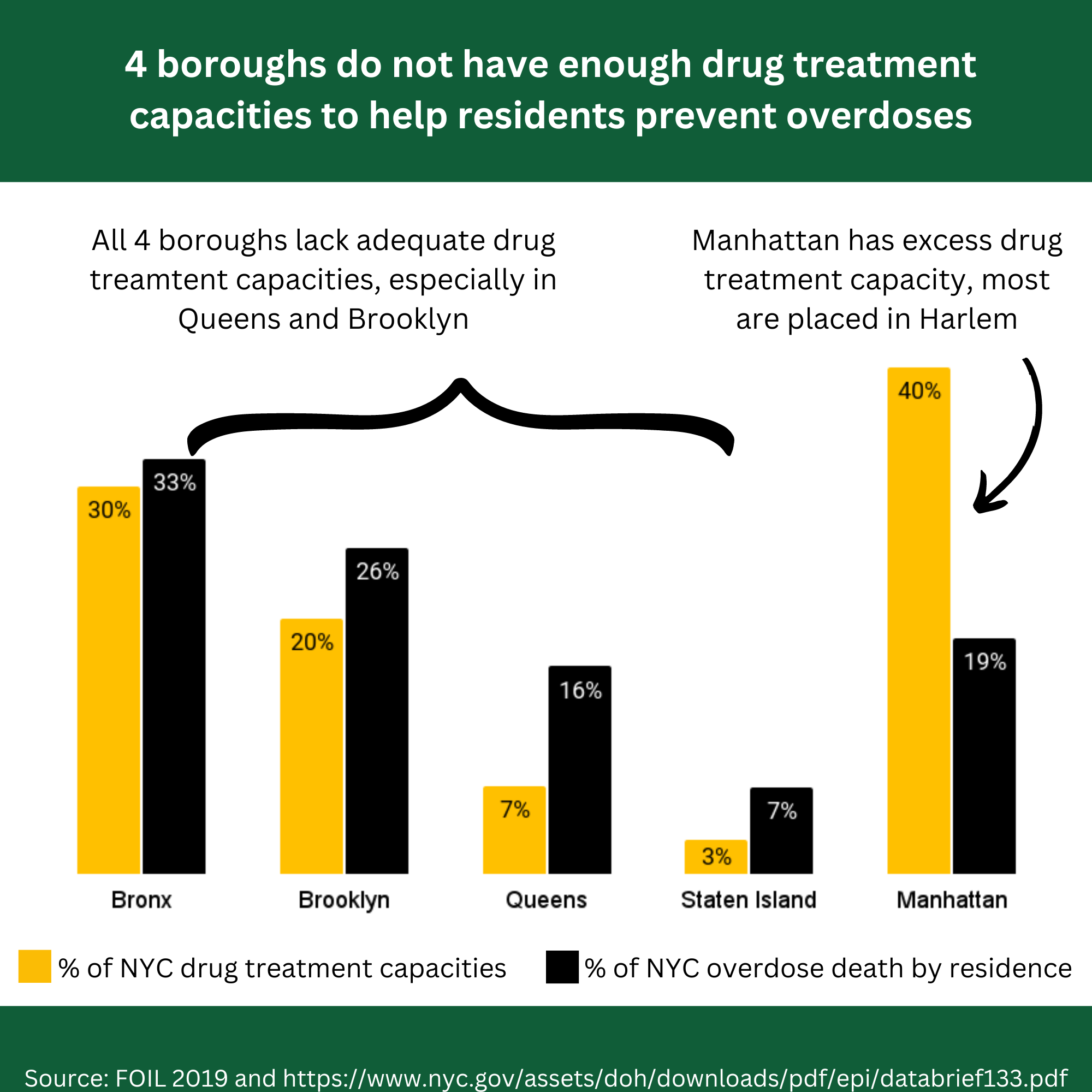
(6) Prioritize Treatment: To reduce addiction, each district needs adequate prevention and treatment services. Currently, 36 out of 64 NYC assembly districts lack treatment capacities. For these 36 Treatment Deserts, the state should add both treatment and harm reduction capacities at the same time so drug users have accessible healthcare.
Learn More
For more information about our proposal, see the asks on our website: https://greaterharlem.nyc/responsible-safe-consumption-site/
For more information about community quality of life and safety issues associated with the site:
- Reporting by reflected feedback from many Harlem residents regarding worsening safety on our streets and the impact on our children: NY Daily News, NY Post, The City, Fox News
- Worsening public drug use scene a few blocks away as reflected in videos taken by the neighbors
- The A-B-C school across the street from the safe injection site pleading for help: See youtube recording here.
For more information about the history of the site, see https://greaterharlem.nyc/asks/nations-first-safe-injection-site/.
Feel free to email us at greaterharlemcoalition@gmail.com if you have interest in hearing our presentation or having a tour of the area near the site.
Other ways to help besides sharing the petition:
- Vote no to the bills S399 and A338 on the NY Senate website and tell your officials why
- Write your elected officials in the Assembly and Senate. Find your representatives
- Donate to the Greater Harlem Coalition so we can help reach out to elected officials. We are a grassroots organization with no funding.
- Join our coalition of 150+ members

1,659
The Issue
New York State Officials should reject Safer Consumption Act, bill s399/a338, unless 6 Safety Guardrails are added to the bills.
In November 2021, New York City Mayor Bill DeBlasio unilaterally placed a Safe Consumption Site, or Overdose Prevention Center (OPC) in Harlem across the street from a Pre-K school WITHOUT community consultation. Within two blocks from this site are 9 schools with +4250 students and nearly 4000 residents, most are people of color. Such a location would not have been sited in wealthier neighborhoods.
A year later, despite the negative impacts of the current site on the community, New York officials hope to legalize such sites via legislative bill s399/a338, the "Safer Consumption Act," which would allow the site to be funded by the government.
Clearly, New York City is putting the cart before the horse - the implementation of the OPC is premature as safety guardrails are missing to protect local community and to promote treatment for users.
Sign this petition to tell your officials to amend the bill. Remember to describe your own experience with the site in the comments. In addition, you can also help by voting NO to the bills S399 and A338 on the NY Senate website and telling your officials why.
As an example to illustrate the issue with the site, there are 9 schools within 2 blocks of the Safe Consumption Site. ABC Graham School, the school directly across, installed bulletproof windows a few months after. For decades, this area has been used as NYC's Containment Zone to host excessive number of large-scale social programs. Such excessive density should be reduced first and zoning regulation of such sites and more security cameras are needed.
Above are some news articles that reported on the safety issues that concerns local residents
About us
The Greater Harlem Coalition is a grassroots community organization in Harlem comprised of 150+ local organizations, including block associations, faith-based organizations, and businesses. We strive for an environment where all people in our community can thrive. To be clear, Harlem residents are not against harm reduction services, but we demand Community Harm Reduction - Harm Reduction for All New Yorkers, including the most vulnerable population and all community members. With proper planning and adequate investments, this goal is achievable.
Proposed Amendments to the Safer Consumption Act
Reviewing best practices in Europe, we learned there are two main issues with the current implementation in NYC:
(1) New York City currently lacks key pieces of infrastructure in our healthcare system to support the OPC. New York City first needs to improve accessibility to drug treatment to all districts and a healthcare system that proactively direct drug users to treatment. (The graph below shows 36 out of 64 NY Assembly Districts have no treatment capacities at all)
(2) The cost of responsibly operating an OPC is grossly underestimated. Once an OPC is installed, the government must heavily invest in other agencies to mitigate harmful impact, such as increasing funding for sanitation, out-reach workers, security cameras, community engagement, data collection, and narcotics police. All the above are missing in the budget for such site.
If you favor legalizing such sites, urge your elected officials to amend the bill a338/ s399 to add these Safety Guardrails:
(1) Have many sites or none. If these sites are to be legalized, they must be spread widely throughout New York. Otherwise, drug dealers would congregate near the sites, exacerbating existing drug dealing conditions in those communities. As in many sites in Europe, only local residents are eligible to use them and not drug-buying commuters. (see P.3 of the reference document). Also, ahead of placing such a site, the government should de-densify the excessive social services not needed by Harlem residents as currently many of the drug users in Harlem are not from Harlem.
(2) Impose zoning restrictions & regulations. Develop zoning restrictions to restrict the distance between OPCs and schools, playgrounds, and faith-based organizations to 1000 feet. (For reference, in NYC, the distance restriction for adult establishments is 500 feet). Improve accountability and quality control by requiring the sites to be operated with a government granted license that requires renewal, like drug treatment programs.
(3) Drastically increase funding to arrest predatory drug dealers and deter open-air drug scenes. Currently, the real cost to responsibly operate these sites is grossly underestimated. Funding is needed for other government agencies in the nearby area such as sanitation, police, and social services to reduce drug dealing activities and other negative impacts on the community. In addition, the Health Department should establish a Dissuasion Committee staffed with healthcare workers, as did Portgual 10+ years before OPC opens. There, drug users using in public are indeed ticketed by the police and are asked to appear before the committee, so healthcare workers can proactively assess whether the drug user is a danger to themselves and others. In addition, a small percentage of users are sanctioned to treatment if they are deemed a danger to themselves. (see P.22 of the referenced document)
(4) Community engagement and impact assessment: Independent community impact studies must be conducted before the site is established and continue to monitor the community impact. In addition, as in Alberta Canada, each site must establish a formal community engagement plan to address issues arising from the community on an ongoing basis.
(5) Require standardized data collection: Put in place a centralized data system that tracks whether the OPC is serving local residents and if they are successful in referring patients to treatment. For example, Alberta (in Canada) tracks all users of OPCs in their healthcare system (see rule #33). Periodically, healthcare workers evaluate the patients and assign a health score to monitor patients' progress towards recovery and hold OPCs accountable for directly patients to treatment.
(6) Prioritize Treatment: To reduce addiction, each district needs adequate prevention and treatment services. Currently, 36 out of 64 NYC assembly districts lack treatment capacities. For these 36 Treatment Deserts, the state should add both treatment and harm reduction capacities at the same time so drug users have accessible healthcare.
Learn More
For more information about our proposal, see the asks on our website: https://greaterharlem.nyc/responsible-safe-consumption-site/
For more information about community quality of life and safety issues associated with the site:
- Reporting by reflected feedback from many Harlem residents regarding worsening safety on our streets and the impact on our children: NY Daily News, NY Post, The City, Fox News
- Worsening public drug use scene a few blocks away as reflected in videos taken by the neighbors
- The A-B-C school across the street from the safe injection site pleading for help: See youtube recording here.
For more information about the history of the site, see https://greaterharlem.nyc/asks/nations-first-safe-injection-site/.
Feel free to email us at greaterharlemcoalition@gmail.com if you have interest in hearing our presentation or having a tour of the area near the site.
Other ways to help besides sharing the petition:
- Vote no to the bills S399 and A338 on the NY Senate website and tell your officials why
- Write your elected officials in the Assembly and Senate. Find your representatives
- Donate to the Greater Harlem Coalition so we can help reach out to elected officials. We are a grassroots organization with no funding.
- Join our coalition of 150+ members
The Decision Makers


Supporter Voices
Petition Updates
Share this petition
Petition created on March 23, 2023