
End the Prohibition on Upper Peninsula Dark Sky Preserves!
The Issue
Print Paper Petitions Here! (Intended for U.P. Residents)
Join the Facebook Group!
PLEASE NOTE: Donations made on Change.org DO NOT reach our campaign. Donating directly allows for more constructive and flexible use of funds.
___________________________________________________________
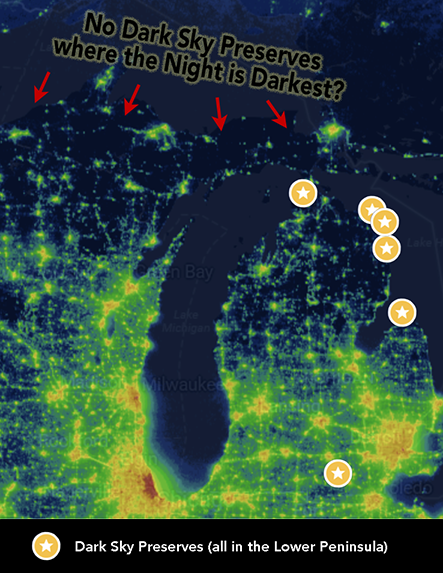
The most pristine night skies in Michigan are found in the Upper Peninsula, yet all of the designated Dark Sky Preserves are located in the Lower Peninsula. This is due to legislation passed in 2012 mandating that “a Dark Sky Preserve shall not be established in the Upper Peninsula.”
Does it really make sense to preserve dark skies only at the final moment when they are already degraded and on the verge of disappearing? Should not we be proactive in protecting our starry skies, which constitute no less than our universal human heritage? And given that light pollution has been called by ecologists “one of the most pressing and imminent threats to global biodiversity,” should not vast expanses of forest and rare old growth ecosystems like those in the Upper Peninsula be prioritized in this effort rather than demoted? Finally, given the Upper Peninsula's relatively limited economy, why should we be denied the opportunity to attract revenue from the growing astro-tourism industry?
OVERVIEW
In November of 2023, the Michigan DNR was contacted regarding the establishment of Porcupine Mountains State Park — largest Wilderness Area and old growth forest in mainland Michigan — as a Dark Sky Preserve. Such a designation serves not only protect the quality of the night sky in an area; it also incentivizes the surrounding lands to be considerate regarding the type and scale of industrial development.
As a beloved old growth wilderness park in a remote location far from the power grid, whose borders hold many fine beaches on the south shore of Lake Superior ideal for northern lights viewing, as well as Summit Peak, the second highest natural point in Michigan, the Porkies should've been as prime a candidate as any.
But the following response was issued by Douglas M Rich, District Supervisor of the Michigan DNR Parks and Recreation Division:
"The Michigan DNR must follow state statute as laid out in Michigan's Natural Resources and Environmental Protection Act (NREPA) 451 of 1994. Specifically, to NREPA's MCL 324.75102, part (2), "a dark sky preserve shall not be established in the Upper Peninsula."
It is true this prohibition does not apply to the "International Dark Sky Park" designation, assigned by an independent organization known as the International Dark-Sky Association, and one such example — the Keweenaw International Dark Sky Park — currently exists in the Upper Peninsula. But while this is an excellent option which might and should be pursued throughout the region and beyond, it will not be considered by State lands due to the real or perceived conflict with official legislation.
Thus, until this statute is overturned, State lands in the Upper Peninsula will be unable to take steps to protect night skies that are permitted on just the other side of the Mackinac Bridge.
THE RIGHT TO NIGHT
For billions of years, lifeforms and ecosystems have evolved according to the regular cycling of day and night, light and darkness. This rhythm is the binary code which programs the biology, psychology, and spirit not just of humans, but of the entirety of the terrestrial biosphere. The division of time into night, day, dawn, and dusk creates a multiplicity of temporal niches and heterogenous scheduling of behaviors such as predation, foraging, mating, migration, and metamorphosis, thus contributing as much as spatial niches to the development of our planet’s biodiversity.
The majority of mammals, amphibians, and insects are nocturnal, as well as a large percentage of birds, reptiles, and fish. Additionally, plants, fungi, and even bacteria develop, live, and thrive according to circadian rhythms (an organism’s internal clock tracking the day and night cycle), and most lifeforms produce melatonin — “the night hormone” — which has a profound effect on health, maturation, and even cancer formation.
But the rise of industrial civilization — for all its charms — has flattened out the photo-temporal landscape such that in many parts of the world every night is illumined as if by a full moon, or even several. In its way, this optical flattening has been no less disruptive than the clearcutting and paving of physical space, and perhaps even more so in some cases, since whereas a clearcut or road has a beginning and end, light may trespass for miles into the distance. As in all instances of ecological disruption, some lifeforms are affected more than others — with a minority even benefiting, at least in the short term — but the overall impact is a dramatic decline in the biodiversity and vibrancy of the natural world.
On a sheerly human but no less profound level, the starry skies constitute our most universal human heritage. Practices like music, dance, and spirituality vary considerably across geography, but the stars unite entire hemispheres. It was the mapping of the night sky into constellations which gave birth to the mythology and archetypes which continue to resonate through our psychology and story-telling today. The disappearance of these stars, then, is the equivalent to the burning of the Library of Alexandria, again and again, every single day, all across the world. And the trend is worsening: a child born under 250 stars today will see only 100 by the time they reach adulthood.
Fortunately, unlike the burning of books, light pollution is entirely reversible. But it will not happen on its own. We must recover our appreciation for the night and recognize its fundamental value to the Tree of Life. In tandem with reducing light pollution, our civilization must take steps to preserve those areas where the night remains relatively pristine. Such places are as living museums; they are among the scarcest resources in the 21st century; and in Michigan, they are located far and away in the Upper Peninsula.
PURE MICHIGAN... BUT NOT PURE UPPER PENINSULA?
In 2019, the Michigan Economic Development Corporation — the entity responsible for the "Pure Michigan" campaign — launched their "Dark Sky" campaign, accompanied by a “Dark Sky” commercial to celebrate and promote the “the state of Michigan as a premier travel destination, even after dark.” In July 2023, a full five minute infomercial for our beloved night skies was released.
The MEDC is perhaps not just promoting night skies out of the goodness of their hearts but also because of the growing astro-tourism industry, which brings in billions of dollars in revenue to states such as Utah.
Dave Lorenz, vice president of Travel Michigan, a division of the Michigan Economic Development Corporation and the state’s official agency for promotion of tourism, states: “Michigan, and the Upper Peninsula in particular, offers optimal night sky viewing conditions and the best opportunity for sky tourists to view the Milky Way, the aurora borealis and more in their purest form.”
But Mr. Lorenz neglects to clarify that Dark Sky Preserves have actively been declared illegal in the Upper Peninsula!
QUESTION: Is the Upper Peninsula part of Michigan? If so, then why is our fair region denied the same right as the Lower Peninsula to protect its night skies, both for the sake of preserving incredible natural heritage and to attract tourist revenue to sustainably strengthen our economy?
CONCLUSION
“I should not like to think that some demigod had come before me and picked out some of the best of the stars. I wish to know an entire heaven and an entire earth.”
Henry David Thoreau wrote these words over a hundred and fifty years ago. Given the exponential exacerbation of light pollution since then, the toll of the lost night and starry skies upon the health and soul of lifeforms is incalculable. In this context, to continue depriving the Upper Peninsula’s human and beyond-human residents of the right to protect their nights — no less than the shared heritage of all terrestrial biology — is unjust, nonsensical, and long overdue to be challenged.
We request that our lawmakers revoke the prohibition on Dark Sky Preserves in the Upper Peninsula with utmost urgency.
Signed,
We The People
_____________________________________
NOTE: Donations made on Change.org do not reach our campaign. If you would like to donate directly to allow for more constructive and flexible use of funding, you may do so here.

3,729
The Issue
Print Paper Petitions Here! (Intended for U.P. Residents)
Join the Facebook Group!
PLEASE NOTE: Donations made on Change.org DO NOT reach our campaign. Donating directly allows for more constructive and flexible use of funds.
___________________________________________________________
The most pristine night skies in Michigan are found in the Upper Peninsula, yet all of the designated Dark Sky Preserves are located in the Lower Peninsula. This is due to legislation passed in 2012 mandating that “a Dark Sky Preserve shall not be established in the Upper Peninsula.”
Does it really make sense to preserve dark skies only at the final moment when they are already degraded and on the verge of disappearing? Should not we be proactive in protecting our starry skies, which constitute no less than our universal human heritage? And given that light pollution has been called by ecologists “one of the most pressing and imminent threats to global biodiversity,” should not vast expanses of forest and rare old growth ecosystems like those in the Upper Peninsula be prioritized in this effort rather than demoted? Finally, given the Upper Peninsula's relatively limited economy, why should we be denied the opportunity to attract revenue from the growing astro-tourism industry?
OVERVIEW
In November of 2023, the Michigan DNR was contacted regarding the establishment of Porcupine Mountains State Park — largest Wilderness Area and old growth forest in mainland Michigan — as a Dark Sky Preserve. Such a designation serves not only protect the quality of the night sky in an area; it also incentivizes the surrounding lands to be considerate regarding the type and scale of industrial development.
As a beloved old growth wilderness park in a remote location far from the power grid, whose borders hold many fine beaches on the south shore of Lake Superior ideal for northern lights viewing, as well as Summit Peak, the second highest natural point in Michigan, the Porkies should've been as prime a candidate as any.
But the following response was issued by Douglas M Rich, District Supervisor of the Michigan DNR Parks and Recreation Division:
"The Michigan DNR must follow state statute as laid out in Michigan's Natural Resources and Environmental Protection Act (NREPA) 451 of 1994. Specifically, to NREPA's MCL 324.75102, part (2), "a dark sky preserve shall not be established in the Upper Peninsula."
It is true this prohibition does not apply to the "International Dark Sky Park" designation, assigned by an independent organization known as the International Dark-Sky Association, and one such example — the Keweenaw International Dark Sky Park — currently exists in the Upper Peninsula. But while this is an excellent option which might and should be pursued throughout the region and beyond, it will not be considered by State lands due to the real or perceived conflict with official legislation.
Thus, until this statute is overturned, State lands in the Upper Peninsula will be unable to take steps to protect night skies that are permitted on just the other side of the Mackinac Bridge.
THE RIGHT TO NIGHT
For billions of years, lifeforms and ecosystems have evolved according to the regular cycling of day and night, light and darkness. This rhythm is the binary code which programs the biology, psychology, and spirit not just of humans, but of the entirety of the terrestrial biosphere. The division of time into night, day, dawn, and dusk creates a multiplicity of temporal niches and heterogenous scheduling of behaviors such as predation, foraging, mating, migration, and metamorphosis, thus contributing as much as spatial niches to the development of our planet’s biodiversity.
The majority of mammals, amphibians, and insects are nocturnal, as well as a large percentage of birds, reptiles, and fish. Additionally, plants, fungi, and even bacteria develop, live, and thrive according to circadian rhythms (an organism’s internal clock tracking the day and night cycle), and most lifeforms produce melatonin — “the night hormone” — which has a profound effect on health, maturation, and even cancer formation.
But the rise of industrial civilization — for all its charms — has flattened out the photo-temporal landscape such that in many parts of the world every night is illumined as if by a full moon, or even several. In its way, this optical flattening has been no less disruptive than the clearcutting and paving of physical space, and perhaps even more so in some cases, since whereas a clearcut or road has a beginning and end, light may trespass for miles into the distance. As in all instances of ecological disruption, some lifeforms are affected more than others — with a minority even benefiting, at least in the short term — but the overall impact is a dramatic decline in the biodiversity and vibrancy of the natural world.
On a sheerly human but no less profound level, the starry skies constitute our most universal human heritage. Practices like music, dance, and spirituality vary considerably across geography, but the stars unite entire hemispheres. It was the mapping of the night sky into constellations which gave birth to the mythology and archetypes which continue to resonate through our psychology and story-telling today. The disappearance of these stars, then, is the equivalent to the burning of the Library of Alexandria, again and again, every single day, all across the world. And the trend is worsening: a child born under 250 stars today will see only 100 by the time they reach adulthood.
Fortunately, unlike the burning of books, light pollution is entirely reversible. But it will not happen on its own. We must recover our appreciation for the night and recognize its fundamental value to the Tree of Life. In tandem with reducing light pollution, our civilization must take steps to preserve those areas where the night remains relatively pristine. Such places are as living museums; they are among the scarcest resources in the 21st century; and in Michigan, they are located far and away in the Upper Peninsula.
PURE MICHIGAN... BUT NOT PURE UPPER PENINSULA?
In 2019, the Michigan Economic Development Corporation — the entity responsible for the "Pure Michigan" campaign — launched their "Dark Sky" campaign, accompanied by a “Dark Sky” commercial to celebrate and promote the “the state of Michigan as a premier travel destination, even after dark.” In July 2023, a full five minute infomercial for our beloved night skies was released.
The MEDC is perhaps not just promoting night skies out of the goodness of their hearts but also because of the growing astro-tourism industry, which brings in billions of dollars in revenue to states such as Utah.
Dave Lorenz, vice president of Travel Michigan, a division of the Michigan Economic Development Corporation and the state’s official agency for promotion of tourism, states: “Michigan, and the Upper Peninsula in particular, offers optimal night sky viewing conditions and the best opportunity for sky tourists to view the Milky Way, the aurora borealis and more in their purest form.”
But Mr. Lorenz neglects to clarify that Dark Sky Preserves have actively been declared illegal in the Upper Peninsula!
QUESTION: Is the Upper Peninsula part of Michigan? If so, then why is our fair region denied the same right as the Lower Peninsula to protect its night skies, both for the sake of preserving incredible natural heritage and to attract tourist revenue to sustainably strengthen our economy?
CONCLUSION
“I should not like to think that some demigod had come before me and picked out some of the best of the stars. I wish to know an entire heaven and an entire earth.”
Henry David Thoreau wrote these words over a hundred and fifty years ago. Given the exponential exacerbation of light pollution since then, the toll of the lost night and starry skies upon the health and soul of lifeforms is incalculable. In this context, to continue depriving the Upper Peninsula’s human and beyond-human residents of the right to protect their nights — no less than the shared heritage of all terrestrial biology — is unjust, nonsensical, and long overdue to be challenged.
We request that our lawmakers revoke the prohibition on Dark Sky Preserves in the Upper Peninsula with utmost urgency.
Signed,
We The People
_____________________________________
NOTE: Donations made on Change.org do not reach our campaign. If you would like to donate directly to allow for more constructive and flexible use of funding, you may do so here.
The Decision Makers

Supporter Voices
Petition Updates
Share this petition
Petition created on January 4, 2025