
Wichita Transit: 24/7 Service and Route Modernization
Wichita Transit: 24/7 Service and Route Modernization
The Issue
Wichita is entering a major transformation in how public transit is structured with the development of The Hub, a new multimodal transportation center in Delano that will serve as the central connection point for the city’s entire bus system. This is a significant investment in Wichita’s future and a rare opportunity to reshape mobility for the next generation of residents.
However, infrastructure alone is not enough.
As the city transitions into a new hub-and-spoke model, the success of The Hub will depend not only on physical design, but on whether the route network and service schedule actually reflect how Wichita moves today, not how it moved decades ago.
Wichita is not a static city. It is a living, expanding network of workers, students, and families whose travel patterns extend far beyond traditional business hours. If routes and schedules remain outdated, even a modern transit center will fail to reach its full potential.
### A Modern Transit Network for a Modern Wichita
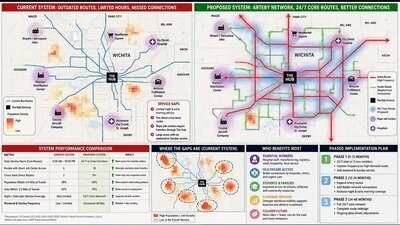
We are calling on Wichita city leaders and Wichita Transit to implement a phased modernization strategy that includes both **route redesign and expanded service hours**, including:
• A full route remapping centered on current population density, job centers, and essential service locations
• Prioritization of high-frequency “artery routes” that directly connect major employment zones, hospitals, industrial parks, and commercial corridors
• Shorter, interconnected feeder routes that efficiently connect residential areas to these main transit arteries
• Reduced reliance on outdated radial patterns that force unnecessary transfers through a central hub for cross-city travel
• Increased direct cross-town connectivity for suburb-to-suburb and job-to-job travel patterns
• Expanded service hours with the long-term goal of **24-hour transit coverage on core routes**, especially those serving hospitals, manufacturing zones, logistics centers, and other essential employment corridors
• Immediate extension of early-morning, late-evening, and overnight service on high-demand routes as a first phase toward full 24/7 accessibility
### Aligning With The Hub Investment
The Hub is designed to unify transportation modes and improve transfer efficiency across the city. To fully realize this investment, the system feeding into it must evolve in both structure and availability.
A redesigned network with extended service hours would:
• Improve ridership by reducing travel time and increasing schedule reliability
• Ensure essential workers can access jobs regardless of shift timing
• Increase access to healthcare, groceries, education, and services outside standard hours
• Strengthen long-term transit sustainability by increasing system utilization across all hours of the day
### A Phased and Practical Approach
We recognize that Wichita’s transit system cannot be rebuilt overnight. Instead, we support a phased implementation approach that begins with:
• Pilot 24-hour or near-24-hour service on high-demand artery routes serving major employment and service zones
• Route restructuring based on real ridership data and changing population patterns
• Continuous adjustment of feeder routes to improve first-mile and last-mile access
• Public reporting on route performance, service coverage, and expansion timelines during the transition to The Hub system
### Closing
The current redesign represents an important step forward, but its success depends on whether it reflects the real movement patterns and time realities of Wichita residents today.
A transit system is not just a map. It is a reflection of how a city understands its own rhythm.
Wichita now has the opportunity to align The Hub with a smarter, more responsive, and more accessible network that serves the people who depend on it most.
A modern city needs a modern transit logic.

65
The Issue
Wichita is entering a major transformation in how public transit is structured with the development of The Hub, a new multimodal transportation center in Delano that will serve as the central connection point for the city’s entire bus system. This is a significant investment in Wichita’s future and a rare opportunity to reshape mobility for the next generation of residents.
However, infrastructure alone is not enough.
As the city transitions into a new hub-and-spoke model, the success of The Hub will depend not only on physical design, but on whether the route network and service schedule actually reflect how Wichita moves today, not how it moved decades ago.
Wichita is not a static city. It is a living, expanding network of workers, students, and families whose travel patterns extend far beyond traditional business hours. If routes and schedules remain outdated, even a modern transit center will fail to reach its full potential.
### A Modern Transit Network for a Modern Wichita
We are calling on Wichita city leaders and Wichita Transit to implement a phased modernization strategy that includes both **route redesign and expanded service hours**, including:
• A full route remapping centered on current population density, job centers, and essential service locations
• Prioritization of high-frequency “artery routes” that directly connect major employment zones, hospitals, industrial parks, and commercial corridors
• Shorter, interconnected feeder routes that efficiently connect residential areas to these main transit arteries
• Reduced reliance on outdated radial patterns that force unnecessary transfers through a central hub for cross-city travel
• Increased direct cross-town connectivity for suburb-to-suburb and job-to-job travel patterns
• Expanded service hours with the long-term goal of **24-hour transit coverage on core routes**, especially those serving hospitals, manufacturing zones, logistics centers, and other essential employment corridors
• Immediate extension of early-morning, late-evening, and overnight service on high-demand routes as a first phase toward full 24/7 accessibility
### Aligning With The Hub Investment
The Hub is designed to unify transportation modes and improve transfer efficiency across the city. To fully realize this investment, the system feeding into it must evolve in both structure and availability.
A redesigned network with extended service hours would:
• Improve ridership by reducing travel time and increasing schedule reliability
• Ensure essential workers can access jobs regardless of shift timing
• Increase access to healthcare, groceries, education, and services outside standard hours
• Strengthen long-term transit sustainability by increasing system utilization across all hours of the day
### A Phased and Practical Approach
We recognize that Wichita’s transit system cannot be rebuilt overnight. Instead, we support a phased implementation approach that begins with:
• Pilot 24-hour or near-24-hour service on high-demand artery routes serving major employment and service zones
• Route restructuring based on real ridership data and changing population patterns
• Continuous adjustment of feeder routes to improve first-mile and last-mile access
• Public reporting on route performance, service coverage, and expansion timelines during the transition to The Hub system
### Closing
The current redesign represents an important step forward, but its success depends on whether it reflects the real movement patterns and time realities of Wichita residents today.
A transit system is not just a map. It is a reflection of how a city understands its own rhythm.
Wichita now has the opportunity to align The Hub with a smarter, more responsive, and more accessible network that serves the people who depend on it most.
A modern city needs a modern transit logic.
65
The Decision Makers



Petition Updates
Share this petition
Petition created on May 30, 2026