
Peter Savaryn’s Legacy: Context, Patriotism, and Service to Canada
As President of the Ukrainian National Federation (Edmonton Branch), I feel compelled to address recent commentary about the late Peter (Petro) Savaryn. An Edmonton Journal opinion column claimed there are “no shades of grey” in Savaryn’s wartime past, implying his legacy is irredeemably tainted by his service in a German unit during WWII. Such a characterization is unfair and ignores crucial historical context. Peter Savaryn’s life story – from a youth caught in the vice of two totalitarian regimes to an esteemed Canadian community leader – deserves a fuller, more nuanced understanding. We acknowledge the genuine pain that any association with Nazi forces evokes. At the same time, we must remember the complexity of Savaryn’s circumstances and recognize his decades of patriotic service to both Ukraine and Canada. In that spirit, I offer this perspective to set the record straight.
Navigating a Double Oppression: Ukrainians Between Hitler and Stalin
To appreciate Savaryn’s choices, one must understand the harsh reality Ukrainians faced during World War II. In the 1930s and 1940s, Ukraine was caught between two brutal dictatorships – Nazi Germany and Stalin’s Soviet Union. In Western Ukraine, where Peter Savaryn was born in 1926, the people first endured Soviet occupation in 1939–41, marked by repression and mass deportations. Then came the Nazi invasion. Initially, some Ukrainians saw the Germans as potential liberators from Soviet terror and hoped Germany might support Ukrainian independence (This hope was swiftly dashed – the Nazis had no intention of granting freedom, and they unleashed the Holocaust and brutal occupation policies on Ukrainian soil)
https://www.britannica.com/place/Ukraine/The-Nazi-occupation-of-Soviet-Ukraine
“Initially, the Germans were greeted as liberators by some of the Ukrainian populace. In Galicia especially, there had long been a widespread belief that Germany, as the avowed enemy of Poland and the U.S.S.R., was the Ukrainians’ natural ally for the attainment of their independence. The illusion was quickly shattered. The Germans were accompanied on their entry into Lviv on June 30 by members of OUN-B, who that same day proclaimed the restoration of Ukrainian statehood and the formation of a provisional state administration; within days the organizers of this action were arrested and interned in concentration camps (as were both Bandera and, later, Melnyk). “
“In the occupied territories, the Nazis sought to implement their “racial” policies. In the fall of 1941 began the mass killings of Jews that continued through 1944. An estimated 1.5 million Ukrainian Jews perished, and over 800,000 were displaced to the east; at Baby Yar (Ukrainian: Babyn Yar) in Kyiv, nearly 34,000 were killed in just the first two days of massacre in the city. The Nazis were aided at times by auxiliary forces recruited from the local population.
In the Reichskommissariat, ruthlessly administered by Erich Koch, Ukrainians were slated for servitude. The collective farms, whose dissolution was the fervent hope of the peasantry, were left intact, industry was allowed to deteriorate, and the cities were deprived of foodstuffs as all available resources were directed to support the German war effort. Some 2.2 million people were taken from Ukraine to Germany as slave labourers (Ostarbeiter, or “eastern workers”). Cultural activities were repressed, and education was limited to the elementary level. Only the revived Ukrainian Orthodox Church was permitted to resume its work as a national institution. Somewhat better was the situation of Ukrainians in Galicia, where restricted cultural, civic, and relief activities were permitted under centralized control.
Under such conditions of brutality, Ukrainian political activity, predicated originally on cooperation with the Germans, increasingly turned to underground organizational work and resistance. The OUN groups that streamed eastward in 1941 were soon subjected by the German authorities to repressive measures, including execution, so they propagated their nationalist views clandestinely and, through their contact with the local population, began to revise their ideology in a more democratic, pluralist direction. “
It is in this context that a teenage Peter Savaryn made an impossible choice. In 1943–44, at just 17 years old, he joined the 14th Waffen Grenadier Division of the SS (the “Galicia Division”), a unit composed of Ukrainian volunteers under German command. Why would a young Ukrainian volunteer in such a unit? For many of these youths, it was not an endorsement of Nazi ideology, but a desperate bid to fight one occupier – the Soviet regime – which had already inflicted immense suffering on Ukraine. Ukrainian survivors of Stalin’s Holodomor famine of 1932–33 and the Soviet terror had ample reason to hate Stalin. As one historical account notes, the division’s supporters insist its members “were never Nazis, but patriots fighting for an independent Ukraine against the Bolshevik hordes,” with the SS designation seen as a formality imposed by the Germans. In other words, Ukrainians like Petro Savaryn were fighting for their homeland’s freedom, albeit tragically on the wrong side of history. Many volunteers believed they would only be used against the Red Army (and in fact, the Galicia Division was deployed against Soviet forces and anti-Soviet partisans, not against Western Allied troops). We do not seek to whitewash any atrocity – any complicity with Nazi units is morally fraught. But to ignore the grey zones of this history is to ignore reality: Ukrainians were squeezed between Hitler and Stalin, forced into terrible choices for survival and patriotism.
“Their supporters claim that the Halychyna were never Nazis, but patriots fighting for an independent Ukraine against the Bolshevik hordes. Their designation as “Waffen-SS,” they insist, was strictly accidental, a matter of form imposed by the Germans and never a matter of ideology or conviction.”
A Patriot Facing Impossible Choices
Peter Savaryn’s wartime story is not one of a war criminal, but of a displaced young man who survived “impossible choices” in WWII. It is important to state clearly: Savaryn personally was never accused of any war crimes. After the war, Allied authorities rigorously vetted members of the Galicia Division, including Savaryn. In the immediate post-war years, both Soviet and British investigators screened this unit; later, Canadian immigration officials did as well. Decades on, Canada’s Commission of Inquiry on War Criminals (the Deschênes Commission) conducted an exhaustive investigation and concluded “the Galicia Division should not be indicted as a group”, and that “charges of war crimes against members of the Galicia Division have never been substantiated… mere membership in the Galicia Division is insufficient to justify prosecution.” In short, Savaryn was cleared of any wrongdoing. He was allowed to immigrate to Canada in 1949 because no evidence implicated him in atrocities. He was one of thousands of displaced persons whom Canada welcomed after the war – people who yearned to rebuild their lives in freedom after the totalitarian nightmares in Europe.
“The Galicia Division should not be indicted as a group,” he declares in his report. “The members of the Galicia Division were individually screened for security purposes before admission to Canada. Charges of war crimes against members of the Galicia Division have never been substantiated… In the absence of evidence of participation or knowledge of specific war crimes, mere membership in the Galicia Division in insufficient to justify prosecution.”
“Nor was the Division screened for war crimes, either by the British or the Russians. A Soviet screening party did visit the division in 1945 after it had surrendered to the British and been interned at Rimini. However, the Russians were interested primarily in determining which of the men were Soviet citizens eligible for repatriation under the Yalta Agreement. The Russian inspection team was given a rough time by the camp’s residents and went away empty handed.”
It bears repeating: Peter Savaryn unequivocally condemned both Hitler and Stalin for their crimes, as those who knew him attest. He and most of his fellow Ukrainian veterans viewed their WWII service not as an endorsement of Nazism, but as a tragic necessity in the fight for Ukraine’s freedom. They hated Nazi tyranny and Soviet tyranny alike. Savaryn himself spent the rest of his life championing democracy, education, and human rights – the very opposite of the hateful ideologies that scarred his youth. For anyone to label this proud Canadian a “Nazi” outright is a grave distortion. Yes, he wore a German uniform as a teenager – but his motivation was patriotism, not fascism, and his life’s work proved where his true values lay.
A Lifetime of Service to Canada and the Community
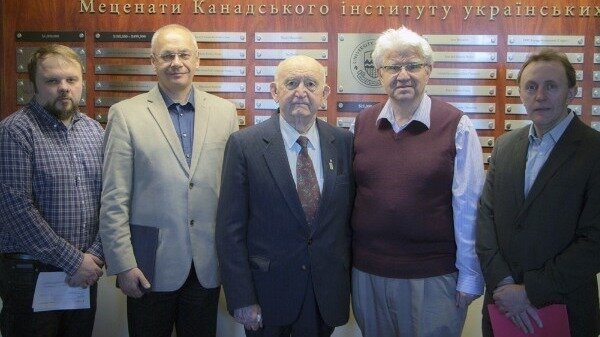
Peter Savaryn (center) being recognized in 2014 for his contributions to Ukrainian studies in Canada. Over seven decades in Alberta, Savaryn built an extraordinary legacy of public service, education, and multicultural community leadership.
After arriving in Canada, Peter Savaryn devoted over 70 years to public service and nation-building. He embraced Canada as his new home and repaid it many times over with leadership and vision. Savaryn earned his degrees at the University of Alberta (B.A. 1955, LL.B. 1956) and became a successful lawyer. But it was outside the courtroom that he truly left his mark. Fluent in five languages, Savaryn was a tireless advocate for multiculturalism, education, and the preservation of Ukrainian heritage as part of Canada’s identity.
Consider just a partial list of his contributions: Peter Savaryn helped introduce Ukrainian language education in Alberta schools. He was a driving force behind Prime Minister Pierre Trudeau’s 1971 proclamation of Canada’s multiculturalism policy, which recognized the diverse cultural fabric of our nation. He helped establish the Ukrainian Cultural Heritage Village museum in Alberta. Importantly, Savaryn was instrumental in founding the Canadian Institute of Ukrainian Studies (CIUS) at the U of A, ensuring Ukrainian scholarship had a permanent home in academia. In 1983, he spearheaded the world’s first memorial to the victims of the Holodomor (Stalin’s man-made famine), erected on the Edmonton City Hall grounds. This speaks volumes about his values: he made sure Canadians remembered the atrocities of Stalinism, even as we also commemorate the victims of Nazism.
Savaryn’s leadership extended to countless organizations. He served on the U of A Board of Governors and Senate starting in 1972. From 1982 to 1986, he was elected Chancellor of the University of Alberta, the ceremonial head of one of Canada’s leading universities. In that role he championed broad, inclusive education – famously reminding the university that Western Canada’s people are not only of British or French origin, and urging recognition of the “right to be different” in our campuses and curricula.
He also served as President of the World Congress of Free Ukrainians (1983–88), uniting the Ukrainian diaspora in the cause of global freedom and Ukrainian independence during the Cold War. Locally, he co-founded the Alberta Cultural Heritage Council, and was active in youth scouting (Plast), seniors’ housing initiatives, the Ukrainian Canadian Congress (formerly Committee), the Ivan Franko School of Ukrainian Studies, and many other charitable and cultural bodies. It is no wonder that U of A President David Turpin once said of Savaryn, “He exemplified the best in public service. He had an irresistible optimism and compassion for others”. Indeed, the very reason Edmonton honored him by naming “Savaryn Drive” in 2007 was to recognize these decades of civic service and leadership – not his brief and complex wartime chapter.
Savaryn’s contributions were widely celebrated. He received an honorary Doctor of Laws from the U of A and, in 1987, was appointed a Member of the Order of Canada, our nation’s highest civilian honour. That appointment explicitly recognized his work in promoting multicultural education and human rights. (This is the same man now being portrayed in some quarters as nothing more than a “Nazi”!) Flawed information about his wartime youth has led to retrospective controversy, but at the time Canada rightly hailed him as a nation-builder. As U of A Folio noted upon his passing in 2017, Savaryn “built many important legacies” for our university, province, and country. Those legacies remain all around us – in institutions, policies, and even physical monuments he helped create.
Judging a Legacy in Full, Not a Footnote
It is crucial that we judge Peter Savaryn’s legacy in full, not reduce it to a single wartime footnote. The recent call by some groups to remove Savaryn’s name from a street and to tarnish his reputation is deeply troubling to the Ukrainian-Canadian community. Of course, we unequivocally condemn the Nazi regime and all its collaborators’ crimes – nothing can ever excuse the Holocaust or the Nazi atrocities in Ukraine or elsewhere. We stand with our Jewish brothers and sisters in remembering that horrific chapter of history. Our intent in defending Savaryn is not to “whitewash” World War II, but to ensure fairness and truth in how we remember individual lives.
Peter Savaryn’s life cannot be painted in black and white terms of “Nazi or not.” He was a victim of both Nazi and Soviet oppression, and like many Ukrainians he made agonizing choices in a context most of us today thankfully will never experience. After the war, he redeemed those early choices by dedicating himself to the very ideals that Nazism and Communism opposed: freedom, democracy, multicultural understanding, and remembrance of historical injustices. He publicly condemned both Hitler’s and Stalin’s tyrannies, and lived his life in service of Canadian democratic values. To flatten such a person’s legacy into a one-dimensional label does a disservice not only to him, but to the historical truth.
It is also worth noting that smearing figures like Savaryn as irredeemable “Nazis” echoes propaganda tactics used by the Soviet regime to discredit Ukrainian independence activists. During the Cold War, the KGB often painted all Ukrainian patriots in the West as “fascists” to undermine their credibility. We must be very careful not to inadvertently amplify those old false narratives. As a community leader, Savaryn was long a target of Soviet slander precisely because he championed Ukraine’s freedom. Erasing his name now, without context or new evidence, risks echoing those propaganda narratives that were historically used to malign Ukrainian Canadians. Canada must not fall into the trap of viewing history through the distortions of its worst actors.
Education Over Erasure: A Way Forward
Rather than erasing Peter Savaryn’s name, a more just approach would be education and contextualization. The calls to strip his name from public places are, in our view, misguided and premature. The City of Edmonton’s naming honor in 2007 was based on Savaryn’s extensive contributions to our city and country. Those contributions remain undeniable. If there are concerns that the public lacks knowledge of the wartime context, we welcome efforts to add context rather than remove names. For example, the community would support installing an informational plaque on Savaryn Drive, explaining his full story: his youth in war-torn Ukraine, his service in the Galicia Division as a teenager, the post-war vetting that found no wrongdoing, and his tremendous record of service in Canada. This way, passersby can learn about the complexity of history – the good and the bad – instead of history being hidden or rewritten. As our petition to the City states, “Ensure historical context is considered in all deliberations about public names and monuments. Consider educational alternatives (such as contextual plaques or public forums) rather than erasure, which distorts rather than clarifies history.”
Keeping Savaryn Drive’s name while providing context upholds both historical truth and justice. It reminds us that Canadians can come from very complicated backgrounds and yet do immense good in our society. It also spares our community the pain of seeing a revered elder’s name scrubbed away as if his entire life of service meant nothing. To Ukraine’s descendants in Edmonton, Peter Savaryn is not a symbol of hate – he is a symbol of perseverance, of making good out of a tragic past. That does not negate anyone else’s suffering; it simply tells a more complete human story.
Conclusion: Embracing Nuance and Canadian Values
In closing, I urge fellow Canadians to approach Peter Savaryn’s memory with the nuance and fairness that our shared values demand. Canada is a nation built by people from all corners of the world, many of whom carried scars from wars and oppression. We rightfully hold them to high standards, but we also pride ourselves on understanding context and forgiving those who strive to do good. Peter Savaryn’s 99% of life was exemplary, even if one chapter as a war-tossed youth was fraught. He survived totalitarianism and then spent his life fighting for freedom, education, and multicultural harmony – in short, fighting for the very ideals Canada cherishes. As Canadians, we should learn from his full story, not cancel him based on incomplete information.
It is easy, in hindsight, to judge those who lived through the darkest of times. But let us have the humility to acknowledge that their choices were agonizing. Savaryn’s legacy is a testament to how one can overcome a difficult past and devote oneself to positive causes. He once said education gives us “strength to survive misfortunes without losing faith in one’s fellow human beings”– a fitting lesson from a man who saw humanity’s worst and still believed in our better nature.
Peter Savaryn’s name deserves to stay in our public landscape, not as an endorsement of any past regime, but as an emblem of the Ukrainian-Canadian journey – a journey from oppression to freedom, from division to understanding. Let us honor that journey by remembering history in its entirety. Justice and historical truth demand that we judge Savaryn “in full, not reduced to a single wartime footnote”. In the spirit of Canadian fairness, we choose education over erasure, context over condemnation, and reconciliation over division. That is how we protect the good name of a man who gave so much of himself to Canada, and that is how we uphold the values that truly have no shades of grey.
Sources:
Folio (University of Alberta) – “Former chancellor devoted himself to 'the right to be different'” (April 10, 2017)
CityNews Edmonton – “Holocaust remembrance group calls on Edmonton to rename street” (Aug. 8, 2025)
Change.org Petition – “Protect Historical Truth: Keep Savaryn Drive” (2025)
Encyclopedia of Ukraine – Entry on Peter Savaryn (biographical details)
Edmonton Journal / Postmedia – “Legacy under fire: Former U of A chancellor’s war record scrutinized” (July 2025)
Reddit (r/Edmonton) – Commentary summarizing veterans’ perspective (public discourse context)
Britannica – “Ukraine: The Nazi occupation of Soviet Ukraine” (historical context on WWII)
Global News / Canadian Press – “Rideau Hall regrets honouring former U of A chancellor who fought for Nazi unit” (Oct. 4, 2023)
Yevhen Burlaka