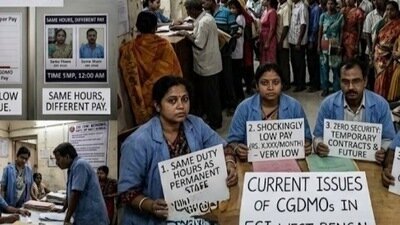

Crisis faced by Contractual GDMO in ESI West Bengal
Crisis faced by Contractual GDMO in ESI West Bengal
The Issue
The Crisis of Contractual GDMOs in ESI West Bengal
Overview
Contractual General Duty Medical Officers (CGDMOs) form the backbone of frontline healthcare delivery across ESI hospitals and dispensaries in West Bengal, including major industrial healthcare hubs like ESI Hospital Durgapur. Despite bearing professional responsibilities and working hours identical to permanent medical officers, CGDMOs face severe economic disparity and systemic professional vulnerability.
Core Issues Faced by CGDMOs
Severe Remuneration Disparity ("Same Work, Fraction of the Pay"): Contractual medical officers manage critical indoor patient care, crowded Outpatient Departments (OPDs), emergency admissions, and Intensive Care Units (ICUs). They perform the exact same life-saving clinical interventions as regular/permanent General Duty Medical Officers (GDMOs), yet receive a significantly lower, static consolidated salary without any basic allowances or pay-scale indexing.
Parity in Strict Duty Hours without Commensurate Benefits: CGDMOs are seamlessly integrated into the standard hospital rosters, working identical demanding schedules. This includes exhausting night shifts, emergency call-outs, and holiday duties. They fulfill the exact same quantum of work, but without the corresponding financial compensation, overtime benefits, or grade pays available to permanent cadres.
Absolute Lack of Job Security: Despite years of uninterrupted service dedicated to the health of the state's insured workforce, contractual doctors operate under a constant cloud of professional instability. The absence of transparent contract renewal policies, clear seniority recognitions, or an administrative framework for regularisation creates immense career insecurity.
Constitutional and Legal Non-Compliance: The current deployment model directly bypasses the principle of "Equal Pay for Equal Work" embedded in Article 39(d) of the Constitution of India. It stands in direct contradiction to settled legal precedents, most notably the landmark Supreme Court ruling in State of Punjab v. Jagjit Singh (2016), which explicitly deems it unjust and irrational to pay temporary or contractual staff less than regular employees when the nature of their duties is identical.
Here by we are putting up a humble request to the decision makers to make a justified desicion.
We will be obliged for your response and we will respectfully comply with the decision made .

20
The Issue
The Crisis of Contractual GDMOs in ESI West Bengal
Overview
Contractual General Duty Medical Officers (CGDMOs) form the backbone of frontline healthcare delivery across ESI hospitals and dispensaries in West Bengal, including major industrial healthcare hubs like ESI Hospital Durgapur. Despite bearing professional responsibilities and working hours identical to permanent medical officers, CGDMOs face severe economic disparity and systemic professional vulnerability.
Core Issues Faced by CGDMOs
Severe Remuneration Disparity ("Same Work, Fraction of the Pay"): Contractual medical officers manage critical indoor patient care, crowded Outpatient Departments (OPDs), emergency admissions, and Intensive Care Units (ICUs). They perform the exact same life-saving clinical interventions as regular/permanent General Duty Medical Officers (GDMOs), yet receive a significantly lower, static consolidated salary without any basic allowances or pay-scale indexing.
Parity in Strict Duty Hours without Commensurate Benefits: CGDMOs are seamlessly integrated into the standard hospital rosters, working identical demanding schedules. This includes exhausting night shifts, emergency call-outs, and holiday duties. They fulfill the exact same quantum of work, but without the corresponding financial compensation, overtime benefits, or grade pays available to permanent cadres.
Absolute Lack of Job Security: Despite years of uninterrupted service dedicated to the health of the state's insured workforce, contractual doctors operate under a constant cloud of professional instability. The absence of transparent contract renewal policies, clear seniority recognitions, or an administrative framework for regularisation creates immense career insecurity.
Constitutional and Legal Non-Compliance: The current deployment model directly bypasses the principle of "Equal Pay for Equal Work" embedded in Article 39(d) of the Constitution of India. It stands in direct contradiction to settled legal precedents, most notably the landmark Supreme Court ruling in State of Punjab v. Jagjit Singh (2016), which explicitly deems it unjust and irrational to pay temporary or contractual staff less than regular employees when the nature of their duties is identical.
Here by we are putting up a humble request to the decision makers to make a justified desicion.
We will be obliged for your response and we will respectfully comply with the decision made .
20
The Decision Makers

Petition Updates
Share this petition
Petition created on 25 May 2026